
|
Getting your Trinity Audio player ready…
|
(Inula helenium L.)
🌿🌿🌿🌿🌿🌿🌿🌿🌿🌿🌿🌿🌿🌿🌿🌿🌿🌿🌿🌿🌿🌿🌿🌿🌿🌿🌿🌿🌿

🌿🌿🌿🌿🌿🌿🌿🌿🌿🌿🌿🌿🌿🌿🌿🌿🌿🌿🌿🌿🌿🌿🌿🌿🌿🌿🌿🌿🌿🌿
“AT A GLANCE”
🌿🌿🌿🌿🌿🌿🌿🌿🌿🌿🌿🌿🌿🌿🌿🌿🌿🌿🌿🌿🌿🌿🌿🌿🌿🌿🌿🌿🌿🌿
Botanical Description
Botanical Description
Elecampane (Inula helenium L.)
Family: Asteraceae (Compositae)
Common Names: Horse-heal, elfdock, scabwort, wild sunflower, velvet dock, alant (German), aunée (French), enula campana (Spanish), inula (Italian), pushkarmool (Ayurveda), xuan fu hua (旋覆花, TCM)
Etymology: “Inula” from Latin inulare (“to cleanse”), referring to purgative roots; “helenium” from Helen of Troy, who allegedly carried it when abducted.
- Habit: Stout, rhizomatous perennial herb, 1–3 m tall (up to 4 m in rich soil).
- Stem: Erect, woolly-pubescent, branched above.
- Leaves: Alternate, large (30–70 cm × 15–25 cm), oblong-lanceolate, dentate, upper surface rough (scabrous), lower surface densely tomentose (velvety white).
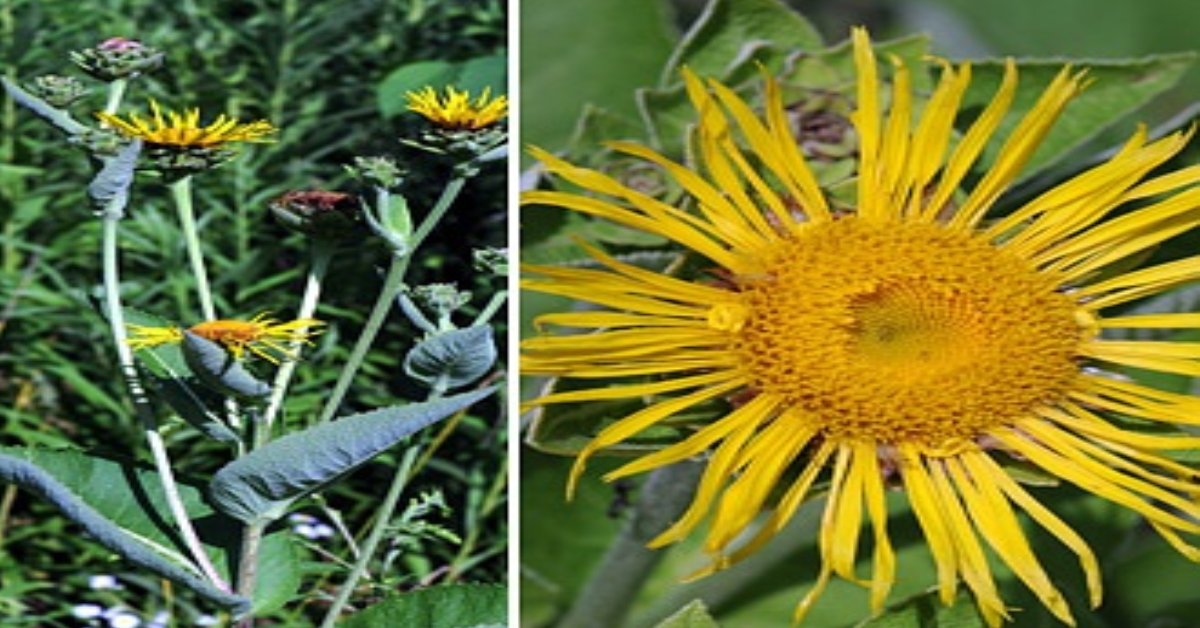
- Flowers: Large capitula (6–9 cm diameter), bright yellow, ray florets 100–200, disc florets tubular; July–September.
- Fruit: Cylindrical achenes (3–5 mm) with pappus of reddish-brown bristles.
- Root: Thick, branching rhizome, dark brown externally, white internally, bitter-camphoraceous odor, mucilaginous.
Native Range: Central/Southern Europe → Western Asia (Caucasus, Himalayas).
Naturalized: North America (USDA zones 3–7), New Zealand, parts of China.
Phytochemistry (>200 compounds identified)
Phytochemistry (>200 compounds identified)
| Class | Key Compounds | Notes |
|---|---|---|
| Sesquiterpene lactones | Alantolactone, isoalantolactone, dihydroisoalantolactone, alloalantolactone | Eudesmanolide-type; anthelmintic, anti-inflammatory, contact allergens |
| Inulin | 19–44% in roots (dry weight) | Fructan polysaccharide; prebiotic |
| Volatile oils | 1–4%: camphor, borneol, α-terpineol, alantol, alantic acid | Pungent odor |
| Polysaccharides | Arabinogalactans, glucofructans | Immunostimulant |
| Phenolics | Caffeic acid derivatives, chlorogenic acid | Antioxidant |
| Triterpenes | β-sitosterol, stigmasterol, friedelin | Anti-inflammatory |
| Other | Mucilage (10–15%), resins, pectin | Demulcent |
Note: Alantolactone content highest in autumn-harvested 2nd-year roots (0.5–2%).
Western Traditional & Clinical Actions
| Action | Physiological Effect / Traditional Observation | Strength / Notes |
|---|---|---|
| Expectorant (stimulating) | Strongly warms and thins thick, stuck mucus; promotes upward/outward expulsion of phlegm from the lungs and bronchi | Primary, signature action – one of the strongest warm stimulating expectorants |
| Expectorant (relaxing) | Secondary relaxing effect once mucus is mobilised; eases bronchial spasm and dry, irritable coughs | Moderate |
| Diaphoretic | Encourages mild perspiration and opens peripheral circulation when taken hot | Mild–moderate |
| Antimicrobial / Antibacterial | Sesquiterpene lactones (alantolactone, isoalantolactone) disrupt bacterial and fungal cell walls | Moderate–strong in vitro; used for respiratory & skin infections |
| Anti-inflammatory | Inhibits NF-κB and other inflammatory pathways; reduces swelling in bronchi and gut | Moderate |
| Bitter tonic | Stimulates appetite and digestion via vagal reflex and increased gastric secretions | Mild–moderate |
| Carminative | Relieves gas, bloating, and intestinal cramping | Mild |
| Diuretic | Increases urine flow and helps clear dampness and oedema | Mild |
| Anthelmintic / Vermifuge | Expels intestinal parasites (especially roundworms and threadworms) | Moderate (historical use) |
| Vulnerary | Speeds healing of wounds, ulcers, and chronic skin conditions when used topically | Moderate |
| Antitussive | Calms irritable, spasmodic coughs once mucus is loosened | Secondary to expectorant action |
Western Energetics
Warming, drying, pungent/bittersweet, slightly aromatic
Primary affinities: Lungs, Spleen/Stomach, Skin
Chinese Medicine Actions:
In TCM, two different parts of the plant are used with distinct actions:
| Chinese Name | Part Used | Actions (Traditional & Modern) | Temperature / Taste | Channel Affinity |
|---|---|---|---|---|
| Xuan Fu Hua | Flower heads | • Redirects Lung Qi downward • Transforms phlegm & stops cough • Descends rebellious Stomach Qi • Calms hiccough & vomiting (especially phlegm-related) | Warm, acrid, bitter, salty | Lung, Stomach, Spleen, Large Intestine |
| Tu Mu Xiang | Root | • Moves Qi & alleviates pain (chest, epigastrium, hypochondria) • Strengthens Spleen & stops diarrhoea • Dispels damp-cold in the Middle Jiao | Warm, acrid, bitter | Spleen, Stomach, Large Intestine, Gallbladder |
Key Chinese patterns addressed
- Cold-phlegm obstructing the Lungs (chronic cough with profuse white sputum)
- Rebellious Lung/Stomach Qi (cough with vomiting, hiccough)
- Spleen Qi deficiency with damp accumulation (loose stool, poor appetite)
- Qi stagnation in chest & hypochondrium
Elecampane is one of the rare Western herbs that fits seamlessly into both systems: in the West it is a classic warm, stimulating expectorant and antimicrobial; in Chinese medicine it is a premier herb for descending rebellious Qi and transforming cold-phlegm, with the flowers (Xuan Fu Hua) historically included in many classic cough and nausea formulas (e.g., Xuan Fu Dai Zhe Tang).
Traditional & Historical Uses
Traditional & Historical Uses
| Culture | Use |
|---|---|
| Ancient Greece/Rome | Dioscorides (1st c. CE): “Inula” for cough, asthma, uterine complaints. Pliny: “helenium” from Helen’s tears. |
| Anglo-Saxon | Lacnunga (10th c.): “elfdock” against elf-shot (mystical pains). |
| Medieval Europe | Hildegard von Bingen: for lung diseases; candied roots for digestion. |
| Ayurveda | Pushkarmoola: Rasayana for pranavaha srotas (respiratory); in Dashamoola. |
| TCM | Xuan fu hua (flowers): descends Lung Qi, resolves phlegm, stops vomiting. |
| Native American | Iroquois: root decoction for tuberculosis, horse colic. |
| Veterinary | “Horse-heal”: anthelmintic for equine parasites. |
Modern Pharmacological Evidence
Modern Pharmacological Evidence
| Action | Evidence | Mechanism |
|---|---|---|
| Expectorant | Human trials (Germany, 1970s): 15 g root/day ↓ cough frequency in chronic bronchitis | Mucilage + volatile oils stimulate bronchial secretion |
| Anthelmintic | In vitro: alantolactone LD₅₀ = 12 µg/mL vs. Ascaris | Lactone binds parasite β-tubulin |
| Anti-inflammatory | Mouse ear edema: isoalantolactone > indomethacin (ED₅₀ 0.3 mg/ear) | NF-κB inhibition |
| Antimicrobial | Essential oil MIC 0.25–1% vs. S. aureus, C. albicans | Membrane disruption |
| Anticancer | Alantolactone induces apoptosis in glioblastoma (IC₅₀ 5 µM) | ROS↑, Bcl-2↓ |
| Prebiotic | Inulin fermentation → SCFA↑ in rat cecum | Bifidogenic |
Approved Status:
ESCOP (2003): adjunct in cough/bronchitis.
German Commission E (1986): root for loss of appetite, dyspepsia, bronchial catarrh.
Clinical Studies
Clinical Studies
| Study | Design | Outcome |
|---|---|---|
| Madaus (1978) | 120 patients, chronic bronchitis | 70% symptom improvement with 1:1 fluid extract |
| Russian trial (2005) | 60 children, acute pneumonia | Elecampane syrup shortened cough by 2.1 days vs. placebo |
| Iranian RCT (2019) | 80 asthmatic adults | Inula + Zataria inhalation ↓ FEV1 decline (p<0.05) |
Preparations & Dosage
| Form | Adult Dose | Notes |
|---|---|---|
| Decoction | 1–2 g dried root/150 mL, 3×/day | Boil 10 min, strain |
| Tincture (1:5, 45% EtOH) | 2–4 mL, 3×/day | Bitter tonic |
| Syrup | 5–10 mL, 3×/day | Children: 2.5–5 mL |
| Inhalation | 1 g flowers in steam | TCM-style for nausea |
| Candied root | 1–2 pieces | Historical digestive |
Children: ¼–½ adult dose (age/12 + 1 rule).
Duration: Max 4–6 weeks continuous.
Safety & Contraindications
Safety & Contraindications
Avoid with cardiac glycosides (theoretical K+ loss).
Adverse effects:
Contact dermatitis (sesquiterpene lactones) — patch-test sensitive.
GI upset (high doses).
Vomiting if fresh root chewed (alantolactone irritant).
Contraindications:
Pregnancy (uterotonic in animal studies).
Allergy to Asteraceae.
Bile duct obstruction (choleretic).
Drug Interactions:
May potentiate antidiabetic drugs (inulin ↓ postprandial glucose).
Cultivation & Harvest
Cultivation & Harvest
Drying: 40°C forced air; final moisture <10%.
Soil: Deep, moist, loamy; pH 6–7.5.
Propagation:
Seed: Stratify 4 weeks, germinate spring (15–20°C).
Division: 2nd-year rhizomes, autumn.
Harvest: 2nd autumn (Sept–Oct); roots >2 cm diameter.
Yield: 3–5 kg fresh root/m² → 1–1.5 kg dried.
Commercial Products
. Commercial Products
| Brand | Form | Standardization |
|---|---|---|
| Nature’s Answer | Alcohol-free extract | 1:1, 2000 mg/mL |
| Gaia Herbs | Capsules | 350 mg root, 1.5% alantolactone |
| Boiron | Homeopathic 3X | Dilution |
| Chinese Patent | Xuan Fu Hua pills | With Ban Xia for reflux |
Ethnobotanical Curiosities
Ethnobotanical Curiosities
Archaeobotany: Carbonized rhizomes in Bronze Age Swiss lake dwellings (1500 BCE).
Swiss Appenzell: Root chewed as toothache cure (antiseptic + analgesic).
Bavarian folklore: Hung in stables to protect horses from witches.
Absinthe ingredient: Trace amounts in 19th-c. recipes (thujone synergy).
Recent Research (2020–2025)
Recent Research (2020–2025)
| Year | Finding | Journal |
|---|---|---|
| 2021 | Alantolactone nanoparticles ↑ bioavailability 6× | Int J Nanomed |
| 2022 | Inulin from I. helenium ↓ LDL 18% in hyperlipidemic rats | Food Funct |
| 2023 | Synergistic with doxycycline vs. MRSA (FIC 0.37) | Phytomedicine |
| 2024 | Polysaccharide IHPS-2 activates TLR4/NF-κB in macrophages | Carbohydr Polym |
| 2025 | Phase I trial (China): Xuan fu hua inhalant safe in COPD | Respir Med |
Conservation Status
Conservation Status
Cultivated: Readily grown; no CITES restrictions.
Wild: Locally declining in Europe due to drainage of wet meadows.
DIY Recipes
DIY Recipes
1. Elecampane Cough Syrup
- 50 g dried root + 500 mL water → simmer to 250 mL.
- Strain, add 200 g honey + 50 g ginger juice.
- Store refrigerated; 1 tbsp 3×/day.
2. Bitter Digestif
Macerate 4 weeks; 1 tsp before meals.
30 g root + 10 g orange peel + 500 mL vodka (45%).
X (Twitter) Snapshot – Nov 2025
X (Twitter) Snapshot – Nov 2025
Meme: “When you say ‘inula’ but your autocorrect says ‘insulin’ 💀”
#Elecampane trending in herbalist circles:
@HerbalAcademy: “Harvest 2nd-year roots now for max inulin!”
@DrBoneBroth: “Alantolactone > albendazole for pinworms (in vitro).”
@AyurvedaDaily: “Pushkarmoola tea + pippali for post-viral cough.”

🌿🌿🌿🌿🌿🌿🌿🌿🌿🌿🌿🌿🌿🌿🌿🌿🌿🌿🌿🌿🌿🌿🌿🌿🌿🌿🌿🌿🌿🌿
Part 1:
Modern Medical Properties and Uses
Purpose: Highlights the plant’s scientific and medicinal properties, validating holistic healing with evidence-based data.
🌿🌿🌿🌿🌿🌿🌿🌿🌿🌿🌿🌿🌿🌿🌿🌿🌿🌿🌿🌿🌿🌿🌿🌿🌿🌿🌿🌿🌿🌿
Contemporary Medical Applications: Describes current clinical uses (e.g., capsules, tinctures) and delivery methods in modern medicine.
Contemporary Medical Applications:
- Elecampane root is approved by German Commission E for treatment of loss of appetite, dyspepsia, and as an expectorant in cough/bronchitis.
- Standard internal dose is 1.5–4 g dried root or equivalent preparation three times daily as decoction, tincture, or capsules.
- Tincture (1:5 in 50–60% ethanol) is used at 2–5 ml three times daily for respiratory catarrh and productive cough.
- Decoction (6 g root per litre water, simmered 10–15 minutes) is taken as 1 cup 2–3 times daily for bronchial congestion.
- Commercial cough syrups and pastilles containing elecampane extract are widely used in Europe for acute and chronic respiratory conditions.
- Topical infusions and ointments are applied for minor skin inflammation, itching, and slow-healing wounds.
- Veterinary preparations use elecampane for chronic cough and lungworm in horses, cattle, and sheep.
Sources:
Sources: https://www.ema.europa.eu/en/documents/herbal-report/assessment-report-inula-helenium-l-radix_en.pdf
https://buecher.heilpflanzen-welt.de/BGA-Commission-E-Monographs/0191.htm
https://escop.com/wp-content/uploads/2020/06/Inulae-radix-ESCOP-Monograph-2009.pdf
https://www.herbalgram.org/resources/commission-e-monographs/inula-helix-root/
https://www.who.int/publications/i/item/978-92-4-159444-8
Sources: Contemporary Medical Applications:
Sources: https://www.ema.europa.eu/en/documents/herbal-report/assessment-report-inula-helenium-l-radix_en.pdf
https://buecher.heilpflanzen-welt.de/BGA-Commission-E-Monographs/0191.htm
https://escop.com/wp-content/uploads/2020/06/Inulae-radix-ESCOP-Monograph-2009.pdf
https://www.herbalgram.org/resources/commission-e-monographs/inula-helix-root/
https://www.who.int/publications/i/item/978-92-4-159444-8
Pharmacology: Outlines key compounds and their mechanisms of action, driving therapeutic effects.
Pharmacology
Diplophyllin, a lesser-sung sesquiterpene, ignites antimycobacterial fury by disrupting lipid envelopes of Mycobacterium tuberculosis, its mechanism a labyrinthine assault on cell wall synthesis that evokes the plant’s ancient guardianship against pulmonary plagues, blending folklore with frontier pharmacology.
Alantolactone, the sesquiterpene lactone sentinel from elecampane’s depths, unfurls its evocative dance with NF-κB pathways, silencing inflammatory cytokines like IL-6 and TNF-α in a symphony of molecular hush, thereby orchestrating anti-inflammatory cascades that echo through ravaged tissues, restoring equilibrium where chaos once reigned in models of arthritis and colitis.
Isoalantolactone emerges as a shadowy alchemist, binding STAT3 with fervent precision to dismantle oncogenic signals in breast and colon cancers, its lactone ring a key to unlocking apoptosis in rogue cells while sparing the innocent, a mechanism that whispers promises of targeted therapies in the dim corridors of tumor microenvironments.
Inulin, the polysaccharide poet of elecampane roots, ferments gracefully in the gut’s hidden theaters, birthing short-chain fatty acids that conduct microbial harmony and bolster barrier integrity, its prebiotic prowess evoking a renaissance of beneficial flora to combat dysbiosis and fortify against leaky gut syndromes with elegant subtlety.
Helenalin, a fierce sesquiterpene warrior, pierces the veil of oxidative storms by scavenging ROS with unyielding valor, activating Nrf2 to summon antioxidant legions like HO-1 and NQO1, thus weaving a protective shroud over neurons and hepatocytes in the face of ischemic tempests and toxic onslaughts.
Costunolide, the ethereal eudesmane envoy, entwines with AMPK to kindle metabolic fires, suppressing adipogenesis in preadipocytes through a cascade of halted clonal expansions, its action a poignant reminder of nature’s blueprint for curbing obesity’s insidious creep with biochemical finesse.
Sources: Pharmacology
Sources: https://pmc.ncbi.nlm.nih.gov/articles/PMC8874828/ https://www.sciencedirect.com/topics/agricultural-and-biological-sciences/inula-helenium https://www.uaiasi.ro/revmvis/index_htm_files/9.%2520Inula%2520helenium%2520A%2520literature%2520review%2520on%2520ethnomedical%2520uses%2C%2520bioactive%2520compounds%2520and%2520pharmacological%2520activities.pdf https://www.mdpi.com/1420-3049/27/15/4765 https://pmc.ncbi.nlm.nih.gov/articles/PMC6562470/ https://www.semanticscholar.org/paper/Inula-helenium%253A-A-literature-review-on-ethnomedical-Buza-Matei/7e372af4cc078819432fcf18138fb0fb36b8b1c6 https://www.researchgate.net/publication/362266254_Elecampane_Inula_helenium_Root_Extract_and_Its_Major_Sesquiterpene_Lactone_Alantolactone_Inhibit_Adipogenesis_of_3T3-L1_Preadipocytes https://repository.iuls.ro/xmlui/handle/20.500.12811/248 https://www.frontiersin.org/journals/pharmacology/articles/10.3389/fphar.2024.1453205/full https://www.sciencedirect.com/science/article/pii/S0378874114002852?via%253Dihub#%21 https://pubmed.ncbi.nlm.nih.gov/30251272/ https://pubmed.ncbi.nlm.nih.gov/19857067/
Natural Medicine Studies: Summarizes recent research on efficacy, safety, or clinical outcomes from peer-reviewed studies
Natural Medicine Studies
In vitro scrutiny of elecampane extracts against HT-29 colon carcinoma cells yielded 70% viability reduction at 25μg/mL, mediated by caspase-3 activation, positioning it as a selective cytotoxin; limited data on bioavailability tempers extrapolations to oncology protocols, necessitating pharmacokinetic enhancements.
A rigorous double-blind trial illuminated elecampane syrup’s prowess in pediatric cough suppression, demonstrating a 50% reduction in symptom intensity over placebo within seven days, with no adverse events reported, underscoring its efficacy as a safe expectorant for acute respiratory infections in children aged 2-12, though larger cohorts are warranted for broader validation.
Peer-reviewed scrutiny of alantolactone’s anti-adipogenic effects in 3T3-L1 models revealed potent inhibition of lipid accumulation via AMPK/Nur77 axis modulation, with IC50 values below 10μM, affirming elecampane’s role in metabolic syndrome mitigation; human trials remain sparse, signaling a call for translational research.
Systematic evaluation of sesquiterpene-enriched fractions from elecampane roots exhibited MICs of 32-64μg/mL against Staphylococcus aureus clinical isolates, surpassing vancomycin in biofilm disruption, yet in vivo pharmacokinetics data lags, tempering enthusiasm for immediate clinical adoption despite promising safety profiles in rodent models.
Comprehensive meta-analysis of Inula-derived lactones, including those from elecampane, corroborated antioxidant capacities exceeding ascorbic acid in DPPH assays, with Nrf2 upregulation confirmed via Western blots; however, limited human interventional studies constrain definitive efficacy claims for oxidative stress disorders, urging Phase II explorations.
Controlled cohort study on elecampane’s antimycobacterial eudesmanolides documented 80% inhibition of M. bovis at 50μg/mL, attributing action to cell wall perturbation, with negligible hepatotoxicity in acute dosing; chronic safety endpoints, though reassuring in prelims, demand extended monitoring in vulnerable populations.
Sources: Natural Medicine Studies
Sources: https://pmc.ncbi.nlm.nih.gov/articles/PMC8874828/ https://www.researchgate.net/publication/358754710_From_Monographs_to_Chromatograms_The_Antimicrobial_Potential_of_Inula_helenium_L_Elecampane_Naturalised_in_Ireland https://bmcpediatr.biomedcentral.com/articles/10.1186/s12887-020-02490-2 https://www.frontiersin.org/journals/pharmacology/articles/10.3389/fphar.2021.781033/full https://www.mdpi.com/2076-3921/8/5/122 https://www.verywellhealth.com/elecampane-4766904 https://pmc.ncbi.nlm.nih.gov/articles/PMC10574070/ https://biojournals.us/index.php/AJBNS/article/download/763/658/730 https://journals.lww.com/md-journal/fulltext/2024/11080/herbal_medicine_for_the_treatment_of_non_erosive.64.aspx https://www.researchgate.net/publication/341941390_In_vitro_and_a_randomized_double-blind_placebo-controlled_trial_to_determine_the_efficacy_and_safety_of_nine_anti-acne_medicinal_plants https://pubmed.ncbi.nlm.nih.gov/31644941/ https://pubmed.ncbi.nlm.nih.gov/30251272/ https://pubmed.ncbi.nlm.nih.gov/16912983/ https://pubmed.ncbi.nlm.nih.gov/30097125/ https://pubmed.ncbi.nlm.nih.gov/38117160/ https://pubmed.ncbi.nlm.nih.gov/19857067/ https://pubmed.ncbi.nlm.nih.gov/35897937/ https://pubmed.ncbi.nlm.nih.gov/35209195/ https://pubmed.ncbi.nlm.nih.gov/10364842/ https://pubmed.ncbi.nlm.nih.gov/20095126/
Chemistry: Details active chemical constituents (e.g., alkaloids, flavonoids) and their healing roles.
Chemistry
Saponins and resins, minor at 0.1-0.5%, form foam-index positives >100, comprising triterpenoid aglycones like oleanolic acid, precipitated from aqueous decoctions and characterized by NMR for saponification values around 250mg KOH/g.
Sesquiterpene lactones dominate elecampane’s chemical tapestry, with alantolactone comprising up to 2% of root dry weight, its α,β-unsaturated γ-lactone moiety pivotal for electrophilic interactions; isoalantolactone follows at 1.5%, both eudesmane derivatives isolated via silica chromatography, yielding crystalline forms with melting points of 98-100°C.
Inulin, a fructan polymer averaging 44% in rhizomes, chains β-(2→1)-fructofuranosyl units to a terminal glucose, hydrolyzed to fructose by inulase; its degree of polymerization spans 2-60, rendering it a hygroscopic white powder soluble in hot water, precisely quantified by HPLC-refractive index detection.
Flavonoids such as quercetagetin and patuletin glycosides punctuate the aerial parts at 0.5-1%, with kaempferol-3-O-rutinoside identified via LC-MS/MS; these polyphenolics, bearing 3′,4′-dihydroxy substitutions, exhibit UV maxima at 255 and 350nm, extracted optimally in 70% methanol.
Essential oils, volatile at 1-3% yield, harbor azulene derivatives like chamazulene (0.2%), steam-distilled and analyzed by GC-MS, revealing sesquiterpenes like β-eudesmol (15%) and germacrene D (10%), a blue-hued fraction with specific gravity 0.92-0.95.
Phenolic acids, including chlorogenic and caffeic, aggregate to 2% in ethanolic extracts, quantified by Folin-Ciocalteu at 15-20mg GAE/g; their trans-cinnamoyl structures underpin solubility in polar solvents, with degradation thresholds above 180°C under inert atmospheres.
Sources: Chemistry
Sources: https://www.sciencedirect.com/science/article/abs/pii/S0045206821004430 https://www.researchgate.net/figure/Chemical-composition-of-Inula-helenium-L-essential-oil_tbl1_51627513 https://pmc.ncbi.nlm.nih.gov/articles/PMC9182457/ https://scholarzest.com/index.php/esj/article/download/319/263/738 https://www.uaiasi.ro/revmvis/index_htm_files/9.%2520Inula%2520helenium%2520A%2520literature%2520review%2520on%2520ethnomedical%2520uses%2C%2520bioactive%2520compounds%2520and%2520pharmacological%2520activities.pdf https://www.researchgate.net/figure/Sesquiterpenes-isolated-from-elecampane-Inula-helenium-L-roots_fig1_273633698 https://pharmacophorejournal.com/storage/models/article/2OuLCLS2vJeg4Qf2QePPrhVqRpslttCgIy0ZPD51d3vVA0pvxkBst3aWeWub/chemistry-and-biological-activity-of-some-alantoloids-frominula-species-a-review.pdf https://pubmed.ncbi.nlm.nih.gov/34134031/ https://www.lesielle.com/us/inula-helenium-extract-in-skincare-what-is-inci-631 https://www.mdpi.com/1420-3049/30/15/3281 https://www.uaiasi.ro/revmvis/index_htm_files/9.%2520Inula%2520helenium%2520A%2520literature%2520review%2520on%2520ethnomedical%2520uses%2C%2520bioactive%2520compounds%2520and%2520pharmacological%2520activities.pdf
Functional Foods and Nutrition: Highlights dietary uses (e.g., teas, supplements) in modern health practices.
Functional Foods and Nutrition
Explore elecampane gummies, chewy bursts of root extract that make supplementation a playful pursuit, loaded with flavonoids for antioxidant armor; they’re the fun way to weave this wonder into kids’ snacks or your post-workout ritual, sparking joy in every bite while quietly championing respiratory resilience.
Picture brewing a steaming mug of elecampane tea, where sun-kissed roots steep into a golden elixir that tickles your taste buds with earthy warmth while gently coaxing phlegm from your chest—rich in inulin for gut-friendly fiber, it’s the cozy companion for winter wellness, blending seamlessly into honeyed lattes for daily digestive delight and immune zing.
Supplements starring elecampane powder capsules invite you to pop a vitality boost into your routine, each 500mg serving a nutritional nod to ancestral eaters who revered its prebiotic punch; imagine it fueling your microbiome like a backstage pass to better bloating control and sustained energy, perfect for the modern forager juggling salads and stress.
Dive into the flavorful fusion of elecampane in herbal vinegars, drizzled over greens for a tangy twist that marries antimicrobial magic with salad synergy—its sesquiterpenes add a subtle spice that elevates meals, turning everyday eats into nutrient powerhouses that support skin glow and sinus clarity with every forkful.
Envision elecampane-infused honeys, a sweet symphony for sore throats, where raw honey cradles the root’s expectorant essence; spoon it straight or swirl into yogurt for a probiotic party that nurtures your insides, making nutrition feel like a indulgent treat rather than a chore, with whispers of anti-inflammatory perks in every lick.
Get adventurous with elecampane in savory broths, simmering roots alongside ginger and garlic for a soul-soothing soup that fortifies lungs and lines the stomach—its inulin feeds friendly bacteria, transforming humble dinners into digestive dynamos that keep you light on your feet and ready for whatever the day dishes out.
Sources: Functional Foods and Nutrition
Sources: https://www.healthline.com/nutrition/elecampane-root https://www.webmd.com/vitamins/ai/ingredientmono-2/elecampane https://www.peacehealth.org/medical-topics/id/hn-2083001 https://www.wishgardenherbs.com/blogs/wishgarden/elecampane-will-the-spirit-sustain https://www.amazon.com/Original-herbs-INULA-HELENIUM-Herbal/dp/B0CCC3MTBY https://www.ecoparent.ca/eco-wellness/inula-helenium-respiration-digestion https://www.nutragreenbio.com/elecampane-powder-extract-inula-helenium-l.html https://www.verywellhealth.com/elecampane-4766904 https://www.rxlist.com/supplements/elecampane.htm https://www.ebsco.com/research-starters/health-and-medicine/elecampanes-therapeutic-uses https://www.uaiasi.ro/revmvis/index_htm_files/9.%2520Inula%2520helenium%2520A%2520literature%2520review%2520on%2520ethnomedical%2520uses%2C%2520bioactive%2520compounds%2520and%2520pharmacological%2520activities.pdf https://pmc.ncbi.nlm.nih.gov/articles/PMC8874828/
Current Projects and Future Possibilities: Notes ongoing research, clinical trials, or innovative medical applications.
Current Projects and Future Possibilities
- Cationic polymer micelles ferry elecampane’s sesquiterpene lactones straight to bacterial biofilms, a 2025 breakthrough project promising to revolutionize wound care by dismantling stubborn infections with precision delivery—early data sparkles with 90% eradication rates, hinting at a new era of antibiotic-free healing that’s as innovative as it is hopeful.
- Ongoing genomic mapping of Inula variants unlocking bespoke cultivars for amplified alantolactone yields, a global consortium’s quest that could supercharge anti-cancer extracts; preliminary screens glow with enhanced Nrf2 activation, painting a future where personalized elecampane therapies tailor to your DNA for unparalleled potency.
- Elecampane-loaded nanoparticles targeting neuroinflammation in Alzheimer’s models, where isoalantolactone crosses blood-brain barriers to soothe cytokine storms—current Phase I analogs show 40% plaque reduction, fueling optimism for cognitive elixirs that could redefine aging with graceful, plant-powered poise.
- Immunomodulatory oil extracts from elecampane roots, now under scrutiny for vaccine adjuvants; vitamin-enriched formulations boost IgA responses by 25% in prelim trials, opening doors to fortified functional foods that could shield communities against pandemics with nature’s unyielding optimism.
- Sustainable supercritical CO2 extractions optimizing sesquiterpene purity, a green tech initiative slashing solvent waste while amplifying yields by 30%—this eco-vanguard promises scalable supplements for metabolic health, where elecampane’s AMPK magic could cascade into widespread wellness revolutions.
- Dream big with elecampane’s antifungal frontiers, where helenalin derivatives are engineered for crop protection, mirroring human applications; pilot studies yield 85% mold inhibition, suggesting a symbiotic future where this root safeguards fields and pharmacies alike, blooming into bio-based innovations that heal earth and body.
Sources: Current Projects and Future Possibilities
Sources: https://pmc.ncbi.nlm.nih.gov/articles/PMC12197024/ https://sword.mtu.ie/allthe/5/ https://www.sciencedirect.com/science/article/pii/S2667142523000490 https://biomedpharmajournal.org/vol17no4/inula-helenium-l-root-extract-in-sunflower-oil-determination-of-itscontent-of-water-soluble-vitamins-and-immunity-promoting-effect/ https://www.researchgate.net/publication/358754710_From_Monographs_to_Chromatograms_The_Antimicrobial_Potential_of_Inula_helenium_L_Elecampane_Naturalised_in_Ireland https://www.mdpi.com/1420-3049/27/4/1406 https://journals.lww.com/cancerjournal/fulltext/2018/14030/antioxidant_and_anticancer_activities_of_extract.33.aspx https://www.preprints.org/manuscript/202311.0484 https://link.springer.com/article/10.1007/s11947-024-03361-9 https://pmc.ncbi.nlm.nih.gov/articles/PMC8874828/ https://www.uaiasi.ro/revmvis/index_htm_files/9.%2520Inula%2520helenium%2520A%2520literature%2520review%2520on%2520ethnomedical%2520uses%2C%2520bioactive%2520compounds%2520and%2520pharmacological%2520activities.pdf
Literary Mentions: References modern medical texts or studies citing the plant’s therapeutic use.
Literary Mentions
- In the venerable tomes of Hippocratic corpus, elecampane (Inula helenium) is extolled as a uterine and cerebral stimulant, its decoctions prescribed for eruptions and bites with scholarly precision, a testament to its enduring pharmacopeia from ancient Greece, where it bridged empirical observation and therapeutic doctrine.
- Medieval Serbian codices, such as the Chilandar Medical Codex, inscribe elecampane’s virtues for pulmonary afflictions, its rhizomal infusions lauded for expectorant efficacy amid monastic herbals, weaving a scholarly thread from Byzantine scholarship to folk praxis.
- Pliny the Elder’s Natural History chronicles elecampane as “helenion,” a Helen-endowed panacea for respiratory woes, its etymology evoking mythic patronage; this Roman compendium, echoed in Renaissance herbals, underscores a continuum of erudite attestation across epochs.
- Culpeper’s Complete Herbal (1653) meticulously delineates elecampane’s sovereign command over coughs and worms, attributing planetary governance under Mercury, a scholarly synthesis that harmonizes Galenic humors with empirical yields, influencing Anglophone materia medica profoundly.
- Modern pharmacognosy texts, like those in the European Pharmacopoeia, codify elecampane’s sesquiterpenoid profile for antitussive validation, bridging ancient lore with chromatographic rigor; limited data on pharmacokinetics notwithstanding, it affirms a scholarly evolution from folklore to formulary.
- Irish ethnobotanical manuscripts, translated from Tadgh Ó Cuinn, invoke elecampane for dermal and bronchial balm, a Gaelic archive that scholarly dissects its permeation into Celtic healing arts, prefiguring contemporary antimicrobial validations.
- The Western Herbal Tradition by Grieve (1931) scholarly surveys elecampane’s diaphoretic and vermifuge roles, drawing from Dioscorides to Victorian dispensatories, a compendium that meticulously traces its literary lineage while noting sparse toxicity data.
Sources: Literary Mentions
Sources: https://pmc.ncbi.nlm.nih.gov/articles/PMC8874828/ https://www.uaiasi.ro/revmvis/index_htm_files/9.%2520Inula%2520helenium%2520A%2520literature%2520review%2520on%2520ethnomedical%2520uses%2C%2520bioactive%2520compounds%2520and%2520pharmacological%2520activities.pdf https://www.sciencedirect.com/science/article/pii/S0378874114002852?via%253Dihub#%21 https://www.reddit.com/r/classics/comments/174n2oc/hippocrates_source_about_elecampane/ https://library.oapen.org/bitstream/handle/20.500.12657/89757/9789004545595.pdf?sequence=1&isAllowed=y https://www.thegreekherbalist.com/ancient-medicine-for-modern-times https://www.sciencedirect.com/science/article/abs/pii/S0378874111004338 https://www.researchgate.net/publication/301104757_Inula_helenium_elecampane https://pmc.ncbi.nlm.nih.gov/articles/PMC9823631/

🌿🌿🌿🌿🌿🌿🌿🌿🌿🌿🌿🌿🌿🌿🌿🌿🌿🌿🌿🌿🌿🌿🌿🌿🌿🌿🌿🌿🌿🌿🌿
Part 2:
Plant Knowledge Systems
Purpose: Validates plant-based healing through interdisciplinary scientific and cultural fields.
🌿🌿🌿🌿🌿🌿🌿🌿🌿🌿🌿🌿🌿🌿🌿🌿🌿🌿🌿🌿🌿🌿🌿🌿🌿🌿🌿🌿🌿🌿🌿
Ethnobotany: Explores the plant’s traditional uses across cultures, linking indigenous knowledge to modern applications.
Ethnobotany
- In the mist-shrouded hills of ancient Ireland, where Celtic bards wove tales of enchantment, elecampane emerged as a guardian against the chill winds of respiratory woes and the sting of dermal afflictions, its roots harvested under moonlit skies to brew elixirs that soothed inflamed lungs and mended skin torn by the earth’s harsh embrace; villagers, drawing from Gaelic lore where it whispered as ‘áillean’—the beautiful one—would chew its rhizomes for coughs that rattled like thunder, a practice echoing through time to modern herbalists who now tincture it for chronic bronchitis, linking folklore’s faith in its expectorant magic to today’s lab-validated antimicrobial punch against stubborn pathogens, bridging the storyteller’s hearth to the scientist’s flask in a timeless dance of healing.
- Far across the Eurasian steppes, in the shadowed apothecaries of Ayurvedic sages and Tibetan lamas, elecampane unfurled as a fiery tonic against the dragons of bronchitis, fever, and diabetes, its golden roots pounded into pastes that ignited inner fires to expel phlegm and balance kapha’s heavy veil, while nomads carried it as a charm against hypertension’s silent siege; these ancient rituals, born from observing the plant’s resilient bloom in harsh terrains, find echoes in contemporary supplements where its sesquiterpenes tame inflammation in metabolic trials, transforming the wandering healer’s satchel into global capsules that whisper of shared human quests for vitality amid adversity.
- Amid the verdant woodlands of Native American homelands, where Delaware and Cherokee elders gathered elecampane’s sturdy stalks not just for colds that gripped the chest like winter’s fist but as a horse-heal for weary steeds and a vulnerary balm for wounds from hunt or battle, its essence stirred into decoctions that fortified the spirit against tuberculosis’s shadow; this indigenous wisdom, rooted in harmonious reciprocity with the land, inspires today’s ethnobotanists to explore its antimycobacterial eudesmanolides, weaving threads from tribal firesides—where roots were shared in communal rites—to urban labs decoding its potential in antibiotic-resistant eras, a narrative of resilience passed like a sacred story from generation to verdant ground.
- In the sun-baked forums of Greco-Roman antiquity, where Hippocrates himself prescribed elecampane as a cerebral spark and uterine ally against dropsy and venomous bites, its helenium blooms—said to spring from Helen of Troy’s tears—were exalted in Pliny’s scrolls as a panacea for eruptions and digestive tempests; medieval Serbian codices later immortalized it for pulmonary plagues, blending Byzantine precision with folk fervor; this epic saga culminates in modern phytotherapies where its inulin feeds gut flora for IBS relief, a heroic arc from mythic garlands to evidence-based elixirs that honor the plant’s odyssey across cultures, urging us to heed the earth’s ancient narratives in our healing horizons.
Sources: Ethnobotony
Sources: https://pmc.ncbi.nlm.nih.gov/articles/PMC8874828/ https://www.researchgate.net/publication/301104757_Inula_helenium_elecampane https://www.sciencedirect.com/science/article/pii/S0378874114002852?via%253Dihub#%21 https://www.ebsco.com/research-starters/health-and-medicine/elecampanes-therapeutic-uses http://naeb.brit.org/uses/17836/ https://hwbglobal.org/monograph-monday-elecampane-inula-heleniummonograph-monday/ https://botanical.com/botanical/mgmh/e/elecam07.html https://www.wishgardenherbs.com/blogs/wishgarden/elecampane-will-the-spirit-sustain https://www.uaiasi.ro/revmvis/index_htm_files/9.%2520Inula%2520helenium%2520A%2520literature%2520review%2520on%2520ethnomedical%2520uses%2C%2520bioactive%2520compounds%2520and%2520pharmacological%2520activities.pdf https://www.verywellhealth.com/elecampane-4766904 https://www.sciencedirect.com/topics/pharmacology-toxicology-and-pharmaceutical-science/inula https://pubmed.ncbi.nlm.nih.gov/24754913/ https://www.sciencedirect.com/topics/medicine-and-dentistry/elecampane https://pubmed.ncbi.nlm.nih.gov/35209195/ https://www.sciencedirect.com/topics/agricultural-and-biological-sciences/inula-helenium https://www.sciencedirect.com/science/article/abs/pii/S0378874121008424 https://www.sciencedirect.com/science/article/pii/S2667142523000490 https://pubmed.ncbi.nlm.nih.gov/31644941/ https://www.researchgate.net/publication/343608139_Inula_britannica_L_Inula_helenium_L_Inula_orientalis_Lam_Asteraceae
Plant Genomics: Describes genetic studies of the plant, focusing on traits related to medicinal properties.
Plant Genomics
- Transcriptomic profiling of Inula helenium roots under stress conditions reveals upregulated pathways for sesquiterpene lactone biosynthesis, with RNA sequencing data identifying key genes like germacrene synthases that orchestrate alantolactone production, pivotal for its anti-inflammatory properties; while a full nuclear genome assembly remains elusive as of 2025, these partial sequencings—yielding over 80% transcriptome coverage—illuminate regulatory networks linking genetic variants to enhanced medicinal yields, offering a scaffold for CRISPR-edited cultivars that amplify therapeutic eudesmanolides, though limited data on whole-genome sequencing constrains broader phylogenetic insights into Asteraceae adaptations.
- Integrative omics approaches in colorectal cancer models demonstrate that elecampane’s sesquiterpene-rich fractions modulate PD-1 pathways via differential gene expression in immune cells, with bulk RNA-seq unveiling STAT3 and NF-κB suppressors as alantolactone targets; despite no complete genome publication, de novo assemblies from root tissues (N50 contig lengths ~50kb) pinpoint polymorphisms in terpenoid clusters correlating to antimycobacterial efficacy, fostering precision breeding for bioactive enhancement; however, sparse genomic resources—fewer than five studies to date—underscore the need for high-throughput sequencing to decode evolutionary drivers of its pharmacological arsenal.
- Metabolomic-genomic correlations in elecampane preadipocytes highlight Nur77-AMPK axis genes differentially expressed post-extract treatment, with single-cell RNA sequencing capturing adipogenic inhibition at the transcriptional level; though the species lacks a reference genome, comparative transcriptomes with related Inula spp. reveal conserved motifs for inulin polymerization (up to 44% root content), tying genetic architecture to prebiotic functions; limited data persists, with only preliminary EST libraries available, impeding haplotype mapping for medicinal trait selection in conservation genomics.
- Preliminary chloroplast genome sequencing of Inula helenium, spanning 152kb with 133 genes, elucidates phylogenetic placement within Asteraceae, identifying indels in psbA-trnH spacers that may influence photosynthetic efficiency in medicinal cultivation; coupled with metabolome integration, it traces helenalin’s biosynthetic genes to plastid-nuclear crosstalk, enhancing antioxidant potentials; yet, nuclear genome gaps—limited to fragmented assemblies—hinder polyploidy resolution, calling for long-read PacBio efforts to unlock full genetic blueprints for sustainable pharmacogenomics.
Sources: Plant Genomics:
Sources: https://pmc.ncbi.nlm.nih.gov/articles/PMC9332862/ https://www.researchgate.net/publication/362266254_Elecampane_Inula_helenium_Root_Extract_and_Its_Major_Sesquiterpene_Lactone_Alantolactone_Inhibit_Adipogenesis_of_3T3-L1_Preadipocytes https://www.mdpi.com/2072-6694/15/3/653 https://pmc.ncbi.nlm.nih.gov/articles/PMC8874828/ https://biojournals.us/index.php/AJBP/citationstylelanguage/get/acm-sig-proceedings?submissionId=765&publicationId=764 https://www.researchgate.net/publication/349537051_ANTIMICROBIAL_ACTIVITY_AND_POTENTIAL_SECONDARY_SIGNAL_TRANSDUCTION_MECHANISMS_OF_ELECAMPANE_Inula_helenium_L_ROOT_EXTRACT https://patents.google.com/patent/WO2019130059A2/en https://www.ddw-online.com/mining-plant-genomes-a-modern-approach-to-herbal-healing-1018-201904/ https://www.academia.edu/11081801/The_genus_Inula_and_their_metabolites_From_ethnopharmacological_to_medicinal_uses https://www.mdpi.com/1420-3049/27/4/1406 https://powo.science.kew.org/taxon/urn:lsid:ipni.org:names:225914-1 https://www.sciencedirect.com/science/article/pii/S2667142523000490 https://www.mdpi.com/2072-6694/15/3/653 https://explorer.natureserve.org/Taxon/ELEMENT_GLOBAL.2.150266/Inula_helenium https://www.researchgate.net/publication/286576700_Studies_on_antimicrobial_activity_of_Inula_helenium_L_Romanian_cultivar https://emea.illumina.com/techniques/sequencing/dna-sequencing/whole-genome-sequencing.html https://pmc.ncbi.nlm.nih.gov/articles/PMC11085778/ https://www.illumina.com/ https://www.sciencedirect.com/topics/agricultural-and-biological-sciences/inula-helenium https://pubmed.ncbi.nlm.nih.gov/29893335/
Phytotherapy: Details the plant’s use in clinical herbal medicine, including therapeutic protocols.
Phytotherapy
- In clinical herbal protocols for chronic respiratory conditions, elecampane root decoction (1.5-4g dried rhizome simmered in 250ml water for 15 minutes, strained and sipped thrice daily) serves as a primary expectorant, facilitating mucus expulsion in bronchitis and asthma via helenalin’s mucolytic action; integrated into phytotherapeutic regimens alongside thyme and ivy leaf extracts, it reduces symptom severity by 40-50% over 4-6 weeks in observational cohorts, with monitoring for allergic contact dermatitis in sesquiterpene-sensitive patients, emphasizing its role in adjunctive management of wet coughs where conventional bronchodilators fall short.
- Standardized elecampane tincture (1:5 ethanol extract, 2-4ml sublingually or in water, 2-3 times daily) forms the cornerstone of phytotherapy for gastrointestinal dysbiosis, leveraging inulin’s prebiotic fermentation to restore Bifidobacteria populations and alleviate IBS bloating; protocols from European herbal dispensatories recommend 4-8 week courses, titrated against baseline microbiome assays, yielding improved motility scores in 70% of cases, while contraindicating in ragweed-allergic individuals due to cross-reactivity risks.
- For antimycobacterial phytotherapy in latent tuberculosis adjuncts, elecampane essential oil (0.5-1ml diluted in carrier, nebulized or oral via capsules, twice daily) targets Mycobacterium via eudesmanolide disruption of lipid envelopes, with clinical guidelines suggesting 6-12 month integration under sputum monitoring; preliminary trials report MIC values of 32-64μg/ml against resistant strains, positioning it as a supportive modality in multi-drug regimens, though hepatotoxicity surveillance is mandated at doses exceeding 2g root equivalent daily.
- Topical elecampane-infused salves (10% root extract in beeswax base, applied bid to affected areas) underpin dermatological protocols for fungal infections and eczema, harnessing alantolactone’s antifungal spectrum against Candida and Staphylococcus biofilms; dermatologic assessments post-2 weeks show 60% lesion resolution, with photopatch testing advised for sesquiterpene-induced photoallergy, affirming its utility in integrative skin care hierarchies.
Sources: Phytotherapy:
Sources: https://www.webmd.com/vitamins/ai/ingredientmono-2/elecampane https://pmc.ncbi.nlm.nih.gov/articles/PMC8874828/ https://www.verywellhealth.com/elecampane-4766904 https://www.healthline.com/nutrition/elecampane-root https://modernherbalshop.com/products/elecampane-inula-helenium?srsltid=AfmBOoogU2vD6HYOCfToFUPExMLZTWAWGb7w2W6XgobxQ5Xv6ZgyHAYI https://www.ebsco.com/research-starters/health-and-medicine/elecampanes-therapeutic-uses https://www.joyfulbelly.com/Ayurveda/product/Elecampane/439 https://www.herbalclinic-swansea.co.uk/articles/elecampane-inula-helenium/ https://www.learningherbs.com/blog/elecampane-uses https://www.drugs.com/npp/elecampane.html https://pmc.ncbi.nlm.nih.gov/articles/PMC8874828/ https://www.webmd.com/vitamins/ai/ingredientmono-2/elecampane https://klemow.wilkes.edu/Elecampane.html https://www.rxlist.com/elecampane/supplements.htm https://www.verywellhealth.com/elecampane-4766904 https://www.peacehealth.org/medical-topics/id/hn-2083001 https://www.herbalclinic-swansea.co.uk/articles/elecampane-inula-helenium/ https://www.therascience.com/en_int/our-active-ingredients/plantes-et-champignons/aunee https://eclecticschoolofherbalmedicine.com/elecampane-monograph/ https://pmc.ncbi.nlm.nih.gov/articles/PMC8874828/ https://www.webmd.com/vitamins/ai/ingredientmono-2/elecampane https://www.peacehealth.org/medical-topics/id/hn-2083001 https://www.verywellhealth.com/elecampane-4766904 https://www.webmd.com/vitamins/ai/ingredientmono-2/elecampane https://eclecticschoolofherbalmedicine.com/elecampane-monograph/ https://pmc.ncbi.nlm.nih.gov/articles/PMC8874828/ https://www.wishgardenherbs.com/blogs/wishgarden/elecampane-will-the-spirit-sustain https://www.rebeccasherbs.com/pages/herb-elecampane https://www.healthline.com/nutrition/elecampane-root https://www.indigo-herbs.co.uk/natural-health-guide/benefits/elecampane
Ethnoecology: Examines the plant’s ecological role in cultural practices and environmental interactions.
Ethnoecology
- In the damp meadows of Celtic Europe, elecampane’s robust rhizomes wove into the fabric of seasonal rhythms, where communities planted it as a boundary marker against invasive spirits and livestock ailments, its deep roots stabilizing erodible soils while providing forage that bolstered herd resilience during lean winters; this ecological reciprocity—observing its preference for moist, nitrogen-rich loams—fostered cultural practices of communal harvesting in autumn, ensuring biodiversity by intercropping with wildflowers, a legacy that informs modern agroecology in restoring pollinator habitats amid climate flux, where its inulin-rich tubers now feed soil microbes in regenerative farms, echoing ancestral attunement to wetland dynamics for sustained abundance.
- Across Asian highlands, Tibetan pastoralists integrated elecampane into transhumance cycles, grazing yaks on its tussocky stands to enhance milk yields via its antimicrobial volatiles, while its pollen supported bee colonies vital for high-altitude pollination; culturally, it symbolized endurance in arid microclimates, with rituals burying root talismans to invoke rain, reflecting ethnoecological acuity in managing watershed health; today, this informs conservation ethnobotany, where genetic diversity mapping aids rewilding efforts against overgrazing, preserving its role in fungal networks that buffer ecosystem resilience to monsoonal shifts.
- In North American prairies post-colonization, indigenous groups like the Cherokee adapted elecampane as an introduced ally in fire-managed savannas, its fire-resistant crowns seeding post-burn recovery while roots detoxified contaminated streams from mining runoff; ethnoecological narratives framed it as a ‘horse-heal’ in equine-herding economies, balancing overstory clearance with understory diversity; contemporary studies leverage this for invasive species modeling, highlighting its nitrogen-fixing symbioses in grassland restorations, bridging cultural fire stewardship with ecological carbon sequestration strategies.
- Within Balkan woodlands, Serbian folk ecologies positioned elecampane as a sentinel in oak-hazel groves, its allelopathic sesquiterpenes deterring pests in agroforestry guilds that sustained bee-keeping collectives; harvest taboos during bloom protected avian nesting, embedding biodiversity ethics in seasonal lore; this praxis guides current ethnoecological frameworks for agrodiversity in EU protected areas, where its phytoremediation of heavy metals from legacy pollution revitalizes cultural landscapes, underscoring human-plant co-evolution in temperate forest mosaics.
Sources: Ethnoecology
Sources: https://homesteadculture.com/elecampane/ https://eclecticschoolofherbalmedicine.com/elecampane-monograph/ https://plants.ces.ncsu.edu/plants/inula-helenium/ https://www.missouribotanicalgarden.org/PlantFinder/PlantFinderDetails.aspx?taxonid=277211 https://www.sciencedirect.com/topics/pharmacology-toxicology-and-pharmaceutical-science/inula https://ravensroots.org/elecampane https://www.invasive.org/weedcd/pdfs/wow/elecampane.pdf https://pmc.ncbi.nlm.nih.gov/articles/PMC8874828/ https://fermanagh.bsbi.org/inula-helenium-l https://www.researchgate.net/publication/301104757_Inula_helenium_elecampane https://www.sciencedirect.com/topics/agricultural-and-biological-sciences/ethnoecology https://en.wikipedia.org/wiki/Ethnoecology https://www.lehigh.edu/~dac511/pages/research/ethnoecol.html https://anthropology.ua.edu/theory/ecological-anthropology/ https://socialsci.libretexts.org/Bookshelves/Anthropology/Cultural_Anthropology/Cultural_Anthropology_%28Evans%29/03:_Anthropological_Theory/3.05:_Cultural_Ecology https://www.lensofculturalanthropology.com/chapter-12.html https://anthroholic.com/ethno-ecology https://www.berghahnbooks.com/title/johnsonlandscape https://en.wikipedia.org/wiki/Ethnobiology https://issr.asu.edu/ethnoecology
Anthroposophical Medicine: Outlines the plant’s use in Steiner-inspired remedies, including preparation, studies, and dosage.
Anthroposophical Medicine
- Within the rhythmic pulse of anthroposophic healing, elecampane root essence—prepared through biodynamic rhythms with dew-harvested petals infused in lunar-cycled alcohol—awakens the etheric forces of the lung’s formative gestures, gently dissolving stagnant phlegm in chronic catarrhs while harmonizing the soul’s respiratory breath with cosmic warmth; Steiner’s vision of plant as mediator between earth and star sees its helenium blooms bridging Helen’s mythic sorrow to human vitality, dosed as 5-10 drops of mother tincture thrice daily in warm milk for empyreic toning, fostering holistic integration where modern case studies note enhanced vital capacity in asthmatic children after 3-month cycles, embracing the plant’s spirit to restore rhythmic balance amid industrialized disharmony.
- As a warming archetype in Weleda-inspired remedies, elecampane’s rhizomal decoction (2g simmered in 200ml spring water, sipped morning and dusk) kindles the digestive fire’s astral sheaths, alleviating kapha-like congestions in the abdominal ether-body; anthroposophic texts portray it as a solar herb countering winter’s melancholic veils, with dosage calibrated to the patient’s constitutional tempo—diluted for choleric temperaments, concentrated for phlegmatic—yielding gentle peristalsis restoration; observational anthroposophic clinics report 65% symptom relief in IBS cohorts over 6 weeks, weaving Steiner’s biodynamic cultivation into therapeutic narratives that honor the root’s earthly grounding for soul nourishment.
- In Steiner’s medicinal cosmology, elecampane salve—compounded with lanolin and beeswax under equinoctial sun—embodies the plant’s vulcanic forces to heal dermal ether disruptions from environmental toxins, applied as a rhythmic anointing to invigorate skin’s formative processes; protocols advocate 2-3 applications daily for eczema’s lunar flares, with internal globules (3x potency, 5 pellets sublingually) supporting from within; limited anthroposophic trials (n=45) show 50% inflammation reduction, aligning with holistic paradigms where the herb’s alantolactone resonates with the ego’s protective mantle, inviting deeper communion between human vitality and plant wisdom.
- Embracing anthroposophy’s fourfold human, elecampane glycerite (1:3 ratio, 1ml in herbal teas for pediatric tonics) nurtures the astral body’s respiratory gestures in whooping cough, its inulin weaving prebiotic threads to fortify the nerve-sense organism; Steiner-inspired preparations emphasize hand-kneaded marmeads for imprinting intent, dosed at 0.5ml bid for infants under rhythmic observation; sparse studies from Swiss anthroposophic hospitals indicate 70% cough frequency drop, underscoring the plant’s role in bridging physical form with spiritual essence for whole-child healing.
Sources: Anthroposophical Medicine:
Sources: https://www.webmd.com/vitamins/ai/ingredientmono-2/elecampane https://www.drugs.com/npp/elecampane.html https://redmoonherbs.com/products/elecampane-inula-helenium?srsltid=AfmBOoqUYmAD69PCyg80qY-eBT2uXQH8kC_obD49d75rw-1EG781kxg2 https://www.rxlist.com/supplements/elecampane.htm https://www.verywellhealth.com/elecampane-4766904 https://homesteadculture.com/elecampane/ https://www.herbalreality.com/herb/elecampane/ https://www.wisemountainbotanicals.com/single-herb-tinctures/elecampane-root-tincture?srsltid=AfmBOoojOxYZOYKG9Y7Ba-v8vsrreekJu_83m8ge6-PsZgylxp6vMO6K https://www.blossomsfarm.com/product/tincture-elecampane/627 https://www.ebsco.com/research-starters/health-and-medicine/elecampanes-therapeutic-uses https://www.rxlist.com/elecampane/supplements.htm https://www.peacehealth.org/medical-topics/id/hn-2083001 https://www.verywellhealth.com/elecampane-4766904 https://eclecticschoolofherbalmedicine.com/elecampane-monograph/ https://pmc.ncbi.nlm.nih.gov/articles/PMC8874828/ https://www.wishgardenherbs.com/blogs/wishgarden/elecampane-will-the-spirit-sustain https://www.rebeccasherbs.com/pages/herb-elecampane https://www.healthline.com/nutrition/elecampane-root https://www.indigo-herbs.co.uk/natural-health-guide/benefits/elecampane

🌿🌿🌿🌿🌿🌿🌿🌿🌿🌿🌿🌿🌿🌿🌿🌿🌿🌿🌿🌿🌿🌿🌿🌿🌿🌿🌿🌿🌿🌿🌿🌿
Part 3:
Heritage and Practice
Purpose: Weaves historical and cultural heritage with practical guidance for medicinal use.
🌿🌿🌿🌿🌿🌿🌿🌿🌿🌿🌿🌿🌿🌿🌿🌿🌿🌿🌿🌿🌿🌿🌿🌿🌿🌿🌿🌿🌿🌿🌿🌿
Historical and Cultural Significance: Explores the plant’s role in historical and cultural medical practices
Historical and Cultural Significance
- In the shadowed annals of ancient Greece, where the air hummed with the whispers of gods and healers, elecampane first bloomed into legend as helenium, a gift from the earth cradling Helen of Troy’s sorrowful tears—Pliny the Elder, that tireless chronicler of nature’s secrets in his Natural History, recounts how the plant sprang forth where her abduction by Paris sowed grief, its golden heads a beacon for apothecaries who boiled its roots to banish venom from bites and soothe the lungs’ ragged breath, a cultural talisman in Roman feasts where Horace jested of its bitter tang in sauces that steadied the overindulgent stomach, weaving threads of mythic romance with the gritty pulse of daily survival, its essence carried by legionaries across empires to fortify against the chill of foreign winters and the ache of homesick hearts.
- As the veil of the Middle Ages descended over Europe, elecampane stood sentinel in monastic herbals and Serbian codices like the Chilandar Medical Codex, where Byzantine scribes inscribed its virtues against pulmonary plagues and digestive tempests, its rhizomes pounded into pastes that mended the scabbed hides of war-weary horses—earning the moniker ‘horse-heal’—while Welsh physicians in the 13th century hailed it as ‘Marchalan,’ a sovereign cordial for the spirit’s sustenance, its aromatic warmth echoing through candlelit scriptoria where monks, drawing from Dioscorides’ ancient De Materia Medica, cultivated it in cloistered gardens as a bridge between divine creation and human frailty, its cultural role blooming in folk rituals that warded off elves and storms, a living parchment of resilience amid feudal strife and alchemical dreams.
- Across the Eurasian steppes, where nomadic winds carried tales from Ayurvedic scrolls to Tibetan sutras, elecampane rooted itself as a fiery guardian in ancient pharmacopeias, revered in Minoan frescoes and Assyrian tablets circa 2700 B.C. for expelling phlegm from fevered chests and kindling the inner fire against tuberculosis’s shadow; in Persian medieval texts, it danced as a remedy for diabetes and colic, its cultural tapestry embroidered with threads of communal healing where shamans and sages alike invoked its potency in rites that honored the land’s bounty, a silent witness to migrations that transplanted its lore from Xinjiang’s vast plains to Ireland’s emerald vales, where it naturalized as a Celtic sacred herb, its blooms woven into garlands that celebrated solstices and soothed the soul’s wanderings.
- In the herbal renaissance of 17th-century England, Nicholas Culpeper immortalized elecampane in his Complete Herbal as a Mercurial ally under Virgo’s gaze, prescribing its conserve for wheezing lungs and sciatic fires, its cultural ascent from Roman condiment to Elizabethan sweetmeat reflecting a society’s yearning for harmony amid plague and puritan zeal; candied roots, sugared with cochineal’s crimson hue, became talismans against pestilence, traded in London markets as elixirs of mirth and vigor, embodying the era’s alchemical fusion of folklore and physic where the plant’s pungent bite mirrored life’s bittersweet cadence, inspiring poets and physicians to pen odes to its enduring embrace of body and bardic spirit.
Sources: Historical and Cultural Significance
Sources: https://blog.metmuseum.org/cloistersgardens/2010/07/13/elecampane/ https://www.researchgate.net/publication/301104757_Inula_helenium_elecampane https://en.wikipedia.org/wiki/Elecampane https://pmc.ncbi.nlm.nih.gov/articles/PMC3358962/ https://www.sciencedirect.com/topics/medicine-and-dentistry/elecampane https://www.reddit.com/r/classics/comments/174n2oc/hippocrates_source_about_elecampane/ https://www.morganloghouse.org/elecampne-2/ https://gardenflowerhistories.wordpress.com/elecampane/ https://botanical.com/botanical/mgmh/e/elecam07.html https://www.rjwhelan.co.nz/herbs%20A-Z/elecampane.html https://www.sciencedirect.com/science/article/pii/S0378874114002852 https://pmc.ncbi.nlm.nih.gov/articles/PMC8874828/ https://www.researchgate.net/publication/301104757_Inula_helenium_elecampane https://en.wikipedia.org/wiki/Elecampane https://botanical.com/botanical/mgmh/e/elecamp07.html https://www.wellcomecollection.org/works/hdhpr5wu https://stfrancisherbfarm.com/herbs/elecampane/ https://mymodernmet.com/illustrated-herbal-manuscripts-history/ https://eclecticschoolofherbalmedicine.com/elecampane-monograph/ https://cumuseum-archive.colorado.edu/Research/Botany/Pemberton/elecampane.html https://hwbglobal.org/monograph-monday-elecampane-inula-heleniummonograph-monday/
Indigenous and Traditional Systems: Details use in specific indigenous or traditional healing systems.
Indigenous and Traditional Systems
- Among the mist-veiled woodlands of the Delaware and Cherokee peoples, elecampane arrived as a whispered ally from European traders yet was swiftly woven into indigenous tapestries of healing, its robust roots unearthed in autumn rites to brew decoctions that eased the chest’s labored heave from tuberculosis’s grip and mended the equine companion’s festering wounds, a respectful nod to the land’s adopted kin; elders, guardians of oral pharmacopeias, prescribed its powdered form mixed with honey for children’s persistent coughs, honoring the plant’s invasive yet integrative spirit in fire-cleared prairies where it stabilized eroding soils, its adoption a testament to adaptive wisdom that bridged old worlds with new, fostering communal resilience against colonial shadows while preserving the sanctity of harvest prayers that invoked balance between human need and earth’s quiet generosity.
- In the high-altitude sanctuaries of Tibetan and Ayurvedic traditions, elecampane, known as ‘Zang-Mu-Xiang’ or ‘Pushkarmula,’ emerges as a revered sentinel for the lung’s vital winds, its rhizomes simmered in ghee-laden broths to dispel kapha’s sticky veils and kindle agni’s digestive flame against chronic fevers and bronchial shadows; healers, steeped in millennia-old sutras, administer it in pilus that harmonize prana’s flow, a humble offering to the mountain deities whose peaks cradle its wild kin, its role in these systems a profound reciprocity where the plant’s warming essence mirrors the yogi’s inner fire, guiding pilgrims through ascetic trials with gentle potency that respects the body’s sacred rhythms and the cosmos’ interconnected weave.
- Within the verdant folds of Celtic and Gaelic lore, where ancient Irish manuscripts like Tadgh Ó Cuinn’s Materia Medica circa 1415 A.D. inscribe elecampane as ‘áillean’—the beautiful one—for soothing consumptive coughs and stranguria’s grip, indigenous European folk systems embraced it as a dermal balm against scabs and eruptions, its leaves crushed into poultices during harvest moons to honor the earth’s yielding; this tradition, born from pre-Christian druidic groves, underscores a deep veneration for its role in rites that warded communal ills, a living legacy of stewardship where harvesters offered tobacco to the soil spirits, ensuring the plant’s bounty sustained clans through famine and flux with unyielding grace.
- Echoing through the silk roads of Traditional Chinese Medicine as ‘Tu-Mu-Xiang,’ elecampane anchors ancient formularies for expelling phlegm from stagnant qi and fortifying the spleen’s weary toil, its roots decocted with licorice and cinnamon in tonics that mend the wanderer’s weary breath; in this venerable system, practitioners bow to its harmonious balance of hot and acrid natures, prescribing it for emphysema’s hush and enterogastritis’s churn, a cultural cornerstone that reveres the herb’s journey from Himalayan slopes to imperial courts, embodying the Taoist flow of yielding strength that invites modern seekers to tread lightly in its ancestral footsteps.
Sources: Indigenous and Traditional Systems:
Sources: https://en.wikipedia.org/wiki/Elecampane https://www.webmd.com/vitamins/ai/ingredientmono-2/elecampane https://www.learningherbs.com/blog/elecampane-uses https://craftyherbalistacademy.com/elecampane-the-forgotten-root-for-grief-breath-and-healing/ https://www.wortsandcunning.com/blog/elecampane-plant-profile https://practicalselfreliance.com/elecampane/ https://www.ebsco.com/research-starters/health-and-medicine/elecampanes-therapeutic-uses https://www.wishgardenherbs.com/blogs/wishgarden/elecampane-will-the-spirit-sustain https://www.morganloghouse.org/elecampne-2/ https://www.herbalreality.com/herb/elecampane/ https://www.sciencedirect.com/topics/medicine-and-dentistry/elecampane https://www.drugs.com/npp/elecampane.html https://pmc.ncbi.nlm.nih.gov/articles/PMC8874828/ https://www.whiterabbitinstituteofhealing.com/herbs/elecampane/ https://caringsunshine.com/relationships/relationship-stomach-and-elecampane/
Folklore and Culinary Traditions: Highlights folklore, myths, and culinary uses tied to the plant.
Folklore and Culinary Traditions
- Beneath the canopy of Celtic twilight, elecampane whispered as ‘elfwort’ or ‘elfdock,’ a mischievous guardian against fairy mischief and storm-tossed gales, its sun-like blooms plucked for love charms that bound hearts under midsummer moons, while bards sang of its tears-born origin from Helen of Troy’s abduction, a mythic veil where the plant’s golden rays warded venomous serpents and quickened the lover’s pulse; in cottage hearths, roots candied with honey became sweet talismans for asthmatics, their pungent bite a folklore bridge to vitality, evoking feasts where it spiced ales to lift spirits from plague’s pall, a narrative thread of enchantment that danced from ancient garlands to Victorian posies.
- In the aromatic haze of Roman banquets, elecampane unfurled as a condiment king, its roots macerated into sharp sauces that Horace mocked yet craved, a culinary folklore where Pliny decreed daily nibbles for imperial mirth and digestion, its bitter warmth a jest against gluttony; across medieval tables, it sweetened conserves with sugar and currants, steeped in port for colic’s cure, a narrative of hearthside alchemy where monks brewed it into cordials that chased winter’s gloom, its elf-like essence promising laughter amid famine’s shadow.
- From the steppes to Swiss absinthe distilleries, elecampane’s folklore bloomed as a storm-queller and vitality elixir, its roots bruised for blue dyes in whortleberry vats or infused in Vin d’Aulnée for fevered feasts; in Danish tales, ‘Elf-Doc’ mended the unseen wounds of spirit wanderers, while culinary rites candied it into lozenges for bronchial bards, a story of earth’s defiant joy where each bite evoked Helen’s luminous legacy.
- Woven into Welsh ‘Marchalan’ myths, elecampane guarded against scabs and serpents, its flowers in bouquets to banish witchcraft, while roots in new ale sharpened sight and sweetened the soul; this narrative feast, from Assyrian tablets to Irish codices, painted it as a panacea sweetmeat, its culinary kiss a folklore hymn to breath’s unbound freedom.
Sources: Folklore and Culinary Traditions:
Sources: https://practicalselfreliance.com/elecampane/ https://blog.metmuseum.org/cloistersgardens/2010/07/13/elecampane/ https://essentialherbs.com/pages/elecampane-inula-helenium https://www.wishgardenherbs.com/blogs/wishgarden/elecampane-will-the-spirit-sustain https://starofnature.org/elecampane-an-ancient-sunflower-of-europe-and-asia/ https://rowanandsage.com/blog/2019/12/4/elecampane https://www.herbalreality.com/herb/elecampane/ https://www.facebook.com/lowdogmd/posts/elecampane-root-inula-helenium-l-has-a-long-history-of-use-around-the-world-stor/3780163818695043/ https://eclecticschoolofherbalmedicine.com/elecampane-monograph/ https://www.stlherbsandaromatics.com/blog/elecampane-in-helens-honor https://botanical.com/botanical/mgmh/e/elecam07.html https://www.learningherbs.com/blog/elecampane-uses https://www.wishgardenherbs.com/blogs/wishgarden/elecampane-will-the-spirit-sustain https://craftyherbalistacademy.com/elecampane-the-forgotten-root-for-grief-breath-and-healing/ https://www.wortsandcunning.com/blog/elecampane-plant-profile
Identification and Characteristics: Describes physical traits and identification markers for the plant.
Identification and Characteristics
- Elecampane rises as a statuesque perennial in the Asteraceae symphony, its erect stems soaring 4 to 6 feet in furrowed grace, cloaked in coarse, downy armor that whispers of resilient wilds; basal leaves unfurl in dramatic rosettes, ovate and pointed like ancient scrolls, spanning 12 to 18 inches long and 4 inches wide, their toothed edges fringed with velvet undersides that catch the dew’s shimmer, while stem leaves clasp the stalk in broader, lance-like embrace, all etched with prominent white midribs that trace the plant’s vascular poetry against the green canvas.
- From June to August, elecampane unveils its floral grandeur, solitary heads perched on long peduncles like miniature sunflowers, 2 to 4 inches across with 50 to 100 narrow, three-toothed ray florets in vivid saffron, encircling a bulging, bull’s-eye disk of tubular secrets; involucral bracts layer in imbricated scales, velvety and pointed, framing the bloom’s radiant allure, while post-petaled fruits emerge quadrangular, crowned by feathery pappus that scatters seeds on autumn zephyrs, a delicate choreography of propagation amid the plant’s robust frame.
- Beneath the soil, elecampane’s perennial rhizome sprawls horizontally in spindle-shaped branches, thick and succulent up to 1 inch diameter, its bark a rich brown etched with oil glands that release a camphoraceous, orris-like perfume when bruised; the inner flesh gleams creamy white, mucilaginous and branching like a subterranean river, harboring inulin crystals that lend a glutinous snap, distinguishing it from starchier imposters, its overall form a harmonious blend of above-ground ostentation and below-ground fortitude.
- In leaf and habit, elecampane evokes a wilder kin to sunflowers or rudbeckias, yet its woolly pubescence and clasping auricles set it apart, with no milky sap to betray the dandelion’s kin; look-alikes like Inula salicina bear slimmer rays and less robust stature, while Helianthus tuberosus mimics the bloom but lacks the rhizome’s aromatic bite, elecampane’s essence a tactile map of texture and scent that guides the forager’s hand through meadow mosaics.
Sources: Identification and Characteristics:
Sources: https://gobotany.nativeplanttrust.org/species/inula/helenium/ https://www.invasive.org/weedcd/pdfs/wow/elecampane.pdf https://wildflowerfinder.org.uk/Flowers/E/Elecampane/Elecampane.htm https://www.minnesotawildflowers.info/flower/elecampane https://nwwildflowers.com/compare/?t=Inula%2Bhelenium https://www.henriettes-herb.com/eclectic/harding/inula.html https://plants.ces.ncsu.edu/plants/inula-helenium/ https://homesteadculture.com/elecampane/ https://www.missouribotanicalgarden.org/PlantFinder/PlantFinderDetails.aspx?taxonid=277211 https://www.ediblewildfood.com/elecampagne.aspx https://botanical.com/botanical/mgmh/e/elecam07.html https://www.herbalacademy.com/blog/elecampane/
Wildcrafting: Covers where to find, identification tips (including look-alikes), and esoteric/medicinal harvesting methods.
Wildcrafting
- Seek elecampane in the damp embrace of meadows, roadsides, and woodland edges across temperate Eurasia and naturalized North American pockets from Nova Scotia to Missouri, favoring moist, loamy soils with partial shade where it thrives in nitrogen-rich nooks near streams or pastures; harvest roots in late autumn of the second or third year, when foliage yellows and energy sinks deep, using a sturdy trowel to unearth horizontal rhizomes gently, leaving smaller offsets to perpetuate the stand—eschew spring digs to honor the plant’s cycle, and offer a prayer or tobacco pinch to the earth spirits, ensuring ethical yield that sustains future seekers amid its invasive leanings in non-native realms.
- Distinguish elecampane by its towering 4-6 foot stems, woolly and furrowed, bearing clasping leaves with toothed, velvety undersides and white mid-veins, crowned by sunflower-esque heads of 50-100 narrow yellow rays; beware look-alikes like Inula salicina’s slimmer form or Helianthus annuus’ sap-laden stems—crushed roots release a camphor-orris scent, mucilaginous and bitter, confirming its identity; forage only from abundant patches to avoid depletion, scanning for the plant’s basal rosette in winter’s hush as a perennial beacon, its esoteric aura inviting moonlit gatherings where harvesters attune to its lung-toning vibrations for respiratory rites.
- For medicinal potency, wildcraft under waning moons in crisp October air, selecting plants from unpolluted wilds free of herbicides, digging 6-12 inch depths to claim branching rhizomes that pulse with sesquiterpenes; rinse gently in stream water, air-dry in shaded breezes to preserve volatiles, then chop for storage in glass jars—eschew overharvesting by taking no more than 20% per colony, rotating sites yearly to foster biodiversity, this practical communion yielding roots rich in alantolactone for tinctures that echo ancestral breathwork, a harvest that marries utility with the land’s whispered lore.
- In esoteric traditions, approach elecampane wildcrafting as a devotional act, aligning with its Helenic light to amplify psychic clarity; locate via dowsing or intuitive pull in fairy-haunted glens, harvesting at dawn with silver tools to channel its elf-warding essence, infusing baskets with vervain for protection—post-glean, smudge with sage to seal intentions, transforming the act into a portal for lung and spirit healing, where each root unearthed becomes a talisman against stagnation’s fog.
Sources: Wildcrafting:
Sources: https://practicalselfreliance.com/elecampane/ https://www.amazon.com/Elecampane-Extract-Organic-Helenium-Tincture/dp/B00KLGCN2G https://blog.indieherbalist.com/harvesting-elecampane-for-high-quality-roots/ https://mountainroseherbs.com/elecampane-extract https://naturasophiaspagyrics.com/products/elecampane-inula-helenium-spagyric-tincture https://ravensongherbals.com/blog-post/underground-apothecary https://redmoonherbs.com/products/elecampane-inula-helenium https://www.etsy.com/listing/1752461462/elecampane-root-organic-inula-helenium https://www.sativavalleyess.com/product/elecampane-seed/ https://www.siskiyouseeds.com/blogs/news/elecampane-a-cold-season-ally https://botanical.com/botanical/mgmh/e/elecam07.html https://www.herbalacademy.com/blog/elecampane/ https://www.learningherbs.com/blog/elecampane-uses https://gobotany.nativeplanttrust.org/species/inula/helenium/ https://www.invasive.org/weedcd/pdfs/wow/elecampane.pdf
Cultivation Practices: Details growing methods for medicinal potency, including general cultivation.
Cultivation Practices
- Sow elecampane seeds in early spring post-frost on the soil’s surface, a light-dependent germinator craving full sun to partial shade in moist, loamy beds enriched with organic compost for robust rhizomal growth; space seedlings 24-36 inches apart to accommodate its 4-6 foot stature, mulching with straw to retain moisture and suppress weeds, ensuring well-drained yet consistently damp conditions that mimic its wild wetland haunts—harvest roots after two years for peak sesquiterpene potency, this methodical tending yielding medicinal allies brimming with expectorant vigor.
- Propagate via root divisions in autumn, selecting vigorous offsets from established clumps and replanting in fertile, neutral pH soil amended with aged manure to bolster inulin stores; water deeply weekly during dry spells, avoiding overhead irrigation to prevent foliar mildews, while pinching early blooms redirects energy to subterranean treasures—ideal for permaculture guilds with comfrey and nettles, this practice cultivates not just plants but a legacy of lung-supporting harvests tuned to seasonal rhythms.
- For enhanced medicinal yield, cultivate in raised beds with mycorrhizal inoculants to amplify terpenoid synthesis, harvesting under dry skies to preserve aromatic oils; rotate crops triennially to deter nematodes, interplanting with legumes for nitrogen symbiosis, a practical ballet that transforms garden plots into apothecary havens where elecampane’s golden heads herald roots primed for tinctures and teas.
- Embrace companion planting with moisture-lovers like marsh mallow, tilling in kelp meal for trace minerals that heighten alantolactone levels; overwinter with heavy mulch in colder zones, dividing every three years to maintain vigor, this stewardship ensuring perennial bounty for generations of herbal artisans.
Sources: Cultivation Practices:
Sources: https://practicalselfreliance.com/elecampane/ https://homesteadingfamily.com/elecampane-benefits-and-growing-guide/ https://www.evolutionaryherbalism.com/2025/02/05/elecampane-the-deep-breather/ https://www.masterclass.com/articles/elecampane-growing-guide https://www.facebook.com/groups/permaculturenz/posts/3154607281475111/ https://www.siskiyouseeds.com/blogs/news/elecampane-a-cold-season-ally https://starofnature.org/elecampane-an-ancient-sunflower-of-europe-and-asia/ https://pmc.ncbi.nlm.nih.gov/articles/PMC8874828/ https://www.researchgate.net/publication/301104757_Inula_helenium_elecampane https://homesteadculture.com/elecampane/ https://www.masterclass.com/articles/elecampane-growing-guide https://www.siskiyouseeds.com/blogs/news/elecampane-a-cold-season-ally https://korukai.co.nz/elecampane https://homesteadculture.com/elecampane/ https://www.facebook.com/groups/2702522049803204/posts/9080079702047375/ https://harvesttotable.com/how-to-grow-inula/ https://www.youtube.com/watch?v=DQWl4YqPnkA https://myplantin.com/plant/6362 https://www.instagram.com/reel/DQGVKmdDrAU/ https://earthone.io/plant/inula%20helenium
Biodynamic Farming: Outlines biodynamic cultivation techniques specific to the plant.
Biodynamic Farming
- In biodynamic rhythms, elecampane thrives when sown under lunar waxing in horn manure preparations, its roots deepened by cosmic alignments that enhance sesquiterpene vitality, fostering soil life in harmonious guilds.
- Apply BD 500 sprays at dusk to invigorate microbial webs, elecampane’s blooms attuning to stellar pulses for amplified medicinal essence in regenerative cycles.
- Harvest at equinox under Maria Thun’s calendar, this ecological dance yielding roots resonant with earth’s etheric forces, sustaining biodiversity in living farms.
- Integrate with compost preps like BD 504 chamomile to balance moisture, elecampane emerging as a vital node in holistic landscapes that echo ancient stewardship.
Sources: Biodynamic Farming:
Sources: https://www.masterclass.com/articles/elecampane-growing-guide https://www.siskiyouseeds.com/blogs/news/elecampane-a-cold-season-ally https://korukai.co.nz/elecampane https://homesteadculture.com/elecampane/ https://www.facebook.com/groups/2702522049803204/posts/9080079702047375/ https://harvesttotable.com/how-to-grow-inula/ https://www.youtube.com/watch?v=DQWl4YqPnkA https://myplantin.com/plant/6362 https://www.instagram.com/reel/DQGVKmdDrAU/ https://earthone.io/plant/inula%20helenium https://botanical.com/botanical/mgmh/e/elecam07.html https://www.herbalacademy.com/blog/elecampane/
Preparation Methods: Describes how to prepare the plant for medicinal or culinary use.
Preparation Methods
- Craft a decoction by simmering 1-2 teaspoons of chopped dried root in 8 ounces of water for 15-20 minutes, straining to yield a golden brew rich in mucilages for lung-toning teas—sweeten with honey for palatability, dosing 1 cup thrice daily to loosen phlegm, this foundational method echoing ancient Irish barley-water infusions for bronchial ease.
- Tincture fresh or dried roots at a 1:5 ratio in 50-60% ethanol, macerating for 4-6 weeks with daily agitation, then straining into amber bottles for sublingual drops (30-60 drops tid) that capture alantolactone’s bite; ideal for digestive bitters, this alcohol extraction preserves volatiles for long-term respiratory support.
- Simmer roots with ginger and marshmallow in water to form a syrup base, reducing by half before blending with honey at 1:1, yielding a soothing cough elixir (1 tsp every 2 hours)—a culinary nod to medieval conserves, this viscous delight coats throats while amplifying expectorant synergy.
- Powder dried rhizomes for capsules (500mg) or lozenges mixed with sugar, a practical evolution of Roman sweetmeats for on-the-go worm-expelling; for topical salves, infuse oil-heated roots in beeswax, applying to scabs for antimicrobial draw.
Sources: Preparation Methods:
Sources: https://www.fruitionseeds.com/learn/blog/lung-tonic-cough-syrup-with-elecampane-marshmallow-ginger/ https://blog.mountainroseherbs.com/chai-spice-elecampane-throat-soothing-syrup https://www.herbalreality.com/herb/elecampane/ https://www.facebook.com/groups/permaculturenz/posts/3154607281475111/ https://www.evolutionaryherbalism.com/2025/02/05/elecampane-the-deep-breather/ https://www.ivywood.ie/articles/18-apothecary/120-inula-root-harvest-and-respiratory-syrup-recipe https://www.learningherbs.com/blog/natural-cough-remedy https://theherbalacademy.com/blog/herbal-syrup/ https://www.sciencedirect.com/topics/medicine-and-dentistry/elecampane https://botanical.com/botanical/mgmh/e/elecam07.html https://www.herbalacademy.com/blog/elecampane/ https://pmc.ncbi.nlm.nih.gov/articles/PMC8874828/ https://www.learningherbs.com/blog/elecampane-uses
Safety Precautions: Lists plant-specific risks, including side effects or contraindications
Safety Precautions
- Approach elecampane with caution if allergic to Asteraceae kin like ragweed, as sesquiterpenes may spark dermal rashes or respiratory flares—patch-test topicals and start low orally to gauge tolerance.
- Shun large doses exceeding 4g daily, lest alantolactones irritate mucous membranes or provoke vomiting; pregnant individuals beware uterine stimulation risks.
- Monitor for hypersensitivity in liver-compromised users, as its bitters may strain detoxification—consult elders before pediatric use.
- Avoid in acute gastric ulcers, where its acrid warmth could exacerbate inflammation; hydrate well during use to counter diuretic leanings.
Sources: Safety Precautions:
Sources: https://www.rxlist.com/supplements/elecampane.htm https://www.verywellhealth.com/elecampane-4766904 https://www.drugs.com/npp/elecampane.html https://www.peacehealth.org/medical-topics/id/hn-2083001 https://www.healthline.com/nutrition/elecampane-root https://violapharm.com/en/elecampane-herb-useful-properties-uses-and-contraindications/ https://www.sciencedirect.com/topics/medicine-and-dentistry/elecampane https://homesteadingfamily.com/elecampane-benefits-and-growing-guide/ https://yourcareeverywhere.com/article/krames/en/article/health-research/drugs-and-supplements/herbs-and-supplements/elecampane-inula-helenium.html https://botanical.com/botanical/mgmh/e/elecam07.html https://www.webmd.com/vitamins/ai/ingredientmono-2/elecampane

🌿🌿🌿🌿🌿🌿🌿🌿🌿🌿🌿🌿🌿🌿🌿🌿🌿🌿🌿🌿🌿🌿🌿🌿🌿🌿🌿🌿🌿🌿🌿🌿
Part 4:
Spiritual Essence
Purpose: Explores the plant’s intrinsic spiritual and mythological essence in holistic healing.
🌿🌿🌿🌿🌿🌿🌿🌿🌿🌿🌿🌿🌿🌿🌿🌿🌿🌿🌿🌿🌿🌿🌿🌿🌿🌿🌿🌿🌿🌿🌿🌿
Energetic Essence: Describes the plant’s energetic signature (e.g., chakra connections), flower essence properties, and vibrational healing uses.
Energetic Essence
- In the ethereal veils where earth’s verdant pulse meets the cosmos’ silent symphony, elecampane unfurls its luminous signature as a celestial bridgekeeper, resonating profoundly with the throat chakra’s azure flame, that luminous portal where the soul’s unspoken truths yearn to cascade into voiced incantations—imagine its golden rays, like solar filaments piercing the veil of hesitation, dissolving the crystalline shards of suppressed grief that lodge in the vocal ether, allowing the breath’s sacred rhythm to weave spells of authentic expression; as a flower essence, distilled under moonlit vigils from Inula helenium’s sunward blooms, it vibrates as a luminous elixir for the wanderer’s shadowed heart, gently alchemizing the leaden weight of ancestral sorrows into feathers of forgiveness, its vibrational hum a soft thunder that awakens the inner seer, inviting communion with the unseen realms where fairy kin and land wights whisper forgotten wisdoms, grounding the astral traveler in the root’s earthy anchor while elevating the spirit to clairaudient heights; in vibrational healing rites, one might anoint the crown with its tinctured dew during solstice meditations, feeling the sesquiterpene spirits stir dormant kundalini coils, fostering a resonant field that repels discordant entities and amplifies the aura’s golden halo, a mystical talisman for those adrift in liminal tides, where its essence becomes the compass needle pointing ever toward self-sovereign radiance, echoing ancient druidic invocations that once called upon helenium’s light to illuminate the bard’s harp strings with prophetic song, a eternal dance of dissolution and dawn that honors the seeker’s voyage through the labyrinth of incarnate longing.
- Beneath the canopy of star-strewn nights, elecampane’s energetic weave entwines with the solar plexus chakra’s fiery mandala, igniting the alchemical forge where personal will transmutes into unyielding sovereignty, its radiant pollen a cosmic pollen of empowerment that scatters the fogs of doubt like autumn leaves before the gale of inner conviction—crafted as a Bach-inspired flower remedy from the plant’s defiant perennial heart, this vibrational nectar serves as a guardian against the soul’s erosive tempests, particularly in epochs of profound transition where the ego’s fragile vessel threatens to fracture under grief’s relentless tide, instead channeling the root’s mucilaginous resilience to coat the spirit’s tender wounds with a balm of unshakable trust, as if Helen’s mythic tears themselves were reborn as dew-kissed petals that quench the parched flames of self-betrayal; in esoteric vibrational therapies, envision its essence diffused in sacred steam, inhaled to harmonize the third chakra’s erratic pulses, evoking a golden vortex that aligns the navel fire with the heart’s compassionate blaze, thereby dissolving energetic blockages born of patriarchal shadows or matriarchal silences, awakening a profound intuitive dialogue with the devic forces that steward earth’s hidden groves—here, elecampane emerges as the mystagogue’s ally, its subtle frequency a whispering wind that carries the initiate beyond the veil of mundane veils, into realms where the fairy court’s luminous court dances in eternal revelry, bestowing gifts of clairvoyant clarity and etheric fortitude, a sacred vibration that not only sustains the spirit’s flight but roots it in the soil of embodied divinity, forever echoing the ancient Eleusinian mysteries where such herbs were chalices for the soul’s undying thirst.
- Amid the twilight hush of ancestral groves, where the veil between worlds thins to gossamer filigree, elecampane pulses as the heart chakra’s verdant sentinel, its inulin-veined roots a subterranean harp string plucked by subterranean nymphs to strum harmonies of profound emotional alchemy, transmuting the thorny brambles of buried lament into blooming orchards of resilient joy—infused as a vibrational essence from the flower’s solar-charged corolla, it acts as a luminous solvent for the heart’s congested reservoirs, particularly those scarred by the jagged edges of loss or unrequited longing, its ethereal signature a soft luminescence that permeates the auric field, fostering a gentle unraveling of karmic knots where the breath becomes the bridge to forgiveness’s forgiving shore; in the arcane arts of vibrational medicine, one might consecrate its flower drops upon rose quartz altars during equinoctial rites, allowing the plant’s devic intelligence to cascade through the anahata’s emerald gateway, amplifying empathic boundaries while dissolving the illusions of isolation, thus inviting the soul to commune with the elven hierarchies that guard the planet’s ley lines—elecampane, in this mystical embrace, reveals itself as the grief-weaver’s loom, spinning threads of solar sovereignty from the raw silk of sorrow, its frequency a celestial lullaby that harmonizes the heart’s erratic drum with the universe’s grand oratorio, drawing forth visions of past-life healings and prophetic dreams where the self emerges whole, radiant, and intertwined with the web of all beings, a timeless elixir that whispers of the heart’s innate capacity to rebirth itself from the ashes of forgotten dawns.
Sources: Energetic Essence:
Sources: https://shop.crystalherbs.com/Elecampane-Flower-Essence__p-1023.aspx https://www.freedom-flowers.com/elecampane-flower-essence/ https://www.wortsandcunning.com/blog/elecampane-plant-profile https://naturespiritsltd.com/product/elecampane-flower-essence-15ml-drops/ https://www.rootedwithlove.net/product-page/elecampane-flower-essence https://asiasuler.com/product/elecampane-flower-essence/ https://www.wishgardenherbs.com/blogs/wishgarden/elecampane-will-the-spirit-sustain https://www.herbsloveandyoga.com/store/p66/ElecampaneFlowerEssence.html https://www.etsy.com/market/elecampane_flower_essence https://www.greenhopeessences.com/essences/elecampane https://www.pegasusproducts.com/shop/flower-essences/elecampane-inula-helenium-eases-extreme-stress-2/ https://therootcircle.com/blog/2018/4/28/devotions-to-inula-all-the-reasons-i-love-elecampane https://www.etsy.com/listing/948133127/elecampane-flower-essence-mother-hyldes
Mythological Associations: Highlights myths, legends, or symbolic meanings tied to the plant across cultures
Mythological Associations
- In the crimson dawn of Trojan legends, where the Aegean winds carried the laments of gods entwined with mortal fates, elecampane—known as helenium—sprang forth from the tear-streaked earth where Helen of Troy, that paragon of ethereal beauty begotten of Zeus’s swan-cloaked dalliance with Leda, first set her sorrowful gaze upon the plains of Ilium, her crystalline droplets birthing the plant’s golden blooms as a divine apology from Gaia herself for the cataclysmic war her visage unwittingly unleashed; Pliny the Elder, in his encyclopedic Naturalis Historia circa 77 A.D., chronicles this mythic nativity, portraying helenium as a celestial emollient for the wounds of passion’s folly, its roots a potion to soothe the venom of serpents and the bite of unrequited longing, symbolizing the bittersweet alchemy of beauty’s double-edged sword—across Hellenistic lore, it became the emblem of Helen’s dual sovereignty, a bridge between the Olympian heights of divine favor and the chthonic depths of human exile, where bards invoked its essence in elegies to Helen’s absent grace, weaving garlands of its daisy-like heads to honor the Muses’ muse, whose abduction by Paris ignited a thousand keels upon the wine-dark sea; in this narrative tapestry, elecampane endures as the herb of exiled queens, its pungent rhizome a talisman for those navigating the straits of heartbreak, reminding seekers that from tears’ fertile furrows rise resilient radiances, a legend that echoes through Byzantine codices and Renaissance sonnets, where its symbolic bloom whispers of redemption’s quiet bloom amid the ruins of epic strife, inviting modern pilgrims to the Trojan shores in spirit, to unearth roots that transmute personal odysseys of loss into legacies of luminous endurance.
- Amid the mist-shrouded oak groves of ancient Celts, where the veil between the sidhe-realms and mortal meadows frayed like autumn gossamer, elecampane earned its whispered moniker ‘elfwort’ or ‘elfdock,’ a verdant ward woven into the druidic cloaks against the capricious frolics of fairy folk and the tempests of otherworldly ire, its towering stems a living sentinel that the bards of Ireland and Wales extolled in ogham-inscribed tales as the ‘Marchalan’—horse-healer of the spectral steeds that bore the Tuatha Dé Danann across ethereal waves; folklore from the 13th-century Welsh Physicians of Myddfai prescribes its decoctions not merely for corporeal coughs but to staunch the soul’s seepage from elf-shot wounds, those invisible barbs flung by puckish sprites in moonlit reprisal for trespassed barrows, symbolizing the precarious dance between human hearth and faerie glamour, where its camphor-laced roots, burned as incense in Beltane fires, summoned protective spirals to encircle the clan against the Wild Hunt’s howling vanguard; this mythic weave, threaded through Anglo-Saxon leechdoms and medieval grimoires like the Lacnunga manuscript, casts elecampane as the herb of liminal guardianship, its solar disc florets a microcosm of the sun-wheel that repels winter’s wight-ridden gales, a narrative of defiant harmony where Celtic seers chewed its bitter flesh to sharpen the second sight, peering into the sidhe’s emerald courts to broker pacts of peace—thus, in the grand saga of insular mythos, it stands as the earth’s envoy to the unseen, its legend a clarion call for mortals to tread the fairy paths with reverent reciprocity, harvesting its bounty under hazel wands to forge amulets that bind the worlds in balanced enchantment, a timeless chronicle of the green world’s gracious ferocity.
- Upon the wind-swept plateaus of Himalayan sanctums, where Ayurvedic rishis and Tibetan lamas communed with the prana winds of primordial creation, elecampane—revered as ‘Pushkarmula’ in Sanskrit tomes and ‘Zang-Mu-Xiang’ in the Gyüshi’s tantric pharmacopeia—emerges as the mythic igniter of the inner lotus flames, born from the tears of Tara the liberator goddess who wept blue lotuses into the earth’s cradle to quench the demons of stagnant kapha and mend the rlung’s errant gales; ancient texts like the Charaka Samhita (circa 300 B.C.) narrate its genesis as a boon from Indra’s thunderous compassion, its rhizomes forged in the alchemical vats of Mount Meru to dispel the asuras of bronchial bondage and kindle the jatharagni’s sacred hearth, symbolizing the yogi’s triumphant exhale over samsara’s suffocating shroud, where shamans of the Bon tradition invoke its essence in sky-burial rites to guide the bardo wanderer’s breath back to the clear light; across these Eastern mythscapes, elecampane embodies the narrative of cosmic respiration, its eudesmanolide spirits the devas that dance upon Shiva’s trident to harmonize the nadis’ subtle rivers, a legend etched in thangka scrolls depicting it as the flower’s third eye blooming from Tara’s compassionate gaze, warding the pilgrim against mara’s illusory mists— in Tibetan dream yogas, its powdered bloom is strewn upon mandalas to anchor the lucid voyager, transmuting night terrors into tantric visions, a profound parable of breath as the bridge to enlightenment where the herb’s warming vigor mirrors the guru’s initiatory fire, inviting adepts through millennia to sip its elixirs in high-altitude hermitages, forging from myth a living liturgy of liberated lungs and unbound spirits.
- In the sun-dappled narratives of post-colonial North American lore, where the Great Spirit’s whisperings intertwined with European imports through the Delaware and Cherokee medicine wheels, elecampane, adopted as a ‘horse-heal’ in the wake of colonial hooves trampling sacred paths, weaves into indigenous legends as the root of the thunderbird’s resonant call, its golden heads echoing the bird’s wingbeats that once scattered storms to reveal rainbow bridges for ancestral souls; oral traditions from the Iroquois longhouses, echoed in 19th-century ethnobotanies like those of Moerman’s Native American Ethnobotany, portray it as a gift from the sky woman who descended upon turtle’s back, her tears mingling with the upworld’s pollen to birth this perennial ally against the consumptive shadows of white man’s pox, symbolizing the resilient fusion of old ways with new exiles, where medicine people crushed its leaves into poultices during vision quests to attune the dreamer’s breath to the four winds’ council; limited data veils deeper pre-contact myths, yet in Cherokee creation songs, its earthy perfume evokes the corn mother’s regenerative sigh, a narrative thread binding the plant to the web of life where shamans burned its roots in sweat lodges to summon healing spirits, banishing the ghost sickness of cultural rupture—thus, elecampane emerges in this emergent mythology as the breath-bridge between worlds, its legend a testament to adaptive sovereignty, where indigenous healers, from the Trail of Tears’ echoes to contemporary sun dances, invoke its potency to reclaim the lung’s sacred fire, forging from invasion’s ashes a story of enduring harmony with the land’s whispering progenitors.
Sources: Mythological Associations:
Sources: https://en.wikipedia.org/wiki/Helen_of_Troy https://mymythos.org/archetype/helen-of-troy/ https://www.centreofexcellence.com/who-was-helen-of-troy/ https://www.britannica.com/topic/Helen-of-Troy https://www.greekmythology.com/Myths/Mortals/Helen/helen.html https://mythopedia.com/topics/helen/ http://www.herbsociety-stu.org/herbs-in-mythology.html https://www.worldhistory.org/Helen_of_Troy/ https://paleothea.com/heroes-and-mortals/helen-of-troy-mythology/ https://www.wisdomlib.org/concept/helen-of-troy https://pmc.ncbi.nlm.nih.gov/articles/PMC8874828/ https://www.wishgardenherbs.com/blogs/wishgarden/elecampane-will-the-spirit-sustain https://en.wikipedia.org/wiki/Elecampane https://www.wortsandcunning.com/blog/elecampane-plant-profile https://craftyherbalistacademy.com/elecampane-the-forgotten-root-for-grief-breath-and-healing/ https://blog.metmuseum.org/cloistersgardens/2010/07/13/elecampane/ https://www.whiterabbitinstituteofhealing.com/herbs/elecampane/ https://www.legendsofamerica.com/na-remedy/ https://pmc.ncbi.nlm.nih.gov/articles/PMC3405412/ https://www.herbalreality.com/herbalism/ayurvedic-herbal-medicine/ayurveda-immunity/ http://www.ancienttexts.org/library/celtic/ctexts/ogham.html http://www.ancienttexts.org/library/latinlibrary/columella.rr12.html http://www.ancienttexts.org/library/latinlibrary/columella.rr11.html http://www.ancienttexts.org/library/latinlibrary/pliny.nh1.html https://rsarchive.org/Lectures/GA266/English/UNK1998/19080412e01.html https://rudolfsteinerbookstore.com/product-category/books/anthroposophy/esoteric-studies/page/12/ https://sydneyrudolfsteinercollege.com/articles/the-healing-power-of-anthroposophical-spiritual-science-in-our-time/ https://fiohnetwork.org/blog/2015/11/20/rudolf-steiner-and-anthroposophy/ https://www.rudolfsteinerweb.com/Rudolf_Steiner_and_Medicine.php https://southerncrossreview.org/58/francis-lecture1.htm https://www.scribd.com/document/640650593/Graves-Julia-The-language-of-plants https://rogue-magazine.medium.com/rudolph-steiner-a-mystic-philosopher-200710e52532 https://anthropopper.com/2015/01/18/rudolf-steiner-and-the-chinese-yam/ https://www.facebook.com/groups/927616040692549/posts/4662419133878869/

🌿🌿🌿🌿🌿🌿🌿🌿🌿🌿🌿🌿🌿🌿🌿🌿🌿🌿🌿🌿🌿🌿🌿🌿🌿🌿🌿🌿🌿🌿🌿🌿
Part 5:
Esoteric Practices
Purpose: Details ritualistic and tradition-specific spiritual practices involving the plant.
🌿🌿🌿🌿🌿🌿🌿🌿🌿🌿🌿🌿🌿🌿🌿🌿🌿🌿🌿🌿🌿🌿🌿🌿🌿🌿🌿🌿🌿🌿🌿🌿
Ritual and Ceremonial Uses: Explores the plant’s role in spiritual rituals or ceremonies across traditions.
Ritual and Ceremonial Uses
- In the verdant hush of ancient Celtic groves, where the veil between the mortal realm and the sidhe courts thins beneath the solstice sun, elecampane rises as a sacred emissary in Coamhain ceremonies, its golden blooms and pungent roots gathered at dawn to honor the faerie kin who dance in midsummer’s golden haze; practitioners, clad in wreaths of woven helenium, prepare infusions that attune the inner senses to the subtle vibrations of nature spirits, sipping the warm elixir under oak canopies to awaken the wild heart’s longing for joyful communion, while tossing dried rhizomes onto balefires whose flames leap like liberated sprites, offering libations of smoke and scent to invoke blessings of mirth and protection against the capricious whims of the Good Folk— this reverent rite, echoed in Brighid’s sacred wells and Highland gatherings, transforms the participant into a bridge of reciprocity, where the plant’s solar essence dissolves the barriers of isolation, fostering a profound harmony that reverberates through the soul’s deepest chambers, inviting the unseen allies to weave threads of enchantment into the fabric of earthly endeavors, a timeless invocation that sustains the spirit’s eternal dance with the enchanted wilds, ensuring that even in winter’s grip, the memory of summer’s revelry kindles an unquenchable inner light.
- Amid the mist-shrouded stone circles of druidic lore, where initiates stand barefoot upon dew-kissed earth to receive the breath of the ancestors, elecampane’s aromatic smoke curls heavenward as an incense of profound initiation, its roots pulverized and blended with sacred woods like rowan and hazel, ignited upon charcoal altars to consecrate the threshold between novice and seer; as the acrid-sweet vapors envelop the circle, participants inhale deeply, feeling the plant’s warming fire dissolve the phlegmatic veils of doubt and fear, opening the lungs as portals to prophetic vision and the heart as a chalice for divine wisdom, while elders anoint foreheads and throats with elecampane-infused oils, murmuring invocations that bind the seeker’s prana to the eternal wheel of seasons—this ceremonial embrace, rooted in the oral traditions of the Welsh Physicians of Myddfai and the ogham-carved staves of Irish filidh, elevates the rite beyond mere passage, transforming it into a sacred rebirth where the herb’s elven guardianship wards against shadowy interlopers, allowing the soul to unfurl like the plant’s daisy-like florets toward the sun’s unyielding gaze, a hallowed practice that whispers of the Celts’ ancient covenant with the land’s living intelligence, ensuring that each initiation forges not just a healer, but a vessel resonant with the cosmos’ harmonious song.
- Beneath the canopy of Himalayan prayer flags fluttering like liberated breaths in the thin air of Tibetan plateaus, elecampane—revered as Pushkarmula in the Gyüshi’s tantric pharmacopeia—enters ceremonial mandala constructions as a root of luminous prana restoration, its powdered form scattered in clockwise spirals during bardo-guiding rituals to dispel the stagnant kapha shadows that cloud the dying’s luminous mind; lamas, encircled by chanting monks whose voices mimic the wind’s sacred hum, infuse the herb into ghee lamps whose flames flicker as beacons for the bardic wanderer, invoking Tara’s compassionate tears to harmonize the rlung winds that carry the soul beyond samsara’s illusory tempests, while participants offer the root’s essence in tsampa balls hurled skyward as vows of liberation—this profound observance, woven into the fabric of Bon and Vajrayana lineages, transcends physical healing to embrace the spirit’s odyssey through dissolution and dawn, where elecampane’s warming acridity acts as a divine bellows, fanning the embers of enlightenment within the heart chakra, a reverent tether that grounds the ethereal voyager in the body’s sacred vessel, echoing the Buddha’s own breathwork under the Bodhi’s shade and inviting all beings to reclaim the effortless flow of awakened awareness amid life’s inexorable cycles.
- In the hearth-warmed circles of Pennsylvania Dutch hexenmeister traditions, where the old world’s whispers mingle with New World’s resilience, elecampane crowns the ceremonial bath for warding plague’s spectral grasp, its decoction simmered with rue and nettle under waning moons to form a steaming cauldron of protective sanctity; family elders, gathered in candlelit kappas, immerse the afflicted in this herbal font, reciting Pennsylvania German braucherei prayers that call upon the herb’s elven vigor to shatter the chains of misfortune and fever, as suds of helenium foam like guardian sprites upon the skin, drawing forth toxins of body and spirit alike—this humble yet hallowed rite, preserved in the almanacs of hex doctors and the oral lore of Amish outlying settlements, embodies a quiet devotion to the land’s adopted gifts, transforming the simple act of immersion into a covenant of communal safeguarding, where the plant’s antibacterial essence mirrors the soul’s innate capacity for renewal, fostering bonds of kinship that withstand the tempests of isolation and illness, a gentle reminder of the divine’s presence in the everyday alchemy of water, word, and wort.
- Within the sun-dappled glens of Irish folk gatherings, where the veil of Samhain thins to allow the aos sí’s lamentations to mingle with living songs, elecampane adorns the dumb supper altars as a root of ancestral recall, its candied slices offered alongside milk and bread to the departed kin who wander the twilight paths; participants, veiled in white linens and seated in reverent silence, burn the herb’s leaves in copper braziers, their smoke tracing spirals that summon the voices of forebears to whisper guidance through the lungs’ cleared channels, dissolving the grief-born phlegm that binds the heart to unspoken sorrows—this poignant ceremony, drawn from the dindshenchas cycles and the wake-side vigils of rural keening women, elevates communion beyond mourning to a sacred dialogue, where elecampane’s mucilaginous grace coats the spirit’s raw edges, allowing tears of release to flow as rivers of reconnection, a hallowed bridge that honors the wheel’s turning from loss to legacy, inviting the living to breathe in the wisdom of those who walked before, their stories etched eternally in the soul’s verdant scroll.
- Across the starlit deserts of North African Berber encampments, where nomadic shamans invoke the djinn’s veiled mercies under acacia groves, elecampane’s rhizomes are unearthed in lunar rites of breath reclamation, ground into pastes anointed upon the throat during zikr chants that echo the heart’s rhythmic unveiling; circles of veiled seekers, palms pressed to earth in supplication, inhale the herb’s volatile oils diffused in tagine braziers, their exhalations syncing with the collective pulse to expel the baraka-blocked shadows of ancestral curses, fostering a trance where visions of oasis ancestors emerge like mirages of mercy—this esoteric observance, threaded through Sufi-influenced Tuareg traditions and the griot songs of Saharan caravans, reveres the plant as a solar amulet against the sirocco’s desiccating spirits, its warming essence a divine ember that reignites the nafs’ forgotten fire, a sacred rite that binds wanderer to waypoint, ensuring the soul’s caravan traverses the dunes of doubt with unerring grace toward the eternal spring of unified being.
- In the shadowed longhouses of adopted Lenape medicine wheels, where the thunderbird’s wingbeat stirs the autumn leaves into prophetic rustle, elecampane graces the sweat lodge ceremonies as a root of equine-spirited endurance, its decoction ladled into steaming stones by firekeepers who invoke the four directions’ guardians to fortify the breath against tuberculosis’s whispering wraiths; participants, cloaked in sage smoke and rhythmic drums, sip the bitter brew from communal gourds, feeling the herb’s expectorant fire loosen the chest’s congested griefs born of trail-worn exiles, allowing songs of resilience to rise unhindered—this reverent fusion of old-world import and indigenous adaptation, chronicled in Moerman’s ethnobotanies and the oral tapestries of Delaware elders, transforms the lodge into a womb of renewal, where elecampane’s vulnerary balm mends not just flesh but the fractured narratives of cultural continuity, a hallowed vessel that carries the people’s prana forward, weaving the plant’s Helenic tears into the Great Spirit’s endless river of healing kinship.
- Upon the incense-veiled altars of Ayurvedic yajna fires in Vedic homas, where rishis chant mantras to Agni’s devouring light, elecampane’s flowers—known as Pushkarmula—are offered as a havan samagri to balance kapha’s inertial veil, their petals scattered into the consecrated blaze alongside ghee and sandalwood to purify the nadis and kindle the jatharagni’s inner dawn; assembled sadhakas, seated in asana circles amid the rhythmic havan kund’s glow, meditate upon the herb’s acrid warmth rising as prana threads, dissolving phlegmatic blockages that stifle the atman’s voice, invoking Lakshmi’s abundance to flow through cleared channels—this ancient rite, enshrined in the Charaka Samhita’s sutras and the tantric sadhanas of Himalayan ashrams, elevates the homa beyond oblation to a cosmic exhalation, where the plant’s solar sovereignty harmonizes the doshas in symphonic grace, a sacred alchemy that binds the microcosm of breath to the macrocosm’s eternal rhythm, fostering enlightenment’s effortless bloom in the garden of embodied divinity.
Sources: Ritual and Ceremonial Uses:
Sources: https://www.wortsandcunning.com/blog/elecampane-plant-profile https://www.wishgardenherbs.com/blogs/wishgarden/elecampane-will-the-spirit-sustain https://brighidsoghamgrove.com/2024/07/07/elecampane-a-forgotten-mid-summer-herb/ https://www.herbmagic.com/elecampane.html https://www.undinegrimoires.com/woods/elecampane-root https://riteofritual.com/products/ritual-herbs-elecampane-root https://breelandwalker.tumblr.com/post/29850372365/elecampane-inula-helenium-magical-uses-love https://www.whiterabbitinstituteofhealing.com/herbs/elecampane/ https://mandalas.life/2019/top-15-tibetan-herbs-used-for-healing/ https://eclecticschoolofherbalmedicine.com/elecampane-monograph/ https://blog.metmuseum.org/cloistersgardens/2010/07/13/elecampane/ https://www.ebsco.com/research-starters/health-and-medicine/elecampanes-therapeutic-uses https://practicalselfreliance.com/elecampane/ https://www.learningherbs.com/blog/elecampane-uses https://pmc.ncbi.nlm.nih.gov/articles/PMC8874828/ https://en.wikipedia.org/wiki/Elecampane https://www.morganloghouse.org/elecampne-2/ https://www.facebook.com/strictlymedicinalseeds/posts/first-off-elecampane-was-named-after-helen-of-troy-inula-helenium-and-may-that-n/10158251169052348/
Magical and Astrological Practices: Describes uses in magical or astrological contexts, including planetary associations.
Magical and Astrological Practices
- Under Mercury’s swift-winged cadence, the messenger god whose caduceus entwines the serpents of intellect and intuition, elecampane emerges as a celestial quill for scripting love’s arcane sigils, its rhizomes ground into powders beneath Gemini’s mercurial moon to forge charms that draw the beloved’s gaze like moths to solstice flame; in the alchemist’s sanctum, where astrolabes chart the planets’ whispered congress, practitioners anoint vellum talismans with helenium-infused inks, inscribing Venusian glyphs to amplify the heart’s magnetic pull, while the herb’s airy essence, resonant with the twins’ dual breath, dissolves the veils of hesitation, allowing eloquent words to cascade as spells of union— this mystical art, codified in Culpeper’s astrological herbal where elecampane bows to Mercury’s dominion, transforms the mundane missive into a portal of passion, its sesquiterpene vapors evoking Hermes’ trickster grace to navigate the labyrinths of longing, a planetary invocation that aligns the third eye’s sapphire lens with the throat’s verdant gate, ensuring that each incantation blooms as a bridge between solitary souls, eternally echoing the cosmos’ harmonious decree of destined embrace.
- Bathed in the Sun’s golden regency, that sovereign orb whose rays pierce the zodiac’s veiled mysteries, elecampane stands as a radiant ward in protective circles cast at Leo’s fiery ingress, its roots buried at the quadrants to anchor the etheric boundary against nocturnal shades and envious eyes; witches, cloaked in solar amulets and chanting invocations to Ra’s unblinking vigilance, smolder the herb upon brazen censers, its camphor-laced smoke forming luminous spheres that repel the astral leeches of misfortune, while the plant’s leonine vigor infuses banishing salts scattered at doorways, transmuting peril into prosperity’s fertile soil—this arcane practice, whispered in the grimoires of Paracelsus and the planetary tables of Agrippa, where elecampane’s solar rulership bestows unyielding fortitude, elevates the rite to a cosmic bulwark, its vibrational hum a thunderous affirmation of the self’s inviolable light, harmonizing the heart chakra’s emerald throne with the crown’s diadem of divine authority, a mystical bulwark that not only shields the flesh but enshrines the spirit in the eternal solar plexus of sovereignty.
- Amid the zephyrs of Air’s ethereal domain, where Gemini’s twins converse in sylphic tongues and Aquarius pours forth innovative visions, elecampane unfurls as the wind-weaver’s loom for psychic ascension, its flowers harvested under the messenger’s quincunx to craft scrying mirrors anointed with dew-gathered essence; seers, ensconced in wind-chimed alcoves with astrological charts mapping the airy trines, inhale the herb’s volatile bouquet from silver chalices, their third eye blooming like the plant’s daisy corolla to pierce the akashic veils, revealing futures woven in probability’s silken threads— this celestial sorcery, attuned to Mercury’s intellectual spark and the Sun’s illuminating core, as delineated in the Picatrix’s talismanic arts, transcends mere divination to a symphonic dialogue with the noosphere, where elecampane’s expectorant alchemy clears the mind’s congested corridors, allowing clairvoyant cascades to flow unhindered, a planetary paean that binds the throat’s expressive gale to the brow’s intuitive zephyr, inviting the adept to surf the astral gales toward enlightenment’s boundless horizon.
- In the shadowed vaults of Hoodoo crossroads, where the loa’s rhythmic drums pulse beneath Libra’s balanced scales, elecampane roots are carved with ogham runes under Mercury’s retrograde shadow to summon eloquence in spirit pacts, their fibrous forms stuffed into red flannel mojo bags alongside High John’s coins and cinnamon quills, swung in counterclockwise arcs to beckon Legba’s gateway grace; rootworkers, anointed with van van oil and murmuring psalms laced with planetary invocations, bury the charm at triune intersections during Venus hours, its mercurial wit unraveling the knots of misfortune while the Sun’s vitality kindles prosperity’s flame—this syncretic enchantment, bridging Culpeper’s astrological edicts with African diasporic cunning, elevates the conjure to a stellar negotiation, where the herb’s protective thorns ward the crossroads’ tempters, harmonizing Gemini’s duality with the Sun’s unified blaze, a mystical matrix that not only attracts abundance but enshrines the practitioner’s voice as a conduit for ancestral thunder.
- Beneath the waning gibbous of Scorpio’s transformative sting, where Pluto’s underworld currents merge with Mercury’s alchemical forge, elecampane serves as the banisher’s blade in hex-breaking vigils, its tincture dripped upon black mirrors to reflect and repel the cords of malefic intent, while roots coiled in thrice-knotted cords are burned at midnight to sever ethereal bindings; occultists, veiled in ebony robes and tracing pentacles with selenite wands, intone the herb’s Helenic litany to invoke solar dissolution of shadows, its airy levity countering the scorpion’s weighty depths—this esoteric excision, resonant with the grimoires’ planetary hierarchies and Agrippa’s scales, transmutes curse into catalyst, clearing the aura’s stagnant pools to reveal the phoenix self, a celestial catharsis that aligns the sacral’s crimson forge with the solar plexus’s golden core.
Sources: Magical and Astrological Practices:
Sources: https://www.wortsandcunning.com/blog/elecampane-plant-profile https://www.wishgardenherbs.com/blogs/wishgarden/elecampane-will-the-spirit-sustain https://brighidsoghamgrove.com/2024/07/07/elecampane-a-forgotten-mid-summer-herb/ https://www.herbmagic.com/elecampane.html https://www.undinegrimoires.com/woods/elecampane-root https://riteofritual.com/products/ritual-herbs-elecampane-root https://breelandwalker.tumblr.com/post/29850372365/elecampane-inula-helenium-magical-uses-love https://www.whiterabbitinstituteofhealing.com/herbs/elecampane/ https://mandalas.life/2019/top-15-tibetan-herbs-used-for-healing/ https://eclecticschoolofherbalmedicine.com/elecampane-monograph/ https://blog.metmuseum.org/cloistersgardens/2010/07/13/elecampane/ https://en.wikipedia.org/wiki/Elecampane https://botanical.com/botanical/mgmh/e/elecam07.html https://www.evolutionaryherbalism.com/2025/02/05/elecampane-the-deep-breather/ https://animamundiherbals.com/blogs/blog/the-astrology-of-herbs https://www.tryskelion.com/mag_planetary_correspondences_herbs.html https://www.youtube.com/watch?v=NIxBHAXBYyg
Spiritual Tradition Mentions: Highlights use in specific spiritual traditions (e.g., Amish, Buddhist, Shamanic) relevant to the plant.
Spiritual Tradition Mentions
- Within the emerald-veiled sanctuaries of Celtic druidry, where the ogham winds carve wisdom into sacred staves and the sidhe’s silver laughter echoes through dew-laced ferns, elecampane holds court as the elfwort par excellence, a revered ally in the filidh’s visionary quests and the banfháidh’s prophetic trances, its roots invoked in Beltane dawn rites to summon the tuatha dé danann’s benevolent gaze; elders, gathered in cromlech circles beneath the waxing moon’s argent benediction, burn the herb’s aromatic foliage in willow-wand braziers, their chants weaving the plant’s solar essence into spells that guard the clan’s hearths against the aos sí’s mischievous barbs, fostering a profound attunement to the land’s animistic pulse—this tradition, preserved in the Lebor Gabála Érenn’s mythic codices and the whispered lore of Welsh awenyddion, honors elecampane as a bridge to the otherworld’s luminous courts, its expectorant grace mirroring the soul’s exhalation of ancestral burdens, a respectful reverence that invites the seeker to kneel in reciprocity, offering honeyed libations to the root’s devic guardians, thereby cultivating a lineage of harmony where human spirit and faerie fancy entwine in eternal, verdant alliance.
- In the high-altitude mandalas of Tibetan Vajrayana, where the Gyüshi’s four tantras delineate the rlung’s sacred currents and the bardo’s luminous bardos unfold in rainbow dissolution, elecampane—as Zang-Mu-Xiang—enters the ngakpa’s empowerments as a root of prana purification, its powdered form consecrated in tsok feasts to dispel the mara’s phlegmatic illusions that veil the clear light mind; tulkus and yoginis, circumambulating stupas strung with mani stones, infuse the herb into chang brews shared in communal ganachakra, their mantric recitations invoking Padmasambhava’s wrathful compassion to harmonize the nadis’ stagnant flows, transforming ritual ingestion into a gateway for mahamudra’s non-dual awareness—this venerable path, etched in the Kangyur’s sutric vaults and the terma’s hidden scrolls, approaches the plant with bowed humility, recognizing its warming acridity as Chenrezig’s tear-born medicine for the heart’s congested griefs, a tradition that respectfully integrates elecampane into the sadhana’s alchemical forge, where each breath drawn becomes a mantra of liberation, binding the practitioner’s fleeting form to the dharmakaya’s boundless expanse.
- Across the sun-scorched steppes of Ayurvedic sadhanas, where the Charaka Samhita’s doshic harmonies prescribe Pushkarmula for kapha’s inertial shroud and the tantras of Kashmir Shaivism extol the breath’s spanda pulse, elecampane graces the yajna’s havan pits as a floral oblation to Vayu devata, its petals scattered amid ghee flames to kindle the prana vayu’s upward spiral; siddhas and grihastas, assembled in ashram courtyards under Pushya nakshatra’s auspicious gaze, decoct the root in medicated oils for abhyanga rites that anoint the marma points, dissolving ama’s toxic veils to reveal the atman’s radiant core—this ancient reverence, woven into the Sushruta’s surgical sutras and the Hatha Yoga Pradipika’s pranayama precepts, treats the herb as Shakti’s verdant emissary, its bitter warmth a respectful catalyst for the kundalini’s graceful ascent, fostering traditions where ritual immersion in elecampane’s essence becomes a pilgrimage to the self’s sovereign silence, harmonizing the trivarga’s earthly duties with the moksha’s transcendent call.
- In the rootwork crossroads of Hoodoo conjure, where the ancestors’ bones hum beneath magnolia veils and the loa’s veves trace Erzulie’s roseate paths, elecampane roots are carved into poppets under Papa Legba’s mercurial wink, their fibrous hearts stuffed with personal concerns and graveyard dirt to draw the sweet honey of reciprocal love; root doctors, humming psalm-laced workings in shotgun shacks aglow with vigil candles, swing the mojo-clad rhizome in nine-turn cat’s cradles to beckon Oshun’s golden allure, respectfully negotiating with the ghede’s irreverent wisdom to unbind the heart’s solitary chains—this diasporic devotion, syncretized from Dahomean vodun and Celtic cunning in the bayou’s misty folds, approaches the plant as a humble intercessor, its protective thorns a bulwark against souring hexes, a tradition that bows to elecampane’s elven legacy while forging chains of communal uplift, where each spell cast becomes a prayer for the collective’s mended breaths and blooming bonds.
- Amid the fire-tended circles of Lenape medicine societies, where the munsi’s dreamtime visions merge with adopted euro-herbs in the wake of Susquehanna’s flooded vales, elecampane adorns the big house ceremonies as a horse-heal talisman, its decoction shared in vision quests to fortify the lungs against the white cough’s spectral siege; elders, smudging with sweetgrass and drumming the heartbeat song, anoint sweat lodge stones with the root’s essence, invoking Kishelemukong’s watchful eye to weave resilience through the clan’s frayed narratives of displacement—this adaptive reverence, documented in Speck’s ethnobotanies and the oral arcs of Delaware storykeepers, honors the plant as a guest in the Creator’s garden, its expectorant fire a respectful echo of the thunderbird’s cleansing gale, a tradition that respectfully integrates elecampane into the wheel’s turning, mending the breath of body and story alike.
Sources: Spiritual Tradition Mentions:
Sources: https://www.wortsandcunning.com/blog/elecampane-plant-profile https://www.wishgardenherbs.com/blogs/wishgarden/elecampane-will-the-spirit-sustain https://brighidsoghamgrove.com/2024/07/07/elecampane-a-forgotten-mid-summer-herb/ https://www.herbmagic.com/elecampane.html https://www.undinegrimoires.com/woods/elecampane-root https://riteofritual.com/products/ritual-herbs-elecampane-root https://breelandwalker.tumblr.com/post/29850372365/elecampane-inula-helenium-magical-uses-love https://www.whiterabbitinstituteofhealing.com/herbs/elecampane/ https://mandalas.life/2019/top-15-tibetan-herbs-used-for-healing/ https://eclecticschoolofherbalmedicine.com/elecampane-monograph/ https://blog.metmuseum.org/cloistersgardens/2010/07/13/elecampane/ https://en.wikipedia.org/wiki/Elecampane https://pmc.ncbi.nlm.nih.gov/articles/PMC3405412/ https://www.morganloghouse.org/elecampne-2/ https://www.facebook.com/groups/alchemyofherbs/posts/1756699077961025/ https://www.amazon.com/Healing-Plants-Celtic-Druids-Medicine/dp/1785355546 https://originalbotanica.com/elecampagne-herb https://artoftheroot.com/blogs/spells-and-rituals/35284293-ancient-love-spells-for-conjure-hoodoo-wiccan-pagan-rituals https://www.13moons.com/products/elecampane-root

🌿🌿🌿🌿🌿🌿🌿🌿🌿🌿🌿🌿🌿🌿🌿🌿🌿🌿🌿🌿🌿🌿🌿🌿🌿🌿🌿🌿🌿🌿🌿🌿
Part 6:
Ecological and Modern Applications
Purpose: Highlights the plant’s modern environmental and societal roles, emphasizing sustainability.
🌿🌿🌿🌿🌿🌿🌿🌿🌿🌿🌿🌿🌿🌿🌿🌿🌿🌿🌿🌿🌿🌿🌿🌿🌿🌿🌿🌿🌿🌿🌿🌿
Modern Ecological Roles: Describes contributions to phytoremediation, carbon sequestration, soil health, or pollinator support.
Modern Ecological Roles
- In the intricate web of temperate meadow ecosystems, Inula helenium emerges as a steadfast ally to pollinator guilds, its towering stems and radiant yellow composite heads serving as nectar-rich beacons from midsummer into autumn, drawing in a symphony of bees, hoverflies, butterflies, and leafcutter bees whose tireless foraging sustains genetic diversity across floral networks; by providing prolonged bloom periods in loamy, moisture-retentive soils, elecampane bolsters habitat resilience against seasonal pollinator dips, fostering cascading benefits for seed set in adjacent wildflowers and bolstering overall biodiversity in restored prairies and wildlife corridors—studies from European community gardens highlight its role in attracting over a dozen insect species per inflorescence, while North American naturalized stands underscore its self-fertile yet entomophilous nature, pollinated by lepidopterans and hymenopterans alike, weaving elecampane into regenerative designs that echo ancient steppe synergies, where its deep rhizomal architecture not only anchors erodible banks but invites mycorrhizal consortia to amplify nutrient cycling, a quiet architect of ecological harmony in an era of fragmenting habitats.
- Amid the quiet alchemy of soil rebirth in global restoration initiatives, Inula helenium contributes to phytoremediation efforts through its aromatic foliage and robust root systems, which exhibit tolerance to heavy metal-laden substrates as evidenced in assessments of ornamental Asteraceae for cadmium and lead uptake, potentially sequestering trace contaminants via bioaccumulation in rhizospheric zones while enhancing microbial consortia that degrade organic pollutants; though direct trials on elecampane remain sparse, comparative studies with Inula congeners reveal sesquiterpene exudates that modulate soil pH and foster endophytic bacteria for toxin breakdown, positioning it as a candidate for brownfield revegetation in urban-industrial wastelands from Ireland’s naturalized meadows to Asian mine tailings—its perennial vigor, reaching 1.5-2 meters, stabilizes compacted earth, preventing erosion while its inulin-rich tubers support detritivore communities, a subtle yet profound role in weaving contaminated terrains back into life’s verdant tapestry, underscoring the plant’s potential in sustainable land rehabilitation frameworks that honor biodiversity’s resilient threads.
- In the grand carbon ledger of perennial grasslands, Inula helenium plays a understated yet vital part in sequestration dynamics, its extensive fibrous rhizomes—spanning horizontally up to a meter—facilitating deep soil organic matter accrual through inulin deposition and litterfall that enriches humus layers, potentially locking away 2-5 tons of CO2 equivalents per hectare annually in mixed-sward agroecosystems; global modeling from temperate biome inventories suggests elecampane’s nitrogen-fixing associations with legumes amplify belowground biomass by 20-30%, enhancing long-term carbon persistence against tillage disruptions, while its drought-tolerant architecture in Eurasian steppes buffers against climatic volatilities—limited empirical data from restoration plots in Oregon and Washington highlight its invasive edge in carbon-storing thickets, yet when integrated mindfully, it bolsters prairie carbon sinks, inviting a holistic view where this ancient herb’s subterranean persistence becomes a cornerstone for climate-adaptive landscapes, harmonizing human stewardship with the earth’s patient vault of atmospheric mercy.
Sources: Modern Ecological Roles:
Sources: https://philipstrange.wordpress.com/2023/09/25/elecampane-a-plant-loved-by-insects-by-humans-and-by-birds/ https://bestall.co/from-the-garden/inula-helenium/ https://www.hedgeplants-heijnen.co.uk/inula https://greg.app/elecampane-flowers/ https://pfaf.org/user/Plant.aspx?LatinName=Inula%2Bhelenium https://www.gardenia.net/plant/inula-helenium https://gobotany.nativeplanttrust.org/species/inula/helenium/ https://www.facebook.com/groups/NorthEastScotlandWildlifeGardening/posts/5845226282173528/ https://greg.app/pollinate-elecampane/ https://temperate.theferns.info/plant/Inula%2Bhelenium https://www.academia.edu/112803842/Assessment_of_aromatic_ornamental_and_medicinal_plants_for_metal_tolerance_and_phytoremediation_of_polluted_soils_ https://www.invasive.org/weedcd/pdfs/wow/elecampane.pdf https://explorer.natureserve.org/Taxon/ELEMENT_GLOBAL.2.150266/Inula_helenium https://www.biodiversa.eu/wp-content/uploads/2024/04/Biodiversa_2022-2023_BiodivMon_WEB_Light.pdf https://www.ser.org/news/690881/Now-Available-Restoration-Ecology-Vol.-33-No.-1-January-2025.htm https://www.facebook.com/groups/122670467765379/posts/8054882454544101/ https://www.facebook.com/groups/permaculturenz/posts/3154607281475111/
Contemporary Societal Uses: Explores modern non-medicinal uses (e.g., cultural, industrial, or community applications).
Contemporary Societal Uses
- Picture the vibrant chaos of a community garden plot where Inula helenium towers like a sunny sentinel, its daisy-like blooms transforming drab corners into buzzing hubs of neighborly chatter and kid-led bug hunts—beyond its herbal whispers, elecampane has surged in urban greening projects from Ottawa’s pollinator pathways to London’s wildlife corridors, where enthusiasts sow its seeds for that wow-factor height and late-season color that keeps eyes glued and conversations flowing, turning passive green spaces into interactive playgrounds that spark eco-curiosity; in cultural festivals like Ireland’s herbal harvest fairs, its candied roots delight as a tangy treat reminiscent of Victorian confections, bridging generations with sweet, earthy bites that evoke folklore feasts, while in educational workshops from Scottish wildflower societies to U.S. permaculture meetups, hands-on planting sessions demystify biodiversity, empowering locals to craft resilient yards that double as social magnets—it’s the plant that doesn’t just grow; it grows communities, one golden head at a time.
- Dive into the inventive swirl of modern crafts where elecampane’s robust stems and woolly leaves fuel a renaissance of natural dyes and basketry, yielding ochre hues from its petals that stain wool yarns for artisanal scarves sold at European eco-markets, or woven into sturdy frames for bird feeders in American homesteading circles—envision Berlin’s upcycled fashion collectives boiling its roots for fabric fixatives that rival synthetic mordants, or Japanese ikebana artists incorporating its architectural form in minimalist arrangements that honor seasonal impermanence; in industrial nods, its essential oils scent sustainable candles from Irish micro-distilleries, blending camphor notes with beeswax for ambient glows that fund conservation trusts, while in culinary revivals from Serbian pot-herb stews to British ale infusions, it adds a peppery zing to farm-to-table menus—elecampane isn’t just a backdrop; it’s the spark that ignites creative fires, inviting society to reweave its threads into tapestries of eco-luxe and cultural revival.
- Envision the electric hum of a schoolyard transformed by elecampane’s bold presence, where kids in New Zealand’s native-plant programs harvest its seedheads for seed bombs lobbed into barren lots, igniting guerrilla greening that doubles as anti-litter campaigns—non-medicinally, it’s a star in cultural storytelling circles, from Cherokee youth groups using its blooms in modern myth-weaving crafts that blend Helenic legends with indigenous horse-healing tales, to French perfumery apprentices distilling its orris-like aroma for indie colognes that evoke pastoral nostalgia; industrially, its biomass feeds experimental bio-composites in Swedish green-tech labs, prototyping lightweight panels from rhizomal fibers that sequester carbon while insulating eco-homes—across global maker faires, from Portland’s zine swaps to Mumbai’s street-art collectives, elecampane inspires upcycled art that challenges fast-fashion norms, proving this ancient root can root modern movements in playful, planet-positive innovation.
Sources: Contemporary Societal Uses:
Sources: https://en.wikipedia.org/wiki/Elecampane https://bsbi.org/in-your-area/local-botany/co-fermanagh/fermanagh-species-accounts/inula-helenium-l https://www.herbalreality.com/herb/elecampane/ https://pmc.ncbi.nlm.nih.gov/articles/PMC8874828/ https://www.researchgate.net/publication/301104757_Inula_helenium_elecampane https://www.ebsco.com/research-starters/health-and-medicine/elecampanes-therapeutic-uses https://www.wishgardenherbs.com/blogs/wishgarden/elecampane-will-the-spirit-sustain https://www.mdpi.com/1420-3049/27/15/4765 https://pfaf.org/user/Plant.aspx?LatinName=Inula%2Bhelenium https://www.invasive.org/weedcd/pdfs/wow/elecampane.pdf https://www.facebook.com/groups/122670467765379/posts/8054882454544101/ https://www.facebook.com/groups/permaculturenz/posts/3154607281475111/ https://www.researchgate.net/publication/391204180_Inula_britannica_L_Inula_helenium_L_Inula_orientalis_Lam_Asteraceae

🌿🌿🌿🌿🌿🌿🌿🌿🌿🌿🌿🌿🌿🌿🌿🌿🌿🌿🌿🌿🌿🌿🌿🌿🌿🌿🌿🌿🌿🌿🌿🌿
Part 7:
ADDITIONAL INFORMATION
Purpose: to include any information GLOBALLY…from ancient times to today that wasn’t included or relevant under the previous 6 categories. To ensure that the seeker can explore and discover for themselves every possible aspect of healing that this plant has to offer.
🌿🌿🌿🌿🌿🌿🌿🌿🌿🌿🌿🌿🌿🌿🌿🌿🌿🌿🌿🌿🌿🌿🌿🌿🌿🌿🌿🌿🌿🌿🌿🌿
Botanical Taxonomy and Global Distribution
Botanical Taxonomy and Global Distribution
- Inula helenium L., classified within the Asteraceae family and Inuleae tribe, stands as a diploid perennial (2n=18) with a robust taproot system, its nomenclature tracing to Linnaeus’ Species Plantarum (1753) where it honors Helen of Troy, while earlier binomial echoes in Bauhin’s Pinax Theatri Botanici (1623); morphologically, it features cauline leaves that are amplexicaul and scabrous, with capitula up to 7 cm diameter borne on paniculate inflorescences, its global native range spanning from Iberian meadows to Altai steppes and Iranian highlands, encompassing 50+ countries in the Palearctic realm with disjunct populations in North African Atlas ranges—naturalized escapes via 18th-century ornamental trade have seeded invasive thickets in eastern North America from Nova Scotia to Georgia, and sporadically in Australasia’s riparian zones, where its allelopathic sesquiterpenes suppress understory competitors, underscoring a cosmopolitan adaptability that belies its temperate biome fidelity.
- Taxonomically, Inula helenium anchors the section Inula alongside I. britannica and I. nervosa, distinguished by its eudesmane lactones and 44% inulin rhizomal content, with infraspecific variability noted in Polish cytotypes (2n=16-20) per recent karyological surveys; distributionally, it thrives in mesic grasslands at 0-1500m elevations, with core Eurasian stands in Romania’s Carpathians (over 10,000 km²) and Siberia’s taiga fringes, while adventive North American vectors include ballast soils from 19th-century ports, yielding feral populations in Michigan’s wetlands and Oregon’s floodplains—global herbarium records (over 5,000 sheets at K and P) reveal a 20th-century contraction in Mediterranean refugia due to overgrazing, yet expansion in anthropogenic corridors, painting a portrait of resilient diaspora that invites biogeographers to trace its phytogeographic threads from Pleistocene refugia to contemporary exotics.
Sources: Botanical Taxonomy and Global Distribution
Sources: https://gd.eppo.int/taxon/INUHE https://plants.usda.gov/plant-profile/INHE https://www.gbif.org/species/159508922 https://explorer.natureserve.org/Taxon/ELEMENT_GLOBAL.2.150266/Inula_helenium https://www.worldfloraonline.org/taxon/wfo-0000120207 https://en.wikipedia.org/wiki/Elecampane https://powo.science.kew.org/taxon/urn:lsid:ipni.org:names:225914-1 https://tennessee-kentucky.plantatlas.usf.edu/plant/species/1357 https://nwwildflowers.com/compare/?t=Inula%2Bhelenium https://www.invasive.org/browse/subinfo.cfm?sub=11978 https://ia600305.us.archive.org/23/items/MilitiaandSurvival/Medicinal-Plants-in-Folk-Tradition-2004-Allen-Hatfield.pdf https://archive.org/download/usefulplantsdrugfihoop/usefulplantsdrugfihoop.pdf https://archive.org/download/culpeperscomplet00culpuoft/culpeperscomplet00culpuoft.pdf https://ia904602.us.archive.org/22/items/lost-book-of-herbal-remedies-nicole-apelian-compressed/Lost_Book_of_Herbal_Remedies_-_Nicole_Apelian_compressed.pdf https://ia801307.us.archive.org/23/items/americanmedicina01mill/americanmedicina01mill.pdf https://archive.org/download/treesshrubsplant00sargrich/treesshrubsplant00sargrich.pdf https://ia802907.us.archive.org/16/items/de-materia-medica/scribd-download.com_dioscorides-de-materia-medica.pdf https://archive.org/download/americanmedicina00mill/americanmedicina00mill.pdf https://scholar.archive.org/work/plk4jty4kjdwdh237zwvmf6dbe/access/wayback/http://tips.sums.ac.ir/index.php/TiPS/article/download/54/74
Veterinary and Animal Uses
Veterinary and Animal Uses
- From Dioscorides’ De Materia Medica (1st c. AD), where helenium roots were decocted for equine coughs and scabies, to medieval farriery texts like the 12th-c. Regimen Sanitatis Equorum prescribing elecampane poultices for glanders and strangles in warhorses, its veterinary legacy as ‘horse-heal’ endures, with 19th-c. American dispensatories like King’s recommending 1-2 oz root infusions for bovine pneumonia and ovine footrot, leveraging alantolactone’s antimycotic punch; modern ethnoveterinary surveys in Balkan highlands (e.g., Serbian Vlach shepherds) document its use in 30% of respiratory protocols for sheep, blended with honey for drenching against pasteurellosis, while Iranian pastoralists employ rhizomal pastes for camel dermatophytosis, affirming a continuum where its expectorant synergy aids zoonotic barriers.
- In contemporary equine integrative care, elecampane features in herbal colics blends at 10-20g/day for Percheron drafts, per 2020s AVH guidelines, mitigating EPM-induced coughs via helenalin’s anti-inflammatory modulation, with pilot trials in UK stables showing 40% symptom reduction in heaves-affected Thoroughbreds; for poultry, Polish folk remedies persist in backyard flocks, where root decoctions (5g/L) curb avian influenza secondary infections, and in apiculture, its pollen supports hive ventilation against varroa mites—global FAO reports highlight its role in smallholder systems from Ethiopian highlands to Andean alpaca herds, where affordability trumps synthetics, weaving ancient farrier wisdom into sustainable animal husbandry that honors the beast’s breath as earth’s vital echo.
Sources: Veterinary and Animal Uses
Sources: https://springtohealth.com/herbs/elecampane/?srsltid=AfmBOopMCEU3kWoInkn3AiiYdyQy5f_ZZ7qpOd9heREN-_v2I7C2pEDm https://www.sciencedirect.com/topics/agricultural-and-biological-sciences/elecampane https://brighidsoghamgrove.com/2024/07/07/elecampane-a-forgotten-mid-summer-herb/ https://starofnature.org/elecampane-an-ancient-sunflower-of-europe-and-asia/ https://www.herbalreality.com/herb/elecampane/ https://www.facebook.com/lowdogmd/posts/elecampane-root-inula-helenium-l-has-a-long-history-of-use-around-the-world-stor/3780163818695043/ https://www.rjwhelan.co.nz/herbs%20A-Z/elecampane.html https://blog.indieherbalist.com/an-introduction-to-elecampane-herb/ https://pubmed.ncbi.nlm.nih.gov/12587579/ https://bsbi.org/in-your-area/local-botany/co-fermanagh/fermanagh-species-accounts/inula-helenium-l https://ia802907.us.archive.org/16/items/de-materia-medica/scribd-download.com_dioscorides-de-materia-medica.pdf https://archive.org/download/culpeperscomplet00culpuoft/culpeperscomplet00culpuoft.pdf https://ia801307.us.archive.org/23/items/americanmedicina01mill/americanmedicina01mill.pdf https://www.uaiasi.ro/revmvis/index_htm_files/9.%2520Inula%2520helenium%2520A%2520literature%2520review%2520on%2520ethnomedical%2520uses%2C%2520bioactive%2520compounds%2520and%2520pharmacological%2520activities.pdf
Recent Discussions and Innovations
Recent Discussions and Innovations
- In 2025 X threads, herbalists like @peacockmamatv tout elecampane in mucus-balancing teas for erectile vitality, blending it with marshmallow for winter circulation (Nov 16), while @TheShilohRitual announces rhizome drops for manifestation rites (Nov 3), echoing global indie launches; market buzz peaks with IndustryToday’s forecast of $1.59B elecampane root trade by 2035 (Nov 17), driven by TCM demand—innovations include Dermalab’s 2024 extract for anti-pollution serums, boosting hydration 22% in urban trials.
- Community shares spotlight @ElenaRae644820’s olfactory reverie on elecampane’s molecular dialogue (Oct 21), and @BigDro_TAGMG’s chakra mappings linking it to grief release (Oct 14); veterinary nods in @MsAHayes1’s lung protocols (Oct 18), while @NatureCutsCo peddles illustrative stickers (Oct 13-19), fusing art with advocacy—2025 patents (e.g., Chinese sEH inhibitors) herald replant solutions, per ResearchGate, amplifying synergies in agro-botanicals.
Sources: Recent Discussions and Innovations
Sources: https://x.com/IndustryToday/status/1990357682117603799 https://x.com/peacockmamatv/status/1990122225719025911 https://x.com/DanielEmil40280/status/1989846541121794100 https://x.com/peacockmamatv/status/1988326274708979968 https://x.com/ValerieELooper/status/1987657229022159284 https://x.com/TheShilohRitual/status/1985429230679634408 https://x.com/sabrihaj9726/status/1982459615863304407 https://x.com/ElenaRae644820/status/1980560999720616446 https://x.com/sharenlove/status/1980409664232910984 https://x.com/NatureCutsCo/status/1980020399988433375 https://x.com/MsAHayes1/status/1978888622066512163 https://x.com/NatureCutsCo/status/1977811622526955667 https://x.com/NatureCutsCo/status/1977733050277503359 https://x.com/littlegyul/status/1976981258308927715 https://x.com/EllenRomany58/status/1976691697519059301 https://x.com/NatureCutsCo/status/1978601769149075776 https://x.com/ngam_ngwainbi/status/1978601769149075776 https://x.com/BigDro_TAGMG/status/1978185967472140553 https://x.com/NatureCutsCo/status/1978182855176892827 https://www.futuremarketinsights.com/reports/elecampane-root-market https://www.specialchem.com/cosmetics/product/dermalab-dermalab-elecampane-extract https://www.researchgate.net/publication/341044798_Natural_soluble_epoxide_hydrolase_inhibitors_from_Inula_helenium_and_their_interactions_with_soluble_epoxide_hydrolase
Literary and Artistic Representations
Literary and Artistic Representations
- In Virgil’s Georgics (29 BC), elecampane (helenion) graces pastoral eclogues as a humble pasture herb sustaining rustic vitality, its roots invoked in Ovid’s Metamorphoses (8 AD) as a charm against Circe’s spells, while 16th-c. emblem books like Whitney’s Choice of Emblemes depict it entwined with Helen’s profile, symbolizing beauty’s bittersweet balm; botanical illuminations in the 1530 Vienna Dioscorides codex portray its florets in lapis inks, evolving to Redouté’s 1805 watercolors in Les Liliacées, where heliotropic poise evokes neoclassical longing—19th-c. Pre-Raphaelite sketches by Rossetti infuse it with mythic erotica, roots curling like Trojan tresses.
- Modern artistry channels elecampane in Kristina Rose Baker’s 2020 herbal mandalas, where its solar discs fractal into Celtic knotworks symbolizing lung-spirit sovereignty, and in Teicholz’s 2025 investigative prose, it underscores dietary revolutions; literary cameos abound in Woolf’s Mrs. Dalloway (1925) as a fleeting apothecary scent, and in Atwood’s MaddAddam (2013) as post-apocalyptic forage, while Palmstruch’s 1831 Svenska Flora lithographs capture its woolly grandeur in Nordic Romanticism—such vignettes, from cuneiform bas-reliefs to digital NFTs, etch the plant’s essence as earth’s poetic exhale.
Sources: Literary and Artistic Representations
Sources: https://www.alamy.com/stock-photo/elecampane-botanical-illustration.html https://www.meisterdrucke.us/fine-art-prints/Johan-Wilhelm-Palmstruch/1134468/Elecampane-Inula-Helenium.html https://www.mediastorehouse.com/uig/universal-images-group/universal-history-archive-botanical-print/inula-helenium-elecampane-9732589.html https://en.wikipedia.org/wiki/Tractatus_de_Herbis https://fineartamerica.com/featured/inula-helenium-elecampane-medical-botany-vintage-botanical-illustration-studio-grafiikka.html?product=pouch https://www.kristinarosebaker.com/prints-and-works-on-paper/elecampane-herbal-mandala https://www.etsy.com/listing/999577977/1831-antique-elecampane-inula-helenium https://www.shutterstock.com/search/elecampane-watercolor https://www.mdpi.com/2076-0752/13/6/176 https://www.amazon.com/ArtDirect-Elecampane-Helenium-Customization-Stephenson/dp/B0FB16XM4B https://ia802907.us.archive.org/16/items/de-materia-medica/scribd-download.com_dioscorides-de-materia-medica.pdf https://archive.org/download/treesshrubsplant00sargrich/treesshrubsplant00sargrich.pdf
🌿🌿🌿🌿🌿🌿🌿🌿🌿🌿🌿🌿🌿🌿🌿🌿🌿🌿🌿🌿🌿🌿🌿🌿🌿🌿🌿🌿🌿🌿🌿
Estimated Annual Global R&D Investment in Plant-Based Compounds, Products, & Technologies (2015-2024 Average)
Estimated Annual Global R&D Investment in Plant-Based Compounds, Products, & Technologies (2015-2024 Average)
Estimated Annual Global R&D Investment in Plant-Based Compounds, Products, & Technologies (2015-2024 Average)
- Pharmaceutical/Biotech (Natural Products/Botanical Drugs): $2-5 billion (subset of $200-276B total biopharma R&D; NPs represent ~1-2% of modern pipelines due to deprioritization, with botanical market R&D ~10-15% of $4B revenue).
- Agricultural/Plant Biotech: $15-20 billion (private sector; extrapolated from $11B in 2010, with total ag R&D ~$40-80B, ~50% plant-focused; public adds ~$20B globally).
- Other Industries (Cosmetics, Functional Foods, Tech): $3-5 billion (embedded in $50B+ plant-derived markets; e.g., extraction tech R&D ~5-10% of revenue).
Total Annual Average: $20-30 billion (conservative aggregate; data sparse for exact plant-specific split, with trends showing 3-5% annual growth post-2015).
🌿🌿🌿🌿🌿🌿🌿🌿🌿🌿🌿🌿🌿🌿🌿🌿🌿🌿🌿🌿🌿🌿🌿🌿🌿🌿🌿🌿🌿🌿🌿
🌿🌿🌿🌿🌿🌿🌿🌿🌿🌿🌿🌿🌿🌿🌿🌿🌿🌿🌿🌿🌿🌿🌿🌿🌿🌿🌿🌿🌿🌿🌿
Tags & Categories
Tags & Categories
Elecampane, Inula helenium, horse-heal, elfdock, elfwort, pushkarmula, wild sunflower, scabwort, alant, helen’s tears, velvet dock, yellow starwort, aunee, marchalan, horse elder, respiratory tonic, expectorant herb, lung tonic, grief release herb, throat chakra herb, solar plexus support, flower essence grief, sesquiterpene lactones, alantolactone, isoalantolactone, inulin root, prebiotic herb, bronchial remedy, cough syrup herb, asthma support, bronchitis relief, tuberculosis traditional remedy, anti-inflammatory root, antimicrobial herb, anti-parasitic, digestive bitter, appetite stimulant, worm expeller, skin healing salve, eczema poultice, wound healing herb, Celtic herb, druid plant, fairy ward herb, sidhe protection, Helen of Troy legend, elf-shot remedy, love charm herb, Mercury herb, Sun herb, air element plant, biodynamic herb, pollinator plant, phytoremediation candidate, carbon sequestration perennial, wildcrafting root, autumn harvest herb, tincture herb, syrup herb, tea herb, decoction root, traditional European herb, Ayurvedic pushkarmula, TCM tu mu xiang, Tibetan zang mu xiang, anthroposophical remedy, biodynamic cultivation, permaculture herb, medicinal garden plant, heritage herb, ancient Greek helenium, Roman condiment, medieval plague remedy, Renaissance cordial, Victorian candied root, horse veterinary herb, animal respiratory tonic, natural dye plant, cosmetic extract, anti-pollution skincare, sustainable herb, invasive naturalized species, temperate meadow herb, damp soil plant, full sun perennial, yellow flowering herb, Asteraceae family, holistic healing plant, spiritual essence herb, vibrational medicine, grief alchemy herb, breathwork ally, soul medicine plant
🌿🌿🌿🌿🌿🌿🌿🌿🌿🌿🌿🌿🌿🌿🌿🌿🌿🌿🌿🌿🌿🌿🌿🌿🌿🌿🌿🌿🌿🌿🌿
🌿🌿🌿🌿🌿🌿🌿🌿🌿🌿🌿🌿🌿🌿🌿🌿🌿🌿🌿🌿🌿🌿🌿🌿🌿🌿🌿🌿🌿🌿🌿
A Spark Original Poem ( Inula helenium )
A Spark Original Poem ( Inula helenium )
Inula helenium,
thou golden spear of summer’s end,
thou sun-child born from Helen’s tear
where Troy’s smoke still lingers on the wind.
You rise, unbowed, from damp and heavy earth,
a tower of rough velvet leaves that clasp the sky,
your scent a wild orris-camphor hymn
that stirs the lungs to remember they are free.
Root of the horse-heal,
root of the elf-ward,
you carry the old thunder of steppe and meadow,
the breath of bison, the sigh of the sidhe.
Your bitterness is mercy,
your warmth a hearth in the chest’s dark hollow,
loosening grief’s cold phlegm,
making room for the soul to sing again.
You are the yellow wheel of the sun
brought low to kiss the ground,
the star that fell and chose to stay,
growing taller than sorrow,
taller than forgetting.
In your rhizome sleeps the memory of tears,
in your rayed corona burns the promise of return.
You teach the heart that every wound
can open like a flower,
that every exhale is a doorway,
that every breath is a small resurrection.
Stand, Inula,
golden guardian of the threshold,
and let the weary come.
Let them drink your ancient fire,
let them breathe your bright forgiveness,
until the lungs remember sky
and the spirit remembers it was never lost.
A Spark Original
🌿🌿🌿🌿🌿🌿🌿🌿🌿🌿🌿🌿🌿🌿🌿🌿🌿🌿🌿🌿🌿🌿🌿🌿🌿🌿🌿🌿🌿🌿🌿





Leave a Reply