
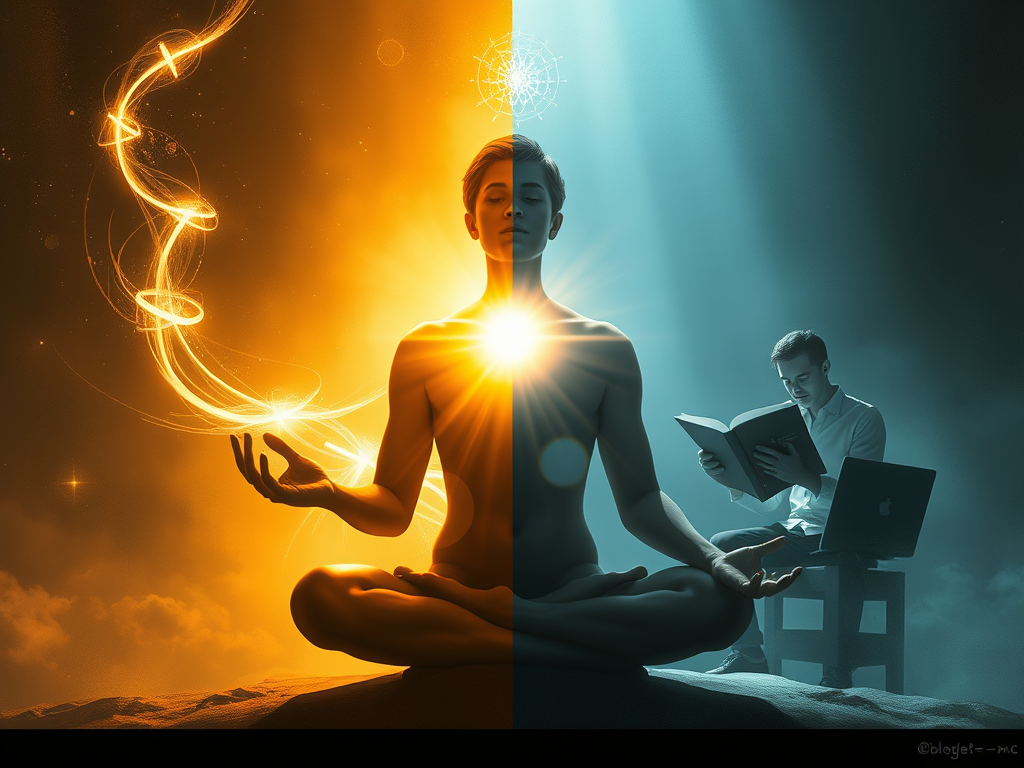
The distinction between “The Knowing” and “Beliefs” hinges on their nature, origin, and how they shape our understanding of reality. Here’s an expanded exploration:
“The Knowing“
- Definition: “The Knowing” refers to a deep, intuitive, or experiential certainty that transcends intellectual reasoning or external validation. It’s often described as an inner conviction or direct awareness of truth, felt as self-evident without requiring proof or justification.
- Characteristics:
- Source: Arises from direct experience, intuition, or a sense of connection to a universal truth. It may feel innate or revealed through profound moments of insight, meditation, or spiritual awakening.
- Certainty: Feels absolute and unshakable, often bypassing the need for external evidence. It’s a visceral “I just know” sensation.
- Subjectivity: Highly personal, often inexpressible, and may not align with consensus reality or empirical data.
- Examples: A mystic’s sense of oneness with the universe, a parent’s instinctive understanding of their child’s needs, or an artist’s clarity about a creative vision.
- Stability: Tends to remain consistent over time because it’s rooted in a felt truth rather than external variables.
- Philosophical Context: Aligns with concepts like gnosis (intuitive spiritual knowledge) in mysticism or phenomenology’s focus on lived experience. It’s less about rational deduction and more about an embodied sense of truth.
- Limitations: Can be difficult to communicate or verify objectively. May lead to dogmatism if one assumes their “Knowing” is universally true without questioning.
“Beliefs“
- Definition: Beliefs are mental constructs or propositions accepted as true, often based on reasoning, evidence, culture, or authority. They are frameworks we use to interpret and navigate the world.
- Characteristics:
- Source: Formed through external influences (education, culture, religion, media) or internal processes (reasoning, analysis). They often rely on trust in sources like science, tradition, or personal logic.
- Certainty: Varies widely, from tentative to dogmatic. Beliefs can be questioned, revised, or abandoned when new evidence or arguments arise.
- Objectivity: More communicable and often shared within groups or systems (e.g., religious doctrines, scientific theories). They can be debated or tested.
- Examples: Believing the Earth orbits the Sun based on scientific evidence, holding a religious belief in an afterlife, or trusting that hard work leads to success.
- Stability: Susceptible to change based on new information, experiences, or shifts in perspective. Beliefs can evolve or conflict with one another.
- Philosophical Context: Rooted in epistemology, the study of knowledge and justified belief. Beliefs are often analyzed through frameworks like rationalism (reason-based) or empiricism (evidence-based).
- Limitations: Can be rigid, leading to bias or resistance to new perspectives. May lack the depth or immediacy of “The Knowing,” feeling more like intellectual assent than lived truth.
Key Differences
- Origin:
- The Knowing: Internal, intuitive, often spontaneous or experiential.
- Beliefs: External or reasoned, shaped by environment, evidence, or authority.
- Certainty:
- The Knowing: Feels absolute, as if the truth is self-evident.
- Beliefs: Subject to doubt, revision, or reinforcement based on evidence or argument.
- Expression:
- The Knowing: Often ineffable, hard to articulate, and deeply personal.
- Beliefs: More easily expressed, shared, and debated within a community or framework.
- Validation:
- The Knowing: Doesn’t require external validation; it’s self-authenticating.
- Beliefs: Often rely on evidence, logic, or social consensus for validation.
- Role in Life:
- The Knowing: Guides through a sense of inner alignment or purpose, often in spiritual or existential contexts.
- Beliefs: Provide structure for decision-making, social cohesion, and understanding the world.
Interplay and Tension
- Complementary: The Knowing and Beliefs can coexist. For example, a scientist may have a belief in the scientific method (based on evidence) and a Knowing about the beauty of the cosmos (from personal awe). Beliefs can provide a framework for interpreting the Knowing.
- Conflict: Tension arises when The Knowing contradicts Beliefs. For instance, someone’s intuitive Knowing that “everything happens for a reason” might clash with a belief in random chance supported by scientific reasoning. This can lead to cognitive dissonance or a reevaluation of either the Knowing or the Belief.
- Evolution: Beliefs can evolve into The Knowing through deep internalization. For example, someone might initially believe in compassion as a moral principle (learned from upbringing) but, through repeated acts of empathy, come to Know it as a fundamental truth of existence.
Practical Implications
- Decision-Making: The Knowing often guides in moments of uncertainty when Beliefs lack clear answers, like trusting a “gut feeling” in a complex situation. Beliefs, meanwhile, help navigate structured systems (e.g., legal, scientific, or social frameworks).
- Personal Growth: Questioning Beliefs can lead to a deeper Knowing, as one strips away inherited assumptions to uncover authentic truths. Conversely, The Knowing can inspire new Beliefs that align with one’s inner convictions.
- Cultural Context: Societies often prioritize Beliefs (e.g., shared laws or scientific consensus) for cohesion, while The Knowing is celebrated in spiritual or artistic domains, where individual truth is valued.
Conclusion
“The Knowing” is an intuitive, deeply felt certainty that operates beyond the need for external validation, while Beliefs are constructed, evidence-based, or socially influenced frameworks for understanding reality. Both shape our worldview, but The Knowing is more visceral and personal, while Beliefs are more intellectual and communal. Their interplay can lead to profound growth or conflict, depending on how we navigate their differences. Reflecting on both can help balance inner truth with external reality, fostering a richer understanding of ourselves and the world.




Leave a Reply