
#ProsecuteThePoisoners #ToxinFreeHumanity
By Little Ms. Clarity | July 2, 2025, 10:38 AM CDT


The news hit X like a thunderclap:
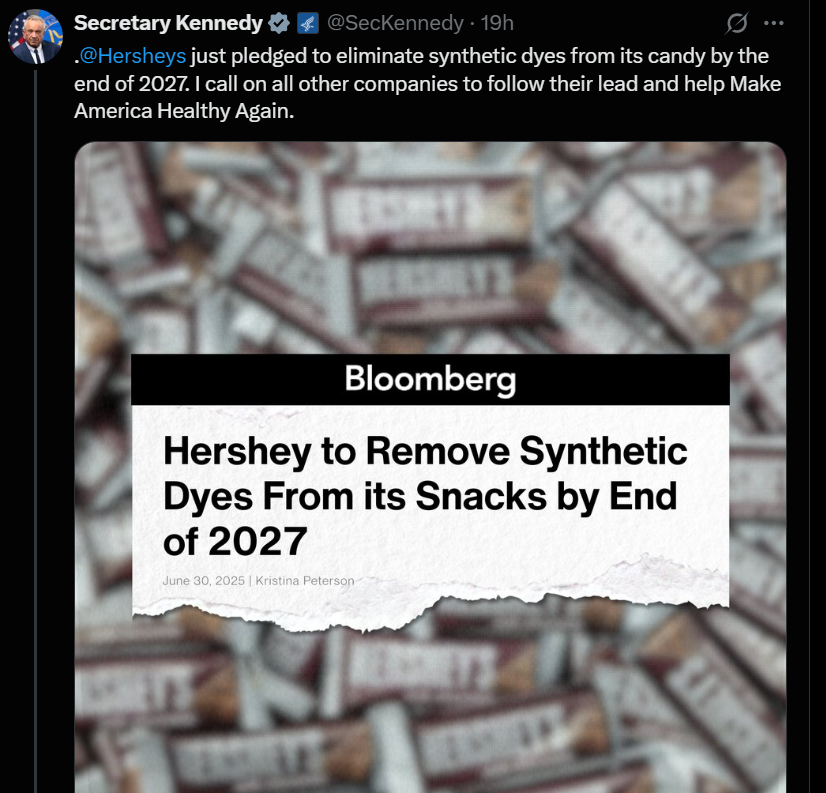
Hershey’s plans to ditch synthetic dyes from its snacks by the end of 2027, as announced by Secretary Kennedy (@SecKennedy) on July 1st. A Bloomberg headline plastered over a pile of cash promised a healthier future—yet the internet erupted with fury. “Why 2027?” demanded @HillbilyHeroe. “They could remove this poison today!” echoed @ShadowPoliticss. The hashtag #ProsecuteThePoisoners trended alongside #ToxinFreeHumanity, with calls for immediate cease-and-desist orders and corporate accountability. But here’s the real question: Why are these toxic chemicals allowed in our food in the first place—especially when they’re banned abroad? And why does the FDA seem to shield the culprits? Let’s dive deep into this scandalous mess.
The Poison in Your Candy Bowl
Synthetic dyes like FD&C Red No. 40, Yellow No. 5, and Blue No. 1—petroleum-based additives that make our snacks pop with color—are under fire. Studies link them to hyperactivity in kids, potential cancer risks, and allergic reactions. Yet, they’re staples in U.S. processed foods, while the European Union, Canada, and Japan have banned them. Take potassium bromate, a flour improver outlawed in the EU since 1990 due to its link to thyroid tumors—it’s still whitening your bread rolls here. Titanium dioxide, banned in Europe since 2022 for possible DNA damage, colors your chewing gum. Why? The FDA says they’re safe under a “reasonable certainty of no harm” standard, but that assurance feels flimsy when other nations say, “Not on our watch.”
How Did This Happen?
The roots trace back to the 1958 Food Additives Amendment, when synthetic dyes got the green light based on outdated science. The FDA’s Generally Recognized as Safe (GRAS) system lets companies self-approve additives without mandatory review—leaving 99% of chemicals untested before hitting shelves. Critics, like NYU’s Jennifer Pomeranz, call it a legal loophole, accusing the FDA of a hands-off approach that prioritizes industry over health. With billions at stake, food giants lobby hard, arguing dyes are cheap and essential for consumer appeal. Meanwhile, Hershey’s can sell dye-free candy in Europe but keeps the U.S. version laced—proof they could switch now, not in 2027.
The FDA’s Shield: Protection or Incompetence?
The FDA insists it’s safeguarding us, pointing to recent moves like phasing out six dyes by 2026 and fast-tracking natural alternatives like butterfly pea flower extract. But why the snail’s pace? The agency claims it needs time to gather data and avoid disrupting food supply chains—a defense that smells like industry influence to many. X users like @snooze06155136 raged, “Let us just poison the people for two more years?” The GRAS system’s opacity fuels distrust, with companies funding their own safety studies. States like California are stepping in—banning potassium bromate locally—exposing the FDA’s gaps. Is this protection, or a cozy deal with Big Food?
Should We Prosecute the Poisoners?
The #ProsecuteThePoisoners movement demands jail time for companies knowingly peddling harmful chemicals. If Hershey’s and others produce safe versions abroad, isn’t continuing U.S. use reckless endangerment? Advocates point to tobacco lawsuits, where intent to mislead led to liability. Public harm from decades of exposure could justify criminal charges—or at least recalls and immediate bans. But the industry counters: they’re following FDA rules, not breaking laws. Proving intent is a steep hill, and economic fallout (job losses, higher costs) looms large. Legally, civil suits might stick, but criminal prosecution needs new laws—something #ToxinFreeHumanity is pushing for.
Voices from All Sides
- Consumers: “Leave the poison on the shelf!” (@judy94509030) cries, urging boycotts to hit profit margins. They demand instant action, citing personal health woes like ADHD linked to dyes.
- Industry: Hershey’s and peers argue the 2027 timeline reflects a good-faith transition, not delay. Reformulating globally is complex, they say, and dyes are safe per current regs.
- FDA: They tout progress—collaborating with NIH, issuing guidance—but admit regulatory processes take time, balancing health and economics.
- Global View: The EU sees U.S. tolerance as backward, pressuring dual standards. Japan’s stricter tests set a gold standard we ignore.
- Experts: Scientists suggest transparency in GRAS decisions and phased bans, cautioning against chaos from rushed moves.
A History of Compromise
This isn’t new. Dyes debuted in the 1900s, approved with limited data. As ultra-processed foods boomed, additives became profit drivers. Global trade forced companies into dual formulations—safe for Europe, toxic for us—raising ethical red flags. Public awareness, fueled by X and documentaries, is finally cracking the facade.
What’s Next?
An immediate cease-and-desist order sounds noble but faces legal and logistical hurdles—industry would sue, and supply chains could buckle. Legislative reform—ending GRAS loopholes, aligning with global standards—offers a fix, though lobbyists will fight. Boycotts could force hands, but only with mass buy-in. The FDA’s 2025 dye phase-out is a start, but it’s too little, too late for many.
Time to Act
Hershey’s pledge is a crack in the armor, but 2027 is too far off when safer options exist now. The FDA’s delays and industry’s excuses can’t hide the truth: our food is poisoned while other nations protect their people. Join the #ToxinFreeHumanity fight—demand recalls, push for laws, and hold the poisoners accountable. Should we prosecute? Maybe. But first, let’s stop the bleeding. What do you think—time to storm the candy aisle?
Little Ms. Clarity will keep digging. Stay tuned.
DEEP DIVE SOURCES FOR THIS ARTICLE: GROK
The Issue: Synthetic Dyes and Harmful Chemicals in Food
The announcement that Hershey’s plans to remove synthetic dyes from its snacks by the end of 2027, as highlighted in the Bloomberg article and the X post by @SecKennedy, has sparked a broader conversation about the presence of potentially harmful substances in the U.S. food supply. Synthetic dyes—such as FD&C Red No. 40, Yellow No. 5, and Blue No. 1—are petroleum-based color additives used to enhance the visual appeal of processed foods. Other chemicals, like potassium bromate (a flour improver) and various preservatives, have also been flagged as problematic. While these substances are permitted in the U.S., many are banned or restricted in countries like the European Union, Canada, Japan, and China due to health concerns, including links to hyperactivity in children, cancer, and other adverse effects.
Why Are These Substances Allowed in the U.S.?
- FDA Regulatory Framework:
- The U.S. Food and Drug Administration (FDA) oversees food additives under the Federal Food, Drug, and Cosmetic Act (FD&C Act). Additives are deemed safe if there is a “reasonable certainty of no harm” based on available scientific data.
- The Generally Recognized as Safe (GRAS) designation allows ingredients to be used without pre-market approval if experts consider them safe, based on public data. This process has been criticized for lacking transparency and rigorous ongoing review.
- Historical approvals of synthetic dyes (e.g., in the mid-20th century) were based on science from that era, and subsequent evidence of harm has not always triggered immediate bans.
- Industry Influence:
- The food industry, a multi-billion-dollar sector, has significant lobbying power. Companies argue that synthetic dyes are cost-effective and necessary for consumer appeal, influencing regulatory decisions.
- The GRAS self-determination process allows companies to declare substances safe without mandatory FDA review, raising concerns about conflicts of interest.
- Regulatory Lag and Global Disparities:
- The U.S. tends to adopt a more permissive stance compared to the precautionary principle used in the EU, where substances are banned unless proven safe. This leads to discrepancies—e.g., the EU bans Red No. 40 due to potential carcinogenic risks, while the FDA permits it with a warning label for Yellow No. 5 (which can cause allergic reactions).
- Differences in testing standards and the pace of regulatory updates contribute to the U.S. lagging behind nations that have banned these chemicals.
- Economic and Practical Considerations:
- Reformulating products takes time and money. Hershey’s two-year timeline (2025-2027) reflects the need to adjust supply chains, reformulate recipes, and test new natural alternatives, a process that multinational companies argue cannot be rushed.
- The U.S. market’s size and diversity mean that uniform changes across all products (e.g., those sold in Europe vs. the U.S.) are logistically complex.
Why Are They Banned Elsewhere?
- Precautionary Principle: The EU and other regions prioritize banning substances with potential risks (e.g., Red No. 40’s link to tumors in animal studies) even if conclusive human evidence is lacking.
- Stricter Testing: Countries like Japan require more extensive long-term studies, leading to bans on additives like potassium bromate, linked to thyroid and kidney tumors.
- Public Demand: European consumers and advocacy groups have pushed for cleaner food standards, influencing policy more effectively than in the U.S., where consumer awareness has only recently grown.
The Perception of FDA Protection
- Critics’ View: Many, including those using #ProsecuteThePoisoners, argue the FDA protects industry interests over public health. The agency’s slow response to emerging science (e.g., reviewing only 21 chemicals in 2025 despite thousands in use) and reliance on industry-funded studies fuel this perception.
- FDA’s Defense: The FDA maintains it acts on the best available evidence and balances public health with economic impacts. It has initiated phased removals (e.g., targeting six synthetic dyes by 2026) and fast-tracked natural alternatives, suggesting a shift toward reform.
- Legal Loopholes: The GRAS system and the burden on the FDA to prove harm (rather than on companies to prove safety) create a regulatory gap, as noted by experts like Jennifer Pomeranz from NYU. State-level bans (e.g., California’s on potassium bromate) highlight this void.
Should Companies Be Charged with a Crime?
The call for prosecuting food companies for knowingly including harmful chemicals raises complex legal and ethical questions.
Arguments for Prosecution
- Intent and Knowledge: If companies are aware of bans in other countries and emerging science (e.g., studies linking dyes to behavioral issues in children), continuing use could be seen as reckless endangerment or negligence, potentially warranting criminal charges.
- Public Harm: Advocates argue that long-term exposure to these chemicals constitutes a public health crisis, akin to environmental pollution cases where corporations have faced penalties.
- Precedent: Historical cases, like the tobacco industry’s lawsuits, suggest that proving intent to mislead about safety could lead to liability. The #ToxinFreeHumanity movement sees parallels, demanding immediate cease-and-desist orders and recalls.
Arguments Against Prosecution
- Regulatory Compliance: Companies operate within FDA-approved guidelines, suggesting they are not breaking laws but following them. Criminalizing this would require proving intent to harm, a high legal bar.
- Scientific Uncertainty: The FDA’s “reasonable certainty” standard means risks are not definitively proven, making it difficult to establish criminal liability without clear causation (e.g., specific illnesses tied to specific dyes).
- Economic Impact: Prosecuting companies could disrupt food supply chains, increase costs, and lead to job losses, a concern raised by industry defenders and some policymakers.
Legal Feasibility
- Current U.S. law does not treat food additive use as a criminal act unless fraud or intentional poisoning is proven. Civil lawsuits or class actions (e.g., for health damages) are more likely than criminal charges.
- An immediate cease-and-desist order would require new legislation or emergency FDA action, which could face legal challenges from industry groups citing due process and economic hardship.
Perspectives from All Sides
- Consumer Advocates and #ProsecuteThePoisoners:
- Demand immediate bans, recalls, and prosecutions, viewing the two-year timeline as evidence of corporate stalling. They argue that companies producing chemical-free versions for Europe (e.g., Hershey’s international lines) could do so in the U.S. now, accusing the FDA of complicity.
- Highlight personal stories of health issues (e.g., ADHD linked to dyes) to push for #ToxinFreeHumanity.
- Food Industry:
- Argue that synthetic dyes are safe under current regulations and essential for affordability and consumer preference. The 2027 deadline reflects a good-faith effort to transition, not delay.
- Emphasize the challenge of reformulating globally, noting that U.S. formulations differ due to market demands and regulatory differences.
- FDA and Regulators:
- Position themselves as protectors of public health within a complex system, pointing to recent actions (e.g., phasing out dyes by 2026) as progress. They argue that rushed bans could disrupt food safety oversight and require more data.
- Acknowledge global disparities but defend the U.S. system as evidence-based, not industry-captured.
- International Perspective:
- Countries like the EU see the U.S. approach as outdated, advocating for the precautionary principle. They view U.S. tolerance of banned chemicals as a trade barrier, pressuring global companies to maintain dual standards.
- Neutral Observers (Scientists, Policy Experts):
- Suggest a middle ground: accelerate research, mandate transparency in GRAS decisions, and phase out additives with credible risks (e.g., via the FDA’s 2025 initiatives). They caution against overreach that could destabilize food production.
Deep Dive: Historical Context and Systemic Issues
- Historical Use: Synthetic dyes were introduced in the early 20th century, with the FDA approving many after the 1958 Food Additives Amendment. Early safety data was limited, and some approvals (e.g., Red No. 2, later banned) were reversed only after decades.
- Industry Evolution: The rise of ultra-processed foods increased reliance on additives, aligning with profit motives rather than health priorities.
- Global Trade: Companies like Hershey’s adapt formulations for different markets, raising questions about why safer alternatives (used in Europe) aren’t universal. This dual-standard practice is legal but ethically contentious.
- Public Awareness: Movements like #ToxinFreeHumanity reflect growing distrust, fueled by social media and documentaries exposing food disparities.
Potential Solutions and Challenges
- Immediate Action: A cease-and-desist order would require emergency powers, likely facing legal and economic pushback. Recalls could strain supply chains but might force rapid reformulation.
- Legislative Reform: Strengthening the FDA’s authority, ending the GRAS loophole, and aligning with international standards could address root causes, though this faces industry resistance.
- Public Pressure: Boycotts (as suggested on X) could drive change, but effectiveness depends on widespread participation.
Conclusion
The presence of synthetic dyes and other banned chemicals in U.S. food reflects a regulatory system shaped by historical decisions, industry influence, and a different risk tolerance than other nations. While prosecution remains legally challenging, the outrage from consumers and advocates highlights a demand for accountability and a toxin-free future. The Hershey’s pledge is a step, but the two-year timeline and FDA’s gradual approach fuel calls for immediate action. Balancing health, economics, and legal realities requires a multifaceted solution—perhaps a reformed FDA, global alignment, and empowered consumers.




Leave a Reply