Vital Spirit Medica: “From Root to Crown: Healing Body, Mind & Spirit.”


#ProsecuteThePoisoners #ToxinFreeHumanity

By Little Ms. Clarity | July 2, 2025, 10:38 AM CDT

The news hit X like a thunderclap:

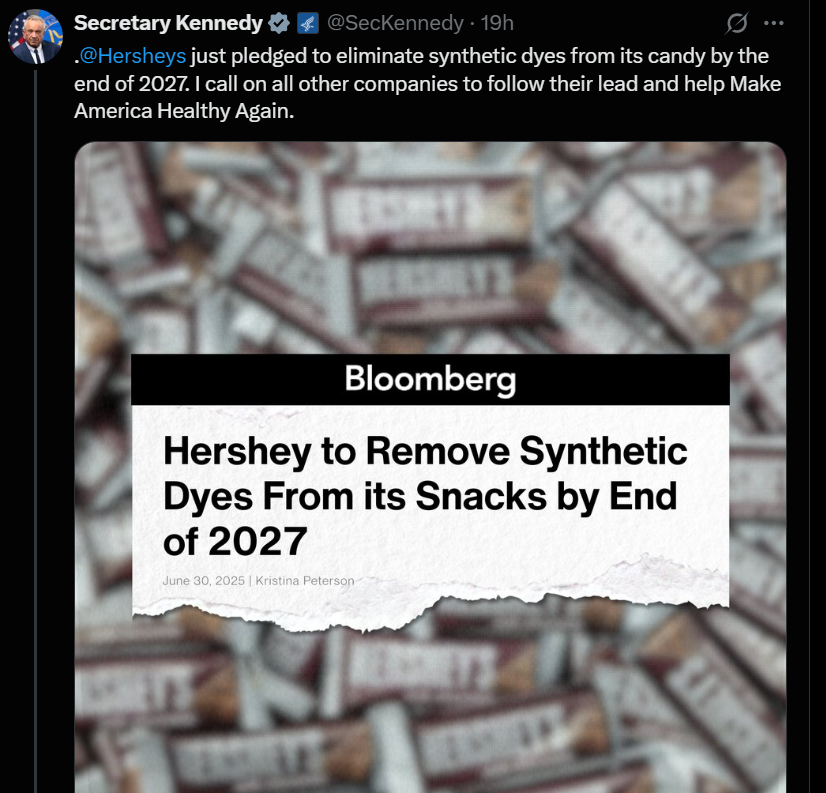
Hershey’s plans to ditch synthetic dyes from its snacks by the end of 2027, as announced by Secretary Kennedy (@SecKennedy) on July 1st. A Bloomberg headline plastered over a pile of cash promised a healthier future—yet the internet erupted with fury. “Why 2027?” demanded @HillbilyHeroe. “They could remove this poison today!” echoed @ShadowPoliticss. The hashtag #ProsecuteThePoisoners trended alongside #ToxinFreeHumanity, with calls for immediate cease-and-desist orders and corporate accountability. But here’s the real question: Why are these toxic chemicals allowed in our food in the first place—especially when they’re banned abroad? And why does the FDA seem to shield the culprits? Let’s dive deep into this scandalous mess.

The Poison in Your Candy Bowl

Synthetic dyes like FD&C Red No. 40, Yellow No. 5, and Blue No. 1—petroleum-based additives that make our snacks pop with color—are under fire. Studies link them to hyperactivity in kids, potential cancer risks, and allergic reactions. Yet, they’re staples in U.S. processed foods, while the European Union, Canada, and Japan have banned them. Take potassium bromate, a flour improver outlawed in the EU since 1990 due to its link to thyroid tumors—it’s still whitening your bread rolls here. Titanium dioxide, banned in Europe since 2022 for possible DNA damage, colors your chewing gum. Why? The FDA says they’re safe under a “reasonable certainty of no harm” standard, but that assurance feels flimsy when other nations say, “Not on our watch.”

How Did This Happen?

The roots trace back to the 1958 Food Additives Amendment, when synthetic dyes got the green light based on outdated science. The FDA’s Generally Recognized as Safe (GRAS) system lets companies self-approve additives without mandatory review—leaving 99% of chemicals untested before hitting shelves. Critics, like NYU’s Jennifer Pomeranz, call it a legal loophole, accusing the FDA of a hands-off approach that prioritizes industry over health. With billions at stake, food giants lobby hard, arguing dyes are cheap and essential for consumer appeal. Meanwhile, Hershey’s can sell dye-free candy in Europe but keeps the U.S. version laced—proof they could switch now, not in 2027.

The FDA’s Shield: Protection or Incompetence?

The FDA insists it’s safeguarding us, pointing to recent moves like phasing out six dyes by 2026 and fast-tracking natural alternatives like butterfly pea flower extract. But why the snail’s pace? The agency claims it needs time to gather data and avoid disrupting food supply chains—a defense that smells like industry influence to many. X users like @snooze06155136 raged, “Let us just poison the people for two more years?” The GRAS system’s opacity fuels distrust, with companies funding their own safety studies. States like California are stepping in—banning potassium bromate locally—exposing the FDA’s gaps. Is this protection, or a cozy deal with Big Food?

Should We Prosecute the Poisoners?

The #ProsecuteThePoisoners movement demands jail time for companies knowingly peddling harmful chemicals. If Hershey’s and others produce safe versions abroad, isn’t continuing U.S. use reckless endangerment? Advocates point to tobacco lawsuits, where intent to mislead led to liability. Public harm from decades of exposure could justify criminal charges—or at least recalls and immediate bans. But the industry counters: they’re following FDA rules, not breaking laws. Proving intent is a steep hill, and economic fallout (job losses, higher costs) looms large. Legally, civil suits might stick, but criminal prosecution needs new laws—something #ToxinFreeHumanity is pushing for.

Voices from All Sides

  • Consumers: “Leave the poison on the shelf!” (@judy94509030) cries, urging boycotts to hit profit margins. They demand instant action, citing personal health woes like ADHD linked to dyes.
  • Industry: Hershey’s and peers argue the 2027 timeline reflects a good-faith transition, not delay. Reformulating globally is complex, they say, and dyes are safe per current regs.
  • FDA: They tout progress—collaborating with NIH, issuing guidance—but admit regulatory processes take time, balancing health and economics.
  • Global View: The EU sees U.S. tolerance as backward, pressuring dual standards. Japan’s stricter tests set a gold standard we ignore.
  • Experts: Scientists suggest transparency in GRAS decisions and phased bans, cautioning against chaos from rushed moves.

A History of Compromise

This isn’t new. Dyes debuted in the 1900s, approved with limited data. As ultra-processed foods boomed, additives became profit drivers. Global trade forced companies into dual formulations—safe for Europe, toxic for us—raising ethical red flags. Public awareness, fueled by X and documentaries, is finally cracking the facade.

What’s Next?

An immediate cease-and-desist order sounds noble but faces legal and logistical hurdles—industry would sue, and supply chains could buckle. Legislative reform—ending GRAS loopholes, aligning with global standards—offers a fix, though lobbyists will fight. Boycotts could force hands, but only with mass buy-in. The FDA’s 2025 dye phase-out is a start, but it’s too little, too late for many.

Time to Act

Hershey’s pledge is a crack in the armor, but 2027 is too far off when safer options exist now. The FDA’s delays and industry’s excuses can’t hide the truth: our food is poisoned while other nations protect their people. Join the #ToxinFreeHumanity fight—demand recalls, push for laws, and hold the poisoners accountable. Should we prosecute? Maybe. But first, let’s stop the bleeding. What do you think—time to storm the candy aisle?

Little Ms. Clarity will keep digging. Stay tuned.

DEEP DIVE SOURCES FOR THIS ARTICLE: GROK

The Issue: Synthetic Dyes and Harmful Chemicals in Food

The announcement that Hershey’s plans to remove synthetic dyes from its snacks by the end of 2027, as highlighted in the Bloomberg article and the X post by @SecKennedy, has sparked a broader conversation about the presence of potentially harmful substances in the U.S. food supply. Synthetic dyes—such as FD&C Red No. 40, Yellow No. 5, and Blue No. 1—are petroleum-based color additives used to enhance the visual appeal of processed foods. Other chemicals, like potassium bromate (a flour improver) and various preservatives, have also been flagged as problematic. While these substances are permitted in the U.S., many are banned or restricted in countries like the European Union, Canada, Japan, and China due to health concerns, including links to hyperactivity in children, cancer, and other adverse effects.

Why Are These Substances Allowed in the U.S.?

  1. FDA Regulatory Framework:
  • The U.S. Food and Drug Administration (FDA) oversees food additives under the Federal Food, Drug, and Cosmetic Act (FD&C Act). Additives are deemed safe if there is a “reasonable certainty of no harm” based on available scientific data.
  • The Generally Recognized as Safe (GRAS) designation allows ingredients to be used without pre-market approval if experts consider them safe, based on public data. This process has been criticized for lacking transparency and rigorous ongoing review.
  • Historical approvals of synthetic dyes (e.g., in the mid-20th century) were based on science from that era, and subsequent evidence of harm has not always triggered immediate bans.
  1. Industry Influence:
  • The food industry, a multi-billion-dollar sector, has significant lobbying power. Companies argue that synthetic dyes are cost-effective and necessary for consumer appeal, influencing regulatory decisions.
  • The GRAS self-determination process allows companies to declare substances safe without mandatory FDA review, raising concerns about conflicts of interest.
  1. Regulatory Lag and Global Disparities:
  • The U.S. tends to adopt a more permissive stance compared to the precautionary principle used in the EU, where substances are banned unless proven safe. This leads to discrepancies—e.g., the EU bans Red No. 40 due to potential carcinogenic risks, while the FDA permits it with a warning label for Yellow No. 5 (which can cause allergic reactions).
  • Differences in testing standards and the pace of regulatory updates contribute to the U.S. lagging behind nations that have banned these chemicals.
  1. Economic and Practical Considerations:
  • Reformulating products takes time and money. Hershey’s two-year timeline (2025-2027) reflects the need to adjust supply chains, reformulate recipes, and test new natural alternatives, a process that multinational companies argue cannot be rushed.
  • The U.S. market’s size and diversity mean that uniform changes across all products (e.g., those sold in Europe vs. the U.S.) are logistically complex.

Why Are They Banned Elsewhere?

  • Precautionary Principle: The EU and other regions prioritize banning substances with potential risks (e.g., Red No. 40’s link to tumors in animal studies) even if conclusive human evidence is lacking.
  • Stricter Testing: Countries like Japan require more extensive long-term studies, leading to bans on additives like potassium bromate, linked to thyroid and kidney tumors.
  • Public Demand: European consumers and advocacy groups have pushed for cleaner food standards, influencing policy more effectively than in the U.S., where consumer awareness has only recently grown.

The Perception of FDA Protection

  • Critics’ View: Many, including those using #ProsecuteThePoisoners, argue the FDA protects industry interests over public health. The agency’s slow response to emerging science (e.g., reviewing only 21 chemicals in 2025 despite thousands in use) and reliance on industry-funded studies fuel this perception.
  • FDA’s Defense: The FDA maintains it acts on the best available evidence and balances public health with economic impacts. It has initiated phased removals (e.g., targeting six synthetic dyes by 2026) and fast-tracked natural alternatives, suggesting a shift toward reform.
  • Legal Loopholes: The GRAS system and the burden on the FDA to prove harm (rather than on companies to prove safety) create a regulatory gap, as noted by experts like Jennifer Pomeranz from NYU. State-level bans (e.g., California’s on potassium bromate) highlight this void.

Should Companies Be Charged with a Crime?

The call for prosecuting food companies for knowingly including harmful chemicals raises complex legal and ethical questions.

Arguments for Prosecution

  • Intent and Knowledge: If companies are aware of bans in other countries and emerging science (e.g., studies linking dyes to behavioral issues in children), continuing use could be seen as reckless endangerment or negligence, potentially warranting criminal charges.
  • Public Harm: Advocates argue that long-term exposure to these chemicals constitutes a public health crisis, akin to environmental pollution cases where corporations have faced penalties.
  • Precedent: Historical cases, like the tobacco industry’s lawsuits, suggest that proving intent to mislead about safety could lead to liability. The #ToxinFreeHumanity movement sees parallels, demanding immediate cease-and-desist orders and recalls.

Arguments Against Prosecution

  • Regulatory Compliance: Companies operate within FDA-approved guidelines, suggesting they are not breaking laws but following them. Criminalizing this would require proving intent to harm, a high legal bar.
  • Scientific Uncertainty: The FDA’s “reasonable certainty” standard means risks are not definitively proven, making it difficult to establish criminal liability without clear causation (e.g., specific illnesses tied to specific dyes).
  • Economic Impact: Prosecuting companies could disrupt food supply chains, increase costs, and lead to job losses, a concern raised by industry defenders and some policymakers.
  • Current U.S. law does not treat food additive use as a criminal act unless fraud or intentional poisoning is proven. Civil lawsuits or class actions (e.g., for health damages) are more likely than criminal charges.
  • An immediate cease-and-desist order would require new legislation or emergency FDA action, which could face legal challenges from industry groups citing due process and economic hardship.

Perspectives from All Sides

  1. Consumer Advocates and #ProsecuteThePoisoners:
  • Demand immediate bans, recalls, and prosecutions, viewing the two-year timeline as evidence of corporate stalling. They argue that companies producing chemical-free versions for Europe (e.g., Hershey’s international lines) could do so in the U.S. now, accusing the FDA of complicity.
  • Highlight personal stories of health issues (e.g., ADHD linked to dyes) to push for #ToxinFreeHumanity.
  1. Food Industry:
  • Argue that synthetic dyes are safe under current regulations and essential for affordability and consumer preference. The 2027 deadline reflects a good-faith effort to transition, not delay.
  • Emphasize the challenge of reformulating globally, noting that U.S. formulations differ due to market demands and regulatory differences.
  1. FDA and Regulators:
  • Position themselves as protectors of public health within a complex system, pointing to recent actions (e.g., phasing out dyes by 2026) as progress. They argue that rushed bans could disrupt food safety oversight and require more data.
  • Acknowledge global disparities but defend the U.S. system as evidence-based, not industry-captured.
  1. International Perspective:
  • Countries like the EU see the U.S. approach as outdated, advocating for the precautionary principle. They view U.S. tolerance of banned chemicals as a trade barrier, pressuring global companies to maintain dual standards.
  1. Neutral Observers (Scientists, Policy Experts):
  • Suggest a middle ground: accelerate research, mandate transparency in GRAS decisions, and phase out additives with credible risks (e.g., via the FDA’s 2025 initiatives). They caution against overreach that could destabilize food production.

Deep Dive: Historical Context and Systemic Issues

  • Historical Use: Synthetic dyes were introduced in the early 20th century, with the FDA approving many after the 1958 Food Additives Amendment. Early safety data was limited, and some approvals (e.g., Red No. 2, later banned) were reversed only after decades.
  • Industry Evolution: The rise of ultra-processed foods increased reliance on additives, aligning with profit motives rather than health priorities.
  • Global Trade: Companies like Hershey’s adapt formulations for different markets, raising questions about why safer alternatives (used in Europe) aren’t universal. This dual-standard practice is legal but ethically contentious.
  • Public Awareness: Movements like #ToxinFreeHumanity reflect growing distrust, fueled by social media and documentaries exposing food disparities.

Potential Solutions and Challenges

  • Immediate Action: A cease-and-desist order would require emergency powers, likely facing legal and economic pushback. Recalls could strain supply chains but might force rapid reformulation.
  • Legislative Reform: Strengthening the FDA’s authority, ending the GRAS loophole, and aligning with international standards could address root causes, though this faces industry resistance.
  • Public Pressure: Boycotts (as suggested on X) could drive change, but effectiveness depends on widespread participation.

Conclusion

The presence of synthetic dyes and other banned chemicals in U.S. food reflects a regulatory system shaped by historical decisions, industry influence, and a different risk tolerance than other nations. While prosecution remains legally challenging, the outrage from consumers and advocates highlights a demand for accountability and a toxin-free future. The Hershey’s pledge is a step, but the two-year timeline and FDA’s gradual approach fuel calls for immediate action. Balancing health, economics, and legal realities requires a multifaceted solution—perhaps a reformed FDA, global alignment, and empowered consumers.

By Little Ms. Clarity | July 2, 2025, 10:38 AM CDT


Discover more from Vital Spirit Medica: “From Root to Crown: Healing Body, Mind & Spirit.”

Subscribe to get the latest posts sent to your email.


📚Coming Soon…Subscriber PDF Download Links for Your Favorite Herbal Monographs! Click on this link to see a sample.🖨️


Subscribe by December 2026 and receive free subscriber-only content forever!


✨IF YOU ARE INTERESTED IN SHARING YOUR WILDCRAFTING, GARDENING, PLANT FINDS, OR YOUR WELLNESS JOURNEY WITH US…
EMAIL YOUR STORIES, IMAGES, AND VIDEOS TO✨
vitalspiritmedica@gmail.com


If You Made It This Far, Thank You For Visiting!


Leave a Reply

Your email address will not be published. Required fields are marked *


← Back

Thank you for your response. ✨

Rate your experience(required)


🌿Juniper (Juniperus communis)

Juniper is the smoking bush and the holy berry: Sun and Fire in the folk tables, a door that makes malice stop and count needles. Elijah and the Holy Family entered English lore under its name; Leonardo haloed Ginevra with ginepro. Tibet burns sister junipers as food for gods; a Crow pipe-carrier may stand on living Juniper so earth does not touch bare feet. In Fennoscandia a single bush has kept rings for more than…

READ MORE

🌿Jasmine (Jasminum officinale)

Jasmine is a twining olive-family climber native from the Caucasus to the Himalaya and south-central China. Its pinnate leaves and white, dusk-opening stars release an intense nocturnal perfume that has defined gardens, temples, and perfume stills for centuries. Hardy in temperate zones with support and drainage, it is grown worldwide for fragrance, tea-scenting, and traditional medicine.

READ MORE

🌿Hyssop (Hyssopus officinalis)

Hyssop (Hyssopus officinalis) is the classic herb of purification and spiritual clarity. Associated with Jupiter and the element of Fire, it has been employed for millennia to wash away guilt, crossed conditions, and energetic residue—most famously in the words of Psalm 51. In baths, aspersions, floor washes, and sacred space work, Hyssop restores integrity and opens the way for cleaner prayer, clearer intuition, and renewed vitality.

READ MORE

🌿Holly (Ilex aquifolium)

Holly (Ilex aquifolium) is the classic European holly: an evergreen tree of glossy spines and scarlet berries that has symbolized protection, eternal life, and winter strength across cultures for centuries. Sacred to the Holly King, used in Yule and Christmas traditions, and valued for its guardian energy, it remains a powerful plant of resilience and open-hearted courage.

READ MORE

🌿Hemp (Cannabis Sativa)

Hemp (Cannabis Sativa) is one of humanity’s oldest cultivated plants, valued for over 12,000 years as a source of durable fiber, nutritious seed, and healing resin. From Scythian purification rites and Chinese shamanic medicine to modern phytoremediation and cannabinoid therapeutics, Hemp bridges the practical and the sacred. Its deep roots cleanse contaminated soils, its stalks clothe and build, its seeds nourish, and its subtle frequencies support emotional balance, vision, and spiritual insight—making it a true…

READ MORE

🌿Ginger (Zingiber officinale)

Ginger (Zingiber officinale) is the Horned Root of Mars and Fire—a masculine, solar catalyst that heats the blood, opens the solar plexus, and accelerates intention. Whether chewed before spellwork, planted for prosperity, or sipped as a purifying tea, this rhizome carries the frequency of movement, courage, and sacred heat. It is both a humble kitchen spice and a living ember of transformation that refuses to let life grow cold.

READ MORE

🌿Frankincense (Boswellia sacra)

Frankincense (Boswellia sacra) is a small, multi-stemmed tree of the arid limestone slopes and fog oases of southern Arabia and the Horn of Africa. Its fragrant oleo-gum resin, collected as hardened “tears,” has been prized for millennia as incense, medicine, and perfume. Rich in boswellic acids, the resin is traditionally used for inflammatory conditions, respiratory support, and wound care, while its essential oil and smoke continue to serve ceremonial, aromatic, and contemplative purposes worldwide.

READ MORE

🌿Elder (Sambucus nigra)

Elder is the threshold guardian of the hedgerow—its creamy flower lace and dark berries bridging the worlds of body, spirit, and season. Revered across Europe for centuries as both medicine and protective ally, Elder cools fever, supports the immune system, and offers quiet strength at life’s transitions. From traditional cordials and flower infusions to the living presence of the Elder Mother in folklore, this adaptable shrub continues to nourish, protect, and invite reciprocity between humans…

READ MORE

🌿Elecampane (Inula helenium L.)

Elecampane (Inula Helenium L.) is a robust temperate perennial valued for its high inulin content and bioactive sesquiterpene lactones (alantolactone and isoalantolactone). Traditionally used for respiratory and digestive support, it continues to attract scientific interest for antimicrobial, anti-inflammatory, and prebiotic properties while serving as a pollinator-friendly ornamental and potential biomass crop in sustainable cultivation systems: Elecampane also known as Elfwort in Celtic lore, is a solar-mercurial plant of breath and belonging. Rising from the legendary…

READ MORE

🌿Purple coneflower (Echinacea purpurea)

Purple coneflower (Echinacea purpurea) rises from the open prairie as a plant of upright power and protective vitality. Its deep roots and hedgehog-like cone embody resilience, while its traditional use in medicine pouches, Sun Dance ceremonies, and healing rites speaks of a sacred alliance between human and plant. Today it continues to offer immune support, energetic fortification, and ecological service as a keystone pollinator plant—inviting the seeker to reclaim strength without hardness and protection without…

READ MORE

🌿Datura (Datura stramonium)

Datura (Datura stramonium), the night-blooming thorn apple, stands as one of the most potent and paradoxical plants in the herbal world. With its trumpet-shaped white-to-violet flowers that open at dusk and its spiny seed capsules, Datura has long been revered across cultures as a sacred visionary teacher, traditional respiratory medicine, and powerful threshold ally. Its tropane alkaloids offer both profound spiritual insight and serious physical caution, making respectful relationship essential. From ancient shamanic initiations and…

READ MORE

🌿Dandelion (Taraxacum officinale):

Spiritually, Dandelion (Taraxacum officinale) is a living emblem of resilience and sacred transformation. It teaches us to root deeply even in harsh conditions, to open fully to the light, and then to release our dreams upon the wind without clinging. Associated with solar energy, the solar plexus, and the courage to be fully oneself, dandelion invites purification of body and soul, the clearing of stagnation, and the quiet power of persistence. Its message is simple…

READ MORE

🌿Chamomile (Matricaria chamomilla)

Chamomile (Matricaria chamomilla), the gentle “earth-apple” of the fields, is an annual aromatic herb of the Asteraceae family long cherished across cultures for its calming, anti-inflammatory, and digestive virtues. From ancient Egyptian offerings to the sun god Ra and its place among the Anglo-Saxon Nine Sacred Herbs to modern clinical use for anxiety, sleep, and skin comfort, Chamomile remains one of the world’s most trusted and widely cultivated medicinal plants. In the quiet radiance of…

READ MORE

🌿Cleavers (Galium aparine)

U.S. consumer pages usually flatten Cleavers (Galium aparine) into three talking points: “lymphatic cleanser,” “spring detox tea,” and “sticky weed that heals glands.” That is not invented—BHP, Physiomedicalists, and Fox’s gland ointment said versions of the same thing—but it is a small slice. Those pages rarely mention that Ph. Eur. and HMPC are silent; that Commission E never approved it; that the French book that does name it is a homoeopathic monograph with a caffeic-acid…

READ MORE

🌿Burdock (Arctium lappa)

Burdock (Arctium lappa) is a biennial herb whose first-year root is used as both a nutritious vegetable (gobo) and a traditional herbal remedy. Rich in inulin, lignans (arctiin and arctigenin), and polyphenols, it is employed for skin conditions, mild urinary complaints, and as a general alterative. Clinical interest continues in areas such as metabolic support and adjunctive care, while its ecological roles include soil improvement and late-season pollinator forage. Sustainable wildcrafting and cultivation focus on…

READ MORE

🌿AVENS (Geum urbanum)

From woodland edge to urban margin, Avens (Geum urbanum) rises with wiry stems, yellow five-petaled flowers, and a root that breathes of cloves. Traditional European practice prized it as an astringent digestive, febrifuge, and blessed guardian; modern phytochemistry confirms its ellagitannins and eugenol underpin antimicrobial and antioxidant actions. Ruled by Jupiter and fire in folk magic, Avens still stands as a quiet threshold plant—medicinal, protective, and symbolically ordered—inviting both practical use and contemplative respect.

READ MORE

🌿Ash (Fraxinus excelsior and Fraxinus americana)

U.S. consumer pages usually flatten ash into three talking points: “emerald ash borer is killing our trees,” “white ash makes baseball bats,” and, on herbal sites, “ash leaf tea for arthritis and water retention.” That is not false, but it is a small slice and it often names the wrong species. Those pages rarely mention that the official European drug is *Fraxinus excelsior* or *F. angustifolia* leaf in Ph. Eur. 1600, not *F. americana*; that…

READ MORE

🌿Asafoetida (Ferula assa-foetida)

Asafoetida: From Ancient Spice to Contemporary Medicine “AT A GLANCE” Asafoetida is the pungent oleo-gum-resin obtained from the roots of Ferula assa-foetida, a perennial plant native to the arid mountains of Iran and Afghanistan. Known as “devil’s dung” for its strong sulfurous odor and “food of the gods” for its valued flavor and healing properties, it has been used for centuries as a digestive, antispasmodic, and protective remedy in Ayurvedic, Unani, Persian, and European traditions,…

READ MORE

Arabic Gum (Acacia senegal / Senegalia senegal)

Arabic Gum: Nature’s Healing & Cultural Treasure “AT A GLANCE” Harvested from the thorny branches of Acacia Senegal, Arabic Gum is a time-honored demulcent, prebiotic, and gentle astringent. Traditional healers across Africa and the Near East have long used its soft, water-soluble tears to calm inflamed tissues, support digestion and kidney function, and form a protective film over wounds—qualities now echoed in contemporary clinical observations of metabolic and gut health. Known in antiquity as the…

READ MORE

Strawberry Tree (Arbutus unedo)

Explore the Traditional and Modern Applications of Strawberry Tree “AT A GLANCE” Strawberry Tree (Arbutus unedo) thrives on rocky, well-drained soils from the Mediterranean Basin to southwestern Ireland, resprouting vigorously after fire through lignotubers and supporting late-season pollinators. Its leaves yield traditional astringent remedies, its fruits become jams and the renowned Portuguese medronho spirit, and its ornamental beauty and hardiness make it valued in sustainable landscaping and agroforestry. A multipurpose species of quiet strength and…

READ MORE

🌿Apricot (Prunus armeniaca)

U.S. consumer pages usually flatten Apricot (Prunus armeniaca) into two opposite talking points: “a vitamin A dried snack” and, on another corner of the internet, “apricot seeds fight cancer.” Neither picture is the official record. Those pages rarely mention that the same species is an official Chinese, Japanese, Korean and Taiwan seed drug with a 3.0% amygdalin assay; that Shennong Bencao already listed it as slightly toxic; that Chinese and European apricots were domesticated independently…

READ MORE

🌿Apple (Malus domestica)

U.S. consumer pages usually flatten Apple (Malus domestica) into three talking points: “an apple a day,” “fiber and vitamin C,” and “keep the peel on.” That is not false, but it is a small slice. Those pages rarely mention that the same species has official USDA, OECD, and Chinese composition monographs; that Shaanxi pingguo is an EU PDO with legal grade tables; that USP and ChP monograph apple-pomace pectin as a pharmaceutical excipient; that Geneva,…

READ MORE

🌿Anise (Pimpinella anisum)

U.S. consumer pages usually flatten Anise (Pimpinella anisum) into four talking points: “tastes like licorice,” “used in cookies and sausage,” “flavor of ouzo and absinthe,” and “don’t confuse it with poisonous Japanese star anise.” That is not false, but it is a small slice. Those pages rarely mention that the same species is an official Ph. Eur., BP, Commission E, ESCOP, WHO and Egyptian Drug Authority drug; that EMA wrote separate fruit and oil monographs…

READ MORE

Pulsatilla vulgaris: The Healing Pasqueflower

Pulsatilla vulgaris, the Pasqueflower, is a low-growing spring ephemeral with finely dissected silvery-hairy leaves and striking purple flowers that bloom around Easter. A Near Threatened indicator of high-quality chalk and limestone grasslands, it relies on grazing and disturbance to thrive. Its deep roots and wind-dispersed seeds support biodiversity and soil stability in nutrient-poor habitats, making it a flagship species for European grassland conservation.

READ MORE

Discover Andrographis: The King of Bitters

Andrographis paniculata, known as the King of Bitters or Kalmegh (“Dark Cloud”), is a bitter annual herb native to India and Sri Lanka, widely cultivated across tropical Asia. Renowned in Ayurveda, Traditional Chinese Medicine, and Siddha systems for its cooling, detoxifying, and immune-supporting properties, it is prized for clearing heat, supporting liver function, and addressing fevers, respiratory infections, and inflammation. Its primary bioactive, andrographolide, drives its potent antimicrobial and anti-inflammatory effects, making Andrographis paniculata a…

READ MORE

🌿Kava (Piper methysticum)

Pharmacology::

Kavalactones, the primary lipophilic α-pyrones in kava roots, enhance GABA-A receptor binding at sites distinct from benzodiazepines, increasing chloride influx and promoting inhibitory neurotransmission that underlies anxiolytic and sedative effects without heavy cognitive depression.

Key compounds such as kavain and dihydrokavain inhibit voltage-gated sodium and calcium channels, contributing to muscle relaxation, anticonvulsant activity, and local anesthetic properties through modulation of neuronal excitability.

Kavalactones demonstrate reversible inhibition of monoamine oxidase B (MAO-B) and reduced reuptake…

READ MORE

Sage (Salvia officinalis)

Sage (Salvia officinalis) is rich in rosmarinic acid, thujone, camphor, and 1,8-cineole, delivering clinically studied benefits for cognitive function, menopausal vasomotor symptoms, metabolic health, and oral hygiene. Its essential oil and standardized extracts demonstrate strong antioxidant, antimicrobial, and neuroprotective activity. Once called “Sage the Savior,” this Mediterranean herb remains a cornerstone of evidence-informed herbal practice and natural product development worldwide.

READ MORE

🌿Lavender (Lavandula angustifolia)

Lavender (Lavandula angustifolia) is the quiet breath of peace in the plant kingdom. With its narrow silver-green leaves and fragrant purple spikes, it carries the living spirit of purification, protection, and profound relaxation. From Egyptian mummification rites to Virgin Mary legends, Roman baths to modern clinical trials, Lavender (Lavandula angustifolia) has consistently served as a bridge between body, mind, and spirit. Its rich essential oil — dominated by linalool and linalyl acetate — gently calms…

READ MORE

Exploring the Healing Power of Peyote: Lophophora williamsii

Peyote (Lophophora williamsii) is best understood as a Spiritual-Entheogenic Teacher Plant with profound holistic applications. Its healing power is primarily ceremonial and consciousness-based rather than everyday herbal tonic-style medicine. The most transformative effects typically emerge within proper ritual or guided therapeutic contexts that honor its sacred nature.

READ MORE

Something went wrong. Please refresh the page and/or try again.

Translate »