
A Comprehensive Herbal Monograph:
👈Note on This Monograph:👇
Note on This Monograph: This extensive entry uses the full 8-part structure, offering a deep, interdisciplinary exploration of Burdock (Arctium lappa)— weaving together modern scientific evidence, traditional and ethnobotanical wisdom, practical cultivation and preparation guidance, and its living spiritual essence. Drawing from clinical studies, historical texts, indigenous knowledge, and esoteric traditions, it serves as a comprehensive resource for holistic understanding and respectful relationship with this powerful plant ally. Please work with trained professionals for therapeutic applications.
“Our Commitment to Transparent Research”
Unlike many herbal resources that offer generalized information with little or no backing, we provide direct links to every source we reference. This allows you to verify claims, explore topics in greater depth, and trust that what you’re reading is grounded in both modern science and time-honored tradition.
Section-specific Sources lists
Most monographs include dedicated “Sources:” sections at the end of major topics (e.g., Sources: Phytotherapy, Sources: Historical and Cultural Significance, Sources: Pharmacology). These contain direct, clickable links to the original material. We created this level of transparency so the research can serve you. Here are some ways readers use our sourced monographs: Anyone seeking truth — Verify claims for yourself instead of taking information at face value. Students & Researchers — Use the references for papers, assignments, or deeper study. Herbalists & Practitioners — Cite sources when educating clients or in professional materials. Curious Explorers — Follow the links to read original studies or historical texts yourself. Writers & Educators — Reference our monographs (with attribution), knowing the information is traceable.

“AT A GLANCE”
Burdock (Arctium lappa) is a biennial herb whose first-year root is used as both a nutritious vegetable (gobo) and a traditional herbal remedy. Rich in inulin, lignans (arctiin and arctigenin), and polyphenols, it is employed for skin conditions, mild urinary complaints, and as a general alterative. Clinical interest continues in areas such as metabolic support and adjunctive care, while its ecological roles include soil improvement and late-season pollinator forage. Sustainable wildcrafting and cultivation focus on first-year roots harvested in autumn. Deep-rooted and tenacious, Burdock rises from disturbed ground with broad green hands and purple late-summer crowns. Its burs travel on fur and fabric; its root stores the quiet strength of the subsoil. Called Beggar’s Buttons, Happy Major, and Bear’s Paw, it has protected households, purified blood, and fed bodies across continents for centuries. In the living pharmacy of the wayside, Burdock remains a steadfast teacher of cleansing, grounding, and resilient abundance.

Provides an overview of key points.
Synopsis
👈At A Glance: Burdock (Arctium lappa)👇
Scientific Name: Arctium lappa L.
Family: Asteraceae (Compositae)
Common Names: Greater burdock, great burdock, edible burdock, gobō (Japanese), niu bang / niúbàng (Chinese), beggar’s buttons, lappa, bardane (French), grande bardane, happy major, thorny burr.
Botanical Description
Arctium lappa is a robust biennial (sometimes described as perennial) herb native to temperate Eurasia, widely naturalized in North America, Australia, and elsewhere as a weed of high-nitrogen soils, waste places, roadsides, fields, and forest clearings (0–3500 m elevation).
It grows 1–3 m tall with a stout, erect, branched, furrowed stem that is often purplish and thinly cobwebby or floccose. The large basal leaves are cordate-ovate to deltoid, up to 50–80 × 20–70 cm, with long solid petioles (15–36 cm), coarsely dentate to subentire margins, green and sparsely hairy above, gray-tomentose or felted beneath. Cauline leaves are similar but smaller.
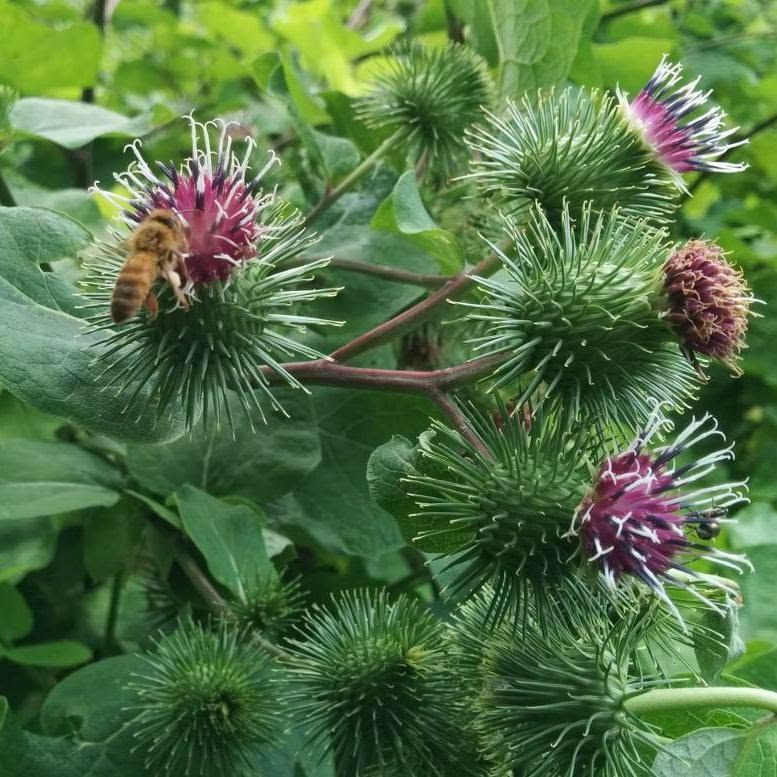
Flower heads (capitula) are 2.5–4.5 cm in diameter, arranged in corymbiform clusters on long peduncles (2.5–9 cm). Involucral bracts (phyllaries) are linear-lanceolate with hooked tips (the characteristic burs); florets are purple (rarely white), 9–14 mm. Achenes (cypselae) are light brown, often spotted, 5–7.5 mm, with a short pappus of bristles. Flowering occurs in summer to early autumn (July–October in the Northern Hemisphere). Chromosome numbers reported include 2n = 32, 34, 36.
Phytochemistry
Key bioactive metabolites include:
- Lignans (especially in fruits/seeds): arctiin, arctigenin, lappaols, matairesinoside.
- Phenolic acids / caffeoylquinic acid derivatives: chlorogenic acid, various di- and tri-caffeoylquinic acids, cynarin.
- Polysaccharides/fructans: inulin (high in roots, 20–45% or more), other fructooligosaccharides.
- Flavonoids: rutin, quercetin, isoquercetin, kaempferol derivatives.
- Others: phytosterols (β-sitosterol), terpenoids/sesquiterpene lactones (arctiopicrin), polyacetylenes, fatty acids, tannins, saponins, minerals (K, Ca, Mg, Fe).
Roots are rich in inulin and phenolics; leaves in tannins and flavonoids; fruits in lignans.
Western Traditional & Clinical Actions
Traditionally used as an alterative (“blood purifier”), diuretic, mild laxative, diaphoretic, and anti-inflammatory. Applied for skin conditions (eczema, psoriasis, acne, boils, ulcers), rheumatism, urinary tract support, and as a general detoxifying agent. EMA recognizes traditional use of the root for increasing urine output (adjuvant in minor urinary complaints) and for seborrheic skin conditions.
Chinese Medicine Actions
In TCM, the fruit (Arctii Fructus / niu bang zi) is pungent, bitter, and cold; it enters the Lung and Stomach meridians. Actions: disperses wind-heat, promotes eruption of rashes (e.g., measles), clears heat and toxicity, benefits the throat, and relieves sore throat/cough. Root is used similarly for detoxification and skin issues.
Traditional & Historical Uses
Used across Eurasia for centuries. In Europe (from medieval times, including Capitulare de villis of Charlemagne), for skin diseases, gout, rheumatism, and as a vegetable. In Japan and East Asia, the root (gobō) is a staple vegetable; seeds and roots used medicinally for colds, sore throat, and detoxification. Indigenous North American uses (post-introduction) included the use of poultices for headaches and rheumatism. Part of the Ojibwa-derived Essiac tea formula historically linked to cancer support and also used for diabetes, infections, and hair loss in various folk traditions.
Modern Pharmacological Evidence
Preclinical studies demonstrate antioxidant, anti-inflammatory (NF-κB, JAK/STAT, NLRP3 modulation), antidiabetic (AMPK activation, improved insulin sensitivity, α-glucosidase inhibition), hepatoprotective, anticancer (especially arctigenin/arctiin), antimicrobial, antiviral, gastroprotective, and immunomodulatory activities. Polysaccharides show antioxidant and immune-regulatory effects; lignans are key for anti-inflammatory and antitumor actions.
Clinical Studies
Human data are limited but growing. Trials and observational studies have examined effects on acne vulgaris, knee osteoarthritis (reduced inflammatory markers with tea), polycystic ovary syndrome (reduced oxidative stress, inflammation, and ovarian volume with root powder), hyperuricemia/gout (ongoing), type 2 diabetes parameters, and chronic inflammation/aging. Some TCM combination studies address respiratory infections. Evidence remains preliminary; larger RCTs are needed.
Preparations & Dosage
- Root infusion/decoction: 2–6 g comminuted root as tea, 3 times daily.
- Powdered root: 350 mg, 3–5 times daily (or up to ~1–18 g dried root/day traditionally).
- Liquid extract: 2–8 mL, 3 times daily.
- Tincture (25–45% ethanol): 8–12 mL, 3 times daily.
- Soft extract: 0.2–2 g daily.
Fruits/seeds: traditionally 4–12 g. Capsules and standardized extracts are common commercially. Always ensure adequate fluid intake with diuretic use.
Safety & Contraindications
Generally recognized as safe when used appropriately. Contraindicated in hypersensitivity to Asteraceae (risk of allergic reactions, rare anaphylaxis). Avoid in pregnancy (possible uterine stimulation) and lactation due to insufficient data; not recommended under 18 years. Caution with diabetes (may affect blood sugar) and concurrent diuretics. Possible interactions with anticoagulants or hypoglycemics theoretically. High-alcohol tinctures contraindicated in certain conditions. Contaminated wild roots have rarely been mistaken for toxic plants.
Cultivation & Harvest
Prefers deep, well-drained, humus-rich soil in full sun to partial shade. Sow seeds in spring or autumn (soak overnight for better germination); thin to 15–30 cm apart in rows 45–90 cm apart. Biennial: harvest first-year roots in autumn (or early second spring) when 60–80+ cm long and tender; second-year plants produce flowers/burs (remove to prevent spread). Young leaves and stalks are also edible. Mechanized harvesting is used commercially in Asia; yields can reach several tonnes per hectare.
Commercial Products
Widely available as dried root (cut/sifted or powdered), tea bags, capsules (often 500–1000 mg), tinctures/extracts, and as the fresh/processed vegetable (gobō) in Asian markets. Also in multi-herb detox formulas, root-beer-style drinks (historically with dandelion), oils for hair/skin, and some functional foods. Regulated as a traditional herbal medicinal product in the EU and as a dietary supplement elsewhere.
Ethnobotanical Curiosities
The hooked burs famously inspired the invention of Velcro after a Swiss engineer observed them sticking to his dog’s fur. In Japan, gobō is a cultural staple in kinpira and other dishes. Medieval European use as a vegetable rivaled parsnip; it appears in traditional British “dandelion and burdock” soft drink (since at least the 13th century). Linked to cancer remedies in various folk systems (including Essiac) and used by Hildegard of Bingen. The plant’s tenacity as a weed contrasts with its esteemed status as both food and medicine across continents.
Recent Research (2020–2025)
Focus areas include polysaccharide extraction/structure–activity relationships, lignan derivatives for anti-inflammatory and neuroprotective effects (including Alzheimer’s models via STAT3/NF-κB), antidiabetic mechanisms (AMPK/GLUT4), molecular networking for new caffeoylquinic acids, genome sequencing of cultivars, and clinical pilots for PCOS, hyperuricemia, and immune-mediated skin diseases. Reviews emphasize potential in metabolic disorders, skin health, and functional foods amid growing interest in sustainable plant bioactives.
Conservation Status
Not threatened. Predicted extinction risk: not threatened (high confidence). IUCN status: Least Concern in assessed regions (e.g., Switzerland); NatureServe Global Rank GNR (not ranked globally as of concern); widely distributed and often weedy/invasive outside its native range. Cultivation reduces pressure on wild populations.
DIY Recipes
Burdock Root Tea (simple infusion): Simmer 2–6 g dried sliced root in 250 mL water for 10–15 minutes (or steep overnight). Strain; drink 1–3 cups daily. Optional: combine with dandelion root for classic “dandelion & burdock.”
Basic Root Decoction for Skin Support: Same as above, or apply cooled tea as a compress.
Simple Tincture: Fill a jar ½ with chopped dried root, cover with 40–50% ethanol, steep 4–6 weeks in a dark place, shaking occasionally; strain. Dose 2–5 mL diluted in water, 2–3 times daily.
(Always consult a qualified practitioner before internal use; source clean, identified material.)
Planting & Harvesting Reference Guide
👈Planting & Harvesting Reference Guide:👇
Burdock (Arctium lappa) – Planting & Harvesting Reference Guide
- Best Time for Planting
- Direct-sow seeds in early spring (when soil is workable and frost risk has passed) or in autumn.
- Soak seeds overnight in water before sowing to improve germination.
- Prefer waxing Moon phases for strong establishment; some practitioners favor fertile water signs (Cancer or Pisces) or Venus/Jupiter hours.
- Ideal location: deep, well-drained, humus-rich, nitrogen-fertile soils in full sun to partial shade; thrives in disturbed ground, field edges, roadsides, or cultivated beds prepared to at least 60 cm depth to encourage long, straight taproots.
- Sow thinly in rows 45–90 cm apart; thin seedlings to 15–30 cm spacing.
- For medicinal/culinary roots, grow as an annual (harvest first-year plants). Select cultivars such as Takinogawa Long for longer, more uniform roots when available.
- Growing Conditions & Magical Minded Tips
- Provide consistent moisture, especially while roots are developing; mulch with organic matter to retain moisture and suppress weeds.
- Apply compost or moderate organic nitrogen in spring; avoid excess that promotes leafy growth at the expense of roots.
- Use crop rotation and manage self-seeding tendency to prevent unwanted spread while ensuring future plants.
- In biodynamic or magical practice: work on root days when possible; apply preparations such as 500 or 501 if following that system.
- Whisper thanks or speak to the plant as Grandmother Burdock when sowing or tending; offer a little water, a song, or a small token of gratitude to the land.
- Monitor for overcrowding; thin thoughtfully and leave some plants to flower and set seed for the next generation.
- Best Time for Harvesting
- Roots (primary medicinal and culinary part): Autumn of the first year (before flowering) or early spring of the second year, before the plant bolts. Prefer the waning Moon for purification and protective potency.
- Leaves: Anytime while vibrant, ideally early summer.
- Stems/young leaf stalks: Spring, when tender.
- Seeds/burs: Late summer to early autumn, when dry and clinging.
- Flowers: Mid- to late summer if using for essences or magical work.
- Sustainable & Magical Harvesting Methods
- Dig first-year roots carefully with a digging fork or by hand to avoid breakage; work the soil deeply and remove the entire taproot when possible.
- Harvest only what is needed; leave sufficient plants (especially second-year seeders) to ensure population continuity and seed set.
- In wildcrafting: choose nitrogen-rich disturbed sites; positively identify (solid petioles, large heart-shaped leaves with gray underside, hooked burs) and avoid look-alikes.
- Magical approach: ask permission, dig under dry conditions, express gratitude or intention aligned with purification and tenacity. Sing or whisper soft praises before and after. Prefer a wooden tool or bare hands when practical; if using a knife, thank the plant first.
- Take no more than is sustainable from any patch; never strip an area bare.
- Post-Harvest Processing
- Roots: Scrub or peel if desired, slice thinly, and dry in a well-ventilated shaded place (or at low heat) to prevent mold; they may become moldy if not dried promptly and thoroughly.
- Leaves and stems: Use fresh or dry flat in shade.
- Seeds: Shake from dry burs onto paper and finish drying.
- Store dried root in cool, dark, airtight containers (glass preferred) with clear intention for purification, protection, or nourishment. Some practitioners add a small stone or written charm.
- For culinary use: soak julienned fresh root briefly in water to reduce any residual bitterness before cooking.
This guide consolidates all planting and harvesting details mentioned across the SPARK sections for quick, practical reference. Always prioritize ethical, sustainable practices to honor the plant’s spirit and ensure its continued abundance.
Healing Categories
👈Burdock (Arctium lappa) most strongly belongs in the following healing categories, ranked by traditional prominence and breadth of use:👇
- Alterative / Depurative (Blood Purifier) — Classic category for plants that gradually cleanse and improve the quality of the blood and extracellular fluids.
- Dermatological / Skin Health — Primary traditional application for chronic and inflammatory skin conditions.
- Lymphatic Support / Lymphagogue — Encourages healthy lymphatic flow and clearance of metabolic waste.
- Urinary / Mild Diuretic — Promotes gentle increase in urine flow to support flushing of the urinary tract.
- Digestive & Prebiotic — Supports gut health through inulin-rich root and mild bitter stimulation.
- Hepatic / Liver Support — Traditional use as a gentle liver and gallbladder tonic.
- Nutritive Tonic — Mineral-rich root that nourishes while it cleanses.
- Protective & Grounding (Energetic/Spiritual) — Used in folk magic and energetic herbalism for protection, purification, and rooting.
Healing Categories
Alterative / Depurative (Blood Purifier)
Burdock is one of the classic Western and global alteratives. Its root is traditionally employed to “cleanse the blood,” supporting the gradual removal of metabolic wastes and improving overall tissue quality. This action underpins many of its historical uses for chronic conditions, especially those involving the skin and joints.
Dermatological / Skin Health
Perhaps the most consistent traditional indication across European, Chinese, and folk systems. Burdock root (internally) and leaves (externally) have long been used for eczema, psoriasis, acne, boils, seborrheic conditions, and other chronic or inflammatory skin complaints. Its anti-inflammatory, antioxidant, and depurative properties work synergistically in this category.
Lymphatic Support / Lymphagogue
Burdock is valued as a gentle lymphagogue that encourages healthy movement of lymph and supports the clearance of cellular debris. This action complements its alterative and skin-healing reputations and makes it useful in protocols addressing stagnation and low-grade inflammation.
Urinary / Mild Diuretic
Recognized in the European Medicines Agency Community herbal monograph as a traditional herbal medicinal product used to increase the amount of urine and achieve flushing of the urinary tract as an adjuvant in minor urinary complaints. The root’s diuretic effect is mild and supportive rather than forceful.
Digestive & Prebiotic
The root is notably high in inulin, a prebiotic fiber that nourishes beneficial gut flora. Combined with its mild bitter and cholagogue qualities, Burdock supports healthy digestion, appetite, and gut microbiome balance. Culinary use as gobō further reinforces its place in digestive wellness.
Hepatic / Liver Support
Traditionally regarded as a gentle liver and gallbladder tonic. By supporting hepatic function and bile flow, Burdock contributes to the body’s natural detoxification pathways and complements its broader alterative action.
Nutritive Tonic
Beyond its cleansing reputation, first-year Burdock root is mineral-rich and nourishing. It supplies potassium, iron, and other minerals while delivering prebiotic fiber, making it a dual-action tonic that strengthens while it purifies—especially useful in convalescence or states of depletion.
Protective & Grounding (Energetic / Spiritual)
In folk-magical and energetic herbalism, Burdock is employed for protection (root amulets, scattered leaves, burs above doorways), purification of space and aura, and deep grounding. Its Venusian–Jupiterian and Water–Earth correspondences support emotional stability, release of unhealthy attachments, and resilient rootedness.
These categories reflect Burdock’s enduring identity as a deep-acting, multi-system plant that cleanses, nourishes, protects, and restores balance from the root upward.
✦ If You Only Read U.S. Consumer Pages ✦
U.S. consumer pages usually flatten Burdock (Arctium lappa) into three talking points: “blood purifier,” “liver and skin detox,” and “dandelion-and-burdock soda’s cousin.” That is not invented—Eclectic Lappa, folk alterative use, and the British soft drink are real—but it is a small slice. Those pages rarely mention that the same species is an official fruit drug in the Chinese and Japanese Pharmacopoeias with an arctiin identity test; that EMA and ESCOP wrote traditional root monographs while Commission E withheld approval; that Japanese tables eat the root as gobō by the tonne; that Tabriz ran root-tea osteoarthritis trials; that EDQM is still arguing fruit markers for a possible European TCM quality standard; or that homeopathic Lappa is not the same article as DAC Bardanae radix. They also rarely distinguish A. lappa from A. minus and A. tomentosum, which European root monographs historically allowed as mixtures. Reading only U.S. retail copy makes the plant look like a muddy detox root in a capsule. Reading the global official and clinical record makes it look like a pharmacopoeial fruit in Beijing and Tokyo, a traditional root in Strasbourg, a negative monograph in 1990 Bonn, a chromosome-sequenced vegetable in Peixian and Dalian, and a small Iranian tea trial sitting next to a large plate of kinpira. Both pictures matter. The second one is the one most American seekers and shoppers never see.
Sources:
https://www.ema.europa.eu/documents/herbal-monograph/final-community-herbal-monograph-arctium-lappa-l-radix_en.pdf
https://www.mhlw.go.jp/content/11120000/001372350.pdf
https://www.herbalgram.org/resources/commission-e-monographs/monograph-unapproved-herbs/burdock-root
https://academic.oup.com/jpp/article/74/3/321/6382157
Globally: Where This Plant Is Studied
👈Global research, official texts, publishers, and human-trial data, rather than U.S.-consumer-page-limited:👇
Where This Plant Is Studied
Burdock (Arctium lappa) is studied as a living research plant across East Asia, Europe, West Asia, and South America—not as a U.S. “blood-cleanser” novelty. Greater burdock is a Eurasian Asteraceae biennial whose hooked burs hitchhike on wool and clothing; Kew maps it from Scandinavia and the Mediterranean through Russia and the Middle East to China, Korea and Japan, with later naturalization in North America. The plant is one body with two official lives. In Japan, Korea, Taiwan and parts of China, the first-year taproot is gobō / ueong / niúbàng—a cultivated vegetable of kinpira, soups and pickles. In Chinese, Japanese and Korean official medicine, the ripe fruit is Niubangzi / Gobōshi / Arctii Fructus, a wind-heat and throat drug. In Europe, the official drug is mostly the first-year root (Arctii radix / Bardanae radix), used as a traditional urinary and skin herb, while Britain still flavors the soft drink dandelion-and-burdock with the same root. The densest modern scientific output has come from China, Japan, Iran, Korea and Europe. Leading institutional clusters include Liaoning University of Traditional Chinese Medicine and China Medical University (first chromosome-level genomes), Jiangsu Normal University and Peixian / Xuzhou production science (endophytes, industry strategy, Peixian yellow cultivar genome), the Traditional Chinese Medicine Resource Center of CACMS, Tsumura and Japanese Pharmacopoeia crude-drug work on Arctii Fructus, Tabriz University of Medical Sciences (the best-known root-tea osteoarthritis trials), European HMPC and ESCOP assessors, and EDQM’s TCM expert group now drafting quality markers for Arctii fructus. Field research tracks Zhejiang “Du Dali” fruit, Northeast Chinese “Guan Dali,” Japanese cylindrical black-skinned root cultivars such as Liu Chuan Li Xiang, and European root supply from Bulgaria, Poland and Hungary. In short: the plant is a dual food-and-pharmacopoeia crop—root on the table in East Asia, fruit in the Kampo/TCM cabinet, root in the European traditional register—not a single-market detox capsule.
Sources:
https://link.springer.com/article/10.1186/s12870-025-07539-x
https://academic.oup.com/jpp/article/74/3/321/6382157
https://www.ema.europa.eu/en/medicines/herbal/arctii-radix
https://onlinelibrary.wiley.com/doi/10.1111/1755-0998.13547
Official Books That Name This Species
Burdock (Arctium lappa) is named, defined, and quality-tested in official national and regional pharmacopoeias—different organs in different books. These are legal or quasi-legal reference texts, not blog herbals.
East Asia names the fruit. The Pharmacopoeia of the People’s Republic of China monographs Arctii Fructus / Niubangzi, the dried ripe fruit of Arctium lappa L., and sets arctiin as the marker (commonly cited floor: not less than 5%). The Japanese Pharmacopoeia monographs Burdock Fruit / Arctii Fructus / ゴボウシ as the fruit of Arctium lappa Linné, with macroscopic and microscopic identity, TLC, loss on drying not more than 12.0%, total ash not more than 7.0%, acid-insoluble ash not more than 1.0%, and dilute-ethanol extractives not less than 15.0%. Korean official materia and Kampo lists carry the same fruit (it appears in a small number of reimbursed Tsumura formulas). EDQM’s TCM working group has commissioned a 2025 expert review of Arctii fructus constituents and possible Ph. Eur. markers.
Europe names the root. The EMA HMPC Community herbal monograph on Arctium lappa L., radix (2010; reviewed 2020 without change of indications) is a traditional-use monograph, not well-established efficacy. It allows comminuted root of A. lappa, and historically also A. minus, A. tomentosum, and related hybrids, collected in the first autumn or second spring, matching DAC Klettenwurzel – Bardanae radix. Traditional indications: increase urine as an adjuvant in minor urinary-tract complaints; temporary loss of appetite; seborrheic skin conditions. ESCOP’s 2016 Arctii radix monograph adds internal/external use for seborrheic skin, eczema, furuncles, acne and psoriasis, plus urinary flushing. German Commission E (1990) issued a negative monograph: it claimed GI, gout, “blood purifying,” and skin uses were not documented, so therapeutic application was not recommended—an older German verdict that later European traditional registration did not simply erase. The French Codex historically listed bardane. USP once carried Lappa (burdock root) in the National Formulary tradition; it is not a modern USP botanical NDA drug. Duke’s USDA database records GRAS-style food use of the plant. Britain’s food law still knows the root as a flavor in dandelion-and-burdock. That is a very different class of “naming” than a U.S. consumer page: fruit with an arctiin assay in Beijing and Tokyo; root with a traditional EU monograph and a Commission E rejection sitting side by side.
Sources:
https://www.ema.europa.eu/documents/herbal-monograph/final-community-herbal-monograph-arctium-lappa-l-radix_en.pdf
https://www.mhlw.go.jp/content/11120000/001372350.pdf
https://academic.oup.com/jpp/article/74/3/321/6382157
https://www.herbalgram.org/resources/commission-e-monographs/monograph-unapproved-herbs/burdock-root
https://www.escop.com/downloads/arctii/
Who Publishes on It
Publication is split across three scholarly worlds that barely speak the same organ language. China leads raw paper volume on Fructus Arctii, arctiin/arctigenin oncology and quality control; Japan publishes Kampo fruit chemistry and gobō agronomy; Iran publishes the small but repeatedly cited root-tea osteoarthritis series; Europe publishes HMPC/ESCOP assessments, DAC identity and lignan reviews; Brazil records leaf use for GI inflammation. The journals that repeatedly carry the plant include Journal of Pharmacy and Pharmacology, Journal of Ethnopharmacology, Frontiers in Pharmacology, Frontiers in Plant Science, International Journal of Rheumatic Diseases, Molecular Ecology Resources, BMC Plant Biology, Biomedicine & Pharmacotherapy, and Homeopathy when the subject is Lappa potencies. Publishers and official bodies include Elsevier, Wiley, Springer Nature, Frontiers, Oxford, the China Pharmacopoeia Commission, Japan’s MHLW / PMDA, EMA HMPC, ESCOP, EDQM, DAC, and Japanese vegetable breeders. Author clusters sit in Liaoning and Jiangsu TCM and agronomy labs, Tabriz rheumatology/nutrition groups, European pharmacognosy chairs, and Kampo manufacturers. Consumer-health sites reprint “detox root”; they are not the original publishers.
Sources:
https://www.sciencedirect.com/science/article/pii/S0753332222014937
https://www.frontiersin.org/journals/plant-science/articles/10.3389/fpls.2019.00834/full
https://www.frontiersin.org/journals/pharmacology/articles/10.3389/fphar.2025.1660352/full
https://orbi.umons.ac.be/handle/20.500.12907/54736
Human Trials Tied to This Species
Human evidence for Burdock (Arctium lappa) is real, small, organ-specific, and easy to overclaim. The HMPC assessment (2010) stated there was a lack of controlled clinical research on root monopreparations; the 2020 addendum found nothing that forced a change of the traditional-use monograph. What has been done since is modest and should be named precisely.
The strongest conventional-root series comes from Tabriz. Thirty-six patients aged 50–70 with knee osteoarthritis were randomized to three daily cups of root tea (2 g / 150 mL) or boiled-water control for six weeks. Separate papers from the same cohort reported reduced pain (VAS), better KOOS and Timed-Up-and-Go scores; lower serum IL-6, hs-CRP, and malondialdehyde with higher TAC and SOD; and improved HDL-C, TC/HDL, and blood pressure versus control. These are small, single-blind or one-way-blind trials of a food-style infusion, not a registered herbal medicinal product, but they are species-tied to A. lappa root in humans.
Acne evidence is homeopathic, not tea. An uncontrolled six-month observational study (NCT01040390; Homeopathy 2014) gave Lappa in potencies from 6c to 1M to 34 people with acne vulgaris; 32 completed follow-up with statistically significant drops in lesion counts, GAGS and Acne-QoL, especially inflammatory lesions. That is a potentized preparation, not Bardanae radix decoction, and it had no placebo arm.
Reviews also list combination or formula trials in which Niubangzi is one ingredient among several for influenza-like illness, viral pneumonia, or COVID-era TCM prescriptions. Those are species-adjacent formula evidence, not a one-to-one trial of greater-burdock fruit. Arctigenin and arctiin oncology work remains largely preclinical. Brazilian traditional leaf use for GI complaints has experimental backing but not a large RCT pile.
Important cautions, held without panic: the root is rich in inulin—useful as food fiber, a problem for some FODMAP-sensitive guts. Fresh root polyacetylenes are higher than in dried drug. Asteraceae sensitization is possible. Fruit is bitter, oily, and officially a cold, pungent TCM drug, not a salad. Do not treat Commission E’s 1990 “not recommended” and HMPC’s 2010 traditional registration as the same sentence; they are two European generations talking past each other about the same taproot.
Sources:
https://www.ema.europa.eu/en/documents/herbal-report/final-assessment-report-arctium-lappa-l-radix_en.pdf
https://pubmed.ncbi.nlm.nih.gov/24931753/
https://doi.org/10.1111/1756-185X.12477
https://research.monash.edu/en/publications/effect-of-arctium-lappa-l-burdock-root-tea-on-clinical-signs-and-
https://www.sciencedirect.com/science/article/pii/S0753332222014937

Part 1: Modern Medical Properties and Uses

Purpose: Highlights the plant’s scientific and medicinal properties, validating holistic healing with evidence-based data.
Contemporary Medical Applications:
Describes current clinical uses (e.g., capsules, tinctures) and delivery methods in modern medicine.
👈Contemporary Medical Applications:👇
Contemporary Medical Applications:
- Burdock root preparations are authorized in the European Union as traditional herbal medicinal products for increasing urine output to support flushing of the urinary tract as an adjuvant in minor urinary complaints, for temporary loss of appetite, and for the treatment of seborrhoeic skin conditions, with standardized dosing including 2–6 g of comminuted root as an infusion three times daily or 8–12 ml of tincture three times daily.
- Capsules containing powdered Burdock root at 350 mg per dose, taken three to five times daily, are available in several European markets and used for mild diuretic support and skin health, reflecting long-standing traditional applications now formalized under regulatory monographs.
- Liquid extracts and soft extracts of Burdock root are employed orally at 2–8 ml or 0.2–2 g daily respectively to promote diuresis and address seborrheic conditions, with external applications of fresh root pulp or decoctions applied directly to the skin for eczema, acne, and related dermatological concerns.
- Tinctures of Burdock root prepared at 1:5 or 1:10 ratios in 25–45 percent ethanol are clinically utilized for skin disorders, rheumatism, and as a mild diuretic, with adult dosing of 8–12 ml three times daily, drawing from both historical European pharmacopeias and modern herbal practice.
- In contemporary clinical settings, Burdock root powder has been administered at 460 mg daily in controlled trials for metabolic and inflammatory conditions such as polycystic ovary syndrome, demonstrating measurable reductions in oxidative stress markers and ovarian volume over twelve weeks.
- Homeopathic and phytotherapeutic preparations of Burdock, including specific medicines and seed tinctures, continue to be prescribed for recurrent boils, styes, psoriasis, and urinary irritation, maintaining continuity with Eclectic medical traditions while aligning with current regulatory frameworks for traditional use.
- Combination products incorporating Burdock root appear in Asian clinical protocols for respiratory and metabolic support, including investigations into blood glucose and lipid parameters in type 2 diabetes, reflecting its dual role as both a vegetable and a medicinal agent.
Sources: Contemporary Medical Applications
https://www.ema.europa.eu/documents/herbal-monograph/final-community-herbal-monograph-arctium-lappa-l-radix_en.pdf
https://www.frontiersin.org/journals/pharmacology/articles/10.3389/fphar.2025.1660352/full
https://theodora.com/drugs/eu/arctii_radix_herbal.html
https://pubmed.ncbi.nlm.nih.gov/41757842/
https://www.sciencedirect.com/science/article/pii/S0753332222014937
https://www.henriettes-herb.com/eclectic/felter/arctium.html
https://ichgcp.net/clinical-trials-registry/NCT07002762
Pharmacology:
Outlines key compounds and their mechanisms of action, driving therapeutic effects.
👈Pharmacology:👇
Pharmacology:
- Arctigenin, a major dibenzylbutyrolactone lignan from Burdock fruits and roots, activates the AMPK pathway through calmodulin-dependent protein kinase kinase and LKB1-dependent mechanisms, thereby enhancing glucose uptake in myocytes, inhibiting hepatic gluconeogenesis, and improving insulin sensitivity in diabetic models.
- Arctiin, the glycoside precursor of arctigenin, undergoes conversion in vivo to release the active aglycone, which modulates NF-κB and MAPK signaling pathways to suppress pro-inflammatory cytokine production and reduce oxidative stress in cellular and animal systems.
- Inulin-type fructans abundant in Burdock roots function as prebiotic polysaccharides that improve intestinal flora composition, exert hypoglycemic and hypolipidemic effects, and contribute to immunomodulatory activity through fermentation-derived short-chain fatty acids.
- Caffeoylquinic acid derivatives, including chlorogenic acid and cynarin, provide potent antioxidant capacity by scavenging free radicals and inhibiting lipid peroxidation, supporting hepatoprotective and anti-inflammatory actions observed across multiple experimental platforms.
- Lignans such as arctigenin inhibit PDE4 activity, elevating intracellular cAMP levels and activating the PKA/CREB pathway, which downregulates iNOS and COX-2 expression and attenuates inflammatory responses relevant to skin and systemic immune-mediated conditions.
- Polysaccharides extracted from Burdock root demonstrate antithrombotic, antioxidant, and gut-microbiota-regulating properties, with specific fructan structures linked to amelioration of inflammation-associated pathways in both in vitro and in vivo assays.
- Flavonoids including quercetin, rutin, and kaempferol glycosides contribute synergistic antioxidant and anti-allergic effects by modulating cellular redox balance and inhibiting mast-cell degranulation, complementing the primary lignan and polysaccharide activities.
Sources: Pharmacology:
https://www.sciencedirect.com/science/article/pii/S0753332222014937
https://www.frontiersin.org/journals/plant-science/articles/10.3389/fpls.2019.00834/full
https://link.springer.com/article/10.1007/s13659-024-00466-8
https://pubmed.ncbi.nlm.nih.gov/38518934/
https://www.ncbi.nlm.nih.gov/pmc/articles/PMC5943914/
https://www.researchgate.net/publication/401113698_Unveiling_the_Antihyperglycemic_Potential_of_Arctium_lappa_L_Asteraceae_Traditional_Application_Phytochemistry_and_Molecular_Insights
https://pubmed.ncbi.nlm.nih.gov/36781057/V
Natural Medicine Studies:
Summarizes recent research on efficacy, safety, or clinical outcomes from peer-reviewed studies.
👈Natural Medicine Studies:👇
Natural Medicine Studies:
- A randomized, double-blind, controlled clinical trial administered 460 mg of Burdock root powder daily for twelve weeks to women with polycystic ovary syndrome, resulting in significant increases in superoxide dismutase and catalase, decreases in malondialdehyde and C-reactive protein, and reductions in ovarian volume compared with placebo.
- European Medicines Agency monographs and ESCOP assessments confirm the traditional use of Burdock root for minor urinary tract complaints, temporary loss of appetite, and seborrhoeic skin conditions on the basis of long-standing clinical experience, with safety data supporting oral and topical application in adults.
- Clinical investigations have evaluated Burdock preparations in acne vulgaris, knee osteoarthritis, influenza, viral pneumonia, and abdominal obesity, demonstrating measurable improvements in inflammatory markers and symptom scores in several randomized or observational settings.
- An ongoing multicentre, double-blind, randomized, placebo-controlled trial is examining Burdock root extract capsules for asymptomatic hyperuricaemia, measuring changes in serum uric acid levels over a two-month period to assess efficacy against placebo.
- Systematic reviews of experimental and clinical evidence highlight the immunopharmacological potential of Burdock lignans in immune-mediated skin diseases, including psoriasis and atopic dermatitis models, although robust large-scale randomized trials remain limited.
- Safety assessments in human studies and regulatory reviews report a favorable profile for standardized root preparations, with rare allergic reactions primarily linked to Asteraceae sensitivity and no significant toxicity at traditional doses.
- Peer-reviewed evaluations of Arctii Fructus (Burdock fruit) document clinical alleviation of chronic inflammation and aging markers, supporting its continued investigation as a multi-target botanical agent.
Sources: Natural Medicine Studies:
https://pubmed.ncbi.nlm.nih.gov/41757842/
https://www.ema.europa.eu/documents/herbal-monograph/final-community-herbal-monograph-arctium-lappa-l-radix_en.pdf
https://www.sciencedirect.com/science/article/pii/S0753332222014937
https://ichgcp.net/clinical-trials-registry/NCT07002762
https://www.frontiersin.org/journals/pharmacology/articles/10.3389/fphar.2025.1660352/full
https://pubmed.ncbi.nlm.nih.gov/36781057/
https://www.frontiersin.org/journals/plant-science/articles/10.3389/fpls.2019.00834/full
Chemistry:
Details active chemical constituents (e.g., alkaloids, flavonoids) and their healing roles.
👈Chemistry:👇
Chemistry:
- Burdock roots and fruits contain more than two hundred identified non-volatile compounds, dominated by lignans such as arctiin and arctigenin, which are present in seeds at concentrations of approximately 5–9 percent and 0.6–1.1 percent, respectively.
- Inulin-type fructans constitute a major polysaccharide fraction of the root, often exceeding 20–45 percent of dry weight, composed primarily of β-(2→1)-linked fructofuranose units that confer prebiotic and metabolic regulatory properties.
- Caffeoylquinic acid derivatives, including chlorogenic acid, 1,5-dicaffeoylquinic acid, and cynarin, form a characteristic phenolic profile responsible for the strong antioxidant capacity of both root and leaf extracts.
- Flavonoids such as rutin, quercetin, isoquercetin, kaempferol, and their glycosides are distributed across aerial parts and roots, contributing to free-radical scavenging and anti-inflammatory activity.
- Additional constituents include phytosterols (β-sitosterol, stigmasterol), polyacetylenes, sesquiterpene lactones (arctiopicrin), fatty acids, tannins, and essential minerals including potassium, calcium, magnesium, and zinc.
- Structural characterization of Burdock root polysaccharides reveals molecular weights and monosaccharide compositions (glucose, fructose, galactose, arabinose, rhamnose) that correlate directly with observed bioactivities such as immunomodulation and gut-flora improvement.
- Volatile components, though present in lower quantities, encompass monoterpenes, sesquiterpenes, aldehydes, and methoxypyrazines that contribute to the characteristic aroma and minor pharmacological effects of the plant.
Sources: Chemistry:
https://www.frontiersin.org/journals/plant-science/articles/10.3389/fpls.2019.00834/full
https://pubmed.ncbi.nlm.nih.gov/38518934/
https://www.sciencedirect.com/science/article/pii/S0753332222014937
https://link.springer.com/chapter/10.1007/978-981-16-4959-2_10
https://pakbs.org/pjbot/papers/1709117925.pdf
https://pubmed.ncbi.nlm.nih.gov/36781057/
https://www.researchgate.net/publication/359225928_Arctium_lappa_A_Review_on_Its_Phytochemistry_and_Pharmacology
Functional Foods and Nutrition:
Highlights dietary uses (e.g., teas, supplements) in modern health practices.
👈Functional Foods and Nutrition:👇
Functional Foods and Nutrition:
- Burdock root, known as gobō in Japanese cuisine, is consumed as a crisp, mildly sweet vegetable in stir-fries, soups, and salads, providing substantial dietary fiber, inulin, and minerals while supporting digestive and metabolic health.
- Dried root is prepared as herbal tea or infusion (2–6 g per cup) for daily consumption, delivering prebiotic inulin and antioxidant phenolics that promote gut microbiota balance and mild diuretic effects.
- Powdered Burdock root is incorporated into dietary supplements and functional food formulations at doses of 350–1000 mg, offering convenient delivery of lignans and polysaccharides for general wellness and metabolic support.
- Fresh or dried Burdock root contributes low-calorie nutrition with notable levels of potassium, calcium, and amino acids, and is traditionally used in East Asian diets as both a food and a tonic for vitality.
- Combination functional beverages historically pairing Burdock with dandelion continue to be produced commercially, leveraging the synergistic prebiotic and detoxifying properties of the roots.
- Inulin extracted from Burdock root is investigated as a natural prebiotic ingredient in food products aimed at improving glycemic control and intestinal health without the caloric load of conventional sugars.
- Leaves and young shoots are occasionally utilized as wild greens or potherbs in regional cuisines, supplying flavonoids and vitamins that complement the nutritional profile of the root.
Sources: Functional Foods and Nutrition:
https://www.sciencedirect.com/science/article/pii/S0753332222014937
https://www.ema.europa.eu/documents/herbal-monograph/final-community-herbal-monograph-arctium-lappa-l-radix_en.pdf
https://link.springer.com/article/10.1007/s13659-024-00466-8
https://pubmed.ncbi.nlm.nih.gov/38518934/
https://www.frontiersin.org/journals/plant-science/articles/10.3389/fpls.2019.00834/full
https://en.wikipedia.org/wiki/Arctium_lappa
https://www.researchgate.net/publication/401113698_Unveiling_the_Antihyperglycemic_Potential_of_Arctium_lappa_L_Asteraceae_Traditional_Application_Phytochemistry_and_Molecular_Insights
Current Projects and Future Possibilities:
Notes ongoing research, clinical trials, or innovative medical applications.
👈Current Projects and Future Possibilities:👇
Current Projects and Future Possibilities:
- Ongoing clinical trials are evaluating Burdock root extract for asymptomatic hyperuricaemia and combinations with other botanicals for type 2 diabetes parameters, aiming to generate high-quality efficacy and safety data by late 2025 and beyond.
- Research into nanomedicine applications of Burdock extracts and isolated lignans explores enhanced bioavailability and targeted delivery for anti-inflammatory, anticancer, and neuroprotective indications.
- Systematic investigations of structure–activity relationships of Burdock polysaccharides continue to identify optimal extraction methods and molecular features that maximize prebiotic, immunomodulatory, and antidiabetic potential for functional food development.
- Genome sequencing of specialized Burdock cultivars is providing new insights into carotenoid biosynthesis and secondary-metabolite pathways, opening possibilities for selective breeding of higher-yielding medicinal varieties.
- Exploratory studies on arctigenin derivatives focus on ester modifications to improve anti-Alzheimer, anticancer, and immunosuppressive profiles while reducing potential toxicity at higher doses.
- Industry analyses of the Burdock sector in Asia examine cultivation scale-up, quality standardization, and market expansion for both food and pharmaceutical-grade materials, supporting sustainable global supply chains.
- Immunopharmacological reviews emphasize the need for standardized extracts in future phase II and III trials targeting immune-mediated skin diseases, positioning Burdock lignans as promising candidates for integrative dermatological therapies.
Sources: Current Projects and Future Possibilities:
https://ichgcp.net/clinical-trials-registry/NCT07002762
https://www.sciencedirect.com/science/article/pii/S0753332222014937
https://pubmed.ncbi.nlm.nih.gov/38518934/
https://www.frontiersin.org/journals/pharmacology/articles/10.3389/fphar.2025.1660352/full
https://link.springer.com/article/10.1007/s13659-024-00466-8
https://www.yydbzz.com/EN/10.3870/j.issn.1004-0781.2025.01.010
https://pubmed.ncbi.nlm.nih.gov/41193967/
Literary Mentions:
References modern medical texts or studies citing the plant’s therapeutic use.
👈Literary Mentions:👇
Literary Mentions: in ancient texts
- The Capitulare de villis of Charlemagne (ninth century) lists Burdock (parduna) among cultivated medicinal and culinary plants, indicating its established role in early medieval European gardens and pharmacopeias.
- Dioscorides and later classical authors referenced related Lappa species for ulcer and breast abscess treatment, with subsequent medieval herbals expanding these uses to include diuretic and alterative applications of the root.
- Traditional Chinese medical texts, including the Mingyi Bielu (late Han Dynasty), record Arctii Fructus for dispelling wind-heat, promoting rash eruption, and relieving sore throat, establishing a continuous documentary history of nearly 1800 years.
- Eclectic medical literature of the nineteenth and early twentieth centuries, such as Felter’s writings, describes Lappa as a potent alterative and diuretic specifically indicated for psoriasis, eczema, recurrent boils, and urinary irritation.
- Japanese and Korean classical sources document the root (gobō/ueong) as both a dietary staple and a medicinal agent for detoxification and metabolic support, reflecting its dual cultural status across East Asia.
- European Renaissance and later herbals, including those citing Galen and Tournefort, attribute anti-inflammatory and depurative properties to Burdock root and leaves, reinforcing its place in the continuous Western herbal tradition.
- Modern pharmacological reviews frequently cite these ancient and classical sources to contextualize contemporary findings, illustrating the enduring continuity between traditional observation and evidence-based validation of Burdock’s medicinal value.
Sources: Literary Mentions:
https://en.wikipedia.org/wiki/Arctium_lappa
https://pubmed.ncbi.nlm.nih.gov/36781057/
https://www.henriettes-herb.com/eclectic/felter/arctium.html
https://www.sciencedirect.com/science/article/pii/S0753332222014937
https://de.wikipedia.org/wiki/Gro%C3%9Fe_Klette
https://www.frontiersin.org/journals/plant-science/articles/10.3389/fpls.2019.00834/full
https://fitoterapiabrasil.com.br/planta-medicinal/arctium-lappa

Part 2: Plant Knowledge Systems

Purpose: Validates plant-based healing through interdisciplinary scientific and cultural fields.
Ethnobotany:
Explores the plant’s traditional uses across cultures, linking indigenous knowledge to modern applications.
👈Ethnobotany:👇
Ethnobotany:
- Across temperate Eurasia, Burdock roots and fruits have been employed for centuries as depurative, diuretic, and anti-inflammatory agents in European folk medicine for dermatological disorders such as eczema, acne, boils, and psoriasis, while in Traditional Chinese Medicine the fruit known as Arctii Fructus disperses wind-heat, promotes eruption of rashes, and relieves sore throat, uses that parallel modern clinical applications for seborrheic skin conditions and minor urinary complaints.
- In East Asian cultures, particularly Japan, Korea, and China, Burdock root (gobō, ueong, or niúbàng) serves dual roles as a nutritious vegetable in stir-fries, soups, and salads and as a medicinal tonic for metabolic support, detoxification, and blood purification, reflecting a continuous tradition of cultivation spanning over three thousand years that links dietary practice with contemporary functional-food research on inulin and lignans.
- Indigenous North American groups, including the Iroquois, adopted Burdock after its introduction by European settlers and applied leaf poultices to the head for headaches and to promote sweating for rheumatism, while infusions addressed diuretic needs, gastrointestinal complaints, and skin ailments, demonstrating rapid cultural integration that now informs ethnobotanical studies of post-contact plant knowledge systems.
- In Latvian and broader Eastern European folk traditions, Burdock leaves and roots prepared as decoctions or juices treat dysentery, toothache, swelling, boils, cuts, wounds, and hair loss, practices that resonate with modern investigations into the plant’s antimicrobial and wound-healing properties and illustrate the ecological embeddedness of local pharmacopeias.
- Historical records from medieval Europe, including the Capitulare de villis and later herbals, document Burdock as both a cultivated garden plant and a remedy for skin diseases, gout, and as a vegetable, while its inclusion in formulas such as Essiac tea among Ojibwa-derived traditions highlights cross-cultural exchanges that continue to inspire integrative oncology and detoxification protocols.
Sources: Ethnobotany:
https://phytochem.nal.usda.gov/ethnobotanical-plant-arctium-lappa
https://www.sciencedirect.com/science/article/pii/S0753332222014937
https://pubmed.ncbi.nlm.nih.gov/36781057/
https://www.frontiersin.org/journals/plant-science/articles/10.3389/fpls.2019.00834/full
https://en.wikipedia.org/wiki/Arctium_lappa
https://globinmed.com/medicinal_herbs/arctium-lappa-l/
https://link.springer.com/rwe/10.1007/978-3-030-98744-2_34-1
Plant Genomics:
Describes genetic studies of the plant, focusing on traits related to medicinal properties.
👈Plant Genomics:👇
Plant Genomics:
- The first high-quality chromosome-level genome assembly of Burdock was published in 2022, yielding an approximately 1.79 Gb genome with a scaffold N50 of 91.64 Mb anchored onto 18 chromosomes, identifying 32,771 protein-coding genes and highlighting candidate genes such as 4-coumarate-CoA ligase, dirigent protein, and hydroxycinnamoyl transferase that correlate strongly with arctiin accumulation and lignan biosynthesis pathways central to the plant’s medicinal properties.
- Subsequent chromosome-level sequencing of the Peixian yellow Burdock cultivar produced a 1.69 Gb reference genome with 40,665 protein-coding genes and extensive comparative analysis against other accessions, revealing millions of single-nucleotide polymorphisms, insertions/deletions, and structural variations that inform genetic regulation of carotenoid biosynthesis and secondary-metabolite production relevant to nutritional and pharmacological quality.
- Whole-genome sequencing of a naturalized North American Burdock accession generated over 125 Gb of high-quality reads with 75× coverage, enabling de novo assembly and recovery of the majority of protein-coding genes when scaffolded against Chinese references, thereby providing resources for population genetics, bioactive-compound investigation, and comparative studies of antimicrobial and medicinal traits across geographic isolates.
- Chloroplast genome reconstruction through genome skimming of a United States accession, combined with public data mining, has produced complete plastome sequences that support species authentication, evolutionary inference, and quality control of medicinal material, addressing widespread misidentification issues in public databases and enhancing traceability for pharmaceutical and functional-food applications.
- These genomic resources collectively enable targeted exploration of genes involved in inulin-type fructan synthesis, lignan pathways, and stress resilience, offering a foundation for molecular breeding of Burdock cultivars optimized for higher yields of therapeutic compounds while preserving the ecological adaptability that underpins its widespread traditional use.
Sources: Plant Genomics:
https://onlinelibrary.wiley.com/doi/10.1111/1755-0998.13547
https://www.sciencedirect.com/science/article/pii/S2352340925002409
https://pmc.ncbi.nlm.nih.gov/articles/PMC12590599/
https://www.sciencedirect.com/science/article/abs/pii/S2452014426000749
https://pubmed.ncbi.nlm.nih.gov/41193967/
Phytotherapy:
Details the plant’s use in clinical herbal medicine, including therapeutic protocols.
👈Phytotherapy:👇
Phytotherapy:
- European Medicines Agency and ESCOP monographs authorize Burdock root as a traditional herbal medicinal product for increasing urine output in minor urinary tract complaints, temporary loss of appetite, and seborrheic skin conditions, with standardized protocols specifying 2–6 g of comminuted root as infusion three times daily, 350 mg powdered root three to five times daily, or 8–12 ml of tincture three times daily for adult use.
- Clinical phytotherapeutic practice employs Burdock root decoctions, liquid extracts, and soft extracts both internally for diuretic and alterative effects and externally as fresh pulp or compresses for eczema, furuncles, acne, and psoriasis, aligning long-standing European and Asian protocols with observed reductions in inflammatory markers in modern trials.
- In contemporary herbal medicine, Burdock is incorporated into protocols addressing chronic skin eruptions, recurrent boils, and lymphatic support, often as specific medicines or seed tinctures at doses of 1–60 drops, reflecting Eclectic traditions that emphasize its value for dry, scaly eruptions and urinary irritation while maintaining safety guidelines that exclude pregnancy and hypersensitivity to Asteraceae.
- Phytotherapeutic combinations featuring Burdock root appear in integrative approaches to metabolic and inflammatory conditions, including polycystic ovary syndrome trials using 460 mg daily powder and ongoing investigations into hyperuricemia, demonstrating measurable improvements in oxidative stress and uric acid parameters under controlled clinical conditions.
- Topical and oral preparations of Burdock lignans and extracts are under evaluation for immune-mediated skin diseases such as psoriasis and atopic dermatitis, with protocols informed by preclinical modulation of NF-κB and PDE4 pathways that guide dosing ranges of 15–100 mg/kg in translational models toward future standardized human regimens.
Sources: Phytotherapy:
https://www.ema.europa.eu/documents/herbal-monograph/final-community-herbal-monograph-arctium-lappa-l-radix_en.pdf
https://www.frontiersin.org/journals/plant-science/articles/10.3389/fpls.2019.00834/full
https://www.henriettes-herb.com/eclectic/felter/arctium.html
https://pubmed.ncbi.nlm.nih.gov/41757842/
https://pmc.ncbi.nlm.nih.gov/articles/PMC12531496/
https://zanotowane.pl/1026/5880
Ethnoecology:
Examines the plant’s ecological role in cultural practices and environmental interactions.
👈Ethnoecology:👇
Ethnoecology:
- Burdock thrives in nitrogen-rich disturbed habitats such as roadsides, waste places, and forest clearings across temperate Eurasia and naturalized regions, where its deep taproot and large basal leaves contribute to soil stabilization and nutrient cycling, practices that traditional foragers and cultivators have long recognized by harvesting first-year roots while allowing second-year plants to support pollinator communities through their nectar-rich flowers.
- In cultural landscapes of East Asia, deliberate cultivation of Burdock as a dual-purpose crop integrates ecological knowledge of its preference for deep, well-drained soils with sustainable harvesting cycles that maintain soil fertility and prevent invasive spread, reflecting a sophisticated ethnoecological understanding that balances food production with medicinal reserve.
- European and North American folk traditions treat Burdock as both a resilient weed and a valued resource, with practices of collecting burs for seed propagation and using leaf mulch or root residues to enrich garden soils, illustrating how the plant’s ecological tenacity has been transformed into reciprocal human–plant relationships that sustain local pharmacopeias.
- The plant’s role in traditional agroecosystems includes providing habitat and forage for beneficial insects while its invasive potential in non-native ranges prompts careful management by communities that simultaneously harvest it for food and medicine, demonstrating adaptive ethnoecological strategies that turn potential ecological challenges into cultural assets.
- Historical records of Burdock in medieval monastic gardens and Charlemagne’s Capitulare de villis reveal early recognition of its ecological suitability for temperate cultivation, linking long-term human selection for larger roots and higher medicinal potency with the maintenance of biodiversity in managed landscapes that continue to inform modern conservation-oriented herbal practices.
Sources: Ethnoecology:
https://powo.science.kew.org/taxon/urn:lsid:ipni.org:names:178385-1
https://en.wikipedia.org/wiki/Arctium_lappa
https://www.sciencedirect.com/science/article/pii/S0753332222014937
https://de.wikipedia.org/wiki/Gro%C3%9Fe_Klette
https://link.springer.com/rwe/10.1007/978-3-030-98744-2_34-1
https://globinmed.com/medicinal_herbs/arctium-lappa-l/
Anthroposophical Medicine:
Outlines the plant’s use in Steiner-inspired remedies, including preparation, studies, and dosage.
👈Anthroposophical Medicine:👇
Anthroposophical Medicine:
- Limited data exist on specific Steiner-inspired remedies featuring Burdock within formal anthroposophical pharmacopeias; however, its traditional alterative and skin-related properties align with broader anthroposophical principles of supporting the etheric body and metabolic processes through plant substances that promote outward elimination and balance of formative forces.
- In holistic anthroposophical approaches to dermatological and lymphatic conditions, Burdock root preparations may be considered analogously to other Asteraceae remedies for addressing hardened or suppressed skin processes, with potential preparation methods following rhythmic processes or potentization that emphasize the plant’s biennial growth cycle as a reflection of developmental polarity.
- Clinical observations within anthroposophically oriented practices occasionally reference Burdock’s diuretic and depurative actions in supporting metabolic and excretory functions, consistent with Steiner’s emphasis on plant remedies that mediate between earthly and formative forces, though dedicated studies and standardized dosages remain sparse compared with more prominently featured anthroposophical botanicals.
- Homoeopathic and phytotherapeutic uses of Lappa arctium for seborrheic eruptions, glandular swellings, and chronic skin conditions provide a complementary bridge to anthroposophical thinking, where the plant’s burs and deep-rooting habit symbolically and practically address issues of adhesion, elimination, and grounded vitality in the human organism.
- Future integration of Burdock into anthroposophical medicine may draw upon emerging genomic and pharmacological data on lignans and polysaccharides to refine preparation methods—such as root extracts or external applications—that honor both traditional knowledge and the spiritual-scientific framework of balancing bodily processes with natural rhythms.
Sources: Anthroposophical Medicine:
https://www.henriettes-herb.com/eclectic/felter/arctium.html
https://homeopathybooks.in/boerickes-materia-medica/lappa-arctium/
https://www.iqhomeopathy.com/materia-medica/lappa-arctium/
https://www.milkandhoneyherbs.com/blog/biomimicry-amp-the-medicine-of-burdock
https://www.anthromed.org/bitstreams/0107654c-b185-4e6e-96a7-e8dd059ad650/download

Part 3: Heritage and Practice

Purpose: Weaves historical and cultural heritage with practical guidance for medicinal use.
Historical and Cultural Significance:
Explores the plant’s role in historical and cultural medical practices.
👈Historical and Cultural Significance:👇
Historical and Cultural Significance:
- Burdock occupies a prominent place in European historical records dating to the ninth-century Capitulare de villis of Charlemagne, where it appears as “parduna” among recommended cultivated plants for monastic and imperial estates, reflecting its dual value as a reliable food source and medicinal root whose alterative and diuretic properties were already recognized in early medieval herbal practice and later expanded in Renaissance and Eclectic texts.
- In East Asian cultural histories spanning more than three thousand years, Burdock root has been continuously cultivated and celebrated as both a staple vegetable and a medicinal tonic, appearing in classical Chinese pharmacopeias as niúbàng and in Japanese and Korean culinary-medical traditions as gobō and ueong, thereby embedding the plant within systems of seasonal agriculture, ritual food preparation, and longevity practices that persist into modern functional-food cultures.
- Across temperate Eurasia and later North America, Burdock’s burs inspired the twentieth-century invention of Velcro after Swiss engineer George de Mestral observed their tenacious attachment to fabric and fur, transforming a common botanical nuisance into a symbol of biomimicry while reinforcing the plant’s long-standing cultural association with tenacity, adhesion, and dispersal in folklore and material innovation.
- British cultural heritage preserves Burdock in the traditional soft drink “dandelion and Burdock,” documented since at least 1265, a mildly fermented beverage that combined the roots’ bittersweet flavors with diuretic and digestive associations, illustrating the seamless historical continuum between everyday refreshment and herbal therapeutics in European popular culture.
Sources: Historical and Cultural Significance:
https://en.wikipedia.org/wiki/Arctium_lappa
https://de.wikipedia.org/wiki/Gro%C3%9Fe_Klette
https://www.sciencedirect.com/science/article/pii/S0753332222014937
https://phytochem.nal.usda.gov/ethnobotanical-plant-arctium-lappa
https://www.researchgate.net/publication/301104469_Arctium_lappa_burdock
Indigenous and Traditional Systems:
Details its use in specific indigenous or traditional healing systems.
👈Indigenous and Traditional Systems:👇
Indigenous and Traditional Systems:
- Within Traditional Chinese Medicine, Burdock fruit (Arctii Fructus or niubangzi) has been recorded since the late Han Dynasty in texts such as the Mingyi Bielu for dispelling wind-heat, ventilating the lung to promote rash eruption, clearing toxicity, and relieving sore throat, establishing a continuous therapeutic framework that remains officially recognized in the Chinese Pharmacopoeia and informs contemporary clinical protocols for respiratory and dermatological patterns.
- Iroquois and other Indigenous North American communities, after the plant’s post-contact introduction, incorporated Burdock into medical and dietary systems by drying roots for winter storage, applying leaf poultices for headaches and rheumatism, and using infusions as diuretics, blood medicines, dermatological aids, and diaphoretics, thereby integrating an Eurasian species into existing ethnomedical frameworks focused on purification and external applications.
- European traditional systems, including Galenic, medieval monastic, and later folk practices, employed Burdock root and leaves as alteratives for skin eruptions, gout, and urinary complaints, with preparations ranging from decoctions to external cataplasms, while Eclectic physicians of the nineteenth and early twentieth centuries refined its indications for psoriasis, recurrent boils, and scaly eruptions, preserving a coherent lineage of practical therapeutics.
- In Korean and broader East Asian traditional medicine, Burdock seeds and roots are valued for diuretic, anti-inflammatory, and detoxifying effects, often prepared as decoctions or crushed fresh material for cough, influenza, and pharyngitis, reflecting regional adaptations of shared Sino-Japanese pharmacological principles that continue to guide both folk and formal herbal practice.
Sources: Indigenous and Traditional Systems:
https://pubmed.ncbi.nlm.nih.gov/36781057/
http://naeb.brit.org/uses/species/329/
https://www.sciencedirect.com/science/article/pii/S0753332222014937
https://phytochem.nal.usda.gov/ethnobotanical-plant-arctium-lappa
https://www.henriettes-herb.com/eclectic/felter/arctium.html
Folklore and Culinary Traditions:
Highlights folklore, myths, and culinary uses tied to the plant.
👈Folklore and Culinary Traditions:👇
Folklore and Culinary Traditions:
- Folklore across Europe associates Burdock’s clinging burs with themes of attachment, love, and persistence, sometimes linking the plant to protective or purifying charms, while its deep root and large leaves symbolize grounded vitality and the capacity to draw nourishment from difficult soils, motifs that parallel its traditional role as a blood purifier and alterative.
- Culinary traditions in Japan elevate Burdock root (gobō) to a cultural staple in dishes such as kinpira gobō, where the crisp, earthy root is julienned, soaked to reduce bitterness, and braised with soy and sesame, embodying macrobiotic principles of balancing yin and yang through root vegetables that support digestive and metabolic harmony.
- In medieval and early modern Europe, Burdock root was prepared similarly to salsify or scorzonera as a boiled or roasted vegetable, while young leaf stalks were peeled and eaten like asparagus; these practices survive regionally in Italy, Portugal, and Brazil under the name bardana, preserving a historical continuum of wild and cultivated foodways.
- The British soft-drink tradition of dandelion and Burdock, dating to the thirteenth century, combines the roots’ complementary bitter and sweet notes into a refreshing beverage historically valued for its cooling, digestive, and purifying associations, illustrating the fluid boundary between folklore, daily refreshment, and herbal medicine.
Sources: Folklore and Culinary Traditions:
https://en.wikipedia.org/wiki/Arctium_lappa
https://de.wikipedia.org/wiki/Gro%C3%9Fe_Klette
https://www.sciencedirect.com/science/article/pii/S0753332222014937
https://www.researchgate.net/publication/301104469_Arctium_lappa_burdock
Identification and Characteristics:
Describes physical traits and identification markers for the plant.
👈Identification and Characteristics:👇
Identification and Characteristics:
- Burdock is a robust biennial that forms a low basal rosette of large, heart-shaped, wavy-edged leaves up to 50–80 cm long in its first year, with solid petioles and undersides densely gray-tomentose, producing a deep, fleshy, brown-skinned taproot that can reach one meter in length and is white and pithy internally when young.
- In the second year, the plant sends up an erect, branched, often purplish stem 1–3 m tall, bearing progressively smaller alternate leaves and terminal clusters of purple, thistle-like flower heads 2.5–4.5 cm in diameter whose involucral bracts terminate in stiff, hooked tips that form the characteristic burs.
- Distinctive identification markers include the solid (not hollow) petioles of the basal leaves, the relatively large flower heads arranged in flat-topped corymbs, and the absence of the densely cobwebby involucres found on related species such as Arctium tomentosum, allowing reliable field differentiation.
- The mature achenes are light brown, often spotted, 6–7.5 mm long, and equipped with a short pappus, while the overall coarse texture, large leaf size, and persistent burs clinging to clothing or fur provide immediate visual and tactile confirmation of identity.
Sources: Identification and Characteristics:
https://en.wikipedia.org/wiki/Arctium_lappa
https://powo.science.kew.org/taxon/urn:lsid:ipni.org:names:178385-1
https://plants.ces.ncsu.edu/plants/arctium-lappa/
https://totallywilduk.co.uk/2020/04/29/identify-burdock/
https://www.milkandhoneyherbs.com/blog/biomimicry-amp-the-medicine-of-burdock
Wildcrafting:
Covers where to find, identification tips (including look-alikes), and esoteric/medicinal harvesting methods.
👈Wildcrafting:👇
Wildcrafting:
- Burdock thrives in nitrogen-rich disturbed habitats—roadsides, waste ground, field edges, and forest clearings—across temperate regions of Eurasia and naturalized areas of North America, Australia, and beyond; first-year rosettes are best located in late summer or autumn when the large, fuzzy-backed leaves are conspicuous and the taproot remains tender.
- Positive identification requires confirmation of solid petioles, large flower heads in corymbs, and the absence of the densely woolly involucres of woolly Burdock; look-alikes include lesser Burdock (smaller heads) and certain docks or thistles, but the combination of leaf shape, root character, and hooked burs is diagnostic.
- Medicinal harvesting focuses on first-year roots dug in autumn or early spring before flowering, carefully excavated with a digging fork to avoid breakage; second-year plants yield seeds and leaves but produce woodier roots of diminished quality, while ethical wildcrafting includes leaving sufficient plants to ensure seed set and population continuity.
- Esoteric and practical traditions emphasize harvesting under dry conditions, expressing gratitude or intention aligned with the plant’s purifying reputation, and processing promptly to preserve the root’s inulin and phenolic content, thereby linking ecological mindfulness with therapeutic potency.
Sources: Wildcrafting:
https://plants.ces.ncsu.edu/plants/arctium-lappa/
https://totallywilduk.co.uk/2020/04/29/identify-burdock/
https://www.milkandhoneyherbs.com/blog/biomimicry-amp-the-medicine-of-burdock
https://en.wikipedia.org/wiki/Arctium_lappa
https://powo.science.kew.org/taxon/urn:lsid:ipni.org:names:178385-1
Cultivation Practices:
Details growing methods for medicinal potency, including general cultivation.
👈Cultivation Practices:👇
Cultivation Practices:
- Burdock prefers deep, well-drained, humus-rich soil in full sun to partial shade; seeds are sown directly in spring or autumn after overnight soaking, thinned to 15–30 cm spacing in rows 45–90 cm apart, and provided with consistent moisture to encourage long, straight roots of high medicinal quality.
- For optimal root potency, plants are grown as annuals for root harvest in the autumn of the first year, before the second-year flowering depletes root reserves; deep soil preparation to 60 cm or more prevents forking and facilitates clean extraction of the slender, inulin-rich taproots.
- Commercial and home growers in Asia and elsewhere select cultivars such as Takinogawa Long for longer, more uniform roots, applying organic matter and moderate nitrogen while removing flower stalks if seed production is not desired, thereby maintaining both culinary and therapeutic standards.
- Sustainable cultivation includes crop rotation, mulching to retain moisture and suppress weeds, and careful management of the self-seeding tendency to prevent unintended spread while ensuring a continuous supply of high-quality medicinal material.
Sources: Cultivation Practices:
https://plants.ces.ncsu.edu/plants/arctium-lappa/
https://www.milkandhoneyherbs.com/blog/biomimicry-amp-the-medicine-of-burdock
https://en.wikipedia.org/wiki/Arctium_lappa
https://www.sciencedirect.com/science/article/pii/S0753332222014937
Biodynamic Farming:
Outlines biodynamic cultivation techniques specific to the plant.
👈Biodynamic Farming:👇
Biodynamic Farming:
- Limited data exist on specific biodynamic protocols for Burdock; however, its biennial rhythm and deep-rooting habit align with biodynamic principles of working with planetary influences and soil vitality, suggesting sowing according to root-day calendars and preparation of compost with horn manure to enhance inulin and secondary-metabolite expression.
- Practitioners may apply biodynamic preparations such as 500 and 501 to strengthen root development and light assimilation, integrating Burdock into diverse polycultures that support soil structure and pollinator habitat while honoring the plant’s ecological resilience.
- Harvest timing under biodynamic guidelines favors autumn root collection when lunar and planetary forces favor downward concentration of medicinal substances, preserving the plant’s alterative qualities within a holistic farm organism.
Sources: Biodynamic Farming:
https://www.milkandhoneyherbs.com/blog/biomimicry-amp-the-medicine-of-burdock
https://en.wikipedia.org/wiki/Arctium_lappa
https://plants.ces.ncsu.edu/plants/arctium-lappa/
Preparation Methods:
Describes how to prepare the plant for medicinal or culinary use.
👈Preparation Methods:👇
Preparation Methods:
- Fresh or dried Burdock root is prepared as a decoction by simmering 2–6 g of sliced material in water for 10–20 minutes, strained, and taken as tea three times daily; soaking sliced fresh root in cold water for several minutes reduces any residual bitterness before culinary or medicinal use.
- Tinctures are made by macerating chopped fresh or dried root in 25–45 percent ethanol at ratios of 1:5 or 1:10 for several weeks, yielding a preparation dosed at 8–12 ml three times daily, while powdered root is encapsulated at 350 mg doses or stirred into warm water.
- Culinary preparation involves peeling or scrubbing young roots, cutting into matchsticks, and braising, stir-frying, or roasting; young leaf stalks may be peeled and cooked like asparagus, and leaves can be used fresh as poultices or infused for external washes.
- Seed preparations traditionally involve crushing or decocting 4–12 g for internal use, while external applications include fresh leaf macerates in vinegar or simple compresses of root decoction applied to affected skin areas.
Sources: Preparation Methods:
https://www.ema.europa.eu/documents/herbal-monograph/final-community-herbal-monograph-arctium-lappa-l-radix_en.pdf
https://zanotowane.pl/1026/5880
https://www.henriettes-herb.com/eclectic/madaus/arctium.html
https://en.wikipedia.org/wiki/Arctium_lappa
Safety Precautions:
Lists plant-specific risks, including side effects or contraindications.
👈Safety Precautions:👇
Safety Precautions:
- Burdock is contraindicated in individuals with known hypersensitivity to the Asteraceae family; rare cases of anaphylactic reactions have been reported, necessitating caution and discontinuation at the first sign of allergic response.
- Use during pregnancy and lactation is not recommended due to insufficient safety data and traditional concerns about possible uterine stimulation; children under eighteen years lack established dosing guidelines.
- Concurrent use with other diuretics or in cases of impaired cardiac or renal function requires professional supervision, and adequate fluid intake should accompany internal use to support the intended flushing effect.
- Wild-harvested material must be positively identified to avoid confusion with toxic look-alikes, and commercially sourced roots should be verified free from contamination with atropine-containing plants historically reported in some regional supplies.
Sources: Safety Precautions:
https://www.ema.europa.eu/documents/herbal-monograph/final-community-herbal-monograph-arctium-lappa-l-radix_en.pdf
https://zanotowane.pl/1026/5880
https://www.ema.europa.eu/en/documents/herbal-report/final-assessment-report-arctium-lappa-l-radix_en.pdf
https://www.henriettes-herb.com/eclectic/madaus/arctium.html

Part 4: Spiritual Essence

Purpose: Explores the plant’s intrinsic spiritual and mythological essence in holistic healing.
Energetic Essence:
Describes the plant’s energetic signature (e.g., chakra connections), flower essence properties, and vibrational healing uses.
👈Energetic Essence:👇
Energetic Essence:
- Burdock carries a profound grounding and purifying vibrational signature that resonates primarily with the root and heart chakras, drawing dense earthly vitality upward through its deep taproot while its expansive leaves and purple flowers open pathways for emotional release and higher awareness; flower essence practitioners describe its energy as assisting those who feel “stuck to the past” or burdened by old attachments, gently dissolving energetic adhesions much as its burs cling and then release, thereby restoring self-nourishment and preventing the compulsive clinging to external sources of security or identity.
- In vibrational healing traditions the plant is regarded as a Jupiterian and Venusian ally whose moistening, cooling, and diffusive qualities stabilize the etheric body, nourish depleted vitality, and support the lymph and blood as carriers of subtle life force; working with Burdock root essence or tea is said to cultivate faith in one’s path, dissolve worries about the unknown that lurk beyond conscious control, and restore momentum by clearing psychological toxins that obscure authentic self-perception.
- Magical and energetic correspondences attribute Burdock to the element of Water and the planet Venus, with secondary associations to Earth and Jupiter, rendering it a potent agent for protection, purification, and spirit communication; root amulets strung on red thread, ritual baths, or incense are employed to create protective barriers, flush residual negativity from the aura, and facilitate grounded communion with ancestral or guiding presences.
- The plant’s dual nature—robust root and tenacious burs—embodies the energetic principle of seizing what must be transformed and then releasing it, making Burdock flower essence especially valuable for individuals navigating transitions, releasing toxic relational patterns, or reclaiming personal sovereignty after periods of emotional or spiritual entanglement.
- Within holistic vibrational frameworks, Burdock serves as a bridge between underworld depths and surface vitality, its dark root associated by some practitioners with Saturnian or Plutonian mastery of hidden forces and its purple blooms with crown-chakra insight, offering a complete circuit of descent, purification, and re-emergence that nourishes both physical and spiritual resilience.
Sources: Energetic Essence:
https://magickalspot.com/burdock/
https://rowanandsage.com/blog/burdock
https://www.holisticfarming.ca/p/the-complete-guide-to-turning-your
https://www.crystalvaults.com/magical-herbs/burdock-root/
https://www.eldrumherbs.co.uk/content/content_files/profiles_burdock_arctium-lappa_state-1.html
https://www.groveandgrotto.com/blogs/articles/magickal-properties-of-burdock
https://www.evolutionaryherbalism.com/2025/10/15/burdock-the-all-purpose-alterative/
https://blessedmaineherbs.com/pages/burdock
Mythological Associations:
Highlights myths, legends, or symbolic meanings tied to the plant across cultures.
👈Mythological Associations:👇
Mythological Associations:
- Though Burdock does not star in classical pantheons of gods and heroes, its name Arctium, derived from the Greek arktos meaning “bear,” links it mythically to the great bear and to Germanic traditions that dedicated the plant to Thor (or Donar), the divine bear and thunder god; in northern German folklore the large leaves, called Toennersbladen or thunder leaves, were hung from roof gables to ward off lightning, while the plant’s hairy, powerful presence associated it with other “bear plants” that conferred strength, protection, and the capacity to drive away malevolent forces.
- In Scottish ritual tradition the annual appearance of the Burry Man of South Queensferry transforms Burdock burs into a living mythic costume: a man covered head-to-toe in clinging burrs parades through the town, symbolically absorbing community misfortune and evil spirits so that the harvest and collective fortune may be renewed, elevating the humble weed into a sacrificial and protective figure of sympathetic magic whose burdensome adornment mirrors the plant’s own tenacious grip.
- Central Asian and Anatolian textile folklore weaves Burdock motifs into kilims and rugs as visual talismans against the evil eye, encoding the plant’s protective essence into fabric that guards households and travelers; this practice parallels European customs of hanging Burdock above stable doors or braiding burs into hair and cattle tails to deflect curses, revealing a widespread cultural intuition that the plant’s adhesive power can seize and neutralize harm before it takes root.
- Nursery-rhyme and folk narratives occasionally place Burdock at the edge of the marvelous: the great leaf that sheltered Hop-o’-my-Thumb only to be swallowed by a cow, or the Cornish belief that pixies tangle horse manes with its “Billy buttons,” illustrating how the plant occupies the liminal spaces between the ordinary and the otherworldly, where everyday vegetation becomes the stage for small spirits and transformative encounters.
- In the language of flowers and romantic folklore, Burdock’s burs symbolize inconsistent or fickle love—clinging to whoever passes—yet this same tenacity is reinterpreted in protective magic as the power to hold fast against adversity; thus the plant bridges the personal drama of attachment and release with larger cosmic themes of resilience, purification, and the bear-like strength required to navigate both human and spiritual wildernesses.
Sources: Mythological Associations:
https://magickalspot.com/burdock/
https://rowanandsage.com/blog/burdock
https://www.holisticfarming.ca/p/the-complete-guide-to-turning-your
https://publicism.info/gardening/curious/29.html
https://www.plant-lore.com/plantofthemonth/burdock/
https://www.groveandgrotto.com/blogs/articles/magickal-properties-of-burdock
https://www.eldrumherbs.co.uk/content/content_files/profiles_burdock_arctium-lappa_state-1.html
https://grassrootsremedies.co.uk/2025/01/28/herb-profile-burdock/

Part 5: Esoteric Practices

Purpose: Details ritualistic and tradition-specific spiritual practices involving the plant.
Ritual and Ceremonial Uses:
Explores the plant’s role in spiritual rituals or ceremonies across traditions.
👈Ritual and Ceremonial Uses:👇
Ritual and Ceremonial Uses:
- In the Scottish festival of the Burry Man held annually in South Queensferry on the second Friday of August, a chosen individual is completely covered from head to toe in Burdock burs and parades through the streets receiving offerings of whiskey, embodying a living ritual of communal purification in which the clinging burs symbolically absorb misfortune, evil spirits, and ill luck so that the harvest and collective well-being may be renewed, transforming the plant into a sacrificial vessel of sympathetic magic that has endured for generations as a protective and regenerative ceremony.
- European folk ceremonial practices include hanging Burdock leaves or burs above stable doors, roof gables, or doorways to ward off lightning, curses, and malevolent entities, a custom rooted in the plant’s association with Thor and its adhesive power to seize negativity before it can take hold, often performed at transitional seasonal moments to safeguard households, livestock, and travelers through the tangible presence of the plant’s protective essence.
- In Albanian ritual tradition, when a person is believed to have been influenced by forest demons, a priestly exorcism involves steeping bread in wine and spreading the mixture upon the broad leaves of Burdock, employing the plant as a sacred intermediary that receives and neutralizes the intrusive spiritual force, thereby restoring the individual’s equilibrium through a formalized ceremonial act that integrates botanical material with liturgical action.
- Central Asian and Anatolian ceremonial textile practices weave Burdock motifs into kilims and rugs as permanent protective talismans against the evil eye, embedding the plant’s image into the fabric of daily and ritual life so that the woven form continually radiates its ward against harm, abundance, and spiritual defense within domestic and communal sacred spaces.
- Hoodoo and African-American conjure traditions incorporate Burdock root into uncrossing and protection rituals, where the root is carried, scattered around the home, or prepared as a floor wash and bath to deflect hexes, restore vitality, and cleanse spiritual impurities, treating the plant as a reliable ally in ceremonial work aimed at reversing malevolent influences and reestablishing personal sovereignty.
- Ritual harvesting of Burdock root under the waning moon, followed by drying and stringing pieces onto red thread to form protective amulets or necklaces, constitutes a ceremonial act of preparation that aligns the plant’s earthly substance with lunar and color correspondences, creating wearable talismans intended to guard the bearer against evil and negativity throughout daily and sacred activities.
- In some North American Indigenous contexts after the plant’s introduction, Burdock was adapted into ceremonial purification rites, where its physical and symbolic cleansing properties supported rituals addressing new illnesses or spiritual imbalances, reflecting an adaptive ceremonial integration of an Eurasian species into existing frameworks of purification and healing.
- Contemporary neo-pagan and earth-centered ceremonies often include Burdock in Lughnasadh or harvest rites, using the burs and root to symbolize tenacity, release of the old, and grounding into the earth’s abundance, thereby extending historical protective practices into modern seasonal observances that honor the plant’s dual role as both clinging burs and nourishing root.
Sources: Ritual and Ceremonial Uses:
https://rowanandsage.com/blog/burdock
https://magickalspot.com/burdock/
https://www.holisticfarming.ca/p/the-complete-guide-to-turning-your
https://grassrootsremedies.co.uk/2025/01/28/herb-profile-burdock/
https://www.groveandgrotto.com/blogs/articles/magickal-properties-of-burdock
https://conjurework.com/product/burdock-root/
https://publicism.info/magic/books/herbs/76.html
https://www.eldrumherbs.co.uk/content/content_files/profiles_burdock_arctium-lappa_state-1.html
Magical and Astrological Practices:
Describes uses in magical or astrological contexts, including planetary associations.
👈Magical and Astrological Practices:👇
Magical and Astrological Practices:
- Astrological herbalism predominantly assigns Burdock to the planet Venus for its moistening, cooling, healing, and relational qualities, or to Jupiter for its expansive, nourishing, and faith-restoring influence, with secondary attributions to Saturn for its purifying and structural persistence; practitioners therefore harvest or prepare the plant on Fridays (Venus day) or under Jupiterian or Venusian planetary hours to amplify its efficacy in spells of protection, vitality, and emotional release.
- Magical protection practices involve casting dried Burdock leaves or root around the home, placing burs above doorways, or carrying root pieces to create barriers against negativity, hexes, and evil spirits, drawing upon the plant’s adhesive burs as a sympathetic mechanism that seizes and holds harmful forces away from the practitioner or dwelling.
- Uncrossing and counter-magical work employs Burdock root in baths, floor washes, or sachets combined with other herbs such as agrimony or rue to reverse curses and prevent “roots” (hexes) from taking hold, a use especially documented in Hoodoo where the plant’s diuretic and purifying physical actions are mirrored in its capacity to flush spiritual toxins from the aura and environment.
- Amulets fashioned by gathering Burdock root under the waning moon, drying it, cutting it into beads, and stringing it on red thread are worn for continuous protection against evil and negativity, aligning lunar timing, color symbolism, and the plant’s grounding essence into a portable magical tool that fortifies the bearer throughout daily life.
- Prosperity, vitality, and virility charms utilize Burdock root or leaves in spells that write wishes upon the large foliage before burning them, or that incorporate the root into oils and sachets intended to restore male potency, enhance abundance, and strengthen life force, reflecting both the plant’s long phallic root form and its traditional associations with nourishment and resilience.
- Elemental magical correspondences place Burdock primarily under Water and Earth, with directional association to the North, making it suitable for grounding rituals, purification baths, and earth-centered spellwork that stabilize the practitioner while facilitating emotional and spiritual cleansing through its moistening and rooting qualities.
- Incense, smudging, and spirit-communication practices burn Burdock leaves or combine them with other herbs to open channels for guidance, clear distracting thoughts, and support divination, leveraging the plant’s dual capacity to seize unwanted influences and nourish clearer perception of subtle realms.
- Spagyric and alchemical preparations of Burdock root as a Venusian or planetary potion integrate the plant’s body, soul, and spirit through processes of separation and recombination, producing concentrated essences used in ceremonial magic to balance hormonal, emotional, and relational energies while eliminating stagnating psychoemotional obstacles.
Sources: Magical and Astrological Practices:
https://rowanandsage.com/blog/burdock
https://magickalspot.com/burdock/
https://www.groveandgrotto.com/blogs/articles/magickal-properties-of-burdock
https://publicism.info/magic/books/herbs/76.html
https://conjurework.com/product/burdock-root/
https://www.crystalvaults.com/magical-herbs/burdock-root/
https://www.eldrumherbs.co.uk/content/content_files/profiles_burdock_arctium-lappa_state-1.html
https://grassrootsremedies.co.uk/2025/01/28/herb-profile-burdock/
https://www.goldwateralchemy.com/planetarypotions/burdock-root-spagyric
https://books.brightlearn.ai/Herbs-of-the-World-The-Global-Compendium-of-83ef081b9-En/page488.html
Spiritual Tradition Mentions:
Highlights the use in specific spiritual traditions (e.g., Amish, Buddhist, Shamanic) relevant to the plant.
👈Spiritual Tradition Mentions:👇
Spiritual Tradition Mentions:
- Within Iroquois traditional medicine and spiritual practice, Burdock (or related Arctium species) was documented as a witchcraft medicine employed in multiple ways to address magical illnesses or sorcery, integrating the plant into frameworks of spiritual diagnosis and counteraction that treated certain afflictions as resulting from malevolent spiritual agency rather than solely physical causes.
- European folk and cunning-craft traditions, including those of witches and rural practitioners, consistently employed Burdock in protective and warding magic, scattering leaves, hanging burs, or wearing root amulets to repel evil, a practice that persisted from medieval associations with Thor into modern pagan and traditional witchcraft lineages as a reliable botanical ally for spiritual defense.
- Hoodoo and African-American spiritual traditions incorporate Burdock root as a key uncrossing and protection agent, carrying it to deflect hexes, bathing in its infusion for spiritual cleansing, and using it to restore male vitality, reflecting an adaptive syncretic system that merged African, European, and Indigenous plant knowledge into practical ceremonial work.
- Limited data exist for formal Buddhist or Amish spiritual applications of Burdock; however, its widespread use as a purifying and grounding plant in East Asian dietary and medicinal systems, particularly Japanese and Chinese contexts where the root is consumed as gobō, suggests an implicit spiritual dimension of nourishment and balance that aligns with broader principles of harmony between body and environment.
- Neo-pagan, Druidic, and contemporary earth-centered spiritualities frequently reference Burdock in seasonal rites, especially around Lughnasadh or harvest festivals, invoking its burs and root as symbols of tenacity, release, and earthly abundance, thereby extending historical protective customs into modern ritual calendars that honor the plant’s ecological and energetic presence.
- Some shamanic and animistic approaches regard Burdock as a plant spirit ally capable of facilitating communication with underworld or ancestral realms due to its deep-rooting habit and dark appearance, employing its essence or smoke in journeys aimed at retrieving lost vitality or releasing stuck energetic patterns.
- Celtic and British folk-spiritual traditions associate Burdock with goddesses such as Medb or Blodeuwedd and with protective harvest figures like the Burry Man, embedding the plant within narratives of desire, transformation, and communal blessing that continue to inform modern Celtic reconstructionist practices.
- In Turkish and Central Asian spiritual textile traditions, the woven Burdock motif functions as a continuous ceremonial object that wards the evil eye and invites abundance, demonstrating how the plant’s protective essence is maintained not only through living ritual but through enduring material culture that sacralizes domestic space.
Sources: Spiritual Tradition Mentions:
https://naeb.brit.org/uses/4327/
https://magickalspot.com/burdock/
https://www.groveandgrotto.com/blogs/articles/magickal-properties-of-burdock
https://conjurework.com/product/burdock-root/
https://rowanandsage.com/blog/burdock
https://www.holisticfarming.ca/p/the-complete-guide-to-turning-your
https://www.crystalvaults.com/magical-herbs/burdock-root/
https://www.eldrumherbs.co.uk/content/content_files/profiles_burdock_arctium-lappa_state-1.html
https://grassrootsremedies.co.uk/2025/01/28/herb-profile-burdock/

Part 6: Ecological and Modern Applications

Purpose: Highlights the plant’s modern environmental and societal roles, emphasizing sustainability.
Modern Ecological Roles:
Describes contributions to phytoremediation, carbon sequestration, soil health, or pollinator support.
👈Modern Ecological Roles:👇
Modern Ecological Roles:
- Burdock functions as a dynamic accumulator and soil-building pioneer species in disturbed, nitrogen-rich habitats, deploying its deep taproot to mine subsoil minerals such as potassium, phosphorus, iron, and calcium and subsequently releasing them into the topsoil upon leaf decomposition or chop-and-drop practices, thereby enhancing nutrient cycling, aerating compacted soils, and supporting regenerative agricultural systems that convert potential weedy growth into ecological service.
- The plant contributes to pollinator support through its mid-to-late summer purple florets, which produce nectar and pollen attractive to bumblebees, honeybees, miner bees, leaf-cutting bees, hoverflies, butterflies, and skippers, while its foliage serves as a host plant for Painted Lady butterfly caterpillars and certain borer moths, extending forage availability during periods when other floral resources diminish and thereby bolstering biodiversity in both wild and managed landscapes.
- Research indicates Burdock’s capacity for phytoremediation, with documented accumulation of heavy metals such as lead and arsenic in its tissues, allowing sacrificial plantings followed by root removal to reduce moderate soil contamination; its substantial biomass and deep-rooting habit position it as a complementary tool in nature-based solutions for environmental reclamation, particularly in urban or industrial sites where more specialized hyperaccumulators may be less adaptable.
- Although specific carbon-sequestration quantification remains limited, Burdock’s robust annual biomass production, including significant root mass, captures atmospheric carbon that is subsequently incorporated into soil organic matter upon plant senescence or managed incorporation, contributing to soil carbon stocks and climate-resilience strategies within regenerative farming and ecological restoration contexts.
- In permaculture and regenerative designs, Burdock is intentionally retained on margins or within guilds to stabilize soil against erosion, provide shade and habitat for beneficial insects and small wildlife, and generate high-volume biomass for compost or mulch, transforming its opportunistic growth into a managed contributor to ecosystem services and long-term soil health.
Sources: Modern Ecological Roles:
https://holisticfarming.substack.com/p/burdock-arctium-minus-comprehensive
https://permacultureplants.com/plants/burdock/
https://www.milkandhoneyherbs.com/blog/biomimicry-amp-the-medicine-of-burdock
https://www.holisticfarming.ca/p/the-complete-guide-to-turning-your
https://www.researchgate.net/publication/393410450_Urban_Phytoremediation_A_Nature-Based_Solution_for_Environmental_Reclamation_and_Sustainability
https://doi.org/10.3390/ma14174920
Contemporary Societal Uses:
Explores modern non-medicinal uses (e.g., cultural, industrial, or community applications).
👈Contemporary Societal Uses:👇
Contemporary Societal Uses:
- Burdock root remains a significant culinary staple in East Asian societies, cultivated extensively in Japan, Korea, China, and Taiwan as gobō, ueong, or niúbàng and prepared in dishes such as kinpira gobō, soups, stews, pickles, and sushi fillings, while its historical European use as a vegetable and continued presence in the traditional British soft drink dandelion and Burdock sustain cultural foodways that emphasize the root’s crisp texture and mild earthy flavor.
- Industrial and biorefinery applications valorize Burdock seeds and roots through integrated processes that extract bioactive compounds, convert residual biomass via enzymatic hydrolysis to glucose, ethanolysis to ethyl levulinate, and pyrolysis to biochar for catalyst supports, enabling production of fine chemicals, biofuels, and value-added materials in alignment with circular-economy principles and sustainable biomass utilization.
- The plant’s burs provided the biomimetic inspiration for the invention of Velcro by Swiss engineer George de Mestral, whose observation of the hooked bracts clinging to fabric and fur led to the development of the ubiquitous hook-and-loop fastener, illustrating how a common botanical structure has generated a globally impactful industrial technology with applications across textiles, medicine, and everyday materials.
- Cultural and artisanal uses persist in the form of protective textile motifs woven into Central Asian and Anatolian kilims, the ceremonial Burry Man costume of Scotland, and contemporary regenerative farming practices that intentionally manage Burdock for soil improvement and pollinator habitat, thereby embedding the plant within living cultural and ecological narratives of resilience and resourcefulness.
- Emerging societal applications include the development of biostimulant granules derived from Burdock root extracts for sustainable agriculture, enhancing crop germination and growth while reducing reliance on synthetic inputs, and the continued role of the plant in macrobiotic and health-conscious dietary movements that promote its consumption as a functional food supporting digestive and metabolic wellness on a global scale.
Sources: Contemporary Societal Uses:
https://en.wikipedia.org/wiki/Arctium_lappa
https://doi.org/10.3390/molecules29050937
https://www.sciencedirect.com/science/article/pii/S0753332222014937
https://www.herbalgram.org/resources/herbalegram/volumes/volume-19/issue-12-december/news-and-features-2/fam-update-burdock/
https://www.holisticfarming.ca/p/the-complete-guide-to-turning-your
https://doi.org/10.3390/ma14174920
https://permacultureplants.com/plants/burdock/

Part 7: ADDITIONAL INFORMATION

Purpose: to include any information GLOBALLY…from ancient times to today that wasn’t included or relevant under the previous 6 categories. To ensure that the seeker can explore and discover for themselves every possible aspect of healing that this plant has to offer.
Additional Information About Burdock (Arctium lappa)
👈Additional Information:👇
Burdock root forms a core ingredient in the historical Essiac formula, a multi-herb tea associated with Ojibwa traditional knowledge and popularized in the twentieth century by Canadian nurse Rene Caisse for supportive use in cancer care; the classic combination typically includes Burdock root with sheep sorrel, slippery elm bark, and Turkish rhubarb, reflecting a cross-cultural synthesis of Indigenous and European herbal approaches that continues to be prepared and studied for its collective depurative and immune-supportive qualities.
- In veterinary applications documented across ethnoveterinary records, Burdock root has been employed to address mastitis in cattle and the whole plant applied against endoparasites in poultry, while traditional Indian practices extend its use to treating scurf or skin conditions in animals and supporting hair retention in both livestock and humans, illustrating practical extensions of its alterative and dermatological actions beyond human medicine.
- Conservation assessments classify Burdock as globally secure (GNR status under NatureServe) with no listings under the U.S. Endangered Species Act or COSEWIC, reflecting its wide naturalized distribution and resilience as a pioneer species; small germplasm collections are maintained in Brazil, China, Germany, Poland, and the United Kingdom, while Japanese breeding programs focus on improving root quality and yield for culinary and medicinal production.
- Recent genomic research has produced a high-quality chromosome-level assembly of the Peixian yellow Burdock cultivar (approximately 1.69 Gb with scaffold N50 of 91.02 Mb), enabling comparative analyses that reveal extensive single-nucleotide polymorphisms, insertions/deletions, and structural variations relative to other cultivars and providing molecular insights into carotenoid biosynthesis pathways relevant to quality traits and future breeding strategies.
- Nanomedicine investigations have explored Burdock extracts and isolated compounds as reducing and capping agents in the synthesis of nanoparticles exhibiting antimicrobial, anticancer, and anti-diabetic activities, positioning the plant as a source of green nanomaterials that integrate traditional phytochemistry with contemporary biomedical engineering applications.
- Laboratory and preliminary in vivo studies demonstrate anti-leishmanial activity of hydroalcoholic extracts from Burdock leaves, roots, and seeds against Leishmania major promastigotes and amastigotes, with concentration- and time-dependent reductions in parasite load and lesion size, expanding the plant’s documented antiparasitic potential into tropical disease research.
- Commercial and agricultural innovations utilize Burdock root extracts as biostimulants and plant-derived biofungicides or insecticides that enhance crop biometric traits, suppress certain soil fungi and weeds, and improve germination, offering sustainable alternatives within integrated pest management and organic production systems.
- Historical botanical literature records multiple synonyms for Burdock, including Lappa major, Lappa officinalis, and Arctium majus, appearing in classical European herbals and East Asian texts such as the Shennong Bencao Jing, Bencao Gangmu, and Mingyi Bielu, underscoring continuous recognition of the plant across millennia of written medical tradition.
- In contemporary clinical and experimental contexts, Burdock preparations have been examined for supportive roles in conditions ranging from immune-mediated skin disorders and gut microbiota modulation to neuroprotection and anti-aging effects, with ongoing trials exploring fruit extracts in advanced pancreatic cancer and other indications, thereby bridging traditional depurative uses with modern pharmacological inquiry.
- Beyond primary medicinal and ecological roles, Burdock continues to appear in specialized applications such as natural food flavoring (Council of Europe category N2), hair and scalp formulations derived from root oil, and integrated biorefinery cascades that convert residual biomass into platform chemicals including glucose, ethyl levulinate, and biochar-supported catalysts, reinforcing its versatility as a multipurpose botanical resource.
https://pmc.ncbi.nlm.nih.gov/articles/PMC12531496/
https://explorer.natureserve.org/servlet/NatureServe?searchName=Arctium%20lappa
https://www.sciencedirect.com/science/article/pii/S0753332222014937
https://sitem.herts.ac.uk/aeru/iupac/Reports/2866.htm
https://www.frontiersin.org/journals/plant-science/articles/10.3389/fpls.2019.00834/full
https://pubmed.ncbi.nlm.nih.gov/41193967/
https://doi.org/10.22038/AJP.2024.24940
https://theodora.com/drugs/eu/arctii_radix_herbal.html
https://plantuse.plantnet.org/en/index.php?title=Arctium_lappa_(PROSEA)
https://doi.org/10.3390/molecules29050937
https://www.researchgate.net/publication/366207331_Arctium_lappa_Burdock_Insights_from_ethnopharmacology_potential_chemical_constituents_clinical_studies_pharmacological_utility_and_nanomedicine

POEM THAT CAPTURES THIS PLANT’S ESSENCE AND HOLISTIC FREQUENCIES
👈SPARK ORIGINAL:
Burdock
Deep in the dark earth you drink,
silent miner of the unseen veins,
drawing potassium, iron, the quiet gold of subsoil
up through a root that knows no hurry.
First year you spread your broad green hands—
heart-shaped, silvered beneath,
sheltering the soil, steadying the wind,
a living cloak against erosion and forgetfulness.
Then you rise,
purple thrones of tiny suns,
each floret a late-summer lantern
for bees and painted ladies,
for hoverflies that still hunger when other tables are bare.
Your burs remember the bear’s grip,
the seizing hand of ancient names.
They teach the art of holding fast
and the greater art of letting go—
clinging only long enough
to travel farther than the parent root ever dreamed.
You are the patient alterative,
the slow river that clears the blood,
the lymph’s soft tide,
the skin’s quiet renewal.
Inulin-sweet, mineral-rich,
you nourish the hidden colonies within us
as you once nourished the gardens of Charlemagne
and the winter stores of the Iroquois.
Venus softens your leaves;
Jupiter expands your faith.
You stand between underworld and open sky,
a bridge of fibrous strength
that says:
Root yourself.
Purify what no longer serves.
Release the old attachments
without fear of falling.
In every clinging seed,
in every thick white root sliced for tea or kinpira,
you whisper the same frequency:
tenacity without hardness,
nourishment without demand,
protection that does not imprison.
Burdock—
common as roadside dust,
yet holding the secret architecture
of how life clings,
cleanses,
and continues.

Magical Mentions: A SPARK Extension

Purpose: You asked for the old ways—the whispers, the prayers, the cunning that our ancestors kept in cracked journals and moonlit gardens. We heard you.
A Page From The Herbal Grimore of SPARK
👈✦SPARK – The Living Spirit of Burdock ✦👇
Names & Titles
Beggar’s Buttons, Happy Major, Clotbur, Cockleburr, Fox’s Clote, Thorny Burr, Love Leaves, Personata, Philanthropium, Bardana, Gobo, Niúbàng, Ueong, Lappa, Hardock, Hurrburr, Sweethearts, Billy Buttons, Sticky Jacks, Bear’s Paw, Thunder Leaf (Toennersbladen).
Magickal Correspondences
Planet: Venus (primary, per Culpeper and Cunningham); also Jupiter for expansive nourishment and faith
Element: Water (with strong Earth undertones)
Zodiac: Virgo (mutable earth of service and purification) or Taurus for rooted abundance
Gender: Feminine
Chakra: Root and Heart — grounding the body while opening the capacity to release what clings
Deity associations: Thor / Donar (as bear-plant and lightning-ward); Venus / Aphrodite; Blodeuwedd; underworld goddesses such as Hecate, Persephone, and Cerridwen in modern folk intuition
Day & Hour: Friday (Venus) or Thursday (Jupiter); waning Moon preferred for root work
Folklore & Mythos
From the Greek arktos (bear) and lappa (to seize), Burdock carries the grip of the bear’s paw. In northern Germany its great leaves, called thunder-leaves, were hung from roof-gables to turn aside the lightning of Thor, the divine bear. In Scotland the Burry Man still walks South Queensferry each August, covered head-to-toe in clinging burs, absorbing the community’s misfortune so the harvest may prosper. Children once threw the burs as love-oracles: if they stuck to a skirt, the affection was true. Pixies in Cornwall tangled horse manes with “Billy buttons.” In Anatolia and Central Asia the plant’s form is woven into kilims as a talisman against the evil eye. Albanian priests once spread bread steeped in wine upon its broad leaves to exorcise forest demons. Sparse in classical myth, Burdock lives instead in the quiet, practical magic of wayside and waste-ground — the common plant that refuses to be forgotten.
Ritual Uses
Scatter dried leaves or root chips around the home or hang burs above doorways to seize and hold negativity. String dried root pieces on red thread as a protective amulet against hexes and the evil eye. Steep root with rosemary or hyssop for uncrossing floor-washes and ritual baths that flush spiritual toxins. Write wishes upon the large leaves and burn them so the desire may travel. Use in purification rites of hearth and property, in counter-magic to prevent “roots” (curses) being laid, and as a grounding ally when contacting spirits or ancestors. The Burry Man tradition itself is a living communal rite of absorption and renewal.
Omens & Signs
When Burdock appears suddenly in a place of disturbance or depletion, it signals the land’s need for deep cleansing and mineral renewal. A plant that thrives against odds speaks of resilience and the opportunity to root more firmly. Burrs that cling insistently to clothing or animals may be taken as a call to examine what attachments are ready to be carried away — or what protection is seeking you. Blooming out of season or in unexpected abundance can be read as a blessing of late-summer nourishment and the promise that even neglected ground can still feed life.
Seasonal Calendar
Plant or transplant under a waxing Moon in spring for strong first-year roots. Harvest roots in the autumn of the first year or early spring of the second, ideally under the waning Moon. Gather leaves in early summer while still tender; flowers and burs from midsummer through early autumn. Align root work with Lughnasadh / Lammas and the Burry Man festival (second Friday of August in South Queensferry). Venus hours on Fridays or Jupiter hours on Thursdays amplify protective and nourishing intent. Offerings of water, milk, or a simple song of gratitude are traditional at harvest.
Growing & Harvesting – The Magical Minded Way
Speak to the plant as Grandmother Burdock — the wise one with the broad apron of leaves and the long gray root-hair. Dig with a wooden stick or bare hands when possible; if a knife is needed, thank the root before the cut. Harvest only what is needed, leaving some to set seed and continue the lineage. Dry the sliced root in a place of quiet air while holding the intention of purification and protection. Store in cloth bags with a small stone or a written charm of tenacity. Sing or whisper while working: “Hold fast what serves, release what harms.”
Culinary & Medicinal – Traditional Only
Young roots boiled, roasted, or braised as a vegetable (gobo in Japan, bardana in parts of Europe). First-year roots decocted as a blood-purifying tea or alterative tonic for skin eruptions, rheumatism, and sluggish digestion. Leaves used as poultices for sores and inflammation. Seeds carried or infused by Romani people against rheumatism. Culpeper notes the leaves applied to the soles of the feet or the navel to influence the womb. Traditional wise-woman doses were simple: a handful of root simmered, or the fresh young stalks peeled and eaten like asparagus.
Contraindications & Karma Notes
Physically: avoid in known Asteraceae allergy; use caution in pregnancy as traditional sources sometimes caution against strong alteratives. Magically: never take without asking the plant’s spirit; never use to bind another’s will. The clinging nature of the burs reminds us that protection must not become imprisonment. Over-harvesting depletes both soil and spirit — leave offerings and take only what is freely given. Debt to the plant is repaid by stewardship of the waste-grounds where it thrives.
Happiness Workings
Carry a small piece of dried root strung on red thread to steady the heart against sorrow and open the way for quiet joy. Brew a simple tea of root and a pinch of honey; drink while naming three things that nourish you. Place a Burdock leaf under the pillow for three nights to release clinging grief and invite restorative dreams. Write a joy-wish on a large leaf and burn it at dusk, letting the smoke carry the lightness upward.
Invocations, Blessings & Calls
“I call thee, Burdock, Bear’s Paw, Seizer of Harm,
Root that drinks the deep and rises clean.
Hold what must be held, release what must be freed.
Purify this place, this body, this path.
By Venus and by Jupiter, by root and by burr,
Walk with me in strength and gentle power.”
“Grandmother of the wayside,
Broad-leafed, deep-rooted,
Teach me tenacity without hardness,
Nourishment without demand.”
Sigils & Seals from Historical Sources
None traditionally recorded in classical grimoires. Contemporary folk practice suggests a simple seal: a circle containing a downward-pointing root crossed by a hooked burr, drawn in earth-brown or deep purple ink. Create one by meditating on the plant’s dual nature of clinging and release, then inscribe it on wood, paper, or the dried root itself.
Frequency & Sound
A low, resonant hum like earth settling after rain; the soft rattle of dry burs in wind; a slow, steady pulse that mirrors the deep root drinking. Chant or tone on the note of the earth — a grounded “mmm” or “oh” — while holding the root to attune to its purifying current.
Ancestral Whisper
“Like bur clinging to the eagle’s wing.” — Ossian
Prayer for the Land
May the Burdock rise in every disturbed place and knit the soil with its roots. May its leaves shelter the small and its flowers feed the late bees. May those who walk these roads remember the common plant that heals the blood and steadies the spirit. May we leave the waste-grounds cleaner than we found them, and may the Burry Man’s blessing still walk among us.
Future Wearable / Pouch Recipe
For protection, purification, and quiet joy:
Dried first-year Burdock root pieces, a few whole burs, a pinch of rosemary, a small red thread, and a clear quartz chip. Place in a natural cloth pouch. Sew or tie while speaking the invocation above. Wear near the heart or carry in a pocket. Refresh under the waning Moon by holding it to the earth and asking Burdock to renew its grip on all that no longer serves.
Sources
Cunningham’s Encyclopedia of Magical Herbs (Scott Cunningham, 1985)
Culpeper’s Complete Herbal
Plant-Lore.com folk archive
Folkard, Plant Lore, Legends, and Lyrics (1884)
Magickalspot.com / Burdock entry
Grove and Grotto – Magickal properties of Burdock
Rowan + Sage – Jupiter’s Stabilizing Burdock
Eldrum Herbs – Burdock profile
Grassroots Remedies – Herb Profile: Burdock
Publicism / Germanic plant lore references
Ossianic and Scottish traditional sources on the Burry Man
Estimated total annual investment worldwide across all sectors

Pharmaceutical, biotechnology, agricultural, and other industries—on research and development focused specifically on plant-based compounds, products, and technologies over the past decade:
👈Global Plant-Based Compounds R&D Investment (Annual Average, Past Decade)👇
Global Plant-Based R&D Investment (approx., past decade)
No single authoritative worldwide total for “plant-based compounds, products, and technologies” across all sectors is available in public data.
- Large biopharma R&D (overall, not plant-specific): ~$100–161 billion annually in recent years (large companies alone hit $161 Bn in 2023).
- Natural-product / botanical fraction: historically significant but now a minority share of modern pipelines; precise annual plant-focused figure not isolated.
- Biologicals / ag-biotech (including plant-derived): rising, with individual large firms spending from hundreds of millions to low billions on biological crop protection and related R&D.
Burdock (Arctium lappa)–Specific Activity
Clinical Trials / Experiments toward Pharma or Supplement Use
- Phase I: GBS-01 (Burdock fruit extract rich in arctigenin) – advanced pancreatic cancer refractory to gemcitabine (n=15; recommended dose 12 g/day).
- Ongoing/recent: Burdock root extract for asymptomatic hyperuricemia (NCT07002762, multicentre, double-blind, placebo-controlled, recruiting 2025).
- Other human trials/studies: knee osteoarthritis (root tea), acne vulgaris, abdominal obesity, hypertension (850 mg twice daily), lymphoproliferative diseases (as adjunct supplement), influenza/viral pneumonia/COVID-related explorations, immune-mediated skin conditions.
- Mostly as traditional herbal medicinal product, dietary supplement, or investigational extract rather than new chemical entity drug. EMA Community herbal monograph exists for traditional use (urinary tract, appetite, seborrhoeic skin).
Patents (examples)
- US 12,403,077 (issued Sept 2025): composition for preventing/slowing signs of inflammation using soilless-cultivated Arctium lappa biomass/root extract (assignee SEPPIC).
- US 2010/0303854 A1 (and related granted patents): botanical anti-acne formulations containing Arctium lappa (Burdock) root extract.
- Multiple additional patents and applications in cosmetics, topical anti-inflammatory, nanomedicine, and extract preparations (exact global count not publicly aggregated; dozens of related filings exist in USPTO, EPO, and Chinese databases).
Litigation / Lawsuits
None identified that specifically involve Burdock (Arctium lappa) pharmaceutical development, patents, or commercial use. (Unrelated corporate or land-patent matters exist under the name “Burdock” but do not concern the plant.)
Summary
Burdock remains primarily in the traditional herbal / dietary-supplement space with limited but ongoing clinical exploration and a modest patent footprint focused on extracts for skin, inflammation, and supportive care. No blockbuster pharmaceutical drug development program or major litigation was found.


Interactive Corner
“Root or burs — which part of Burdock carries the stronger magic for you, and why?”
Leave your answer (and why!) in the comments below (bottom of this page) for a chance to be featured as our “Comment of the Month” on the homepage!
Winners receive a special spotlight section with their full comment, name (or username), and the win date.
Past features are archived for inspiration.
“In Closing”
In summary, Burdock (Arctium lappa) emerges as a plant of remarkable versatility — culinary staple, traditional alterative, ecological pioneer, and subtle ally of purification and protection. From ancient herbal texts to contemporary research and folk practice, its value endures. Future inquiry and continued respectful use will determine how fully its potential is realized. With this, the monograph concludes, leaving the living plant itself as the final and most eloquent authority.
TAGS, CATEGORIES & IMAGE RESOURCES
👈Tags & Categories:👇
Burdock, Arctium lappa, Greater Burdock, Gobo, Niubang, Beggar’s Buttons, Happy Major, Clotbur, Alterative, Depurative, Blood Purifier, Dermatological, Skin Health, Lymphatic Support, Lymphagogue, Urinary Support, Mild Diuretic, Digestive Support, Prebiotic, Hepatic Support, Liver Tonic, Nutritive Tonic, Protective, Grounding, Energetic Herbalism, Venusian Herb, Jupiterian Herb, Water Element, Earth Element, Biennial Herb, Taproot Medicine, Inulin-Rich Root, Arctigenin, Arctiin, Traditional Chinese Medicine, European Folk Medicine, Japanese Cuisine, Wildcrafting, Cultivation, Sustainable Harvest, First-Year Root, Burs, Velcro Inspiration, Pollinator Support, Soil Builder, Phytoremediation, Flower Essence, Magical Protection, Uncrossing, Purification, Folk Magic, Burry Man, Essiac Formula, Herbal Monograph, SPARK Herbal Repository, Holistic Healing, Plant Spirit Medicine, Root Medicine, Wayside Medicine, Resilience Plant, Tenacity, Ancestral Plant Wisdom
👈Image Resources:👇
Burdock (Arctium lappa)
WIKIPEDIA /Burdock (Arctium lappa)
GOOGLE /Burdock (Arctium lappa)
YANDEX /Burdock (Arctium lappa)
✨Other Posts You Might Enjoy👇

Discover the Power of Plant Medicine: A Comprehensive Guide
Vital Spirit Medica’s Site Navigation Tool This Comprehensive guide on plant medicine serves as Vital Spirit Medica’s Site Navigation Tool, the central pillar and authoritative hub. Here you will find a detailed map that honors both ancient traditions and rigorous modern research. Every monograph in our repository connects back to this guide, creating a complete…
Keep reading
🌿 A ~ Z PLANT MONOGRAPHS ( by common name ) IN ALPHABETICAL ORDER 🌿
A / B / C / D / E / F / G / H / I / J / K / L / M / N / O / P / Q / R / S / T / U / V / W / X / Y / Z

Vital Spirit Medica’s A~Z Plant Repository
A Medicinal Plants Library Welcome, seekers and kindred spirits. 🌿For too long, the living wisdom of the plant world has been filtered through a marketplace that too often bends truth for profit. Names of respected herbalists are borrowed, traditional knowledge stretched or simplified, and potent remedies packaged into promises that rarely honor the full depth…
Keep reading

🌿“Unlocking Nature’s Pharmacy: Science, Spirit & Self-Healing.”🌿





Leave a Reply