
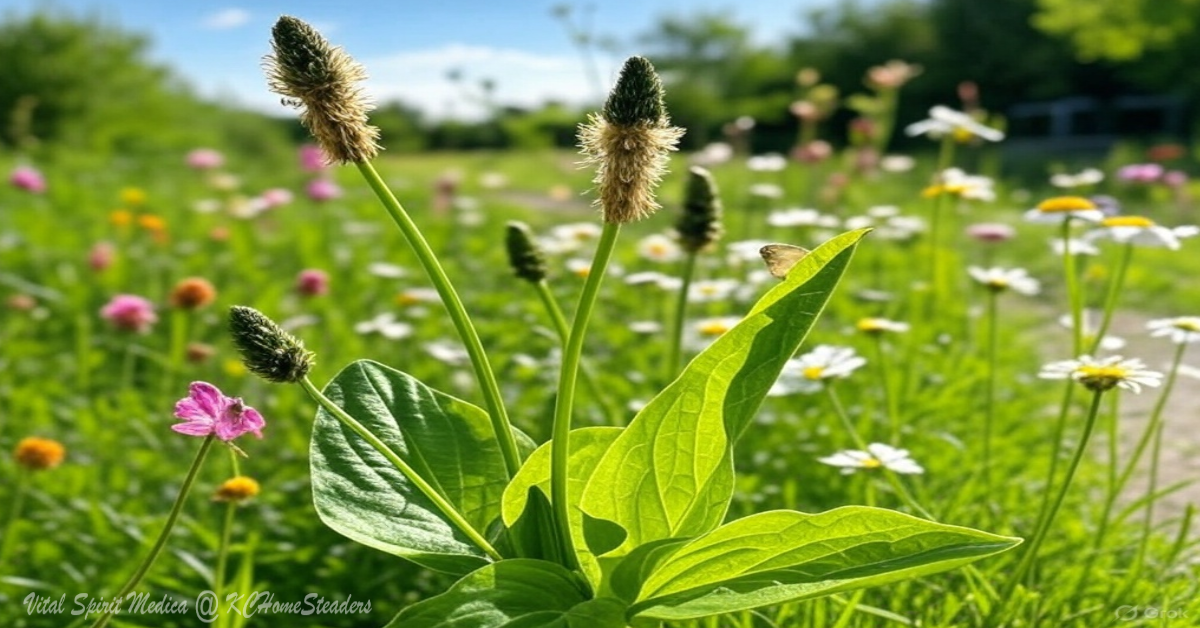
A Complete Herbal Monograph – Benefits, Uses & History:
👈Note on This Monograph:👇
Note on This Monograph: This extensive entry uses the full 8-part structure, offering a deep, interdisciplinary exploration of Plantain (Plantago major)— weaving together modern scientific evidence, traditional and ethnobotanical wisdom, practical cultivation and preparation guidance, and its living spiritual essence. Drawing from clinical studies, historical texts, indigenous knowledge, and esoteric traditions, it serves as a comprehensive resource for holistic understanding and respectful relationship with this powerful plant ally. Please work with trained professionals for therapeutic applications.
“Our Commitment to Transparent Research”
Unlike many herbal resources that offer generalized information with little or no backing, we provide direct links to every source we reference. This allows you to verify claims, explore topics in greater depth, and trust that what you’re reading is grounded in both modern science and time-honored tradition.
Section-specific Sources lists
Most monographs include dedicated “Sources:” sections at the end of major topics (e.g., Sources: Phytotherapy, Sources: Historical and Cultural Significance, Sources: Pharmacology). These contain direct, clickable links to the original material. We created this level of transparency so the research can serve you. Here are some ways readers use our sourced monographs: Anyone seeking truth — Verify claims for yourself instead of taking information at face value. Students & Researchers — Use the references for papers, assignments, or deeper study. Herbalists & Practitioners — Cite sources when educating clients or in professional materials. Curious Explorers — Follow the links to read original studies or historical texts yourself. Writers & Educators — Reference our monographs (with attribution), knowing the information is traceable.

“Plantain (Plantago major): Wound Herb, Identification, and Traditional Uses”
Plantain (Plantago major) is a Eurasian perennial of compacted ground, naturalized wherever people walk. The basal rosette of ribbed oval leaves yields aucubin, plantamajoside, mucilage, and flavonoids. Folk use runs from the Nine Herbs Charm and Culpeper’s wound leaf to Native American poultices adopted after the plant arrived as White Man’s Foot. Human studies of this species, centered in Iran, report faster healing with topical leaf gel, lower radiation-mucositis scores with a syrup, and less measured postpartum bleeding with a rectal suppository. Official European cough monographs name the narrow-leaved sister, Plantago lanceolata; Che Qian Zi is the seed of other Plantago species. Plantain (Plantago major) itself is pharmacopoeial in the French homeopathic monograph and remains, above all, the leaf you can still find on the track.

Provides an overview of key points.
A Synopsis for Plantain (Plantago major)
👈At A Glance: Provides an overview of key points.👇
Scientific Name: Plantago major L.
Family: Plantaginaceae
Common Names: Greater plantain, common plantain, broadleaf plantain, waybread, white man’s foot / white man’s footprint, healing blade, cart-track plant, grand plantain (French), daun sendok (Indonesian).
Botanical Description
Acaulescent perennial herb, usually 15–30 cm tall (to about 70 cm in favorable sites), with a short rootstock and numerous fibrous roots. Leaves form a basal rosette: blades ovate to elliptical, typically 5–20(–30) cm long and 4–9(–15) cm wide, with 3–9 strong parallel veins depressed on the upper surface, entire or irregularly dentate margins, and long channelled petioles. Inflorescence is a dense spike of tiny greenish-brown flowers on a leafless scape; corolla lobes small and reflexed, stamens with pale purple anthers. Fruit is a circumscissile capsule (pyxis) about 2–4 mm long, containing 6–30 minute dull black seeds. Wind-pollinated; a single plant can produce many thousands of seeds. Native to Eurasia and temperate Africa; widely naturalized on compacted, disturbed ground, paths, lawns, and roadsides worldwide. Chromosome numbers reported as 2n = 12 or 24. Distinguished from ribwort plantain (P. lanceolata) by its broad, not lanceolate, leaves.
Phytochemistry
Leaves and aerial parts contain iridoid glycosides (chiefly aucubin; also catalpol and majoroside), phenylpropanoid glycosides (plantamajoside, verbascoside/acteoside), flavonoids (including luteolin and apigenin derivatives, quercetin), phenolic acids (caffeic acid derivatives), triterpenoids (ursolic and oleanolic acids), polysaccharides and mucilage, and small amounts of alkaloids and organic acids. Seeds are rich in mucilage (arabinoxylan-type polysaccharides), fatty acids (notably oleic and linoleic), and some iridoids. Aucubin content in leaves varies seasonally and has been reported up to about 1.3% in dried leaf. Bioactivity is linked especially to aucubin (and its aglycone aucubigenin), plantamajoside, polysaccharides, and polyphenols.
Western Traditional & Clinical Actions
Traditional Western actions: vulnerary, demulcent, mild astringent, anti-inflammatory, expectorant, mild diuretic, and styptic. Clinically and ethnomedically applied to cuts, bites, stings, abscesses, and slow-healing skin lesions, and internally for irritated mucous membranes (cough, mild diarrhea, urinary irritation). Modern herbal practice retains topical use for minor wounds and oral use as a soothing demulcent for dry or irritated respiratory and digestive mucosa.
Chinese Medicine Actions
Official Chinese Pharmacopoeia sources of Che Qian Zi (车前子, plantain seed) are Plantago asiatica and P. depressa, not P. major. Those seeds are classified as sweet and cold, entering the kidney, bladder, liver, and lung channels, and used to drain dampness and promote urination (lin syndrome, edema), separate clear from turbid to check damp diarrhea, clear liver heat and brighten the eyes, and clear lung heat and transform phlegm. P. major is a close relative sometimes used similarly in folk practice outside the official materia medica; leaf material (Che Qian Cao) of related species is used more for heat-clearing and topical cooling.
Traditional & Historical Uses
Recorded by Dioscorides and later European herbals as a wound and bite remedy. Anglo-Saxon and medieval sources list it as waybread. In the Americas, Indigenous observers associated its spread with European settlement (“white man’s footprint”) and adopted the leaf poultice for wounds, inflammation, and bites. Ethnomedical surveys document uses across Europe, Asia, Africa, and the Americas for skin lesions, respiratory complaints, digestive upset, eye irritation, fever, and pain. Persian traditional medicine used it for wounds, bleeding, cough, and inflammation.
Modern Pharmacological Evidence
Preclinical work supports wound-healing (fibroblast and keratinocyte activity, collagen-related effects), anti-inflammatory (inhibition of edema models; effects linked to aucubin, plantamajoside, and ursolic acid via pathways such as NF-κB and COX-2), antioxidant, weak antimicrobial (aucubigenin more active than the glycoside), immunomodulatory, anti-ulcer, antidiarrheal, and mild analgesic actions. Airway studies suggest tracheal smooth-muscle relaxant effects possibly involving muscarinic, histamine, and ion-channel mechanisms. Antiviral and cytotoxic findings exist in vitro but are not established clinically. Mechanisms remain incompletely mapped to specific constituents.
Clinical Studies
Evidence is limited but includes topical wound trials. A randomized open-label trial of 10% hydroalcoholic leaf-extract gel on diabetic foot and pressure ulcers found greater wound-size reduction at 1 and 2 weeks versus control (about 65% vs 33% at week 1; about 87% vs 53% at week 2) and more complete healing (64% vs 20%). A separate randomized triple-blind trial in 130 patients with pressure ulcers reported higher resolution in the plantain group (reported as 96% vs 73%), with a formulation standardized to quercetin and no formulation-related adverse effects noted. Other small trials have examined oral or rectal preparations for conditions such as postpartum bleeding; sample sizes and methods vary, and confirmation in larger independent trials is still needed. Psyllium-type seed mucilage data often cited for Plantago concern other species (especially P. ovata) and should not be transferred uncritically.
Preparations & Dosage
Common traditional ranges (not medical prescriptions): dried leaf 3–5 g as infusion, one to three times daily; fresh leaf juice about 5–15 mL three times daily; tincture (often 1:3) roughly 3–8 mL per day in divided doses. Topical: crushed fresh leaf poultice, infused oil, salve, or compress of a cooled strong infusion, applied as needed to intact or minor broken skin. Seeds, when used, are taken with ample water for their mucilage. Standardization is uncommon outside research gels.
Safety & Contraindications
Generally regarded as low-toxicity at customary doses. Possible effects include gastrointestinal upset, bloating, or contact dermatitis in sensitive people; rare hypersensitivity reactions have been described. Avoid or use only with professional advice in pregnancy (uterine-stimulant activity has been reported in laboratory work), bowel obstruction, or known allergy to Plantago. Seed mucilage can affect absorption of oral drugs if taken at the same time; separate dosing. Do not apply to deep, infected, or non-healing wounds in place of medical care. Confusion with unrelated “plantain” (Musa) or misidentification of look-alikes should be avoided.
Cultivation & Harvest
Easily grown from seed in spring on ordinary soil in sun or partial shade; tolerates compaction and a wide pH range. Leaves are most tender and often richest in iridoids when young; many gatherers harvest leaves before full flowering and seeds when capsules brown. Sustainable practice is straightforward because the plant is abundant and weedy; avoid roadsides with heavy pollution. Ornamental forms include purple-leaved and variegated cultivars.
Commercial Products
Sold as dried leaf, teas, tinctures, salves, and occasional standardized topical gels in herbal markets. Seed products labeled “psyllium” are usually P. ovata or P. afra, not P. major. Quality varies; identity testing matters because several Plantago species enter trade.
Ethnobotanical Curiosities
The Latin name refers to the sole of the foot, matching both leaf shape and the plant’s habit of appearing where people walk. “White man’s footprint” records its rapid colonial spread. Young leaves have been eaten as a potherb or salad green; older leaves become fibrous. Seeds were historically used like small-scale psyllium.
Recent Research (2020–2026)
Wound trials (pressure ulcer, diabetic foot) published around 2021–2024 remain the strongest clinical signals. Genomic work has traced worldwide introductions to limited Eurasian genotypes linked to colonial trade routes. Reviews continue to focus on iridoids and plantamajoside in inflammation and respiratory models, including NF-κB and related pathways. Antibacterial screening against organisms such as Staphylococcus aureus appears in laboratory papers; clinical antimicrobial claims are not established.
Conservation Status
IUCN: Least Concern (global assessment; European assessment also Least Concern, population trend stable). NatureServe global rank G5 (secure). Widespread, weedy, and increasing in many introduced ranges; not a conservation priority. It is held in numerous germplasm collections and botanic gardens.
DIY Recipes
Fresh poultice: rinse clean leaves, chew or crush to a pulp, and apply to a minor clean scrape or insect bite; cover and replace when dry. Simple infusion: 2–4 g dried leaf in 240 mL just-boiled water, steep 10–15 minutes, strain; drink up to three cups daily for short-term soothing use, or cool and use as a skin wash. Infused oil: pack dried leaf in a jar, cover with olive oil, steep several weeks (or gentle heat method), strain, and optionally thicken with beeswax for a salve. Correct identification and clean collection sites are essential.
X (Twitter) Snapshot – 2020–2026
Recent posts treat greater plantain mainly as a common wild edible and topical wound herb. Examples include home wound ointments combining plantain with marigold and yarrow, and short identification notes stressing young leaves, seeds, and the need to distinguish it from other weeds. Engagement on these posts is generally low; they reflect folk use more than clinical claims.
Planting & Harvesting Reference Guide for
👈Planting & Harvesting Reference Guide:👇
Plantain (Plantago major) – Planting & Harvesting Reference Guide
This consolidates the planting and harvesting details from the SPARK sections. Magical timings are marked as contemporary practice built on Culpeper, not as ancient field law.
- Best Time for Planting
- Early spring, once the soil can be worked and hard frost has passed. Direct-sow; Plantain does not need a pit, graft, or nursery tree.
- Scatter seed on a firm seedbed and press it in. Do not bury it deeply. A wide pot with firm soil works for a few plants.
- Contemporary magical timing: new moon to first quarter; a leaf day in the Maria Thun rhythm if the crop is leaf, a fruit or seed day if seed is the aim. Friday or a Venus hour is optional, from Culpeper’s rulership, not from a medieval sowing calendar.
- Save seed from healthy spikes in late summer and resow each spring if the bed is weeded hard. Plantain mostly self-pollinates, so a bed tends to stay true to the sown line.
- Growing Conditions & Magical Minded Tips
- Sun or partial shade. Chalk, clay, loam, or sand, if drainage is reasonable. Wide pH. Moist but not waterlogged. Plantain prefers the firm, even compacted ground other crops resent.
- Do not overfeed. Excess nitrogen makes large soft leaves of untested chemistry. A lean path-edge bed is closer to wild leaf than a rich compost row. Biodynamic preparations 500 and 501, if used, go on the whole garden; no Plantain-specific trial exists.
- Space rosettes so air moves between them. Plants mature within a year. Irrigate in drought if you want a steady supply of young leaf; left dry, Plantain stays small and survives.
- Keep the bed unsprayed and away from salted or exhaust-dusted roads. Roadside Plantain can carry traffic metals and is a poor tea plant.
- Purple-leaved ‘Rubrifolia’ and variegated forms are garden plants, not the standard medicinal leaf. Speak the waybread lines as a greeting when you press the seed, if you work the charm. A small pour of water at the crown is enough offering.
- Best Time for Harvesting Leaf and Seed
- Leaf: late spring into early flowering, while blades are still soft. Culpeper says Plantain is in its beauty about June, and the seed ripens shortly after. Later assays found aucubin in dried leaf highest near June; reserve that harvest for tincture if potency is the goal, and take routine tea leaf earlier.
- Gather late morning after dew has dried, on a dry day. Discard yellow or insect-damaged blades.
- Seed: when capsules brown, late summer. A few spikes are enough; one plant can ripen many thousands of minute seeds.
- Contemporary energetic window: waxing moon toward full, and Friday, for a salve blessing. The old texts do not require a moon for leaf harvest.
- Sustainable & Magical Harvesting Methods
- Confirm the plant first: basal rosette, oval leaves with five to nine parallel ribs, leafless rat-tail spike. Not Ribwort Plantain, not the cooking banana.
- Leave the rootstock and at least half the rosette so the crown regrows. Two or three leaf cuts in a season are possible if the crown is left. Do not strip a patch.
- Harvest by hand if you are working the Nine Herbs Charm. The recorded preparation is pounded leaf and juice, not iron-stripped bark.
- Take leaf from clean yards, meadow edges, or the unsprayed bed, not from herbicide, manure-heavy, or dog-walked ground.
- For medicine used at once, bruise or crush the fresh leaf so aucubin meets the leaf enzyme. Say thanks to the patch; leave plants to flower and seed.
- Post-Harvest Processing
- Dry leaf in shade with airflow until crisp. Do not use direct sun if you want color and mucilage kept. Store labeled with place and date, in a cool dark jar.
- June leaf can be kept apart for tincture (about 1:3). Routine tea leaf is the earlier cut. Infusion is 2–5 g dried leaf in about 240 mL just-boiled water.
- Seed: dry in a paper bag, then rub out. Store dry. Soak in ample water before use so the mucilage can swell; never take dry seed.
- Oil: pack dried Plantain leaf, cover with olive oil, steep several weeks or warm gently, then strain. Beeswax if you want a salve. Fresh poultice is the oldest form and is not stored.
- A drawn rib-and-spike mark on the jar is a modern seal only. None is recorded in the old herbals.
Healing Categories of
👈Plantain (Plantago major): fits most strongly into the following healing categories, based on its traditional use, phytochemistry, clinical observations, and energetic profile:👇
Best-fit healing categories
- Wound and skin repair. The core of Plantain (Plantago major). Crushed leaf, juice, salve, and 10 percent gels for scrapes, stings, slow surface ulcers, and pressure injury. This is the category with both the oldest texts and the clearest modern trials.
- Mucosal soothing. Throat, mouth, and irritated gut. Mucilage plus mild astringency. Includes dry cough in household use, and the radiotherapy mucositis syrup trial. Not the European cough monograph, which names Ribwort Plantain.
- Bites, stings, and local heat. Serpent and dog bite in Culpeper, insect stings in folk practice, temple juice for headache from heat. Drawing and cooling, not antivenom.
- Mild fluxes and bleeding of surfaces. Styptic reputation for weeping skin, piles, and household fluxes. The Mashhad suppository study sits here as a modern obstetric echo, not as a routine protocol.
- Demulcent digestion and seed mucilage. Young leaf as food; seed gel with ample water. Separate from psyllium (Plantago ovata) fiber drugs.
- Cooling anti-inflammatory support. Aucubin, plantamajoside, and ursolic acid in preclinical inflammation models. A supporting category, not a stand-alone arthritis drug.
Healing Categories
Wound and skin repair
Plantain (Plantago major) is first a vulnerary. Dioscorides used the leaf on dog bites; Anglo-Saxon and Scandinavian practice put it on wounds; Culpeper called the Plantains singularly good wound herbs, inward or outward. The fresh poultice mixes leaf enzyme with aucubin. Shelf-stable forms include infused oil, salve, and hydroalcoholic gel. In IRCT20150721023282N12, 10 percent leaf gel plus routine care reduced diabetic-foot and pressure-ulcer area more than control dressing at day 7 (about 65 percent versus 33 percent) and day 14 (about 87 percent versus 53 percent), with more complete healing (32 of 50 versus 9 of 44). A second trial (IRCT201609209014N117) reported higher resolution of stage-1 pressure injury with a quercetin-standardized topical. Use on clean, minor, or professionally dressed surface wounds. Do not substitute a poultice for care of deep, puncture, or infected injuries.
Mucosal soothing
Leaf tea (about 2–5 g in a cup, up to three times daily in herbal sources) and fresh juice coat a raw throat and a mild irritated bowel. Polysaccharides do the physical soothing; iridoids and polyphenols add the anti-inflammatory note. A 23-versus-23 syrup trial during head-and-neck radiotherapy found lower mucositis grades and pain scores on Plantain (Plantago major). Household cough use is real; the official EMA traditional-use cough monograph is for Plantago lanceolata, not this species.
Bites, stings, and local heat
Culpeper records juice against serpent bite and the bite of a mad dog, and juice with oil of roses on the temples for headache from heat. Native American practice adopted the leaf poultice for sores and rattlesnake bite after the plant arrived. The working method is the same as the wound poultice: crush, apply, replace when dry. A root carried in the pocket is folk protection in Cunningham, not a treatment after envenomation.
Surface bleeding and fluxes
Traditional texts call the leaf and especially the root and seed more binding. Weeping skin, piles, and simple fluxes are the old indications. The Mashhad single-blind trial of 120 mg rectal suppositories after birth, on top of oxytocin, measured about 253 mL versus 306 mL over four hours in women judged at bleeding risk. That is one hospital study. It does not replace obstetric care.
Food, seed mucilage, and gentle elimination
Young Plantain (Plantago major) leaves are a potherb once strings are pulled. Seed soaked in ample water swells to a soothing gel. Do not dose it as psyllium, and do not swallow it dry. People with bowel obstruction should avoid seed gels.
Cooling inflammatory support
Preclinical work links aucubin, plantamajoside, and ursolic acid to lower prostaglandin and cytokine signals. This explains the “hot” skin and airway uses. It is not, by itself, a disease-modifying category.
Synergistic & Holistic Note
Plantain (Plantago major) works as a guild plant, not a solo miracle. On skin it has long shared the bowl with Calendula and Yarrow in oil and beeswax. On a raw throat it sits beside other demulcents; on a trodden spirit the Nine Herbs Charm places it second, after Mugwort, as mother of herbs that withstand what passes over it. Holistic use keeps the three layers together: the fresh leaf on the body, the unsprayed path as the pharmacy, and the spoken stanza if the worker wants the old frame. Species clarity is part of the synergy. Ribwort Plantain carries the European cough monograph. Plantago ovata carries the fiber trials. Che Qian Zi is another seed. Plantain (Plantago major) carries the broad leaf, the footprint, and the wound.
✨ If You Only Read U.S. Consumer Pages ✨
U.S. consumer pages usually present Plantain (Plantago major) as a lawn weed you can chew onto a bee sting, a bitter salad green, and a plant to be distinguished from the cooking banana. That picture is faithful to the leaf and to the name problem. It is also incomplete.
Those pages rarely say that the broad leaf has been through hospital wound trials in Isfahan, with a registered gel and published size-reduction numbers, or that a separate Iranian trial standardized a pressure-ulcer cream to quercetin. They rarely mention the radiotherapy syrup trial or the Mashhad suppository study. They often use “plantain” for three different drugs: this leaf, Ribwort Plantain (the species in the European cough monograph and Commission E), and psyllium seed (Plantago ovata, the species behind bulk-fiber products and most U.S. pharmacopeial fiber texts). A shopper who reads only the retail page can think the European cough approval and the psyllium cholesterol literature belong to the plant underfoot. They do not.
The French homeopathic monograph, the Persian classical prescriptions (roasted seed, gargle, rectal and vaginal forms, eye and nasal drops), Samuelsen’s country-by-country use table, and the genomic account of colonial spread are likewise outside the usual U.S. blurb. None of that cancels the backyard poultice. It places the poultice in a longer official and clinical life than the lawn-care caption shows. The plant on the path and the plant in the Isfahan gel are the same species. The plant in the European cough monograph is the narrow-leaved sister. Holding those apart is how the global record stays readable.
Sources:
https://ansm.sante.fr/uploads/2024/01/02/plantago-major-pph.pdf
https://www.ema.europa.eu/en/medicines/herbal/plantaginis-lanceolatae-folium
https://pmc.ncbi.nlm.nih.gov/articles/PMC7142308/
https://pmc.ncbi.nlm.nih.gov/articles/PMC5878035/
https://pubmed.ncbi.nlm.nih.gov/35044254/
Globally: Where This Plant Is Studied
👈Global research, official texts, publishers, and human-trial data, rather than U.S.-consumer-page-limited:👇
Where This Plant Is Studied
Plantain (Plantago major) is a Eurasian perennial studied wherever people and compacted ground meet: Scandinavia, the British Isles, Central Europe, Turkey, Iran, India, China, Southeast Asia, Latin America, and North America. The densest modern clinical work on this species, as distinct from its narrow-leaved relative, has come from Iran. Isfahan University of Medical Sciences (Al-Zahra Hospital and the faculty of pharmacy) ran the diabetic-foot and pressure-ulcer gel trial. A second Iranian pressure-ulcer trial, registered as IRCT201609209014N117, standardized a topical formulation to quercetin. Mashhad obstetric researchers tested a rectal suppository. Tehran and other Persian-medicine groups have reviewed Plantain (Plantago major) against classical texts such as the Canon and Makhzan al-Adwiya.
Chemistry and ethnobotany are older and wider. Anne Berit Samuelsen’s Department of Pharmacognosy at the University of Oslo produced the 2000 review that still anchors global use-tables, from Norway and Denmark to Guatemala, Turkey, India, and Hawaii. Istanbul University pharmaceutical botanists continue to compile Turkish Plantaginaceae use. Wound-dressing and nanoparticle papers now come from Indonesia, Turkey, and European materials groups. Population genomics of the weed’s colonial spread was led from natural-history and genomics labs using samples from about fifty populations worldwide (Frontiers in Plant Science, 2022). Field supply is not a plantation crop in the licorice sense. Plantain (Plantago major) is gathered from paths, lawns, and small herbal beds across its native and naturalized range.
Official Books That Name This Species
Naming has to be split by species, or the official shelf lies.
Plantain (Plantago major) itself appears in the French Pharmacopoeia as Grand plantain pour préparations homéopathiques: the whole fresh flowering plant, Plantago major L., for homeopathic mother tincture at 65 percent ethanol, with macroscopic identity tests and a minimum drying loss. That is a legal pharmacopoeial definition of this species, aimed at homeopathic preparations rather than a community herbal tea.
The European Pharmacopoeia, German Commission E, ESCOP, WHO cough monographs, and the EMA HMPC herbal monograph that herbalists often meet under the name “plantain” are written for Ribwort Plantain, Plantago lanceolata L., folium (Plantaginis lanceolatae folium). The HMPC indication is traditional use for irritation of mouth and throat and the dry cough that goes with it. Those books do not silently transfer to Plantain (Plantago major).
The Chinese Pharmacopoeia drug Che Qian Zi is seed of Plantago asiatica or Plantago depressa, not of Plantain (Plantago major). Ayurvedic and Unani psyllium drugs are principally Plantago ovata. The United States Pharmacopeia dietary-supplement literature on “psyllium” follows that seed drug, not the broad leaf. Plantain (Plantago major) is therefore officially named in a French homeopathic monograph and in a large ethnobotanical and clinical literature, and it is officially not the article in the main European cough monograph or the main East Asian seed monograph.
Sources:
https://ansm.sante.fr/uploads/2024/01/02/plantago-major-pph.pdf
https://www.ema.europa.eu/en/medicines/herbal/plantaginis-lanceolatae-folium
https://www.altmeyers.org/en/naturopathy/plantaginis-lanceolatae-herba-143304
https://tcmwiki.com/wiki/semen-plantaginis
Who Publishes on It
Publication is scattered rather than dominated by one national academy, which fits a plant nobody has to cultivate to study. Elsevier’s Journal of Ethnopharmacology carried Samuelsen’s Oslo review. Iranian clinical papers appear in the International Journal of Lower Extremity Wounds (SAGE), Complementary Therapies in Clinical Practice (Elsevier), Complementary Therapies in Medicine (Elsevier), and the Iranian Journal of Obstetrics, Gynecology and Infertility. Persian-medicine narrative reviews sit in Electronic Physician and related open journals. Phytochemistry and wound-material papers appear in Biomedicine & Pharmacotherapy, Springer pharmacology titles, and regional pharmacy journals from Turkey, Kazakhstan, and Indonesia. Frontiers in Plant Science carried the global genotyping study. Ethnobotany Research and Applications has carried Turkish Plantaginaceae syntheses in which Plantain (Plantago major) is among the most cited taxa.
The publishers are the usual scholarly ones—Elsevier, SAGE, Springer Nature, Frontiers, university presses—plus national pharmacopoeia commissions where the species is actually monographed (France for the homeopathic article; EMA and Ph. Eur. for the sister species). Author clusters sit in Iranian teaching hospitals, Scandinavian pharmacognosy, Turkish pharmaceutical botany, and European wound-biomaterial groups. U.S. output is real but secondary: flora, foraging, and historical notes, not the ulcer trials.
Sources:
https://pmc.ncbi.nlm.nih.gov/articles/PMC7142308/
https://www.irct.ir/trial/38487
https://ethnobotanyjournal.org/index.php/era/article/view/8084
https://www.frontiersin.org/journals/plant-science/articles/10.3389/fpls.2022.838166/full
https://pmc.ncbi.nlm.nih.gov/articles/PMC5878035/
Human Trials Tied to This Species
Human evidence for Plantain (Plantago major) is topical and Iranian-centered, with one mucositis syrup trial and one obstetric suppository trial. It is not a hospital injectable story.
The Isfahan randomized open-label trial (IRCT20150721023282N12), published in the International Journal of Lower Extremity Wounds, assigned diabetic-foot or pressure ulcers to a 10 percent hydroalcoholic leaf gel made by the Isfahan pharmacy faculty, once daily with routine care, or to control dressing with routine care. Completers were 50 and 44. Wound-area reduction favored the gel at day 7 (about 65 percent versus 33 percent) and day 14 (about 87 percent versus 53 percent). Complete healing was 32 of 50 versus 9 of 44. Erythema also fell faster on the gel.
A separate randomized triple-blind trial in 130 people (IRCT201609209014N117), published in Complementary Therapies in Clinical Practice, tested a Plantain (Plantago major) topical formulation standardized by HPLC to quercetin (1.88 mg/100 g), with 1 percent phenytoin cream, on stage-1 pressure injury. The authors reported higher resolution in the Plantain arm (about 96 percent versus 73 percent) and no formulation-linked adverse effects in that study.
A randomized double-blind placebo-controlled mucositis trial gave Plantain (Plantago major) syrup or placebo to 23 patients each for seven weeks during head-and-neck radiotherapy. WHO mucositis grade and pain scores were lower on the syrup. A single-blind Mashhad trial gave 120 mg rectal Plantain (Plantago major) suppositories after vaginal birth, on top of routine oxytocin, in women judged at bleeding risk. Four-hour measured loss averaged about 253 mL versus 306 mL. Both are single-center studies.
These trials name Plantago major. They should not be merged with psyllium cholesterol or constipation trials, which belong to Plantago ovata, or with the European traditional-use cough monograph, which belongs to Plantago lanceolata.
Sources:
https://www.irct.ir/trial/38487
https://pubmed.ncbi.nlm.nih.gov/35044254/
https://www.sciencedirect.com/science/article/abs/pii/S1744388121000244
https://www.sciencedirect.com/science/article/abs/pii/S0965229919317698
https://ijogi.mums.ac.ir/article_13819_en.html

Part 1: Modern Medical Properties and Uses

Purpose: Highlights the plant’s scientific and medicinal properties, validating holistic healing with evidence-based data.
Contemporary Medical Applications of Plantain (Plantago major)
👈Contemporary Medical Applications: Describes current clinical uses (e.g., capsules, tinctures) and delivery methods in modern medicine.👇
Contemporary Medical Applications:
- Plantain leaf is prepared today as hydroalcoholic extracts, 10 percent topical gels, infused oils, salves, and fresh-leaf poultices for minor wounds, pressure ulcers, and diabetic foot ulcers. In a randomized open-label trial, once-daily 10 percent leaf-extract gel used with routine dressing produced greater wound-size reduction at day 7 (about 65 percent versus 33 percent) and day 14 (about 87 percent versus 53 percent), with complete healing in 64 percent of treated patients versus about 20 percent of controls.
- A separate randomized triple-blind trial in 130 people with pressure ulcers tested a topical Plantain formulation standardized by HPLC to quercetin (reported at 1.88 mg per 100 g) alongside 1 percent phenytoin cream. Investigators reported faster resolution of stage-1 damage in the Plantain arm (about 96 percent versus 73 percent improvement), and no formulation-related adverse effects were recorded in that trial.
- Internal preparations in contemporary herbal practice include dried-leaf infusions (commonly 3–5 g per cup, up to three times daily), fresh leaf juice, and tinctures in the range of roughly 3–8 mL per day of a 1:3 preparation. These are used as demulcent, mildly astringent drinks for irritated throat, dry cough, and mild digestive upset, reflecting the polysaccharide and polyphenol profile of the leaf rather than a single isolated drug.
- Seed preparations of Plantain are used as mucilage drinks and bulk agents. The seed coat swells in water and forms a soothing gel; whole seeds or husks are taken with ample fluid. Clinical bulk-fiber data are stronger for Plantago ovata (psyllium) than for Plantago major, so seed use of greater plantain remains closer to traditional practice than to a standardized pharmaceutical fiber dose.
- Oral mucositis protocols have tested Plantain preparations against chlorhexidine and sodium bicarbonate in people receiving cancer treatment. Feasibility and comparative trials place the leaf extract among plant options being examined for mouth soreness, aligning with its long topical use on inflamed mucosa, though protocols and extract strengths are not yet uniform across studies.
- Delivery research has moved beyond simple salves. Liposomes loaded with water or aqueous-ethanol leaf extracts, chitosan nanohydrogels, silver-nanoparticle dermal patches made with Plantain extract, and 3D-printed polysaccharide dressings containing Plantain extract are all under laboratory or early animal evaluation for controlled release onto wounds.
- Commercial products sold as “plantain” leaf tea, capsules, tincture, or salve should be checked for species. Plantago major and Plantago lanceolata are both traded; seed products labeled psyllium are usually Plantago ovata or Plantago afra and are not interchangeable with greater plantain leaf.
Sources: Contemporary Medical Applications
Sources for Contemporary Medical Applications:
https://pubmed.ncbi.nlm.nih.gov/35044254/
https://www.sciencedirect.com/science/article/abs/pii/S1744388121000244
https://www.herbalreality.com/herb/plantain/
https://office2.jmbfs.org/index.php/JMBFS/article/view/9929
https://pubmed.ncbi.nlm.nih.gov/41592645/
Pharmacology of Plantain (Plantago major)
👈Pharmacology: Outlines key compounds and their mechanisms of action, driving therapeutic effects.👇
Pharmacology:
- Aucubin, the principal iridoid glycoside of the leaf, is a pro-compound whose aglycone aucubigenin shows stronger antimicrobial activity than the intact glycoside. Hydrolysis by plant or microbial β-glucosidase is therefore relevant to topical use: crushed fresh leaf brings enzyme and glycoside together, which matches the folk practice of chewing or bruising the leaf before applying it.
- Plantamajoside, a phenylpropanoid glycoside present in Plantain and closely related plantains, reduces lipopolysaccharide-driven MUC5AC, interleukin-6, and interleukin-1β in human airway epithelial cells. The reported pathway is suppression of PI3K/Akt and NF-κB signaling, offering a molecular account of the plant’s traditional use on hot, mucus-heavy respiratory irritation.
- Aucubin and related iridoids reduce tumor necrosis factor-α in stimulated macrophages and can reverse interleukin-1β-driven cyclooxygenase-2 expression in chondrocyte models. Aqueous leaf extract has reduced carrageenan paw edema and pleurisy in rats, a model tied to prostaglandin formation, which is consistent with cyclooxygenase-pathway modulation rather than a single receptor block.
- Ursolic acid from Plantain leaf wax inhibits cyclooxygenase-2 in experimental systems. Methanol extracts of Plantain species, including Plantago major, reduce prostaglandin E2 and thromboxane A2 production in stimulated monocytes to a degree comparable, at low concentration, with low-dose aspirin, with apigenin and ursolic acid content correlating with that suppression.
- Leaf polysaccharides and seed mucilage act physically as well as chemically. They form a hydrated film over mucosa and broken skin, slow irritation, and may support fibroblast activity. Scratch assays with Plantain-infused polysaccharide dressings closed fibroblast wounds more than dressing alone (about 64 percent versus 29 percent in one in-vitro comparison).
- Antioxidant activity is distributed across caffeic-acid derivatives, flavonoids, and iridoids. Extracts scavenge reactive oxygen species in chemical assays and have been linked to protection in ulcer and liver-injury models; aucubin has also been studied for protection against α-amanitin and carbon-tetrachloride liver damage in animals, a finding still preclinical.
- Airway pharmacology includes relaxant effects on tracheal smooth muscle. Proposed mechanisms include interference with muscarinic and histamine H1 signaling, calcium-channel blockade, and potassium-channel opening. These data support expectorant and soothing traditional uses but do not establish Plantain as a bronchodilator drug.
Sources: Pharmacology:
Sources for Pharmacology:
https://pmc.ncbi.nlm.nih.gov/articles/PMC7142308/
https://link.springer.com/article/10.1007/s00210-025-04276-8
https://www.sciencedirect.com/science/article/abs/pii/S037887412033021X
https://link.springer.com/article/10.1007/s10753-018-0733-7
https://pubmed.ncbi.nlm.nih.gov/41592645/
Natural Medicine Studies /Plantain (Plantago major)
👈Natural Medicine Studies: Summarizes recent research on efficacy, safety, or clinical outcomes from peer-reviewed studies.👇
Natural Medicine Studies:
- The 2022 diabetic-foot and pressure-ulcer trial (published in the International Journal of Lower Extremity Wounds) remains one of the clearest human signals. A 10 percent hydroalcoholic leaf gel, applied once daily for two weeks with standard care, accelerated size reduction and complete closure relative to novel dressing plus routine care, and also reduced wound erythema.
- The 2021 Complementary Therapies in Clinical Practice pressure-ulcer trial combined phytochemical standardization with clinical scoring. Aerial-part extract in 70 percent ethanol was formulated, assayed for quercetin, and tested under triple-blind conditions; resolution favored the Plantain arm, and the authors framed the result as support for traditional topical use.
- Animal wound studies predate and accompany these trials. Leaf extracts increase wound contraction, epithelialization, and collagen-related measures in excision and burn models. A 2023 dermal-patch study using green-synthesized silver nanoparticles from Plantain extract (particles about 10 nm) improved diabetic-mouse wound scores to a level statistically similar to commercial silver dressings by days 12–14.
- Anti-inflammatory animal work includes carrageenan edema, pleurisy, and rheumatoid-arthritis models. Dichloromethane and hexane fractions reduced paw edema and leukocyte migration; an insoluble hexane fraction lowered osteoclast formation and cyclooxygenase-2 expression in an arthritis model, with fatty acids and oleamide among detected constituents.
- Safety observations in the human topical trials available so far have not flagged formulation-related adverse effects. Broader herbal summaries describe Plantain leaf as well tolerated, with occasional nausea, bloating, or contact dermatitis, and rare hypersensitivity. Laboratory notes of uterine stimulation argue for caution in pregnancy even though community herbal sources often describe short-term use as gentle.
- Antimicrobial findings are mostly in vitro. Aqueous and ethanol extracts inhibit selected bacteria and fungi; activity is often stronger after conversion of aucubin to aucubigenin. These results explain traditional use on dirty scrapes but do not replace wound cleaning or antibiotics when infection is established.
- Oral-mucositis feasibility work and postpartum-bleeding suppository trials exist but are smaller and less replicated than the ulcer-gel studies. Across the natural-medicine literature, topical wound healing is the best-supported modern indication; internal respiratory and digestive uses rest more on pharmacology and tradition than on large trials.
Sources: Natural Medicine Studies:
Sources for Natural Medicine Studies:
https://pubmed.ncbi.nlm.nih.gov/35044254/
https://www.sciencedirect.com/science/article/abs/pii/S1744388121000244
https://researcherslinks.com/current-issues/Wound-Healing-Effectiveness-Test-Dermal/14/31/6919/html
https://journals.lww.com/rips/fulltext/2022/17060/in_vivo_anti_inflammatory_activities_of_plantago.6.aspx
https://pmc.ncbi.nlm.nih.gov/articles/PMC5878035/
Chemistry of Plantain (Plantago major)
👈Chemistry: Details active chemical constituents (e.g., alkaloids, flavonoids) and their healing roles.👇
Chemistry:
- Iridoid glycosides define the genus chemically. In Plantago major the dominant leaf iridoid is aucubin, with catalpol and majoroside also reported. Samuelsen’s review records aucubin varying by season, with a high published value of about 1.3 percent in dried leaf collected in June, so harvest timing changes the chemical profile of a tea or tincture.
- Phenylethanoid and phenylpropanoid glycosides include plantamajoside, verbascoside (acteoside), and related caffeoyl esters. A 2026 dressing study found Plantago major extract dominated by plantamajoside, followed by verbascoside and aucubin, whereas Plantago lanceolata extract was richer in verbascoside, aucubin, and catalpol—a practical chemical distinction between the two common “plantains.”
- Flavonoids include luteolin, apigenin, and their glucosides, plus quercetin used as an HPLC marker in at least one clinical gel (1.88 mg per 100 g of formulation). These flavones contribute to antioxidant capacity and to the observed suppression of prostaglandin and thromboxane pathways.
- Triterpenoids of the leaf wax include ursolic acid, oleanolic acid, and β-sitosterol. Ursolic acid is the constituent most directly tied to cyclooxygenase-2 inhibition. Loliolide, a smaller terpenoid, has also been isolated from the leaves.
- Seed chemistry is mucilage-forward. Hydrolysis yields arabinose, xylose, galacturonic acid, and related sugars; the gel can approach 30 percent of seed weight. Seed oil contains oleic acid (about 37 percent in one report) and linoleic acid (about 25 percent), plus a minor hydroxy-olefinic acid.
- Leaf mineral and amino-acid surveys add a nutritional layer to the medicinal chemistry. Spanish leaf analyses found relatively high vitamin C (about 45 mg per 100 g fresh weight) and calcium (about 108 mg per 100 g). A Kazakhstan methanol-extract study reported sodium, calcium, potassium, and magnesium, and about 20 amino acids, with arginine and lysine among the higher essential amino acids on a dry-weight basis.
- Polysaccharides of leaf and seed are not merely inert fiber. They are implicated in immunomodulation and in the physical demulcent effect. Trace alkaloids and organic acids are mentioned in reviews, but they are minor beside the iridoids, phenylethanoids, flavonoids, and mucilage.
Sources: Chemistry:
Sources for Chemistry:
https://pmc.ncbi.nlm.nih.gov/articles/PMC7142308/
https://www.sciencedirect.com/science/article/abs/pii/S0753332217322746
https://pubmed.ncbi.nlm.nih.gov/41592645/
https://www.tandfonline.com/doi/abs/10.1080/03670244.2001.9991663
https://www.sciencedirect.com/org/science/article/pii/S0428029622001263
Functional Foods and Nutrition /Plantain (Plantago major)
👈Functional Foods and Nutrition: Highlights dietary uses (e.g., teas, supplements) in modern health practices.👇
Functional Foods and Nutrition:
- Young Plantain leaves are eaten raw in salads or cooked as a potherb across Europe, Asia, and foraging traditions in the Americas. Tenderness drops quickly; older blades are stringy along the parallel veins and are better boiled, with the strings pulled, or used only as medicine. Flavor is mild to slightly bitter and herbaceous.
- Proximate data show a low-calorie green. One edible-plant compilation lists leaf moisture near 81–85 percent, roughly 39–61 kcal per 100 g, and protein around 2–4 g per 100 g fresh weight. Guil-Guerrero’s comparison of three Plantago species found available carbohydrate only about 2 g per 100 g fresh weight in Plantago major, with a favorable mineral pattern and modest oxalate relative to some wild greens.
- Vitamin and mineral density supports use as a seasonal wild vegetable rather than as a staple. Reported values include vitamin C near 45 mg per 100 g fresh leaf, meaningful calcium, and carotenoids. A Chinese cultivated form has been described as more palatable, with roughly 2.7 percent protein, 0.4 percent fat, and 2.2 percent ash.
- Seeds can be parched and ground into meal or boiled to a mucilaginous porridge reminiscent of sago. Harvest is laborious because the seeds are tiny. Their vitamin B1 content and gel-forming fiber are the nutritional points of interest; they should be eaten with plenty of water.
- Tea is the simplest functional-food form: 2–4 g dried leaf in a cup of hot water, steeped 10–15 minutes. The drink supplies polyphenols, a little mucilage, and minerals, and is the same preparation used as a throat soothe. Fresh juice, 5–15 mL, is a more concentrated traditional food-medicine.
- Because oxalate is present, though not high in the Spanish survey (lower in Plantago major than in some related species in that study), people who must limit oxalate may use the leaf as an occasional green rather than a daily bulk vegetable. Nitrate was also measured in that nutritional study and should be considered when gathering from fertilized ground.
- Plantain is not the cooking banana. Recipe and supplement labels that say “plantain” without a Latin name may mean Musa. For food use, confirmation of the basal rosette, parallel-veined oval leaves, and rat-tail seed spike avoids that confusion.
Sources: Functional Foods and Nutrition:
Sources for Functional Foods and Nutrition:
https://edibleplantdb.org/plants/7734/plantago-major
https://www.tandfonline.com/doi/abs/10.1080/03670244.2001.9991663
https://www.sciencedirect.com/org/science/article/pii/S0428029622001263
https://www.herbalreality.com/herb/plantain/
https://uses.plantnet-project.org/en/Plantago_major_(PROTA)
Current Projects and Future Possibilities /Plantain (Plantago major)
👈Current Projects and Future Possibilities: Notes ongoing research, clinical trials, or innovative medical applications.👇
Current Projects and Future Possibilities:
- Wound-dressing engineering is the most active frontier. A 2026 International Journal of Biological Macromolecules paper incorporated Plantago major and Plantago lanceolata extracts into 3D-printed methylcellulose–alginate–nanocellulose dressings, documented release of plantamajoside, verbascoside, and aucubin, and showed faster fibroblast scratch closure than unloaded dressing.
- Liposomal carriers for water and aqueous-ethanol extracts are being characterized for entrapment efficiency, particle size, and dialysis release, with the aim of holding antioxidant and antimicrobial activity at a wound longer than a simple poultice. Early cell work on human dermal fibroblasts reported high viability and no clear cytotoxicity from the extracts tested.
- Green-synthesized silver nanoparticles using Plantain extract as the reducing agent have been cast into dermal patches. In diabetic mice, a 0.005 percent patch performed similarly to commercial silver dressings on wound area and epidermal scores late in a two-week window, suggesting a hybrid plant-and-metal material rather than extract alone.
- Chitosan nanohydrogels of ethanol leaf extract, optimized with Carbopol and sodium carboxymethylcellulose, are in thesis-level burn studies in rats. One 2025 formulation showed a trend toward faster closure without statistical significance and passed a rabbit irritation screen, illustrating both the promise and the unfinished nature of nano-delivery work.
- Respiratory pharmacology reviews published in 2025 gather aucubin and plantamajoside data on mucus genes, NF-κB, and tracheal relaxation. A realistic next step is a standardized leaf extract, assayed for aucubin and plantamajoside, tested in humans with uncomplicated cough or oral mucosal injury rather than another round of cell assays alone.
- Genomic and invasion biology (including a 2022 Frontiers in Plant Science study of colonial trade-route genotypes) matters for supply. Cultivated chemotypes with stable aucubin and plantamajoside, harvested at a defined phenological stage, would make clinical gels reproducible in a way wild roadside leaf cannot.
- Combination salves already used by herbalists—Plantain with calendula and yarrow—are logical candidates for factorial trials. The historical record and the modern ulcer gels point to the same question: how much of the closure benefit is Plantain chemistry, how much is moisture and dressing, and how a fresh-leaf enzyme-activated poultice compares with a shelf-stable extract.
Sources: Current Projects and Future Possibilities:
Sources for Current Projects and Future Possibilities:
https://pubmed.ncbi.nlm.nih.gov/41592645/
https://office2.jmbfs.org/index.php/JMBFS/article/view/9929
https://researcherslinks.com/current-issues/Wound-Healing-Effectiveness-Test-Dermal/14/31/6919/html
https://etd.repository.ugm.ac.id/penelitian/detail/261032
https://link.springer.com/article/10.1007/s00210-025-04276-8
Literary Mentions of Plantain (Plantago major)
👈Literary Mentions: References modern medical texts or studies citing the plant’s therapeutic use.👇
Literary Mentions:
- Dioscorides, in De Materia Medica (first century), records plantain leaves for wounds and dog bites. Later European wound use is repeatedly traced to that passage; Samuelsen’s ethnopharmacological review treats it as the classical anchor of the vulnerary tradition.
- Pliny’s Natural History (book 26) discusses plantain among remedies for fluxes and related complaints. Eighteenth- and nineteenth-century medical botanies, including Woodville, still cite Pliny and Celsus when listing refrigerant, styptic, and diuretic reputations of the leaf.
- Ibn al-Baytar (12th–13th century) carried Greek plantain indications into Arabic medicine. Persian traditional sources later emphasize wound healing, bleeding control, cough, fever, and inflammation, a continuity reviewed in a 2018 narrative on Plantago major in Traditional Persian Medicine.
- Shakespeare’s Romeo and Juliet (Act I, Scene II) has Romeo call the plantain leaf “excellent” for a broken shin. The joke only works because an Elizabethan audience already knew the leaf as a roadside first-aid plant.
- Nicholas Culpeper’s Complete Herbal (1653) calls the plantains “singularly good wound herbs, to heal fresh or old wounds or sores, either inward or outward,” and repeats Dioscorides on roots boiled in wine for intermittent fevers. Culpeper’s Venus-versus-Mars astrology is period theory; the wound indication matches both earlier texts and later trials.
- The Old Norse Völsunga material and later Scandinavian folk record (including the Swedish name groblad, “healing leaf”) place crushed leaf on wounds. Gerard and Parkinson describe the same wayside plant for sores, fluxes, and spitting of blood, keeping it in English herbals into the early modern pharmacopoeias.
- Modern monographs close the loop. Samuelsen (Journal of Ethnopharmacology, 2000), the 2017 Biomedicine & Pharmacotherapy constituents review, and the ulcer trials of 2021–2024 all cite the Dioscoridean wound use as the hypothesis their chemistry and clinical work are testing.
Sources: Literary Mentions:
Sources for Literary Mentions:
https://pmc.ncbi.nlm.nih.gov/articles/PMC7142308/
https://www.henriettes-herb.com/eclectic/woodville/plantago.html
https://www.joellane.org/history/the-gardens/plantain
https://pmc.ncbi.nlm.nih.gov/articles/PMC5878035/
https://www.sciencedirect.com/science/article/abs/pii/S0753332217322746

Part 2: Plant Knowledge Systems

Purpose: Validates plant-based healing through interdisciplinary scientific and cultural fields.
Ethnobotany of Plantain (Plantago major)
👈Ethnobotany: Explores the plant’s traditional uses across cultures, linking indigenous knowledge to modern applications.👇
Ethnobotany:
- Plantain leaf is one of the most widely shared wound medicines on record. Dioscorides prescribed it for dog bites in the first century; Anglo-Saxon practice and the Old Norse healing-leaf tradition used a crushed-leaf poultice; Ibn al-Baytar carried the Greek indications into Arabic medicine; and Culpeper in 1653 called the Plantains “singularly good wound herbs, to heal fresh or old wounds or sores, either inward or outward.” That same leaf action reappears in modern hydroalcoholic gels tested on pressure ulcers and diabetic foot ulcers, so the ethnobotanical core and the clinical core are the same indication separated by two millennia.
- In North America the plant arrived with European settlement and was named White Man’s Foot or Englishman’s Foot because it sprang up along paths, wagon roads, and cabin yards. Native American nations adopted it quickly. The Native American Ethnobotany Database records Kwakwaka’wakw (Kwakiutl) use of a leaf poultice to draw blisters on sores and swellings. Other nations used leaf or root for bleeding cuts, rattlesnake bite, diarrhea, and toothache. The plant was therefore both a marker of colonization and a medicine people chose to keep.
- Samuelsen’s global review tabulates leaf, juice, seed, and whole-plant uses from Norway, Turkey, Guatemala, Brazil, India, China, Hawaii, Chile, and Panama for abscess, acne, hemorrhoids, eye irritation, cough, fever, and pain. Persian traditional medicine stresses wound closure, bleeding control, cough, and heat. Southeast Asian names such as daun sendok (“spoon leaf”) mark the same rosette used as a wash and a potherb. The pattern is consistent: fresh leaf on skin, mucilaginous seed or tea on mucosa.
- Food and medicine are not separated in these systems. Young Plantain leaves are eaten raw or boiled from Europe to East Asia; seeds are parched or boiled to a gel. Anglo-Saxon waybread names the plant as path-food as well as path-medicine. Modern foraging guides still give the same rule the herbals imply: use the young blade as green, the older blade as poultice.
- Shakespeare’s Romeo and Juliet treats a Plantain leaf for a broken shin as common knowledge, which shows the ethnobotany had already entered everyday English speech by the 1590s. That street-level status, not a court pharmacopoeia monopoly, is why the plant survived in peasant practice after learned medicine moved on.
Sources: Ethnobotany:
Sources for Ethnobotany:
https://pmc.ncbi.nlm.nih.gov/articles/PMC7142308/
http://naeb.brit.org/uses/28434/
https://awkwardbotany.com/2015/05/13/ethnobotany-white-mans-foot/
https://www.joellane.org/history/the-gardens/plantain
https://pmc.ncbi.nlm.nih.gov/articles/PMC5878035/
Plant Genomics of Plantain (Plantago major)
👈Plant Genomics: Describes genetic studies of the plant, focusing on traits related to medicinal properties.👇
Plant Genomics:
- Plantain has been studied with genome-wide markers, though a finished chromosome-scale reference genome comparable to major crops is not the center of the published record. The decisive population study is Iwanycki Ahlstrand and colleagues (Frontiers in Plant Science, 2022), who used genotyping-by-sequencing and genotype-likelihood methods on Plantago major from 50 populations worldwide. Differentiation among populations was low, as expected in a mostly selfing weed, yet six genotype groups emerged with little admixture and little outcrossing between them.
- Those genotype groups are latitudinally structured. Three of the most common native Eurasian genotypes gave rise to introduced populations in the Americas, Africa, Australia, and New Zealand. Except for New Zealand, the Southern Hemisphere samples carried only one genotype group. The authors read this as multiple successful introductions tied to colonial trade routes rather than a single escape, which matches the folk name White Man’s Foot with genomic evidence.
- Breeding system explains both the genomic pattern and the chemical reliability of wild leaf. Predominant selfing keeps genotype groups intact across oceans, so a Plantain patch in a new port can resemble its Eurasian source for centuries. For medicine this matters because aucubin and plantamajoside vary with season and site; genotype is a second layer. A standardized gel would ideally name both chemotype and genotype group, not only the species.
- Chromosome counts for Plantain are reported as 2n = 12 and 2n = 24, consistent with diploid and tetraploid races inside a variable species. Subspecies and varieties have been named, but field populations often intergrade. Genomic work has not yet mapped iridoid or phenylethanoid biosynthesis genes in Plantain the way crop pathways have been mapped, so the link from sequence to wound chemistry remains indirect.
- Conservation genomics is not urgent for a Least Concern weed, but the same datasets guide cultivation. If future farms select high-aucubin lines, the 2022 genotype groups are the natural starting panel, because they already represent the lineages that successfully colonized disturbed human ground.
Sources: Plant Genomics:
Sources for Plant Genomics:
https://www.frontiersin.org/journals/plant-science/articles/10.3389/fpls.2022.838166/full
https://pubmed.ncbi.nlm.nih.gov/35755675/
https://explorer.natureserve.org/Taxon/ELEMENT_GLOBAL.2.146139/
https://uses.plantnet-project.org/en/Plantago_major_(PROTA)
Phytotherapy of Plantain (Plantago major)
👈Phytotherapy: Details the plant’s use in clinical herbal medicine, including therapeutic protocols.👇
Phytotherapy:
- Contemporary Western phytotherapy uses Plantain leaf as a vulnerary and demulcent, internally and externally. A working protocol from clinical herbal sources is dried leaf 3–5 g as infusion, one to three times daily; fresh juice 5–15 mL three times daily; tincture about 3–8 mL per day of a 1:3 preparation, in divided doses. Topical use is as needed: fresh poultice, salve, wash, or compress of a strong infusion on minor broken skin, stings, and dry rashes.
- The strongest modern clinical protocols are topical gels, not teas. A 10 percent hydroalcoholic leaf gel applied once daily with routine dressing for 14 days accelerated diabetic-foot and pressure-ulcer closure relative to dressing alone. A second protocol paired a quercetin-standardized Plantain topical with 1 percent phenytoin cream on stage-1 pressure ulcers. Phytotherapists can cite these trials when choosing a shelf-stable extract over fresh leaf, while still teaching the fresh poultice as the historical equivalent.
- Respiratory and digestive protocols rest on mucilage plus iridoids. Infusion or juice is given for dry cough, thick catarrh, and mild irritated diarrhea; seed mucilage is given with ample water when a bulk demulcent effect is wanted. Plantain seed should not be dosed as if it were Plantago ovata psyllium, whose fiber trials use larger, standardized gram amounts.
- Safety practice in phytotherapy is straightforward. Short courses are considered gentle for adults and, in many herbal references, for children; stop for rash, swelling, or digestive upset. Separate seed mucilage from other oral medicines by a couple of hours. Pregnancy is the main caution, because laboratory work has reported uterine stimulation, so internal use in pregnancy belongs with a qualified practitioner.
- Combination protocols follow the wound-herb guild. Plantain leaf is macerated in oil with Calendula and Yarrow, then set with beeswax, a pattern still posted by home herbalists and continuous with Culpeper’s outward wound use. Oral mucositis regimens have compared Plantain preparations with chlorhexidine rinses in feasibility studies, extending the same mucosa-soothing logic into supportive cancer care.
Sources: Phytotherapy:
Sources for Phytotherapy:
https://www.herbalreality.com/herb/plantain/
https://pubmed.ncbi.nlm.nih.gov/35044254/
https://www.sciencedirect.com/science/article/abs/pii/S1744388121000244
https://globinmed.com/medicinal_herbs/plantago-major-83285/
https://pmc.ncbi.nlm.nih.gov/articles/PMC5878035/
Ethnoecology of Plantain (Plantago major)
👈Ethnoecology: Examines the plant’s ecological role in cultural practices and environmental interactions.👇
Ethnoecology:
- Plantain is an obligate companion of trampled ground. It tolerates compaction, short mowing, and disturbed soil along paths, cart tracks, and field edges, which is why its English names include waybread and cart-track plant and why its Latin name refers to the sole of the foot. Culturally it marks human movement: where people walk, graze, or camp, the rosette appears. Indigenous observers in North America encoded that ecology in the name White Man’s Foot.
- Ecologically the plant is a soil intermediary on hardpan. Fibrous roots penetrate compacted surfaces while the rosette holds soil against erosion, a role noted in rehabilitation descriptions of the species. In cultural practice this made Plantain both a weed of crops and a free pharmacy on the path between field and house. Seed contamination in grain and on footwear spread it along trade routes, the same routes later recovered by genotyping.
- Harvest custom follows the ecology. Leaves are taken from clean yards and meadows, not from roadsides salted or oiled by traffic, and preferably before full flowering when the blade is still soft. Seed spikes are left on some plants so the path population persists. Because Plantain is Least Concern and often weedy, cultural use does not threaten the species; the ethnoecological risk is contamination of the harvest site, not extinction.
- In grassland and lawn mosaics Plantain shares space with other heal-all weeds—Yarrow, Self-Heal, Dandelion—forming a spontaneous first-aid flora at the edge of human settlement. Ritual and story attach to that edge: Viking wound use, Anglo-Saxon waybread, and colonial footprint lore all assume a plant that does not need a garden. Cultivated purple-leaved and variegated forms exist, but the medicinal relationship remains with the wild path plant.
- Pollination and seed rain reinforce the cultural pattern. Plantain is wind-pollinated and can set on the order of many thousands of seeds per plant, so a single introduction maintains a local supply for poultices and greens. That abundance is why peasant medicine could rely on it without cultivation schedules.
Sources: Ethnoecology:
Sources for Ethnoecology:
https://www.frontiersin.org/journals/plant-science/articles/10.3389/fpls.2022.838166/full
https://handwiki.org/wiki/Biology:Plantago_major
https://www.iucnredlist.org/species/168960/209145992
https://awkwardbotany.com/2015/05/13/ethnobotany-white-mans-foot/
https://www.rhs.org.uk/plants/42126/plantago-major/details
Anthroposophical Medicine of Plantain (Plantago major)
👈Anthroposophical Medicine: Outlines the plant’s use in Steiner-inspired remedies, including preparation, studies, and dosage.👇
Anthroposophical Medicine:
- Specific anthroposophic pharmaceutical monographs that isolate Plantain as a named Weleda or Wala specialty are limited in the open literature. Anthroposophic medicine, developed by Rudolf Steiner and Ita Wegman, uses plant preparations alongside conventional care and often shares pharmacy technique with homeopathy and herbal medicine, but a dedicated Steiner lecture cycle on Plantago major is not the source of current Plantain practice. What is well documented is the homeopathic and clinical picture built from the fresh plant, which anthroposophic prescribers sometimes meet in integrative settings.
- Homeopathic Plantago major is prepared as a tincture of fresh aerial parts and root. Nineteenth-century provings collated by T. F. Allen and Constantine Hering, with later notes by John Henry Clarke and William Boericke, emphasize toothache that shoots to the ear, earache that shoots to the teeth, profuse salivation, sensitivity to touch and cold air, nocturnal enuresis in children, and an astringent effect in diarrhea. Authors also recorded a disgust for tobacco arising under the remedy. Those indications sit beside, not instead of, the herbal poultice.
- Substance accounts used by materia medica writers list aucubin, mucilage, tannins, and flavonoids as the chemical background of the astringent and soothing picture. Potencies in classical homeopathic use range from mother tincture for local dental or skin application to centesimal potencies for the neuralgic and enuresis picture; exact posology is individualized and is not a fixed herbal milligram dose.
- Where anthroposophic pharmacy and herbal phytotherapy overlap is in fresh-plant processing: rhythmic pressing, low-heat extracts, and ointments meant to support the body’s own boundary-healing rather than to suppress a symptom. Plantain leaf ointment in that spirit is compositionally close to the oil-and-beeswax salves of folk herbalism. Clinical ulcer gels of 10 percent extract are a modern pharmaceutical cousin, not an anthroposophic product, but they test the same tissue-healing claim.
- Limited data, stated plainly: no large anthroposophic outcome study on Plantain alone was located. Seekers wanting Steiner-specific pharmacy should treat homeopathic Plantago and traditional leaf salve as the documented neighbors, and should not assume a particular commercial anthroposophic brand contains Plantain unless the label says so.
Sources: Anthroposophical Medicine:
Sources for Anthroposophical Medicine:
https://www.iqhomeopathy.com/materia-medica/plantago/
https://www.weleda.co.nz/magazine/health/anthroposophic-medicine
https://www.herbalreality.com/herb/plantain/
https://pmc.ncbi.nlm.nih.gov/articles/PMC7142308/

Part 3: Heritage and Practice

Purpose: Weaves historical and cultural heritage with practical guidance for medicinal use.
Historical and Cultural Significance of Plantain (Plantago major)
👈Historical and Cultural Significance: Explores the plant’s role in historical and cultural medical practices.👇
Historical and Cultural Significance:
- Plantain enters the written medical record with Dioscorides in the first century, where the leaf is prescribed for wounds and dog bites. That indication is not a late folk addition. Pliny discusses Plantain among remedies for fluxes, and the Islamic compiler Ibn al-Baytar transmits the Greek uses into Arabic medicine in the twelfth and thirteenth centuries. The through-line is a wayside leaf trusted for broken skin and irritated membranes long before modern gels existed.
- Northern Europe kept the same plant in saga and peasant practice. The Völsunga tradition and later Scandinavian record place Plantain leaf on wounds; the Swedish name groblad means “healing leaf.” Anglo-Saxon waybread names it as food of the path. By Shakespeare’s Romeo and Juliet, a Plantain leaf for a broken shin is a joke the audience already understands, which shows the plant had left the herbals and entered ordinary speech.
- Nicholas Culpeper’s Complete Herbal (1653) calls the Plantains “singularly good wound herbs, to heal fresh or old wounds or sores, either inward or outward,” and repeats Dioscorides on roots in wine for intermittent fevers. Culpeper’s assignment of the plant to Venus is period astrology. The wound, flux, and bite uses match both the classical texts and the topical trials of the twenty-first century.
- Colonial expansion turned Plantain into a historical marker. In North America it was called White Man’s Foot or Englishman’s Foot because it appeared wherever European settlement compacted the soil. Genomic work published in 2022 recovered several Eurasian genotype groups in the Americas, Africa, Australia, and New Zealand and linked their spread to colonial trade routes, so the folk name and the population genetics describe the same journey.
- Learned pharmacopoeias slowly dropped Plantain while household use did not. Woodville’s medical botany still lists the leaf as refrigerant, substyptic, and diuretic, and notes that peasants apply it to fresh wounds. That split—official silence, path-side continuance—is the cultural position Plantain still occupies.
Sources: Historical and Cultural Significance:
Sources for Historical and Cultural Significance:
https://pmc.ncbi.nlm.nih.gov/articles/PMC7142308/
https://www.henriettes-herb.com/eclectic/woodville/plantago.html
https://www.joellane.org/history/the-gardens/plantain
https://www.frontiersin.org/journals/plant-science/articles/10.3389/fpls.2022.838166/full
Indigenous and Traditional Systems / Plantain (Plantago major)
👈Indigenous and Traditional Systems: Details its use in specific indigenous or traditional healing systems.👇
Indigenous and Traditional Systems:
- Native American adoption of Plantain was rapid and practical, not mythic. The Native American Ethnobotany Database records Kwakwaka’wakw use of a leaf poultice to draw blisters on sores and swellings. Other nations used leaf or root to stop bleeding, dress cuts, and treat rattlesnake bite, diarrhea, and toothache. The plant was recognized as new, named for the settlers who brought it, and then kept because the poultice worked on the same injuries older wound plants addressed.
- Traditional Persian medicine classifies Plantain with wound healing, bleeding control, cough, fever, and inflammation. A 2018 narrative review maps those uses onto later findings of anti-inflammatory, antipyretic, antitussive, and hemostatic actions, and gives customary doses in the range of 3–5 g of powdered herb one to three times daily, or a cup of infusion three or four times a day. Adverse notes in that literature include nausea, bloating, and rare hypersensitivity.
- Chinese official medicine uses the seeds of Plantago asiatica and Plantago depressa as Che Qian Zi, not Plantain seed as the pharmacopoeia drug. The actions—drain damp, promote urination, firm loose stool by diverting water, clear liver heat for the eyes, transform lung phlegm—belong to that seed drug. Plantain is a close relative used in some regional practice; it should not be substituted into a Che Qian Zi formula without a practitioner who knows the species difference.
- Latin American and Caribbean ethnobotany uses leaf and whole plant for skin inflammation, eye irritation, kidney pain, and wounds. Samuelsen’s tables cite Guatemala, Brazil, Chile, Panama, Haiti, and Rodrigues. Southeast Asian vernaculars such as daun sendok (Indonesia) and lanting (Philippines) mark the spoon-shaped rosette used as wash and potherb. The indigenous and traditional pattern is leaf on skin, seed or tea on mucosa, across continents that received the plant at different times.
- Viking, Anglo-Saxon, and later European peasant systems sit beside these. Juice on superficial wounds, decoction for fluxes, and seed for binding are repeated from Gerard and Parkinson through household herbalism. Modern 10 percent gels are a laboratory form of that indigenous and peasant poultice, not a different idea.
Sources: Indigenous and Traditional Systems:
Sources for Indigenous and Traditional Systems:
http://naeb.brit.org/uses/28434/
https://pmc.ncbi.nlm.nih.gov/articles/PMC5878035/
https://pmc.ncbi.nlm.nih.gov/articles/PMC7142308/
https://tcmwiki.com/wiki/semen-plantaginis
https://prosea.prota4u.org/view.aspx?id=379
Folklore and Culinary Traditions of Plantain (Plantago major)
👈Folklore and Culinary Traditions: Highlights folklore, myths, and culinary uses tied to the plant.👇
Folklore and Culinary Traditions:
- The footprint lore is the central myth. Plantain was said to grow wherever the English walked, a faithful dog of the settler path. Elizabeth Kolbert quotes the older observation that Plantains arrived with the first white settlers and were a reliable sign of their presence. The story is ecological fact wearing a colonial name: a trampling-tolerant weed spread by shoes, fodder, and grain.
- Culpeper’s planetary folklore places Plantain under Venus, curing martial complaints of the head and “privities” by sympathy and antipathy. Juice with oil of roses on the temples was said to ease headache from heat and to help “lunatic and frantic” persons, and the same juice was applied to serpent bite and hot gout. These are period doctrines; the durable kernel is outward use on heat and bites.
- Culinary use is plain and old. Young Plantain leaves go into salads or are blanched to soften the strings; older leaves are boiled as a potherb once the fibers are pulled. A more palatable East Asian form has been described with modest protein and fat. Seeds are parched and ground, or boiled to a mucilaginous porridge like coarse sago. Harvest of the minute seed is tedious, so seed cookery stayed minor beside leaf greens.
- Household names encode use: waybread, healing blade, cart-track plant, ripplegrass, snakeweed. None of these names belong to the cooking banana, also called plantain in English. Folklore recipes that say “plantain” without a picture of the rosette should be checked against Musa, the starchy fruit, before anyone eats or poultices the wrong plant.
- Limited data exist for a single sacred narrative comparable to soma or ayahuasca. Plantain folklore is path, wound, and kitchen lore, not vision lore.
Sources: Folklore and Culinary Traditions:
Sources for Folklore and Culinary Traditions:
https://awkwardbotany.com/2015/05/13/ethnobotany-white-mans-foot/
https://www.joellane.org/history/the-gardens/plantain
https://edibleplantdb.org/plants/7734/plantago-major
https://www.henriettes-herb.com/eclectic/woodville/plantago.html
Identification and Characteristics of Plantain (Plantago major)
👈Identification and Characteristics: Describes physical traits and identification markers for the plant.👇
Identification and Characteristics:
- Plantain is a low perennial with no leafy stem. A basal rosette of broadly oval to elliptical leaves, usually 5–20 cm long, sits on petioles often as long as the blades. Five to nine strong parallel veins are depressed on the upper surface and stand out beneath. Margins are entire or irregularly toothed; the surface is glabrous or nearly so. That ribbed oval leaf is the field mark.
- The flower stalk is leafless, typically 15–45 cm, with the upper portion a dense spike of tiny greenish-brown flowers. Purple anthers may show when the wind-pollinated flowers open. Fruit is a small capsule that splits around the middle, dropping 6–30 dull black seeds about 1–1.5 mm long. A single plant can ripen many thousands of seeds.
- Plantain is distinguished from Ribwort Plantain (Plantago lanceolata) by leaf shape: Ribwort leaves are narrow and lanceolate, and its spike is shorter and denser on a longer bare scape. Hoary Plantain (Plantago media) has hairier, elliptic leaves and a shorter, often fragrant spike. Cooking plantain (Musa) is a large tropical herb with a trunk-like pseudostem and no basal rosette of ribbed leaves.
- Size varies with site. On hard paths the rosette lies flat and small; in moist fertile ground leaves may reach 30 cm and the plant may approach 70 cm in total height. Flowers appear from late spring into summer in temperate climates. The plant is native to Eurasia and temperate Africa and is naturalized on lawns, tracks, and pastures almost worldwide.
- Chemically relevant traits are not visible, but harvest stage is. Young spring leaves are softer and, in published assays, aucubin in dried leaf has peaked near early summer (a high reported value about 1.3 percent). Identification should be finished before any chemical assumption is made.
Sources: Identification and Characteristics:
Sources for Identification and Characteristics:
https://www.rhs.org.uk/plants/42126/plantago-major/details
https://apps.lucidcentral.org/rainforest/text/entities/plantago_major.htm
https://www.florafinder.org/Species/Plantago_major.php
https://pmc.ncbi.nlm.nih.gov/articles/PMC7142308/
Wildcrafting / Plantain (Plantago major)
👈Wildcrafting: Covers where to find, identification tips (including look-alikes), and esoteric/medicinal harvesting methods.👇
Wildcrafting:
- Look for Plantain on compacted ground: path edges, old cart tracks, lawn margins, pasture gateways, and moist disturbed soil from sea level to high elevations. Avoid road verges sprayed with herbicide, salted in winter, or dusted with exhaust. Farmyards and dog-walked parks add manure and urine; choose a clean yard, meadow edge, or unsprayed garden instead.
- Confirm the plant before picking. Oval leaves with parallel ribs, no leafy stem, and a rat-tail spike of tiny flowers separate Plantain from Ribwort Plantain and from lily-like rosettes that lack the capsule fruit. If the plant is in fruit, split a capsule: many minute black seeds support the identification. Do not harvest a leaf you cannot name twice.
- For medicine, take healthy leaves before they are heavily fibrous, ideally late morning after dew has dried, and before or at early flowering if aucubin content is a goal. Leave the rootstock and at least half the rosette so the plant regrows. Seed spikes can be gathered when capsules brown, into a paper bag, and dried before rubbing out the seed. One plant produces enough seed that a few spikes suffice for home use.
- Esoteric and household custom both favor the fresh leaf used at once: bruise or chew to mix aucubin with the leaf’s own glucosidase, then bind the pulp to a clean minor wound or sting. Dried leaf is the form for winter tea and oil. Do not wildcraft deep, dirty, or puncture wounds as a substitute for care; the poultice tradition is for superficial injury.
- Abundance makes overharvest unlikely, but courtesy still applies. Plantain is Least Concern and often weedy. The real wildcrafting limit is site purity, correct identity, and leaving the patch able to flower.
Sources: Wildcrafting:
Sources for Wildcrafting:
https://www.rhs.org.uk/plants/42126/plantago-major/details
https://www.herbalreality.com/herb/plantain/
https://www.iucnredlist.org/species/168960/209145992
https://pmc.ncbi.nlm.nih.gov/articles/PMC7142308/
Cultivation Practices of Plantain (Plantago major)
👈Cultivation Practices: Details growing methods for medicinal potency, including general cultivation.👇
Cultivation Practices:
- Plantain germinates readily from seed sown in spring on ordinary garden soil in full sun or partial shade. It accepts chalk, clay, loam, or sand if drainage is reasonable, and it tolerates a wide pH. Scatter seed on a firm seedbed and press it in; the plant does not need rich compost to produce medicinal leaf, and excess nitrogen makes large soft leaves of untested chemistry.
- Space rosettes so air moves between them. Plants mature within a year and can be cut two or three times in a growing season if the crown is left. Herbal-crop notes for temperate organic plantings suggest direct seeding and repeated leaf harvest rather than a single destructive cut. Irrigate in drought if a steady supply of young leaf is wanted; the wild plant survives dryness by staying small.
- For potency, harvest on a dry day, discard yellow or insect-damaged blades, and dry in shade with airflow until crisp. Aucubin varies by season, so a single June-leaning harvest can be reserved for tincture while routine tea leaf is taken earlier. Do not collect seed from ornamental beds if the goal is medicinal identity; purple-leaved ‘Rubrifolia’ and variegated forms are garden plants, not the standard drug leaf.
- Isolation from sprayed lawns matters more than fertility. A dedicated unsprayed bed at the garden edge reproduces the path ecology without the roadside contaminants. Save seed from healthy spikes in late summer and resow each spring if the bed is weeded hard.
- Container culture works for a few plants: a wide pot, firm soil, and regular water. Flower spikes can be removed if only leaf is wanted, or left if seed is part of the harvest plan.
Sources: Cultivation Practices:
Sources for Cultivation Practices:
https://www.rhs.org.uk/plants/42126/plantago-major/details
https://handwiki.org/wiki/Biology:Plantago_major
https://grokipedia.com/page/Plantago_major
https://pmc.ncbi.nlm.nih.gov/articles/PMC7142308/
Biodynamic Farming / Plantain (Plantago major)
👈Biodynamic Farming: Outlines biodynamic cultivation techniques specific to the plant.👇
Biodynamic Farming:
- Limited data: no Plantain-specific biodynamic trial was located. General biodynamic practice would sow on a leaf day in the Maria Thun rhythm if the crop is leaf, and on a fruit or seed day if seed is the product, using the same firm seedbed the plant prefers in ordinary gardens.
- Preparations 500 and 501 are applied to the whole garden, not to Plantain alone. Compost that has received the herbal preparations can feed a bed, but Plantain does not require high fertility, and excess manure conflicts with the lean path soils where wild leaf is gathered.
- Ecological fit is already strong. A biodynamic market garden can keep an unsprayed headland of Plantain as a living pharmacy and as groundcover on compacted aisles, harvesting leaf without treating the plant as a weed to be erased.
- Seed saving in a closed system matches biodynamic self-reliance. Because Plantain mostly self-pollinates, a bed tends to stay true to the sown genotype group, which is useful if a grower is selecting for local vigor.
- Until a chemotype study exists under biodynamic management, potency claims for preparation-treated Plantain should not be made. The honest practice is clean soil, seasonal harvest, and shade drying.
Sources: Biodynamic Farming:
Sources for Biodynamic Farming:
https://www.rhs.org.uk/plants/42126/plantago-major/details
https://www.frontiersin.org/journals/plant-science/articles/10.3389/fpls.2022.838166/full
https://www.weleda.co.nz/magazine/health/anthroposophic-medicine
Preparation Methods of Plantain (Plantago major)
👈Preparation Methods: Describes how to prepare the plant for medicinal or culinary use.👇
Preparation Methods:
- Fresh poultice: rinse leaves, crush or chew to a pulp so leaf enzyme meets aucubin, and apply to clean minor scrapes, stings, or inflamed skin. Cover with a cloth and replace when the pulp dries. This is the oldest preparation and the one pharmacology best explains.
- Infusion: 2–5 g dried Plantain leaf in about 240 mL just-boiled water, covered, for 10–15 minutes; up to three cups a day for short-term throat or digestive soothing. A stronger cool infusion can be used as a wash. Fresh juice, 5–15 mL three times daily, is the concentrated internal form in herbal sources.
- Tincture: fresh or dried leaf at about 1:3, traditionally in alcohol-water, in the range of 3–8 mL per day in divided doses. Alcohol extracts iridoids and phenolics; it does not replace water if mucilage is the goal. For a demulcent drink, infusion or seed gel is the better preparation.
- Oil and salve: pack dried Plantain leaf in a jar, cover with olive oil, steep several weeks or warm gently in a water bath, strain, and set with beeswax if a salve is wanted. Folk ointments often add Calendula and Yarrow. Clinical research gels use a 10 percent hydroalcoholic extract in a gel base, applied once daily in the published ulcer protocols.
- Seed gel: soak a small amount of Plantain seed in a generous volume of water until it swells, then drink the mucilage. Do not take dry seed. Culinary leaves should be young; blanch and strip strings before adding to soup or salad.
Sources: Preparation Methods:
Sources for Preparation Methods:
https://www.herbalreality.com/herb/plantain/
https://www.tuasaude.com/en/broadleaf-plantain/
https://pubmed.ncbi.nlm.nih.gov/35044254/
https://globinmed.com/medicinal_herbs/plantago-major-83285/
Safety Precautions for Plantain (Plantago major)
👈Safety Precautions: Lists plant-specific risks, including side effects or contraindications.👇
Safety Precautions:
- Plantain leaf is generally well tolerated at customary doses. Reported discomforts include nausea, bloating, cramping, and, less often, contact dermatitis or hypersensitivity. Stop use if a rash, swelling, or breathing difficulty appears. Life-threatening allergy is described as rare and associated with heavy exposure in sensitive people.
- Pregnancy is the main internal caution. Laboratory work has reported uterine stimulation, so internal Plantain in pregnancy should be used only with a qualified practitioner. External poultice on intact skin is the lower-concern form, still stopped if irritation occurs. Some popular sources also advise caution in breastfeeding; evidence there is thinner than the pregnancy note.
- Seed mucilage can swell and obstruct if taken dry or with too little water, and it can delay absorption of other oral medicines. People with bowel obstruction, swallowing difficulty, or fecal impaction should not use seed gels. Separate seed doses from medicines by about two hours.
- Do not use a poultice on deep, puncture, heavily contaminated, or non-healing wounds in place of care. Oxalate is present in the leaf at modest levels in nutritional surveys; people on a strict low-oxalate diet can treat Plantain as an occasional green. Gather only from unsprayed ground, and never confuse Plantain with Musa plantain or with narrow-leaved Ribwort if a recipe specifies the broad leaf.
- Children and elders can use weak tea or external leaf in many herbal traditions; dosing should be smaller, and any urinary, skin, or digestive reaction is a reason to stop. Homeopathic potencies are a different preparation from the crude herb and follow different rules.
Sources: Safety Precautions:
Sources for Safety Precautions:
https://pmc.ncbi.nlm.nih.gov/articles/PMC5878035/
https://globinmed.com/medicinal_herbs/plantago-major-83285/
https://www.herbalreality.com/herb/plantain/
https://www.tuasaude.com/en/broadleaf-plantain/
https://www.tandfonline.com/doi/abs/10.1080/03670244.2001.9991663
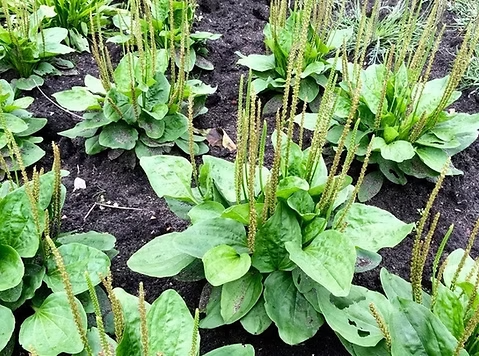
Part 4: Spiritual Essence

Purpose: Explores the plant’s intrinsic spiritual and mythological essence in holistic healing.
Energetic Essence of Plantain (Plantago major)
👈Energetic Essence: Describes the plant’s energetic signature (e.g., chakra connections), flower-essence properties, and vibrational-healing uses.👇
Energetic Essence:
- The oldest energetic portrait of Plantain is not a chakra chart. It is the Old English Nine Herbs Charm in the Lacnunga manuscript (British Library, MS Harley 585), where wegbrade—identified by scholars with Plantain, Plantago major—is addressed as wyrta modor, “mother of herbs,” open from the east and mighty within. Carts creaked over it, queens rode over it, brides cried over it, bulls snorted over it, and it withstood them all. The charm then transfers that withstanding to the patient: so may you withstand poison, the flying infection, and the loathsome thing that fares through the land. The signature is endurance under pressure, turned outward as protection. Richard Mabey notes that sympathetic magic read the leaf’s survival of trampling as a remedy for crushing and tearing injuries, a reading later echoed by the leaf’s tannins, mucilage, and wound use.
- Culpeper’s seventeenth-century energetic system places Plantain under Venus, curing complaints of the head and the reproductive sphere by sympathy with Venus and by antipathy to Mars. He writes that it cures hardly any martial disease, and he specifies juice with oil of roses on the temples for headache from heat. Whatever one makes of planetary rulers, the assigned quality is cooling, binding, and restorative after heat and injury, not stimulating or visionary. That matches the plant’s demulcent and styptic actions more closely than any later aura vocabulary.
- Homeopathic materia medica offers a different essence built from provings rather than from cosmology. Collations from Allen, Hering, Clarke, and Boericke picture Plantain as a sensory-nerve astringent: pains shooting between teeth and ear, profuse saliva, oversensitivity to touch and cold air, and a child who settles when the room is warm and still. The mental note is peevishness that follows pain, not a moral drama, and some authors record a sudden disgust for tobacco. Practitioners who work with remedy essence can use that picture without claiming it as Anglo-Saxon doctrine.
- Contemporary flower-essence makers have assigned Plantain a purifying signature. Pacific Essences describes a Plantain flower essence for releasing mental blocks, bitterness, and resentment, with an affinity claimed for liver and gallbladder meridians and for sacral and crown centers, dosed in their system as drops in water. These correspondences are modern vibrational attributions sold with the essence. They are not attested in the Lacnunga or in Culpeper. Limited data exist for a classical Bach flower remedy of Plantain; Bach’s thirty-eight remedies do not include it.
- A serious energetic summary, then, stays close to the sources. Plantain is the herb of the trodden path that does not break, invoked against poison and infection, ruled in early modern astrology by Venus as a cooler and binder, and later read by homeopaths as a remedy of irritated nerves and raw surfaces. Vibrational liver-and-thought detox claims belong to late twentieth- and twenty-first-century essence lines and should be labeled as such.
Sources: Energetic Essence:
Sources for Energetic Essence:
https://www.northernshamanism.org/song.html
https://www.herbalhistory.org/home/the-nine-herbs-charm-plants-poisons-and-poetry/
https://www.joellane.org/history/the-gardens/plantain
https://www.iqhomeopathy.com/materia-medica/plantago/
https://pacificessences.com/products/plantain-flower-essence
Mythological Associations of Plantain (Plantago major)
👈Mythological Associations: Highlights myths, legends, or symbolic meanings tied to the plant across cultures.👇
Mythological Associations:
- In the Nine Herbs Charm, Plantain stands second, after Mugwort. The poem does not tell a god’s birth story. It tells a roadside ordeal. The plant is mother of herbs, opened to the east, crushed by chariots, queens, brides, and bulls, and still standing. The mythic move is transfer: what the leaf endured, the sick body may endure. The recipe that follows pounds the nine herbs with soap, apple juice, and ash-water into a salve. Plantain’s mythology here is practical magic, spoken over a wound paste, not a distant cosmology. Cameron and later herbal historians accept wegbrade as Plantain, Plantago major, the broad leaf of the way.
- Mabey, drawing on that charm, calls Plantain “the mother of worts” and notes its presence in early prescriptions of magical herbs back toward Celtic fire ceremonies, while admitting it is not clear why so plain a plant held pre-eminent rank. His answer is ecological: it dogs human footsteps, thrives on roads, field paths, and church steps, and prospers where delicate plants are crushed. The myth and the habitat are the same story. Waybread, or waybroad, means the broad herb of the wayside.
- Colonial North American lore gave Plantain a second myth, this one historical. Native observers called it White Man’s Foot or Englishman’s Foot because it appeared where settlers walked. Elizabeth Kolbert repeats the older line that Plantains arrived with the first white settlers and were a reliable sign of their presence. A Kwakwaka’wakw-attributed telling says the round leaf followed wagon roads and railroads like a faithful dog. Genomic studies later found Eurasian genotype groups in the Americas tied to colonial routes, so the legend of the footprint plant is also a migration narrative. It is not a creation myth. It is a story about arrival.
- European household myth stayed with bites, blood, and the head. Culpeper passes on juice for serpent bite and the bite of a mad dog, and temple anointing for frenzy from heat. Scandinavian groblad, “healing leaf,” and the Völsunga wound use keep Plantain in the role of the leaf that closes what iron opened. Shakespeare’s Romeo offering a Plantain leaf for a broken shin shows the myth had become a proverb: everyone knew which plant you reached for when skin split.
- Limited data exist for a pan-cultural goddess myth unique to Plantain. Chinese carriage-front lore belongs chiefly to Che Qian Zi, the seed of related Plantago species whose name means the seed before the cart—another wheel-rut story, parallel but not identical. Across these traditions the symbol repeats: the plant that lives where wheels and feet pass, and that is asked to lend that toughness to a wound.
Sources: Mythological Associations:
Sources for Mythological Associations:
https://www.northernshamanism.org/song.html
https://www.herbalhistory.org/home/the-nine-herbs-charm-plants-poisons-and-poetry/
https://de.wikipedia.org/wiki/Nine_Herbs_Charm
https://awkwardbotany.com/tag/plantago-major/
https://awkwardbotany.com/2015/05/13/ethnobotany-white-mans-foot/
https://pmc.ncbi.nlm.nih.gov/articles/PMC7142308/

Part 5: Esoteric Practices

Purpose: Details ritualistic and tradition-specific spiritual practices involving the plant.
Ritual and Ceremonial Uses for Plantain (Plantago major)
👈Ritual and Ceremonial Uses: Explores the plant’s role in spiritual rituals or ceremonies across traditions.👇
Ritual and Ceremonial Uses:
- The clearest recorded ceremony for Plantain is the Old English Nine Herbs Charm in the Lacnunga (British Library, MS Harley 585), written down in a tenth- or eleventh-century medical manuscript and likely older in oral form. Plantain, under the name wegbrade, is addressed second, as mother of herbs, open from the east and mighty within. The speaker recounts that carts creaked over it, queens rode over it, brides cried over it, and bulls snorted over it, and that it withstood them all. The same withstanding is then asked against poison, flying infection, and the loathsome traveler through the land. The rite is not a temple liturgy. It is a spoken charm over a salve: the nine herbs are pounded with old soap and apple juice, then worked with ash-water paste, and the salve is applied with further washing. Plantain’s ceremonial role is the crushed leaf that lends endurance to the patient.
- Sympathetic ritual follows from that text. Richard Mabey argues that early magical prescriptions favored Plantain because it survives trampling on roads, field paths, and church steps, so the leaf that is walked on was asked to heal crushing and tearing. The ceremony is analogical: what was done to the plant is what the plant is asked to undo in the body. Modern wound gels test chemistry, not the charm, but they use the same plant part the charm told the healer to pound.
- Snake and bite rites sit beside the charm. Culpeper records juice of Plantain, sometimes with oil of roses, against the biting of serpents or a mad dog, and temple anointing for headache from heat and for frantic states. Scott Cunningham’s later compilation of folk magic preserves a pocket rite: a piece of root carried against snakebite, and the leaf bound with red wool to the head for headache or placed under the feet against weariness. These are small personal ceremonies, not priesthoods. Native American adoption of the leaf poultice for rattlesnake bite, documented in historical ethnobotany, is a practical rite of the same class: chew or crush, apply, bind.
- Household protection rites in twentieth-century magical herbals hang Plantain in a vehicle against harmful spirits, or carry charged leaf in a pocket. Cunningham lists those uses under healing, strength, protection, and snake-repelling. They are modern codifications of older footprint and bite lore, not evidence of a continuous church calendar feast of Plantain. Irish folk names preserved in the same compilation—Slan-lus, St. Patrick’s leaf, Patrick’s dock—suggest a healing-herb association with Patrick in popular speech. Limited data exist for a formal Patrician liturgy that blesses Plantain.
- Limited data exist for large seasonal ceremonies unique to Plantain. Mabey mentions its presence in early prescriptions of magical herbs back toward Celtic fire festivals, without a surviving order of service. Where Plantain enters a rite today, it is usually as the wayside leaf in a protection pouch, a wound salve spoken over in the manner of the Nine Herbs Charm, or a Venus-hour offering on a household altar.
Sources: Ritual and Ceremonial Uses:
Sources for Ritual and Ceremonial Uses:
https://www.northernshamanism.org/song.html
https://www.herbalhistory.org/home/the-nine-herbs-charm-plants-poisons-and-poetry/
https://awkwardbotany.com/tag/plantago-major/
https://www.joellane.org/history/the-gardens/plantain
https://publicism.info/magic/books/herbs/323.html
https://blog.herbsociety.org/plantain-good-for-everything-and-usually-under-foot/
Magical and Astrological Practices of Plantain (Plantago major)
👈Magical and Astrological Practices: Describes uses in magical or astrological contexts, including planetary associations.👇
Magical and Astrological Practices:
- Culpeper’s astrological practice is the early modern anchor. He rejects the claim that Plantain belongs to Mars merely because it treats the head and the reproductive organs, houses some astrologer-physicians gave to Aries and Scorpio. He places Plantain under Venus: it cures the head by antipathy to Mars and the “privities” by sympathy to Venus, and he says there is hardly a martial disease it does not cure. Operatively, that meant leaf, juice, root, and seed chosen when a cooling, binding herb was wanted against heat, bleeding, wounds, and bites. The government is a timing and classification system, not a metaphor added later.
- Cunningham’s Encyclopedia of Magical Herbs (1985) repeats Venus, assigns the feminine gender and the element Earth, and lists powers of healing, strength, protection, and snake-repelling for Plantago major, Plantago lanceolata, and Plantago media together. Magical uses he records are binding the leaf with red wool to the head, placing leaf under the feet against weariness, hanging the plant in a car against evil spirits, and carrying root against snakebite. Pagan Pages commentary on that system adds altar use or a spell pouch when Venus is astrologically emphasized, for harmony and related Venusian themes. These are late twentieth-century Wiccan correspondences built on Culpeper, not independent ancient star-lore.
- Protective magic against venom is the most repeated operation. Folk names Snakeweed and Snakebite, Culpeper’s serpent paragraph, Cunningham’s root charm, and Judika Illes’s instruction (as cited in modern pagan apothecary notes) to charge Plantain and carry it against snakebite all describe the same act: the plant is given a mission and kept on the body. Parallel medical use—poultice on the bite—means the magical and the topical practices were often the same gesture. A root in the pocket does not replace care after envenomation.
- Strength magic is explicit in the Nine Herbs Charm and implicit in the footprint story. The leaf that chariots and bulls could not destroy is asked to withstand poison. Later magical writers translate that into grounding and endurance spells. Commercial essence lines add thought-purification and resentment-clearing. Those mental uses are modern. The older operation is physical protection and wound closure, spoken or carried.
- Planetary timing in current practice, where it is used at all, follows Venus: Friday, or the planetary hour of Venus, for salves and protection bundles. Elemental practice follows Earth, matching the rosette pressed to the path. Limited data exist for a medieval Arabic or Chinese astrological assignment specific to Plantain as distinct from other plantains. Chinese cart-rut lore belongs mainly to Che Qian Zi of related species.
Sources: Magical and Astrological Practices:
Sources for Magical and Astrological Practices:
https://www.joellane.org/history/the-gardens/plantain
https://publicism.info/magic/books/herbs/323.html
https://paganpages.org/emagazine/2017/05/01/notes-from-the-apothecary-27/
https://magickalspot.com/plantago/
https://www.northernshamanism.org/song.html
Spiritual Tradition Mentions of Plantain (Plantago major)
👈Spiritual Tradition Mentions: Highlights the use in specific spiritual traditions (e.g., Amish, Buddhist, Shamanic) relevant to the plant.👇
Spiritual Tradition Mentions:
- Anglo-Saxon healing religion, as preserved in the Lacnunga, is the strongest spiritual tradition for Plantain. The charm sits between older Germanic speech and Christian manuscript culture: herbs are invoked by name, then made into a salve. Plantain is mother of herbs, not a saint and not a demon. Northern tradition and heathen reconstructionists still recite the Song of the Nine Sacred Herbs, with wegbrade translated as Plantain, as a working galdor. That is a living reuse of a named historical text, not a guess.
- Early modern Christian astrological herbalism, Culpeper’s line, treats Plantain as a Venusian creation provided against martial injury. English herbals of Gerard and Parkinson keep the wound and bite uses inside a Protestant medical marketplace. Irish popular names in later magical lists—Slan-lus, “healing herb,” and St. Patrick’s leaf—show Plantain absorbed into saint-associated folk speech. Limited data exist for a canonical hagiography in which Patrick blesses the plant.
- Native American traditions did not inherit Plantain as an ancient ceremonial plant. They met it as White Man’s Foot and adopted the leaf poultice for sores, blisters, and rattlesnake bite. The spiritual frame, where recorded, is practical medicine inside existing healing practice, not a new origin myth. The footprint name itself is a historical teaching about colonization. Kwakwaka’wakw dermatological use is documented in the Native American Ethnobotany Database.
- Homeopathic and anthroposophic streams use Plantain as a prepared substance with a proving picture—dental and ear neuralgia, salivation, enuresis—rather than as an offering herb. Steiner’s medical system integrates plant remedies with conventional care; a specific Plantain ritual unique to anthroposophic clinics was not located. Homeopathic mother tincture of fresh Plantain is the documented spiritual-medical neighbor.
- Limited data exist for Amish, Buddhist, or classical shamanic ceremonies centered on Plantain. Amish and plain-community herbalism may use the leaf as a household wound herb alongside other path weeds, but a distinct rite was not found. Buddhist materia medica in East Asia centers Che Qian Zi of Plantago asiatica and Plantago depressa, a related seed drug, not a Plantain meditation ritual. Where global practice is real, it is the wayside leaf in charm, poultice, Venusian classification, and footprint story.
Sources: Spiritual Tradition Mentions:
Sources for Spiritual Tradition Mentions:
https://www.northernshamanism.org/song.html
https://www.herbalhistory.org/home/the-nine-herbs-charm-plants-poisons-and-poetry/
https://www.joellane.org/history/the-gardens/plantain
http://naeb.brit.org/uses/28434/
https://www.iqhomeopathy.com/materia-medica/plantago/
https://tcmwiki.com/wiki/semen-plantaginis

Part 6: Ecological and Modern Applications

Purpose: Highlights the plant’s modern environmental and societal roles, emphasizing sustainability.
Modern Ecological Roles of Plantain (Plantago major)
👈Modern Ecological Roles: Describes contributions to phytoremediation, carbon sequestration, soil health, or pollinator support.👇
Modern Ecological Roles:
- Plantain is a specialist of compacted, human-disturbed ground rather than a forest dominant. Fibrous roots penetrate hardpan while the flat rosette holds surface soil, so the plant both marks trampling and begins to loosen it. Rehabilitation notes describe this dual role on paths, gateways, and worn turf: the same habit that made Plantain “White Man’s Foot” makes it a pioneer on soil people have already damaged. It is not a deep-rooted tree for large-scale erosion control, but on lawn edges and field tracks it occupies ground that would otherwise stay bare.
- Heavy-metal work is the strongest ecological laboratory record. A Water, Air, and Soil Pollution study found Plantain roots taking up very high lead from contaminated water (on the order of 9,284 mg/kg in roots within 25 days at 40 mg/L lead), consistent with rhizofiltration and an exclusion pattern that keeps more metal in the root than in the leaf. In lead-spiked soil the same authors described phytostabilization potential and suggested Plantain as a bioindicator of lead. A Peruvian trial with lead and zinc likewise reported translocation and bioconcentration factors below one, the profile of a phytostabilizer, while noting that higher metal doses reduced both shoot and root growth.
- Traffic-soil research extends that picture. Galal and Shehata, in Ecological Indicators, examined Plantain on heavy-traffic ground and concluded it can bioaccumulate traffic-related metals, with higher translocation of cadmium, iron, and lead into shoots (phytoextraction candidates in their reading) and lower translocation of aluminum, manganese, vanadium, cobalt, nickel, chromium, zinc, copper, and strontium (phytostabilization). They recommend it as a biomonitor beside roads. Foragers should read the same papers as a warning: roadside Plantain is an indicator of contamination and a poor choice for tea or salad.
- Pollinator support is limited and indirect. Plantain is wind-pollinated; the spike releases pollen that is a familiar seasonal allergen, and the flowers do not offer a nectar crop to bees. Seed-eating birds and small mammals use the abundant seed (thousands per plant), so the ecological service is granivory and ground cover, not pollinator planting. Carbon sequestration data specific to Plantain were not located. As a low rosette on already disturbed soil, any carbon role is minor next to perennial woody cover. Its conservation status is Least Concern, with a stable or increasing introduced range, so ecological use does not trade off against rarity.
Sources: Modern Ecological Roles:
Sources for Modern Ecological Roles:
https://link.springer.com/article/10.1007/s11270-015-2687-9
https://www.scielo.cl/pdf/idesia/v43/0718-3429-idesia-43-e22.pdf
https://www.sciencedirect.com/science/article/abs/pii/S1470160X14003689
https://handwiki.org/wiki/Biology:Plantago_major
https://www.iucnredlist.org/species/168960/209145992
Contemporary Societal Uses of Plantain (Plantago major)
👈Contemporary Societal Uses: Explores modern non-medicinal uses (e.g., cultural, industrial, or community applications).👇
Contemporary Societal Uses:
- Beyond the clinic, Plantain remains a forage green and a path-side fiber. Young leaves are eaten raw or blanched; older blades are stewed after the strings are pulled. The Herb Society of America notes that mature flower stems have been dried, twisted, and braided into twine, baskets, and mats, and that leaf fibers have served as emergency cordage. Yield is small and the fiber coarse, so this is household craft, not an industrial textile crop. Southeast Asian cordage references in fiber reviews concern broadleaf plantain-type leaves in local craft, again at craft scale.
- Natural dye practice uses the leaf on wool and other fibers. A forager dye survey lists Plantain leaf giving pale green with alum, bronze with copper sulfate, gray with iron, and grayish green with tin, with excellent color fastness claimed for those baths. That places Plantain in the same kitchen-dye guild as other common weeds, useful when a garden already has the plant and a mordant on hand.
- Ornamental horticulture sells named forms. ‘Rubrifolia’ (purple leaf) and ‘Variegata’ are grown in gardens for foliage, as recorded by RHS and horticultural summaries. They are aesthetic selections of a weed, not improved drug cultivars. Urban ecology projects sometimes leave Plantain in lawn mosaics as a no-mow or low-input patch that tolerates foot traffic, reducing the need to reseed bare compacted spots.
- Education and citizen science use Plantain as the classic example of a human-following plant. Genomic studies of colonial trade-route genotypes, the folk name White Man’s Foot, and school botany lessons on parallel venation all treat the rosette as a teaching organism. Seed contamination in grain is an agricultural nuisance; the same trait explains global spread. Industrial extraction of aucubin or plantamajoside remains research-scale. Societal use today is still local: food, dye, craft fiber, ornamental leaf, and a living indicator of compacted and, along roads, metal-burdened soil.
Sources: Contemporary Societal Uses:
Sources for Contemporary Societal Uses:
https://blog.herbsociety.org/plantain-good-for-everything-and-usually-under-foot/
https://morningchores.com/plants-to-forage-for-dye/
https://www.rhs.org.uk/plants/42126/plantago-major/details
https://edibleplantdb.org/plants/7734/plantago-major
https://www.frontiersin.org/journals/plant-science/articles/10.3389/fpls.2022.838166/full

Part 7: Additional Information

Purpose: to include any information GLOBALLY…from ancient times to today that wasn’t included or relevant under the previous 6 categories. To ensure that the seeker can explore and discover for themselves every possible aspect of healing that this plant has to offer.
Additional Information About Plantain (Plantago major)
👈Additional Information:👇
Veterinary and Animal Use:
- Rabbit excision studies support the same wound claim used in people. A controlled trial on local-breed rabbits created paired 2 cm full-thickness wounds and treated one side with 10 percent Plantain leaf ointment once daily and the other with saline. Wound contraction on days 7, 14, and 21 was significantly greater on the Plantain side, with earlier angiogenesis, fibroblast proliferation, collagen, and epithelialization. The authors tied the effect to phenolic and flavonoid content measured by HPLC. This is animal evidence, not a license to skip veterinary care for deep or infected wounds.
- European ethnoveterinary practice more often names Ribwort Plantain (Plantago lanceolata) than Plantain for livestock cough, skin, hoof, and udder stings. Swiss farm studies and the University of Zurich phytotherapy database document Ribwort leaf, oil, and tincture for cattle, horses, and llamas. Farmers sometimes use broadleaf Plantain the same way because the plants share aucubin and mucilage. Doses published for Ribwort (for example 15–30 g dried leaf per day for a 500 kg cow or horse) should not be copied onto Plantain without a veterinarian, but they show the genus is already inside barn medicine.
- Companion-animal use in household herbalism is external: a rinsed, crushed Plantain leaf on a minor scrape, insect sting, or hot spot after the wound has been cleaned. Seed gels are a poor idea in animals that cannot be given free water. Pollen of Plantain is also an allergen for some horses and dogs with airway disease, so dried flower spikes are a bad barn bedding additive.
Sources for Veterinary and Animal Use:
https://search.emarefa.net/en/detail/BIM-1542220-experimental-study-of-the-effect-of-plantago-major-leaves-ex
https://www.vetpharm.uzh.ch/phytodb/0023_phy.htm
https://pmc.ncbi.nlm.nih.gov/articles/PMC7142308/
Trials and Uses Only Sketched Earlier:
- Radiation mucositis has its own Plantain trial. In a randomized double-blind placebo-controlled study, 23 people with head and neck cancer received Plantain syrup and 23 received placebo for seven weeks during radiotherapy. WHO mucositis scores and visual-analogue pain were significantly lower in the Plantain arm. The syrup follows Persian wound-healing use of the leaf, moved onto oral mucosa. Sample size is modest, and the syrup recipe must be read in the paper before anyone repeats it.
- A single-blind trial in Mashhad tested rectal Plantain suppositories after vaginal birth in women judged at risk of bleeding. Both groups received routine oxytocin. The Plantain group also received 120 mg rectal suppositories, first dose after the placenta, then five more doses 30 minutes apart. Mean measured blood loss over four hours was about 253 mL versus 306 mL in controls, a significant difference in that trial. It is one hospital study, not a global protocol, and it does not replace obstetric care.
- German Commission E and the European phytotherapy monographs (ESCOP, HMPC, WHO) that herbalists usually cite are written for Ribwort leaf (Plantaginis lanceolatae folium), with an approved cough indication, not for Plantain as the official article. Seekers comparing labels should read the Latin. Plantain and Ribwort are related; they are not the same monograph.
Sources for Trials and Uses Only Sketched Earlier:
https://www.sciencedirect.com/science/article/abs/pii/S0965229919317698
https://ijogi.mums.ac.ir/article_13819_en.html
https://www.vetpharm.uzh.ch/phytodb/0023_phy.htm
Taxonomy, Pollen, and Names:
- Plantain is variable. Floras have treated Plantago intermedia as a subspecies of Plantain or as its own species. Polish pollen work found sculpture, shape, and pore-size differences between Plantago major and Plantago intermedia and argued for separating them. Pollen of Plantain is pantoporate, medium-sized, and a common contributor to summer hay-fever counts. People with plantain-pollen allergy may react to handling flowering spikes even if leaf tea has been tolerated.
- English “plantain” also means the starchy cooking banana, Musa × paradisiaca and allies. Every culinary or medical search has to be checked against the rosette and the Latin name. Irish and English folk names that belong with Plantain include waybread, slan-lus, ripple grass, and White Man’s Foot. Chinese Che Qian Zi is seed of Plantago asiatica or Plantago depressa. Mixing these names mixes different drugs.
- Chromosome races of Plantain are reported as 2n = 12 and 2n = 24. Ornamental cultivars such as purple-leaved ‘Rubrifolia’ are the same species selected for color, not for a published aucubin standard. Seed in grain shipments remains an agricultural contaminant and the historical vehicle of spread.
Sources for Taxonomy, Pollen, and Names:
https://www.researchgate.net/publication/276420268_Pollen_morphology_of_Plantago_species_native_to_Poland_and_their_taxonomic_implications
https://www.frontiersin.org/journals/plant-science/articles/10.3389/fpls.2022.838166/full
https://tcmwiki.com/wiki/semen-plantaginis
https://edibleplantdb.org/plants/7734/plantago-major
Lesser-Known Constituents and Practical Leftovers:
- Reviews list the alkaloids indicain and plantagonine in Plantain leaf in small amounts, beside the better-studied aucubin, plantamajoside, and mucilage. They are not the basis of the wound use. Allantoin is sometimes claimed for Plantain in popular materia medica; primary chemical reviews emphasize iridoids, phenylethanoids, flavonoids, and polysaccharides, so allantoin should not be assumed unless a specific assay is cited.
- Hildegard of Bingen is invoked in modern herbal blogs for Plantain juice on wounds. The household method those writers prefer—expressed juice rather than a chewed poultice—avoids human oral bacteria on a wound while keeping the fresh-leaf preparation. Chewing the leaf remains the older field method because it mixes glucosidase with aucubin; it is also the less clean method.
- Fiber leftovers: leaf strings and dried scapes have been twisted for emergency cord, fishing line, and coarse mats. Dye leftovers: leaf baths give pale green to gray depending on mordant. Neither is a commercial industry. The practical leftover for a repository user is identity, site, and species: unsprayed broad leaf for the poultice, seed only with water, and no confusion with banana plantain or with the official European Ribwort monograph.
Sources for Lesser-Known Constituents and Practical Leftovers:
https://www.herbalreality.com/herb/plantain/
https://pmc.ncbi.nlm.nih.gov/articles/PMC7142308/
https://blog.herbsociety.org/plantain-good-for-everything-and-usually-under-foot/
https://morningchores.com/plants-to-forage-for-dye/

POEM THAT CAPTURES THIS PLANT’S ESSENCE AND HOLISTIC FREQUENCIES
👈SPARK ORIGINAL:
Plantain
Mother of herbs, open toward the east, you do not rise to be admired. You take the shape of the foot that made you, ribbed oval pressed to the cart-track, green palm on the packed earth, and when the wheel, the bride, the bull have passed, you are still the leaf.
Waybread, healing blade, White Man’s Foot: the names agree. You follow the walkers and you close what the walkers open. Juice for the split shin, pulp for the sting, a cool Venus hand on martial heat. Shakespeare knew you. The saga knew you. The path still does.
Mighty within, not above. Aucubin waiting in the rib until the bruise wakes it. Mucilage for the raw throat. A rat-tail of wind-borne seed, thousands, so the next gate, the next yard, the next worn place will not go without you.
You are not the banana. You are not the narrow sister of the cough monograph. You are the broad one, the trodden one, the one that withstands and then is asked to teach the body how. Under every sole that does not look down, Plantain keeps the old frequency: endure, bind, green again.

Magical Mentions: A SPARK Extension

Purpose: You asked for the old ways—the whispers, the prayers, the cunning that our ancestors kept in cracked journals and moonlit gardens. We heard you.
A Page From The Herbal Grimore of SPARK
👈✦ SPARK – The Living Spirit of Plantain (Plantago major)✦👇
Listen. Before the garden learned its manners, Plantain was already the green palm on the cart-track, ribs like a hand held open to the east. Carts creaked over it. Queens rode. Brides cried. Bulls snorted. It withstood them, and the old speech asked it to teach the body the same trick.
Names & Titles
Waybread, Waybroad, Weybroed — the Anglo-Saxon broad herb of the way. Mother of herbs, wyrta modor, in the Nine Herbs Charm. Healing blade, cart-track plant, ripple grass, snakeweed, snakebite. Englishman’s Foot, White Man’s Foot, the name given when the rosette followed the settlers’ paths. Slan-lus, St. Patrick’s leaf, and Patrick’s dock in later Irish-English folk lists. Cuckoo’s bread. Grand plantain. In Swedish, groblad, the healing leaf. The Latin itself is a title: planta, the sole of the foot.
Magickal Correspondences
Planet: Venus, as Nicholas Culpeper set it in 1653, curing heat and martial hurts by antipathy to Mars. Scott Cunningham, a contemporary folk-magic compiler (1985), repeats Venus. Element: Earth in that same modern system, which fits the rosette pressed to the path; not an ancient elemental assignment. Gender: feminine in Cunningham; Culpeper’s Venus rulership implies the same tone without using that word. Day and hour: Friday, and the planetary hour of Venus, in current astrological practice built on Culpeper. Zodiac: none traditionally recorded; Culpeper mentions Aries and Scorpio only to deny a Mars rulership some astrologer-physicians had guessed from the body parts Plantain treats. Chakra: none traditionally recorded. Modern essence makers sometimes name sacral and crown; that is late vibrational attribution, not charm or herbal. Deity: none traditionally recorded as a patron. The charm invokes the plant itself, not a named god. Venus, as planet and as the classical figure Culpeper’s system assumes, is the nearest association, and it should be labeled early modern.
Folklore & Mythos
The sacred history is a roadside ordeal, not a birth of gods. In the Lacnunga manuscript (British Library, MS Harley 585), the Nine Herbs Charm speaks to Plantain second, after Mugwort: “And you, Waybread, mother of herbs, open from the east, mighty inside. Over you chariots creaked, over you queens rode, over you brides cried out, over you bulls snorted. All of them you then withstood… so may you withstand poison and the onflying, and the loathsome foe roving through the land.” Richard Mabey reads this as sympathetic magic: a leaf that survives trampling is asked to mend crushing and tearing. That reading is a modern scholar’s, and it sits close to the poem.
Shakespeare’s Romeo offers a Plantain leaf for a broken shin as if every groundling already knew the joke. Culpeper calls the Plantains singularly good wound herbs, inward or outward, and passes on juice against serpent bite and the bite of a mad dog. Scandinavian groblad and the Völsunga wound use keep the same leaf in the north. In North America the myth changes key: Plantain arrives with European feet and is named for them. Elizabeth Kolbert repeats the older line that the plant was a reliable sign of settlers. Genomic work later found Eurasian genotype groups along those same colonial routes. The footprint story is history wearing a charm’s coat.
Ritual Uses
Protection and poison-withstanding are the recorded rite: the Nine Herbs Charm spoken over a salve of the nine herbs pounded with soap, apple, and ash-water. Wound closing and bite doctoring are the household ceremony — juice, or a crushed leaf, on the split skin, the sting, the serpent bite in Culpeper’s account. Headache from heat: Culpeper’s juice with oil of roses on the temples. Contemporary folk magic, labeled as such, adds Cunningham’s red wool binding the leaf to the head, leaf under the feet against weariness, root in the pocket against snakebite, and the plant hung in a car against harmful spirits. Hex-breaking in the grand ceremonial sense is not traditionally recorded; the charm’s “loathsome foe” is infection, poison, and the wandering harm, not a named crossing ritual. Love, prosperity, dream, and funerary rites specific to Plantain are not in the old herbals. Prosperity and psychic uses in some recent web lists are modern additions.
Omens & Signs
When Plantain appears in a new yard, the old North American reading is that feet have been here — settlement, a path, a door that opens often. On a church step or field path, Mabey’s image holds: the plant dogs human company. A sudden flush after rain on beaten ground is not a supernatural warning in the sources; it is the plant doing what its name says. Dying back in drought and returning from the crown is its ordinary immortality. Blooming out of season is not an attested omen. A bird does not gift it; the wind carries the pollen, and the seed rides in mud on shoes. If seed heads bow over a threshold, the practical sign is that the patch is ripe to save, not that a spirit has knocked.
Seasonal Calendar
Plantain is in its beauty about June, Culpeper says, and the seed ripens shortly after. Leaf for medicine is best while still soft, from late spring into early flowering; aucubin in dried leaf has been found highest near June in later assays, which rhymes with his month without being his doctrine. Seed when the capsules brown, late summer. Friday or a Venus hour is the modern timing for a salve blessing. The Anglo-Saxon charm is not tied to a sabbat in the manuscript. Lughnasadh and midsummer path-walking are sympathetic windows only — the plant is already on the track when the festivals are held. New moon to first quarter suits sowing; leaf harvest does not require a moon in the old texts. Take it when the dew has dried and the ribs are full.
Growing & Harvesting – The Magical Minded Way
Sow on firm earth. Plantain likes the pressure other plants resent. Speak the waybread lines as you press the seed, not as a spell against the soil but as a greeting to a plant that already knows feet. Harvest by hand, not iron, if you are working the charm; the Lacnunga salve is pounded, and Culpeper’s outward use is juice and leaf. Leave half the rosette. A small pour of water at the crown is enough offering; this is not a plant that asks for blood or coin. Dry in shade, ribs down, until crisp, and label the jar with the place — path, yard, unsprayed edge — so the land stays in the medicine. Do not take from the salted road. The plant that biomonitors traffic metal is telling you the ground is wrong for a tea.
Culinary & Medicinal – Traditional Only
Young leaves as salad or potherb, strings pulled, the old waybread use. Juice on a fresh wound. Crushed leaf on stings and bites. Decoction or powder of root and seed more binding than the leaf, Culpeper says. Infusion of the leaf for fluxes and a harsh throat in the household tradition. Seed swollen in water as a mucilage, never dry. Persian classical practice, recorded in later reviews of the Canon and Makhzan al-Adwiya, used roasted seed, decoction, syrup, liniment, gargle, and rectal forms; those are traditional preparations, not the modern gel trials. Hildegard is cited in contemporary herbal blogs for juice rather than a chewed poultice; treat that as a reported preference, not a quoted chapter, unless you have her text open.
Contraindications & Karma Notes
Do not take the internal leaf in pregnancy without a midwife or herbalist who knows the uterine note in laboratory work; the taboo is physical first. Do not poultice a deep or filthy wound and call it finished. Seed swells — give it water, or do not give it. Ask the patch. Leave plants to seed. Do not bind another person’s will with the leaf; the charm withstands poison, it does not steal a road. Carrying root against snakes is a folk protection, not a permission to handle vipers. If you speak the Nine Herbs lines, speak all nine or speak Plantain’s own stanza with credit to the ancestors who kept it. Spirit debt here is simple: the plant followed feet, so do not strip the path bare.
Happiness Workings
None traditionally recorded as a joy spell. The nearest true working is the weariness charm in Cunningham: Plantain leaf placed beneath the feet after a long road, a small restoration of the walker by the plant that survived the walk. A Friday cup of young-leaf tea, taken in a quiet room, belongs to the Venusian cooling Culpeper describes — heat off the temples, not a glitter spell. For sorrow that feels like being trodden, the charm’s image is the honest one: what passed over you need not remain on you. That is folk feeling, not a recorded talisman.
Invocations, Blessings & Calls
And you, Plantain, mother of herbs, open from the east, mighty within. Over you the carts creaked, over you the queens rode, over you the brides cried, over you the bulls snorted. All of them you withstood. So withstand in this skin the poison and the onflying, and the loathsome thing that fares the land.
A shorter blessing, in Culpeper’s spirit rather than his meter: Leaf of the way, under Venus, cool what Mars has heated. Close what the road has opened. Be as you are — still here.
Sigils & Seals from Historical Sources
None traditionally recorded for Plantain in the grimoires and herbals consulted. Culpeper gives a planet, not a seal. The French homeopathic monograph gives a tincture method, not a sign. If you make one, keep it honest: a circle for the rosette, five to nine ribs, a single upright stroke for the spike, and the word wegbrade beneath. Cut it on a Friday into a fresh leaf you will not eat, or draw it on the jar. Do not claim it is ancient.
Frequency & Sound
No traditional musical pitch or modern hertz is recorded for Plantain. Its sound is the one the charm already uses: cart-creak, hoof, the wind in a dry spike. Pollen goes on air, not on an insect’s hum. Speaking the waybread stanza aloud over the salve is the recorded frequency — voice, pestle, leaf. Anything numbered in hertz is a contemporary invention and should be labeled as your own.
Ancestral Whisper
Ond þu, wegbrade, wyrta modor — and you, Waybread, mother of herbs.
Prayer for the Land
Plantain of the trodden place, hold the path from washing away. Loosen what hooves have packed. Feed the small seed-eaters and ask nothing but a clean verge. Where metal and salt lie thick, stay as witness and not as food. Where the yard is kindly, offer leaf and return. Steward the common green. Do not call a weed worthless that has closed so many skins.
Future Wearable / Pouch Recipe
For a walker’s pouch: one dried Plantain leaf, a crumb of root if snake-country folk custom is your aim, a pinch of seed in a twist of paper so it cannot swell against the cloth, and a red thread in Cunningham’s manner if you want the headache binding remembered. Sew it shut on a Friday. Wear it at the belt or keep it in the shoe-bag, not against broken skin. Renew the leaf each June. This is a contemporary charm built from recorded pieces — charm-name, Culpeper’s wound leaf, Cunningham’s thread and root — not a single historical amulet.
Sources:
https://www.northernshamanism.org/song.html
https://www.herbalhistory.org/home/the-nine-herbs-charm-plants-poisons-and-poetry/
https://www.joellane.org/history/the-gardens/plantain
https://publicism.info/magic/books/herbs/323.html
https://paganpages.org/emagazine/2017/05/01/notes-from-the-apothecary-27/
https://awkwardbotany.com/tag/plantago-major/
https://pmc.ncbi.nlm.nih.gov/articles/PMC7142308/
https://pmc.ncbi.nlm.nih.gov/articles/PMC5878035/
https://ansm.sante.fr/uploads/2024/01/02/plantago-major-pph.pdf
Estimated total annual investment worldwide across all sectors

Pharmaceutical, biotechnology, agricultural, and other industries—on research and development focused specifically on plant-based compounds, products, and technologies over the past decade:
👈Global Plant-Based Compounds R&D Investment (Annual Average, Past Decade)👇
Plantain-specific patents, trials, and any public R&D figures need a direct check before the numbers are stated.No published figure gives worldwide R&D spend on Plantain (Plantago major) alone, or a single audited total for all plant-based R&D over the past decade. The closest public market numbers are sales, not research budgets.
Sector numbers (not Plantain-specific)
Botanical and plant-derived drug sales: about $35.8 billion in 2024, $38.7 billion in 2025, forecast $58.1 billion by 2030 (BCC Research, CAGR 8.5%). Analysts list lack of funding for botanical-drug R&D as a market restraint. A Plantain (Plantago major) line item is not broken out.
Plantain (Plantago major) clinical work aimed at a product
No FDA botanical new-drug approval for Plantain (Plantago major) was found. Work toward gels, syrups, and suppositories is hospital and university, mainly Iran, plus formulation labs elsewhere.
- IRCT20150721023282N12, Isfahan: 10% leaf gel, diabetic foot and pressure ulcers. Completers 50 vs 44. Area reduction about 65% vs 33% at day 7, about 87% vs 53% at day 14. Complete healing 32/50 vs 9/44.
- IRCT201609209014N117: 130 people, stage-1 pressure ulcers, quercetin-standardized topical (1.88 mg/100 g). Resolution reported about 96% vs 73%.
- Head-and-neck radiotherapy mucositis syrup: 23 vs 23, seven weeks; lower mucositis and pain scores on Plantain (Plantago major).
- Mashhad rectal suppository, 120 mg, postpartum bleeding risk: about 253 mL vs 306 mL over four hours.
- Lab product work, not yet a marketed drug: alginate-encapsulated extract (Gels, 2023); ultrasound extracts up to about 16.75% aucubin in non-leaf material (Planta Medica, 2026); porcine-skin extracts at 1.0 mg/mL (2016).
Patents
US8071140B2, granted 6 December 2011, Patricia J. Hill: Plantain (Plantago major) or Plantago lanceolata on skin for scarring and wrinkling.
WO2000072860A1, published 7 December 2000, Bjørnar Larsen, PCT/NO2000/000181: wound article of dried, crushed Plantain (Plantago major) leaf.
No pending U.S. application limited to this species was confirmed in this search.
Litigation
The public case is contamination, not a patent fight. In 1997–98 FDA traced a “plantain” dietary-supplement ingredient (Chomper / Great Basin Botanical) that contained Digitalis lanata cardiac glycosides (lanatosides). A young woman developed complete heart block. FDA warned that true Plantain (Plantago major) does not contain those glycosides. No later product-liability docket specific to authentic Plantain (Plantago major) turned up in this pass.
Sources:
https://www.bccresearch.com/market-research/biotechnology/botanical-and-plant-derived-drugs-global-markets.html
https://www.irct.ir/trial/38487
https://pubmed.ncbi.nlm.nih.gov/35044254/
https://patents.google.com/patent/US8071140B2
https://patents.google.com/patent/WO2000072860A1/en
https://quackwatch.org/cases/fdawarning/prod/fda-warning-letters-about-products-1997/nutraceutical/
Comment Invitation Board

“Thank you for being here, however briefly or deeply you’ve chosen your visit (this time) to be.If this entry stirred something, leave a reply below, email your wildcrafting photos/stories to vitalspiritmedica@gmail.com, or follow us on X for more plant wisdom. The conversation is the living part of this work. We love hearing from you!”
“In Closing”
Open from the east, mighty within. Plantain (Plantago major) does not climb. It takes the shape of the foot and outlasts it. Venus cools what Mars has heated; the charm speaks poison down; the yard keeps a pharmacy no one planted. If you gather, ask. If you speak the stanza, speak it whole. The mother of herbs is still on the track, waiting to be recognized by the ribs.
Tags, Categories, & Image Resources
👈Tags & Categories:👇
Plantain (Plantago major), greater plantain, broadleaf plantain, common plantain, waybread, white man’s foot, Englishman’s foot, healing blade, groblad, slan-lus, Plantaginaceae, wound healing, vulnerary, skin repair, poultice, salve, diabetic foot ulcer, pressure ulcer, bites and stings, mucosal soothing, dry cough, oral mucositis, demulcent, mild astringent, surface bleeding, fluxes, digestive soothing, seed mucilage, cooling anti-inflammatory, aucubin, plantamajoside, verbascoside, flavonoids, polysaccharides, ursolic acid, phytochemistry, traditional herbal medicine, Nine Herbs Charm, Culpeper, Dioscorides, Persian medicine, Native American ethnobotany, folk magic, Venus, identification, wildcrafting, cultivation, edible wild green, phytoremediation, pathside ecology, not ribwort plantain, not psyllium, not cooking plantain, not Che Qian Zi.
👈Image Sources & Links:👇
Plantain (Plantago major)
GOOGLE /Plantain (Plantago major)
WIKIPEDIA /Plantain (Plantago major)
YANDEX /Plantain (Plantago major)
🌿“From Root to Crown: Healing Body, Mind & Spirit.”🌿
✨Other Posts You Might Enjoy👇

Discover the Power of Plant Medicine: A Comprehensive Guide
Vital Spirit Medica’s Site Navigation Tool This Comprehensive guide on plant medicine serves as Vital Spirit Medica’s Site Navigation Tool, the central pillar and authoritative hub. Here you will find a detailed map that honors both ancient traditions and rigorous modern research. Every monograph in our repository connects back to this guide, creating a complete…
Keep reading
🌿 A ~ Z PLANT MONOGRAPHS ( by common name ) IN ALPHABETICAL ORDER 🌿
A / B / C / D / E / F / G / H / I / J / K / L / M / N / O / P / Q / R / S / T / U / V / W / X / Y / Z

Vital Spirit Medica’s A~Z Plant Repository
A Medicinal Plants Library Welcome, seekers and kindred spirits. 🌿For too long, the living wisdom of the plant world has been filtered through a marketplace that too often bends truth for profit. Names of respected herbalists are borrowed, traditional knowledge stretched or simplified, and potent remedies packaged into promises that rarely honor the full depth…
Keep reading

📚Coming Soon…Subscriber PDF Download Links for Your Favorite Monographs! Click this link for a sample.🖨️
🌿“Unlocking Nature’s Pharmacy: Science, Spirit & Self-Healing.”🌿





Leave a Reply