
A Comprehensive Herbal Monograph:
👈Note on This Monograph:👇
Note on This Monograph: This extensive entry uses the full 8-part structure, offering a deep, interdisciplinary exploration of Mimosa (Albizia julibrissin)— weaving together modern scientific evidence, traditional and ethnobotanical wisdom, practical cultivation and preparation guidance, and its living spiritual essence. Drawing from clinical studies, historical texts, indigenous knowledge, and esoteric traditions, it serves as a comprehensive resource for holistic understanding and respectful relationship with this powerful plant ally. Please work with trained professionals for therapeutic applications.
“Our Commitment to Transparent Research”
Unlike many herbal resources that offer generalized information with little or no backing, we provide direct links to every source we reference. This allows you to verify claims, explore topics in greater depth, and trust that what you’re reading is grounded in both modern science and time-honored tradition.
Section-specific Sources lists
Most monographs include dedicated “Sources:” sections at the end of major topics (e.g., Sources: Phytotherapy, Sources: Historical and Cultural Significance, Sources: Pharmacology). These contain direct, clickable links to the original material. We created this level of transparency so the research can serve you. Here are some ways readers use our sourced monographs: Anyone seeking truth — Verify claims for yourself instead of taking information at face value. Students & Researchers — Use the references for papers, assignments, or deeper study. Herbalists & Practitioners — Cite sources when educating clients or in professional materials. Curious Explorers — Follow the links to read original studies or historical texts yourself. Writers & Educators — Reference our monographs (with attribution), knowing the information is traceable.

“AT A GLANCE”
Mimosa is a small umbrella tree with ferny leaves and summer powder-puffs of pink silk. From Iran to Japan she has been named for two offices: silk in the heat of day, sleep when the light goes. Chinese classics say long use may make the body light and the Heart open to happiness; later physicians split bark from flower so the medicine could both ground and lift. Korea mapped receptor stories; Taiwan wrote her into everyday insomnia formulas; gardeners carried her west until roadsides remembered her too well. She is not Mimosa pudica, not Acacia, not Ayurvedic Shirisha. She is He Huan: a communal joy, a dusk teacher, a pharmacopoeial herb whose science is catching up to a two-thousand-year name. Use her where sorrow has knotted the chest. Do not ask her to erase feeling. Do not plant her where the land cannot bear another thicket.

Provides an overview of key points.
A Synopsis for Mimosa (Albizia julibrissin)
👈At A Glance:👇
Scientific Name: Albizia julibrissin Durazz. (1772)
Family: Fabaceae (subfamily Caesalpinioideae, mimosoid clade)
Common Names: Persian silk tree, pink silk tree, silk tree, mimosa tree, pink siris, nemu-no-ki (Japan), He Huan (合欢; China), collective happiness tree/bark/flower. Medicinal parts: He Huan Pi (bark), He Huan Hua (flowers).
Do not confuse this species with Mimosa pudica (sensitive plant) or Mimosa hostilis/tenuiflora.
Botanical Description
Deciduous, fast-growing small-to-medium tree, typically 5–16 m tall with a broad, spreading, often umbrella-like crown and relatively weak wood. Bark is smooth, light gray to dark greenish-gray, becoming vertically striped with age and bearing scattered lenticels.
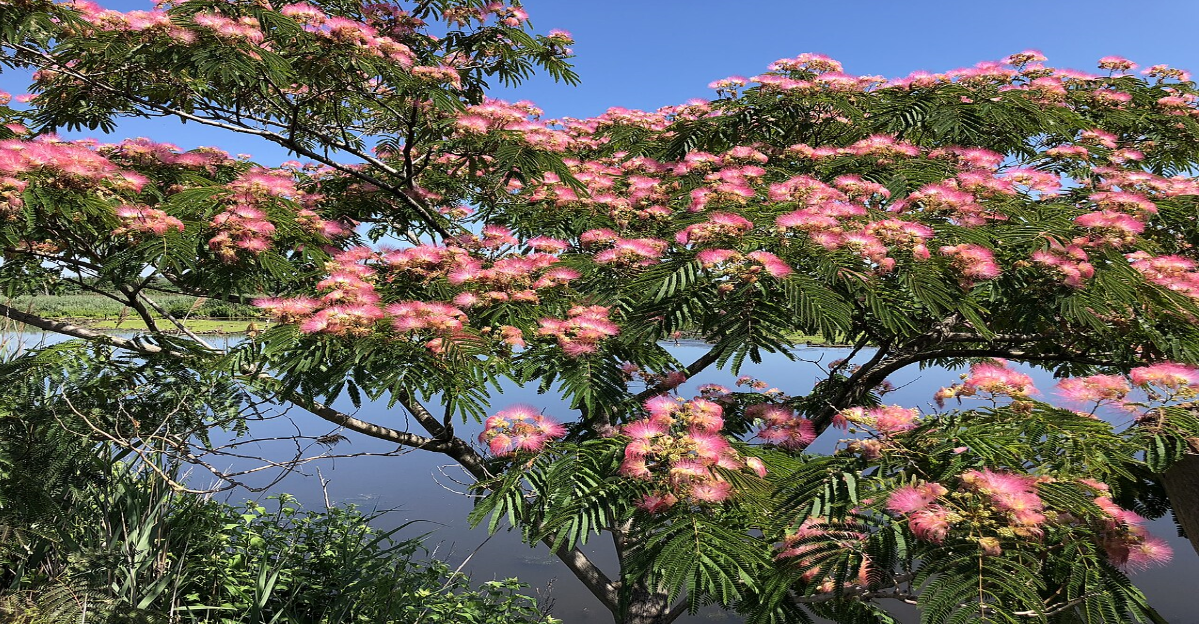
Leaves are alternate, large (20–50 cm), bipinnate (fern-like), with 4–12 (sometimes more) pairs of pinnae and many pairs of small oblong leaflets (about 7–15 mm long) that fold at night and when touched (nyctinasty). Flowers appear in summer as fragrant, powder-puff or starburst heads of numerous long pink stamens (white at the base). Fruit is a flat, papery, brown legume pod (about 10–20 cm) with several seeds. Native range: Iran/Transcaucasus through the Himalayas to China, Korea, and Japan. Widely planted and naturalized; often invasive in the southeastern United States and some other warm-temperate regions. Habitat: disturbed roadsides, riverbanks, thickets; prefers sun and well-drained soils.
Phytochemistry
Major classes include oleanane-type triterpenoid saponins (julibrosides J-series and related compounds, often with monoterpenoid acyl groups), lignans and neolignans, flavonoids (more abundant in flowers), phenolic acids, tannins, sterols, and polysaccharides. Bark is richer in saponins and lignans; flowers are richer in flavonoids. These metabolites underlie reported cytotoxic, anti-inflammatory, antioxidant, and CNS-modulating activities.
Western Traditional & Clinical Actions
Western herbal use emphasizes nervine, mild sedative, anxiolytic, mood-lifting, and vulnerary (wound-healing) effects. Practitioners use bark and flowers for grief, irritability, constrained emotion, insomnia of a restless or brooding type, and as a gentle adjunct for trauma-related swelling. Actions commonly listed: nervine, analgesic (mild), vulnerary. Evidence remains mostly traditional plus preclinical; robust standalone Western clinical data are limited.
Chinese Medicine Actions
He Huan Pi (bark) and He Huan Hua (flowers) are sweet and neutral; they enter the Heart and Liver (bark also Lung). Category: herbs that calm the Shen (spirit).
- Calm the Shen and relieve constraint (Liver Qi stagnation with irritability, depression, poor sleep, poor memory).
- Invigorate Blood and reduce swelling (trauma, fractures, sores, abscesses)—stronger with bark.
- Flowers emphasize moving constrained Liver Qi and lifting mood; bark adds Blood-moving and abscess-resolving actions.
Classic indication: “makes people happy” / “collective happiness.” Typical decoction doses: bark 6–15 g; flowers 4.5–9 g.
Traditional & Historical Uses
Recorded in Chinese sources from at least the early centuries CE (Shen Nong Ben Cao tradition and later materia medica) for melancholy, insomnia, forgetfulness, trauma, lung abscess, and sores. Related Albizia species appear in Ayurvedic and Unani practice (Shirisha / Siras), often for skin, respiratory, and inflammatory complaints; A. julibrissin and A. lebbeck have sometimes been used analogously. Japanese name “sleeping tree” refers to leaflet folding. Ornamental introduction to Europe in the mid-18th century (Filippo degli Albizzi).
Modern Pharmacological Evidence
Preclinical work supports:
- Antidepressant- and anxiolytic-like effects (serotonergic 5-HT1A involvement, monoamines, HPA axis, BDNF-related pathways in animal models).
- Sedative / sleep-related effects.
- Cytotoxic and anti-angiogenic activity of certain julibrosides against cancer cell lines.
- Anti-inflammatory and NO-inhibitory effects of lignans and phenolics.
- Immunomodulatory, antioxidant, hepatoprotective, and metabolic (e.g., SREBP-1c, adipocyte differentiation) activities.
- Wound-healing and antimicrobial effects in some extracts.
Mechanisms are multi-target and still incompletely mapped. Saponins can be irritant or more toxic by injection than by oral route.
Clinical Studies
Human evidence is sparse. Notable items include a small single-blind burn-wound trial comparing an A. julibrissin preparation with silver sulfadiazine (improved some symptoms and healing time in that study) and TCM clinical reports/formulae studies using He Huan-containing combinations for depression, often as adjuncts rather than monotherapy. WebMD and similar reviews classify uses for anxiety, depression, insomnia, and trauma as insufficiently evidenced. Larger, well-controlled trials of standardized single-herb products are lacking.
Preparations & Dosage
Traditional: decoction of bark (soak 20–30 min, simmer 20–30 min) or flowers. Modern: tincture (e.g., 1:2 or similar liquid extracts), capsules, granules, topical applications for wounds/sores.
Typical traditional ranges: bark 9–15 g/day (sometimes higher in TCM for severe insomnia/constraint); flowers 3–9 g. Commercial liquid extracts often suggest a few mL daily in divided doses—follow product labels and a qualified practitioner. Seed pods are not used medicinally and are described as toxic.
Safety & Contraindications
Generally regarded as well tolerated in traditional oral use of bark and flowers, but human safety data are limited. Caution or avoid in pregnancy (TCM texts note Blood-invigorating action and possible uterine stimulation for bark; insufficient data overall). Avoid or use caution with CNS depressants/sedatives (additive drowsiness). Stop before surgery (possible interaction with anesthesia). Allergy possible. Insufficient data for lactation. Seeds/pods should not be ingested. Not a substitute for emergency psychiatric or medical care.
Cultivation & Harvest
Full sun, well-drained soil of many types; drought-tolerant once established; hardy roughly USDA zones 6–9 depending on cultivar (‘Ernest Wilson’, ‘Ombrella’, ‘Summer Chocolate’, f. rosea). Fast growth; flowers young. Harvest bark in summer–autumn; flowers when fully open in summer. Dry in shade. Sustainable harvest matters because the species is invasive in some regions and short-lived/wilt-prone (Fusarium) in others. Seeds need scarification (hot water) for germination.
Commercial Products
TCM granules and raw herbs (He Huan Pi / Hua); Western tinctures and capsules (often labeled Albizia or mimosa); ornamental nursery stock and colored-leaf cultivars. Wood is used locally for light furniture. Not a source of a major single-molecule pharmaceutical. Quality and part used (bark vs flower) vary widely between products.
Ethnobotanical Curiosities
Chinese name 合欢 (“joined happiness”) and Japanese “sleeping tree” encode both mood and nyctinastic leaflets. Flowers have been used as tea and in mood formulas; the tree is a classic ornamental that later became a poster child for ornamental-to-invasive escape. In popular culture it appears as a poetic “tree of happiness.” Related Albizia saponins and alkaloids (in other species) have drawn separate phytochemical interest.
Recent Research (2020–2026)
Reviews through 2024–2025 synthesize antitumor, antidepressant, anxiolytic, anti-obesity, antimicrobial, and anti-inflammatory data. Newer work includes: lignans and SREBP-1c activity; bark polysaccharides with neuroprotective effects and ultrasound-extraction comparisons; a novel polysaccharide (AJDW) with PI3K-binding and anti-pancreatic-cancer activity in vitro and in xenografts; leaf extracts inhibiting adipocyte differentiation; cortex extract in an atopic-dermatitis model; stem-fiber characterization for biomaterials; and even aquaculture behavioral studies. Clinical translation still lags preclinical volume.
Conservation Status
IUCN: not evaluated (or not globally threatened). NatureServe global rank GNR. Native populations are not the conservation concern; the species is invasive in parts of the United States, Portugal’s invasive list, and other regions, where it outcompetes natives, resprouts after cutting, and produces abundant long-lived seed. Planting is discouraged or restricted in some jurisdictions. Harvest for medicine should not encourage further planting in invasion-prone areas.
DIY Recipes
Educational only—identify the plant correctly, use bark or flowers (not pods), and consult a practitioner if you have medical conditions or take medications.
- Flower tea (traditional mood/sleep tea): 3–6 g dried flowers steeped 10–15 min; 1 cup, not as a sole treatment for clinical depression.
- Bark decoction: 6–12 g dried bark simmered 20–30 min after soaking; used in TCM-style formulas, not as a high-dose solo experiment.
- Tincture idea (folk): fresh or dried flowers in mid-to-high proof alcohol, standard folk ratios; typical adult use is dropperfuls in water, not a standardized drug.
Do not use internally in pregnancy. Patch-test topicals.
X (Twitter) Snapshot – 2020–2026
Recent posts treat the tree as both invasive weed and “tree of happiness”: homemade flower teas and tinctures for stress, sleep, and grief; herbalists harvesting blossoms despite invasive status; TCM name-play (He Huan / “conjoined happiness”) in drama fandom; occasional mention of bark for pain or mood alongside other nervines. Tone is mostly experiential and aesthetic rather than clinical.
This monograph is informational, not medical advice. Standardization, part used, and individual response vary; evidence for many claimed uses is still preliminary.
Planting & Harvesting Reference Guide for Mimosa (Albizia julibrissin)
👈Planting & Harvesting Reference Guide:👇
Mimosa (Albizia julibrissin) – Planting & Harvesting Reference Guide
- Best Time for Planting
- After frost risk has passed and soil is workable; Mimosa wants warmth and full sun more than a cold, wet start.
- Do not plant Mimosa in jurisdictions where she is listed as invasive (especially much of the southeastern United States). There, work only with trees already standing.
- Where planting is appropriate (native or non-invasive range, or a contained garden already committed to her): sow scarified seed in spring, or set a young tree in spring after hard freeze is done.
- Seed from the flat brown pods is hard-coated. Nick the coat or pour near-boiling water over seed and soak until swollen before sowing. Do not eat or tea the pods; they are a planting material only, and a stewardship risk.
- Store dry seed cool and dry in a labeled jar. Do not toss leftover pods into clean compost or wild ground.
- Magical timing, if you use it: waxing moon for root-setting; Venus Friday or a warm bright day for a happiness-tree. This is contemporary folk timing, not a Chinese agricultural statute.
- Growing Conditions & Magical Minded Tips
- Full sun for bloom; light shade is tolerated but flowers thin.
- Well-drained soil of many kinds—poor, alkaline, even somewhat saline. Mimosa is a nitrogen-fixer and a pioneer, not a swamp tree. Skip the “riparian elm” picture; she likes heat, drainage, and open sky.
- Fast, vase-to-umbrella canopy, often 15–40 feet tall and as wide. Give her room; weak wood breaks in ice and wind.
- Space young trees far enough that umbrellas will not lock (roughly 20–30 feet if you must plant more than one).
- Mulch to hold moisture the first season; she is drought-tolerant once established. Compost in spring is enough; she makes her own nitrogen.
- Cultivars you may meet: f. rosea, ‘Ernest Wilson’, ‘Summer Chocolate’ (burgundy leaf). None of these cancel wilt or seed-spread by magic.
- Watch Mimosa wilt (Fusarium), webworm browning, ice-break, and a rain of pods. There is no Dutch elm disease on this tree.
- Whisper thanks before you set a root. Ask the land whether another Mimosa is a gift or a thicket. Offer water, a breath, or the promise that seed will not travel in your cuffs.
- Best Time for Harvesting Flowers
- High summer, when the pink silk is fully thrown—often June through August, by latitude.
- Gather at peak bloom, on a dry day, while bees and hummingbirds still work the canopy.
- Magical window: heat of day for the outward joy; dusk tea from the same day’s blossom to match the night-fold.
- Fresh flowers make the most fragrant tea; dry what you cannot use at once.
- Best Time for Harvesting Bark
- Late spring through summer, when the tree is in leaf and a pruning cut is clean—not midwinter deadwood if you can help it.
- Pharmacopoeial Chinese timing: collect bark in summer and autumn, sun-dry.
- Take bark from a limb already coming off, a storm-break, or a tree already marked for removal. Never girdle a living trunk.
- Mature wood is fine; age “10+ years” is not a hard Mimosa law. Sustainability is the law: a strip from a doomed or pruned limb, not a ring around a street tree you hope will live.
- Sustainable & Magical Harvesting Methods
- Flowers: bare hands or snips. They are thread; crush them and the silk bruises.
- Bark: a clean knife on a pruning cut. Peel what the cut already offered. Do not strip a standing bole “no more than 10%” as a loophole for girdling.
- Leave most of the canopy for pollinators. Take a basket, not a truck.
- Leave pods on the tree or bag them for trash if you are in an invasion zone. Do not “return seed to the land” where Mimosa is a pest.
- Ask permission. Sing low if you sing. Offer water at the roots. Do not pretend a silver athame is required; reverence is the tool.
- Label the harvest by part. Bark anchors; flower lifts. They are not one jar.
- Post-Harvest Processing
- Flowers: dry in shade on cloth until papery, perfume still a ghost of dusk. Store dark, dry, labeled. Use sooner rather than years later.
- Bark: wash grit, cut slivers or pieces, dry until snap-dry (sun is traditional in the pharmacopoeia; shade is kinder if you fear bleaching). Store cool, dark, dry.
- Tea: flowers steeped; bark decocted (often 10–15 minutes, then a rest).
- Tincture: fresh or dried flowers; dried bark. Keep the two separate or blend on purpose, not by accident.
- Powder bark only as needed. Do not grind pods into “flour.”
- Moonstone in the jar is optional contemporary folk magic. A tight lid and a true name on the label are the real charm.
Always prioritize ethical practice: plant Mimosa only where she belongs or is already wanted; harvest what already stands; keep seed out of clean ground; honor the night-sleeper by taking no more than the day’s honest work.
Healing Categories of Mimosa (Albizia julibrissin)
👈Mimosa (Albizia julibrissin): fits most strongly into the following healing categories, based on its traditional use, phytochemistry, clinical observations, and energetic profile:👇
Mimosa (Albizia julibrissin) — best-fit healing categories
Primary
- Spirit / Shen calming — Settles a restless Heart: irritability, brooding, the feeling that joy has left the house.
- Mood & emotional constraint — For grief, low mood, and Liver-Qi tightness in the chest, not as a slogan but as joined-happiness medicine.
- Sleep — Insomnia from emotion and an over-bright mind; the night-sleeper teaching inwardness at dusk.
- Grief & heartbreak — After loss, when mourning threatens to seal the Heart rather than move through it.
- Trauma of flesh and blood (bark) — Classical use to invigorate blood, ease swelling, and aid the aftermath of injury, abscess, or fracture language in TCM.
Secondary
- Nervous-system ease — Anxiolytic and antidepressant signals in the laboratory; gentle opening without a hammer.
- Memory & presence (flower) — Forgetfulness tied to constraint; flower-essence work of staying in the present beauty.
- Skin & tissue (external bark tradition) — Sores, swellings, and the old “reduce swelling” office of He Huan Pi.
- Land & pollinator medicine — Summer silk for bees and hummingbirds; stewardship as part of the healing, not an afterthought.
Healing Categories
Calm the Spirit (Shen)
Mimosa’s oldest official home. Bark anchors a spirit that has been driven out by worry; flower lightens a spirit that has grown too heavy to admit joy. Best when sleeplessness, irritability, and poor memory rise from pent-up feeling rather than from empty Blood or Yin alone.
Relieve Constraint / Lift Joined Happiness
He Huan means happiness held in common. This category is for the knotted chest, the quarrel that will not cool, the household weather of resentment. It is reconciliation medicine more than conquest medicine.
Sleep & the Night-Fold
Nemunoki, night-sleeper. Use when the person cannot go inward at dusk. Pair often in tradition with Ye Jiao Teng or Suan Zao Ren when the picture is insomnia from emotion.
Grief, Loss, and the Unsealed Heart
Not erasure of sorrow. Mimosa keeps the Heart from closing into armor. Flower for the lift after heartbreak; bark when the whole frame feels unmoored.
Move Blood, Reduce Swelling (Bark)
The second official Chinese office of He Huan Pi: trauma, pain and swelling, lung abscess and skin-sore language. Flower does not replace this. Part matters.
Neuro-emotional support (modern map)
Laboratory work on 5-HT1A, SERT lignans, GABA-A, and stress-axis calming sits here. It explains why the old Shen category still reads true. It does not turn Mimosa into a licensed single-extract drug.
Sensory / vibrational
Silk, dusk perfume, leaflets bowing. Flower essence and gazing work for those who need permission to feel without flooding. Start small; she can open a raw field.
Stewardship as healing
In invasion country, the healing act includes not planting new seed. A thicket is not a sacrament. Harvest what already stands.
Adapted question & perfect scenario
Adapted question
When the Heart cannot rest, when joy feels disloyal to grief, and when the chest is tight with words unsaid—what living plant practices both the closing of dusk and the opening of morning?
Perfect scenario
A person after loss or long constraint: sleep broken, temper close to the surface, affection present but unable to land. Evening. The leaflets of a standing Mimosa have begun to bow. A small cup of flower tea, or bark-and-flower in the classical range, taken without demanding cheer. Tomorrow the same Heart is still a Heart—only the room around the feeling is wider. No pregnancy. No pods in the cup. No new tree planted where the land cannot bear her. Rose or hawthorn nearby if the opening is too sudden. That is Mimosa’s best hour.
Synergistic & holistic note
Mimosa rarely works as a lone hero. Tradition pairs her with spirit-calming vines and seeds (Ye Jiao Teng, Bai Zi Ren, Suan Zao Ren), with Liver-softening companions when the chest is bound, and with blood-moving allies when bark is used after trauma. Holistically she asks for the same pairing in life: rest plus honest feeling, harvest plus restraint, bark plus flower—anchor and lift in one name. He Huan. Happiness joined, not happiness forced.
✨ If You Only Read U.S. Consumer Pages ✨
U.S. consumer pages usually flatten Mimosa (Albizia julibrissin) into a pink-flowered “happiness herb” or “herbal Prozac,” a dropper of bark-and-flower tincture for stress, and a warning that the same pretty tree is invasive in the Southeast. Those sentences are not invented. They leave almost everything official off the table. They rarely say that China wrote two separate pharmacopoeial drugs—bark and flower—from one species, with different constituent families and different classical jobs. They rarely say that in a single year of Taiwan’s insured TCM practice, Mimosa bark stood among the top individual herbs written for insomnia, in the same prescriptions as sour-jujube seed and fleeceflower vine. They rarely name the Korean receptor papers, the roughly 140 isolated compounds, the lignans that inhibit the serotonin transporter by a non-competitive route, or the chromosome-level genome now sitting in public databases. They almost never distinguish this silk tree from Mimosa pudica, yellow florist acacia, or Ayurvedic Albizia lebbeck, so a shopper can buy the wrong plant and think they have studied the right one. Reading only U.S. retail copy makes Mimosa look like a mood supplement growing too freely along the highway. Reading the official and clinical record makes it look like a two-part East Asian spirit medicine, a hospital granule ingredient, a quality-controlled Chinese crude drug, and a research plant whose human evidence is still catching up to its two thousand years of named use. Both pictures describe the same living tree. The second is the one most American seekers and shoppers are never shown.
Sources:
https://pubmed.ncbi.nlm.nih.gov/36509253/
https://pmc.ncbi.nlm.nih.gov/articles/PMC3095483/
https://bidd.group/TCMID/herb.php?herb=TCMH816
https://www.mdpi.com/1422-0067/26/16/7778
https://www.herbalreality.com/herb/albizia/
Globally: Where This Plant Is Studied
👈Global research, official texts, publishers, and human-trial data, rather than U.S.-consumer-page-limited:👇
Where This Plant Is Studied
Mimosa (Albizia julibrissin) is studied as an official East Asian materia medica plant and as a global ornamental-invasive tree—not as a U.S. wellness novelty. The densest medicinal chemistry and pharmacology have come from China, with important experimental clusters in Korea and clinical-practice epidemiology in Taiwan. Chinese work isolates julibrosides, lignans, flavonoids, and bark polysaccharides, maps antidepressant and antitumor mechanisms, and treats bark (He Huan Pi) and flower (He Huan Hua) as two pharmacopoeial drugs from one tree. Korean laboratories, especially groups publishing in Life Sciences and Pharmacology, Biochemistry and Behavior, established much of the modern 5-HT1A / elevated-plus-maze and tail-suspension picture of bark extracts. Taiwan’s National Health Insurance Research Database and China Medical University (Taichung) document how often Mimosa is actually prescribed for insomnia in a living health system. Japan preserves the tree as Nemunoki in horticulture and language and has explored bark-water extracts against clock-gene expression and daytime sleepiness. Iran and the wider West–Central Asian native range appear in botanical and phytochemical surveys; Europe appears mainly in quality-control fingerprinting of Chinese bark (Wagner–Bauer chromatographic analysis of Cortex Albiziae against the Pharmacopoeia of the People’s Republic of China) and in invasion ecology. United States output splits: herbal education and tincture culture on one side, USDA/extension invasion biology and a chromosome-level genome on the other. Field identity still tracks the old belt from Iran and the Caucasus across the Himalaya to China, Korea, and Japan—the same geography that first named the tree silk flower and collective happiness.
Sources:
https://pubmed.ncbi.nlm.nih.gov/36509253/
https://pmc.ncbi.nlm.nih.gov/articles/PMC10230641/
https://pmc.ncbi.nlm.nih.gov/articles/PMC6463593/
https://pmc.ncbi.nlm.nih.gov/articles/PMC3095483/
https://www.mdpi.com/1422-0067/26/16/7778
https://www.ncbi.nlm.nih.gov/datasets/genome/GCA_037074505.1/
Official Books That Name This Species
Mimosa (Albizia julibrissin) is named, split by plant part, and quality-described in official Chinese drug books. The Pharmacopoeia of the People’s Republic of China lists Silktree Albizia Bark—He Huan Pi, Cortex Albiziae—as the dried stem bark of Albizia julibrissin Durazz. (Fabaceae), collected in summer and autumn and sun-dried, with a legal description of quilled grey-brown bark, dense transverse lenticels, and a pale fibrous fracture. The same pharmacopoeia records the flower separately as He Huan Hua. That two-monograph structure is the official recognition that bark and blossom are not interchangeable commodities. The Taiwan Herbal Pharmacopoeia gives extracted-herb dosing used in island clinical practice. Classical books that still govern interpretation include the Shen Nong Ben Cao Jing (quiet the five viscera, harmonize heart and will, render a person happy and free of worry) and Li Shizhen’s Bencao Gangmu, together with later formula collections such as the Tai Ping Sheng Hui Fang (He Huan Hua Wan). Japanese and Korean scholarly materia medica use the names gōkanhi and haphwanpi; those are living East Asian drug names even when a seeker cannot assume a one-line Japanese Pharmacopoeia or Korean Herbal Pharmacopoeia monograph identical to the Chinese bark entry. Wagner, Bauer and colleagues treated Cortex Albiziae as a fingerprintable official Chinese drug in their chromatographic atlas. What is absent is also official information: there is no EMA HMPC well-established-use monograph, no European Pharmacopoeia cone-or-oil style definition, and no USP–NF dietary-supplement monograph comparable to licorice root. In Western law Mimosa remains a traditional herb and a dietary ingredient, not a licensed botanical NDA drug.
Sources:
https://bidd.group/TCMID/herb.php?herb=TCMH816
https://link.springer.com/chapter/10.1007/978-3-319-32328-2_1
https://content.e-bookshelf.de/media/reading/L-7642810-01f4a49b45.pdf
https://sacredlotus.com/go/chinese-herbs/substance/he-huan-pi-mimosa-tree-bark
https://unipub.uni-graz.at/obvugrhs/download/pdf/6712664
https://pmc.ncbi.nlm.nih.gov/articles/PMC6463593/
Who Publishes on It
Publication sits in two scholarly worlds that rarely speak on the same page. The first is ethnopharmacology and natural-products chemistry: Journal of Ethnopharmacology, Chinese Herbal Medicines, Molecules, Life Sciences, Pharmacology, Biochemistry and Behavior, International Journal of Molecular Sciences, and newer titles such as Glycoscience & Therapy. Elsevier, Springer, MDPI, Wiley, and Chinese medical presses carry the reviews that now tally roughly 140 isolated constituents and separate flower flavonoids from bark lignans and saponins. Author clusters include mainland Chinese materia medica and polysaccharide groups (including antitumor polysaccharide AJDW work associated with the Shanghai Institute of Materia Medica lineage), Korean behavioral-pharmacology teams that first made the 5-HT1A story internationally visible, and Taiwanese clinical-epidemiology groups mining insurance claims. The second world is horticulture, invasion biology, and genomics: USDA, state extension services, CABI/GISD, botanical gardens, and NCBI genome records. Official bodies that “publish” Mimosa without being journals include the China Pharmacopoeia Commission, Taiwan’s herbal pharmacopoeia editors, and hospital granule manufacturers (for example Sun Ten in Taiwan) who treat He Huan Pi / He Huan Hua as everyday dispensed drugs. Consumer-health sites reprint the words “happiness herb.” They are not the original publishers of either the pharmacopoeial definition or the receptor work.
Sources:
https://www.sciencedirect.com/science/article/abs/pii/S0378874122010418
https://www.mdpi.com/1422-0067/26/16/7778
https://pubmed.ncbi.nlm.nih.gov/37265761/
https://www.meandqi.com/knowledge-base/herbs/he-huan-pi
https://www.sciengine.com/GLYCOS/doi/10.1016/j.glycos.2025.100003
Human Trials Tied to This Species
Human evidence for Mimosa (Albizia julibrissin) is real, geographically specific, and still thinner than the animal literature. It is strongest as clinical use inside Chinese-medicine health systems, not as a Western single-extract Phase 3 program. In Taiwan, analysis of 2002 National Health Insurance TCM claims found 16,134 people treated with Chinese herbal medicine for insomnia and 29,801 prescriptions; He Huan Pi (Albizia julibrissin) was the fourth most common individual herb (about 10 percent of those prescriptions) and a frequent partner in the triple combination Suan-Zao-Ren-Tang + Mimosa + Ye Jiao Teng (Polygonum multiflorum vine). Later Taiwanese papers still call Mimosa one of the most prescribed Chinese herbs for insomnia on the island. That is observational practice-pattern evidence of a living drug, not a placebo-controlled trial of bark alone. In mainland China, reviews of antidepressant formulae collect hospital studies of Hehuan Granules, Jieyu Granules, and other multi-herb products scored on HAMD and sleep; a 2013 multicenter parallel-controlled trial of Mimosa flower versus venlafaxine (Shi Xue-Ling and colleagues, Journal of Practical Traditional Chinese Internal Medicine) reported comparable mood effect and a cognitive-function advantage for the flower arm. Those formula and flower trials matter, and they should be read as Chinese-language clinical literature with the usual limits of blinding, standardization, and reporting. A Japanese–Chinese patent line describes oral bark-water extract in human volunteers with clock-gene, KSS sleepiness, and VAS mood/alertness measures—exploratory physiology, not a registered international RCT. What has not appeared, as of the reviews through 2025–2026, is a large, independently replicated, Western-registry RCT of a single standardized Albizia julibrissin bark or flower extract against placebo for major depression or primary insomnia. Preclinical papers on 5-HT1A, SERT lignans, GABA-A, HPA axis, and BDNF remain the mechanistic spine. Honesty honors the plant: it is a prescribed official herb with formula-level human data and a still-open single-herb trial question.
Sources:
https://pmc.ncbi.nlm.nih.gov/articles/PMC3095483/
https://onlinelibrary.wiley.com/doi/10.1093/ecam/nep018
https://pmc.ncbi.nlm.nih.gov/articles/PMC6463593/
https://pmc.ncbi.nlm.nih.gov/articles/PMC10230641/
https://www.semanticscholar.org/paper/Study-on-the-Effects-of-Albizia-Julibrissin-Flower-Shi/8cba48f992be914bd1e5a50f64956d8df6b5e1f2
https://patents.google.com/patent/CN107890476B/en

Part 1: Modern Medical Properties and Uses

Purpose: Highlights the plant’s scientific and medicinal properties, validating holistic healing with evidence-based data.
Contemporary Medical Applications of Mimosa (Albizia julibrissin)
👈Contemporary Medical Applications: Describes current clinical uses (e.g., capsules, tinctures) and delivery methods in modern medicine.👇
Contemporary Medical Applications:
- Mimosa bark and flowers circulate today as Cortex Albiziae and Flos Albiziae in Chinese pharmacopeia practice, Western tinctures, liquid extracts, granules, and capsules aimed at constrained mood, restless sleep, irritability, and trauma-related swelling, with manufacturers commonly suggesting several milliliters of 1:2 liquid extract daily or capsule blends taken with meals rather than a single globally standardized dose.
- Traditional Chinese Medicine clinics still decoct He Huan Pi at roughly 6–15 grams and He Huan Hua at 3–9 grams, often pairing the bark with Ye Jiao Teng, Bai Zi Ren, or Yu Jin for insomnia and emotional constraint, while the flower is favored when the presentation emphasizes Liver Qi stagnation, chest oppression, and low mood.
- Topical and wound-oriented use persists in both folk and investigational settings: bark or extract preparations have been applied to boils, abscesses, bruises, and, in one clinical comparison, burn surfaces, reflecting the plant’s long dual identity as a Shen-calming and Blood-moving vulnerary.
- Western herbal product lines market dried-flower tinctures and “collective happiness” formulas as nervines for grief, anxiety, and sleep hygiene; suggested use is often 20–30 drops in water up to three times daily, with explicit distinction that flower products are not interchangeable with bark products.
- Delivery remains extract-driven rather than isolated-drug driven: aqueous decoctions, hydroalcoholic tinctures, spray-dried granules, and proprietary multi-herb capsules dominate, while purified julibrosides and polysaccharides stay in laboratory and early translational pipelines rather than routine pharmacy shelves.
- Veterinary and aquaculture experiments have begun testing bark aqueous extracts in feed for behavioral modulation, showing that contemporary interest now extends beyond human mood formulas into comparative physiology, even though those uses are not established clinical standards.
- Part distinction matters in practice: flowers lean toward uplifting constrained emotion and tea-like use; bark adds Blood invigoration, swelling reduction, and abscess indications, so modern formulas should specify the organoleptic and pharmacopeial identity of the material.
Sources: Contemporary Medical Applications
https://www.herbalreality.com/herb/albizia/
https://www.attiliodalberto.com/chinese-herbal-medicine/herbs/he-huan-pi.php
https://www.rxlist.com/supplements/albizia.htm
https://hawaiipharm.com/albizia-alc-extract
https://vitabase.com/ingredients/ingredient-silk-tree
https://www.drugs.com/npp/mimosa.html
https://sacredlotus.com/go/chinese-herbs/substance/he-huan-pi-mimosa-tree-bark
https://www.meandqi.com/knowledge-base/herbs/he-huan-pi
Pharmacology of Mimosa (Albizia julibrissin)
👈Pharmacology: Outlines key compounds and their mechanisms of action, driving therapeutic effects.👇
Pharmacology:
- Julibrosides, oleanane triterpenoid saponins carrying variable sugar chains and often monoterpenoid acyl groups at C-21, are repeatedly implicated in cytotoxic, anti-angiogenic, and membrane-active effects; structure–activity work shows that the outer monoterpenoid unit strongly influences potency against cancer cell lines.
- Serotonergic and GABAergic signaling help explain nervine actions: animal studies report 5-HT1A receptor involvement, shifts in serotonin, 5-HIAA, and dopamine, and anxiolytic-like behavior that can be blocked by selected receptor antagonists, aligning traditional “calms the Shen” language with monoamine and receptor pharmacology.
- Lignans and phenolic glycosides from stem bark inhibit nitric oxide production in LPS-stimulated macrophages, offering a mechanistic bridge between anti-inflammatory, antioxidant, and possible neuroimmune effects that accompany mood and wound indications.
- Flower flavonoids such as quercetin-related glycosides have been linked to sedative and sleep-prolonging effects in rodents, supporting the observation that He Huan Hua is not a chemically identical twin of He Huan Pi even though both calm constrained emotion.
- Polysaccharide fraction AJDW binds PI3K, dampens PI3K/Akt/mTOR phosphorylation, arrests pancreatic cancer cells in S phase, lowers mitochondrial membrane potential, and drives ROS-linked apoptosis in vitro and in patient-derived xenograft models, expanding the plant’s pharmacology beyond saponin cytotoxicity.
- Metabolic and dermatologic pharmacology is emerging: selected bark constituents inhibit SREBP-1c in hepatocyte models, leaf ethanol extracts suppress 3T3-L1 adipocyte differentiation markers, and cortex extracts reduce inflammatory cytokines and scratching in an atopic-dermatitis model via p38 MAPK-related pathways.
- Oral versus parenteral exposure matters: saponin-rich extracts can be far more toxic by injection than by mouth, reminding investigators that traditional decoction and tincture routes are not interchangeable with isolated high-dose saponin administration.
Sources: Pharmacology:
https://pmc.ncbi.nlm.nih.gov/articles/PMC12386540/
https://pubmed.ncbi.nlm.nih.gov/40869099/
https://www.mdpi.com/1420-3049/25/9/2065
https://www.sciencedirect.com/science/article/pii/S1674638423000199
https://www.sciencedirect.com/science/article/pii/S3050608525000035
https://pubmed.ncbi.nlm.nih.gov/36597895/
https://www.herbalreality.com/herb/albizia/
Natural Medicine Studies / Mimosa (Albizia julibrissin)
👈Natural Medicine Studies: Summarizes recent research on efficacy, safety, or clinical outcomes from peer-reviewed studies.👇
Natural Medicine Studies:
- A 2023 comparison review of Hehuan bark and flowers compiled roughly 140 isolated compounds and mapped antineoplastic, immunomodulatory, anti-inflammatory, anxiolytic, antidepressant, anti-insomnia, neuroprotective, hepatoprotective, and sedative activities across crude extracts and purified constituents, while stressing composition differences between parts.
- A 2025 pharmacological-spectrum review covering 2004–2024 literature organized julibrosides, flavonoids, and lignans against antitumor, antidepressant, anxiolytic, anti-obesity, antimicrobial, and antiparasitic endpoints, giving a current map of in vitro and in vivo work without claiming completed human drug development.
- Molecular-mechanism papers on depression models describe modulation of monoaminergic transmission, HPA-axis markers, BDNF signaling, and neuroimmune tone, and they catalog TCM formulae that include Albiziae Cortex with reported clinical use as adjuncts in depressive presentations.
- A small single-blind burn study compared an Albizia julibrissin preparation with silver sulfadiazine and reported improvements in pain, inflammation, purulent discharge, and healing time for second- and third-degree burns, with no major adverse reactions recorded in that cohort.
- Lignan isolation work from stem bark identified a new lignan alongside known furofuran, furan, and dibenzylbutane types; multiple isolates inhibited NO in RAW264.7 cells at low-micromolar IC50 values, supplying anti-inflammatory laboratory support for traditional sores and swelling uses.
- 2025 cortex-extract work in a DNCB atopic-dermatitis model reduced scratching, dermal thickness, serum IL-6, and infiltration of eosinophils, mast cells, and T cells, with high-dose groups also lowering p38 MAPK phosphorylation.
- Human monotherapy RCTs of standardized single-herb Mimosa remain limited; much of the clinical literature still concerns multi-herb formulae, so efficacy for isolated anxiety, depression, or insomnia products cannot yet be graded as definitively proven by large modern trials.
https://pubmed.ncbi.nlm.nih.gov/36509253/
https://www.sciencedirect.com/science/article/pii/S0378874122010418
https://pmc.ncbi.nlm.nih.gov/articles/PMC10230641/
https://wjps.ir/files/site1/user_files_c1050c/eng/azadbakhtm-A-10-323-1-cc807a4.pdf
https://www.mdpi.com/1420-3049/25/9/2065
https://www.sciencedirect.com/science/article/abs/pii/S0254629925001541
https://pubmed.ncbi.nlm.nih.gov/40869099/
Sources: Natural Medicine Studies:
Chemistry of Mimosa (Albizia julibrissin)
👈Chemistry: Details active chemical constituents (e.g., alkaloids, flavonoids) and their healing roles.👇
Chemistry:
- The bark is a rich source of oleanane saponins based on acacic or related sapogenins, including numerous julibrosides (J8, J21, J28–J31, J37–J46 and analogues) that differ in oligosaccharide substitution at C-3 and C-28 and in monoterpenoid glycosyl decoration at C-21.
- Lignans from stem bark include furofuran types such as pinoresinol and syringaresinol glycosides, furan-type lariciresinol relatives, dibenzylbutane lignans including the newer julibrissinoside structures, and neolignans, many first reported from this species or family in 2020 isolation campaigns.
- Flowers concentrate flavonoids, monoterpenoids, and volatile constituents (linalool-related oxides, ocimene-type notes) together with phenolic acids, helping explain why flower tea and flower tincture chemistry is not identical to bark decoction chemistry.
- Phenolic acids, gallic and protocatechuic relatives, formononetin, scopoletin, fatty acids such as linoleic and palmitic acids, and sterols appear across extracts and contribute antioxidant and metabolic assay activity.
- Neutral polysaccharides such as AJDW contain mannose, glucose, galactose, xylose, and arabinose, with 1,4,6-Glcp and 1,4-Manp among abundant residues; ultrasound versus hot-water extraction changes yield, chain conformation, and reported neuroprotective potency of bark polysaccharide fractions.
- Tannins accompany the saponin-lignan complex in bark and add astringency relevant to topical and wound traditions; seeds and pods are chemically and toxicologically distinct from the official medicinal bark and flowers and are not used as food-medicine in the same way.
- About 140 compounds have been catalogued from bark and flowers combined, yet many remain incompletely quantified in commercial extracts, so chemical identity of a given tincture still depends on plant part, solvent, and processing.
Sources: Chemistry:
https://pmc.ncbi.nlm.nih.gov/articles/PMC12386540/
https://www.mdpi.com/1420-3049/25/9/2065
https://pubmed.ncbi.nlm.nih.gov/36597895/
https://www.sciencedirect.com/science/article/abs/pii/S0367326X17309668
https://pubmed.ncbi.nlm.nih.gov/25282893/
https://sys01.lib.hkbu.edu.hk/cmed/mpid/detail.php?lang=eng&herb_id=D00911
https://www.sciencedirect.com/science/article/pii/S3050608525000035
Functional Foods and Nutrition / Mimosa (Albizia julibrissin)
👈Functional Foods and Nutrition: Highlights dietary uses (e.g., teas, supplements) in modern health practices.👇
Functional Foods and Nutrition:
- Dried silk-tree flowers are brewed as a fragrant tea in contemporary herbal kitchens and sold as “happiness flower” infusions intended for evening relaxation; this is a culinary-herbal crossover rather than a staple macronutrient food.
- Commercial dietary-supplement practice includes flower tinctures in glycerin-alcohol bases, bark-inclusive capsules, and TCM granules taken in warm water, positioning Mimosa as a functional botanical rather than a calorie-bearing food crop.
- Nutritional composition of the edible flower infusion is not a complete dietary protein or vitamin source; interest centers on flavonoid and aromatic fractions rather than established RDA-level nutrient density, so claims should stay in the realm of traditional beverage use.
- Folk mocktails and sparkling-water preparations using fresh-flower tincture appear in modern herbal social practice, treating the blossom as a seasonal aromatic nervine rather than a salad green or grain substitute.
- Seed pods are not functional foods; they are repeatedly described as toxic relative to bark and flowers, and they should not be improvised into snacks, flours, or homesteading protein experiments.
- Pairing in food-like preparations often follows TCM logic—flowers with other gentle spirit-calming botanicals in teas—rather than Western nutraceutical stacking with isolated vitamins, keeping the plant in a whole-extract dietary niche.
- Limited data exist on caloric value, amino-acid completeness, or mineral contribution of bark or flowers as everyday foods; available literature treats them as medicinal botanicals consumed in tea or extract form, not as dietary staples.
Sources: Functional Foods and Nutrition:
https://www.herbalreality.com/herb/albizia/
https://hawaiipharm.com/albizia-alc-extract
https://vitabase.com/ingredients/ingredient-silk-tree
https://www.drugs.com/npp/mimosa.html
https://www.rxlist.com/supplements/albizia.htm
https://sys01.lib.hkbu.edu.hk/cmed/mpid/detail.php?lang=eng&herb_id=D00911
Current Projects and Future Possibilities / Mimosa (Albizia julibrissin)
👈Current Projects and Future Possibilities: Notes ongoing research, clinical trials, or innovative medical applications.👇
Current Projects and Future Possibilities:
- Isolation of polysaccharide AJDW and demonstration of PI3K binding with anti-pancreatic-cancer activity in cell and patient-derived xenograft models opens a path toward polysaccharide-based leads distinct from classical julibroside saponin cytotoxicity.
- Ultrasound-assisted extraction studies on bark polysaccharides are refining yield, conformation, thermostability, and neuroprotective readouts in oxygen-glucose-deprivation cell models, suggesting process chemistry can change bioactivity of the same plant part.
- Leaf ethanol extracts that suppress PPARγ, C/EBPα, and SREBP during 3T3-L1 differentiation point toward metabolic and anti-obesity screening programs that complement the older CNS and antitumor literature.
- Atopic-dermatitis and burn-healing studies keep topical and dermatologic development alive, including possible standardized cortex extracts for inflammatory skin presentations that traditional texts already associated with sores and swelling.
- Stem-fiber characterization (crystallinity, tensile strength, thermal stability, modest antibacterial zones) explores Mimosa as a sustainable biomaterial, widening “plant medicine” into green materials without abandoning medicinal chemistry.
- Formulae research continues to document Albizia-containing granules and classical combinations used alongside conventional antidepressants in clinical practice reports, inviting better-controlled add-on trials rather than isolated-herb megatrials alone.
- Future work still needed includes pharmacokinetics of key saponins and lignans after oral decoction, quality standards that distinguish bark from flower, and rigorously designed human studies that match the depth of the 2020–2026 preclinical wave.
Sources: Current Projects and Future Possibilities:
https://www.eurekalert.org/news-releases/1091540
https://www.sciencedirect.com/science/article/pii/S3050608525000035
https://www.sciencedirect.com/science/article/pii/S1350417725003876
https://www.kci.go.kr/kciportal/landing/article.kci?arti_id=ART003249426
https://www.sciencedirect.com/science/article/abs/pii/S0254629925001541
https://www.sciencedirect.com/science/article/pii/S2590123024019807
https://pubmed.ncbi.nlm.nih.gov/37265761/
Literary Mentions of Mimosa (Albizia julibrissin)
👈Literary Mentions: References modern medical texts or studies citing the plant’s therapeutic use.👇
Literary Mentions:in ancient texts
- The Shen Nong Ben Cao Jing (Divine Farmer’s Classic of Materia Medica), compiled in the Han milieu and transmitted as the fountainhead of Chinese herbal classification, records He Huan as calming the five zang, harmonizing Heart and will, and making one “joyful and free of worry,” the locus classicus for the plant’s spirit-lifting reputation.
- In the same classical grading tradition, He Huan is treated among middle-grade medicinals that cultivate temperament—resolving anger—placed beside Xuan Cao (daylily) in the proverb that one dispels sorrow while the other eliminates resentment.
- Li Shizhen’s Bencao Gangmu adds Blood-harmonizing, swelling-reducing, and pain-stopping language, knitting the emotional indication to trauma, fracture, and carbuncle uses that later pharmacopeias kept for the bark.
- Bencao Huiyan describes sweet, mild He Huan Pi as opening the five spirits and dispelling the five emotions, easing Heart Qi so that Shen flows and joy returns without worry, a psychological reading that modern nervine practice still echoes.
- Later compendia and regional handbooks preserve aliases such as Yehe, dusk tree, and related night-folding names, and they extend indications to restlessness, melancholy, insomnia, lung carbuncle, rash, cough, and sinew contracture.
- Tai Ping Sheng Hui Fang preserves He Huan Hua Wan-type combinations for chronic leg and low-back pain with Niu Xi, Hong Hua, Xing Ren, and Gui Zhi analogues, showing the flower entered official formula literature rather than remaining only a folk tea.
- Cross-cultural literary threads appear where Indian sources discuss related Albizia (Shirisha/Siras) for mind, skin, and respiratory complaints, and where later translators treat Chinese He Huan and certain Indian siris uses as analogical rather than identical species monographs.
Sources: Literary Mentions:
https://www.meandqi.com/knowledge-base/herbs/he-huan-pi
https://www.herbalreality.com/herb/albizia/
https://www.medicinetraditions.com/albizia-cortex-he-huan-pi-pro.html
https://www.chinawiki.net/thread/23/301.html
https://www.medicinetraditions.com/albizia-flos-he-huan-hua-pro/
https://archive.org/download/shouzhongyang1998thedivinefarmersmateriamedicaatranslationoftheshennongbencaojing/Shou-Zhong%20Yang%20-1998-%20The%20Divine%20Farmer%27s%20Materia%20Medica%20-%20A%20Translation%20of%20the%20Shen%20Nong%20Ben%20Cao%20Jing.pdf
https://sacredlotus.com/go/chinese-herbs/substance/he-huan-pi-mimosa-tree-bark
https://pubmed.ncbi.nlm.nih.gov/36509253/

Part 2: Plant Knowledge Systems

Purpose: Validates plant-based healing through interdisciplinary scientific and cultural fields.
Ethnobotany of Mimosa (Albizia julibrissin)
👈Ethnobotany: Explores the plant’s traditional uses across cultures, linking indigenous knowledge to modern applications.👇
Ethnobotany:
- Across East and West Asia, Mimosa has been gathered as two complementary medicines from one tree: bark (He Huan Pi) to “anchor” a constrained Heart and Liver spirit, and flowers (He Huan Hua) to lift mood and move stagnant Qi. Han-period Shen Nong Ben Cao Jing language—“makes one joyful and free of worry”—still shapes how Chinese, Korean, and Japanese practitioners prescribe Mimosa for grief, irritability, brooding insomnia, and poor memory, while later materia medica added Blood-moving uses for bruises, fractures, lung abscess, and sores that modern vulnerary and anti-inflammatory research now investigates.
- In South Asian systems the picture is analogical rather than identical: Unani Siras and Ayurvedic Shirisha more often name Albizia lebbeck, yet Indian sources have treated Mimosa and related siris trees as interchangeable for mind, skin, respiratory, and trauma complaints, including Charaka-linked uses for migraine, asthma formulas with long pepper and honey, and external ghee applications for erysipelas. This cross-mapping explains why a seeker will find Mimosa in Chinese Shen formulas and a cousin Albizia in Indian skin and breath formulas without the two traditions being chemically or botanically the same monograph.
- European and American ethnobotany of Mimosa is younger and ornamental-first: introduced mid-eighteenth century via Filippo degli Albizzi and later widely planted in the United States, the tree entered Western herbalism as “collective happiness bark,” “herbal Prozac” in popular speech, and a flower tincture for grief and stress. Contemporary wildcrafters in invasion-prone regions now harvest blossoms that landscapers once only admired, converting an escaped garden tree into a seasonal nervine while arguing that use of an already-naturalized species can be stewardship rather than further planting.
- Japanese naming—nemunoki, nemurinoki, “sleeping tree”—encodes observed nyctinasty: leaflets fold at night and when touched. That ecological behavior became cultural metaphor for rest and inward gathering, reinforcing why Mimosa flowers are steeped as evening tea and why bark is classed with Heart-calming herbs rather than with purely stimulant tonics.
- Agroforestry and folk-economy uses travel beside the medicine: leaves as fodder, flowers as bee forage, wood for light furniture, and bark or flower teas as household nervines. These utilitarian layers kept Mimosa visible in village and garden life from Iran to Japan even when the official indication remained emotional constraint and swelling, so modern capsules and tinctures sit on top of a much older human–tree relationship rather than replacing it.
Sources: Ethnobotany:
https://www.herbalreality.com/herb/albizia/
https://www.medicinetraditions.com/albizia-cortex-he-huan-pi-pro/
https://www.medicinetraditions.com/albizia-flos-he-huan-hua-pro/
https://plants.ces.ncsu.edu/plants/albizia-julibrissin/
https://tonicherbshop.com/mimosa/
https://www.attiliodalberto.com/chinese-herbal-medicine/herbs/he-huan-pi.php
http://www.worldagroforestry.org/treedb/AFTPDFS/Albizia_julibrissin.PDF
https://en.wikipedia.org/wiki/Albizia_julibrissin
Plant Genomics of Mimosa (Albizia julibrissin)
👈Plant Genomics: Describes genetic studies of the plant, focusing on traits related to medicinal properties.👇
Plant Genomics:
- Mimosa now has a chromosome-level nuclear reference genome. Assembly ASM3707450v1 (GenBank GCA_037074505.1), produced with PacBio HiFi and Hi-C by the Agricultural Genomics Institute at Shenzhen and released in 2024, is approximately 705 Mb across 13 chromosomes, with contig N50 about 43 Mb, scaffold N50 about 55.5 Mb, GC content near 34.5 percent, and annotation of roughly 40,866 predicted genes. BioProject PRJNA1005079 and WGS project JAYWLI01 make the tree searchable in public databases rather than known only from herbarium morphology.
- That nuclear genome sits inside a 2024 comparative project on seven Caesalpinioideae trees. Phylogeny places Mimosa in the faster-evolving mimosoid clade; macrosynteny links its 13 chromosomes to an ancestral pattern of chromosome fusion and breakage that explains the 13-versus-14 chromosome counts across the subfamily. After a shared ancient whole-genome duplication around 72 million years ago, lineage-specific histories of gene retention become a map for secondary-metabolite genes, including pathways that produce triterpenoid saponins of the julibroside type so central to Mimosa pharmacology.
- The chloroplast genome of Mimosa was assembled earlier (Zhang et al., Planta, 2021; NCBI MW539046.1). It is 175,922 bp in the classic quadripartite layout: large single-copy region 91,323 bp, small single-copy region 5,145 bp, and two inverted repeats of 39,725 bp each, with 93 unique coding genes plus 30 tRNA and 4 rRNA genes, 36.9 percent GC, 149 simple sequence repeats, and 55 predicted RNA-editing sites. Those plastid data supply barcodes and phylogenetic anchors for authenticating He Huan crude drugs versus related Albizia species.
- Medicinal-genomics value is still emerging rather than finished. Public assemblies and transcriptomic reads now allow investigators to hunt saponin-biosynthesis genes, lignan and flavonoid pathway members, and quality-marker loci for bark-versus-flower chemistry. A full, published gene-to-julibroside map comparable to the saponin gene set reported for Gleditsia sinensis in the same 2024 paper is not yet the center of Mimosa literature, so claims should stay at “genomic resources exist and are being used,” not “every medicinal enzyme is functionally proven.”
- Additional chloroplast sampling by Chinese materia medica resource centers (for example NGDC biosamples under medicinal-plant plastome projects) shows Mimosa is being treated as a sequenced official herb, not only an ornamental. Combined nuclear, plastid, and forthcoming population data can eventually distinguish cultivars such as ‘Summer Chocolate’ or f. rosea from wild-type medicinal bark—an authentication need created by global trade and look-alike Albizia species.
Sources: Plant Genomics:
https://www.ncbi.nlm.nih.gov/datasets/genome/GCA_037074505.1/
https://pubmed.ncbi.nlm.nih.gov/38733080/
https://pmc.ncbi.nlm.nih.gov/articles/PMC11412931/
https://pubmed.ncbi.nlm.nih.gov/34940902/
https://link.springer.com/article/10.1007/s00425-021-03812-z
https://www.ncbi.nlm.nih.gov/nuccore/MW539046
https://ngdc.cncb.ac.cn/biosample/browse/SAMC200359
Phytotherapy of Mimosa (Albizia julibrissin)
👈Phytotherapy: Details the plant’s use in clinical herbal medicine, including therapeutic protocols.👇
Phytotherapy:
- Clinical herbal protocols treat Mimosa as a gentle, medium-duration nervine rather than a one-dose hypnotic. Standard TCM decoction ranges are bark 6–15 g and flowers 3–9 g after a 20–30 minute soak and a 20–30 minute simmer in non-metallic vessels; classical and clinical notes allow much higher bark amounts (30–60 g, occasionally reported higher) when the target is lung abscess or severe inflammatory swelling, always under practitioner supervision because strength scales with dose.
- Pattern matching guides part and partners. Bark is chosen when the spirit needs anchoring plus Blood movement after trauma, fracture, or sores; flowers are chosen when constrained Liver Qi shows as irritability, chest oppression, poor appetite, and brooding insomnia. Frequent combinations include Ye Jiao Teng for sleep and emotion, Bai Zi Ren when Heart Yin is also dry, and blood-moving herbs such as Hong Hua or Niu Xi when pain and stasis dominate.
- Western phytotherapy translates the same plant into tincture math: dried-flower extracts often at 1:2 in about 50 percent alcohol; dried-bark extracts often at 1:5; drop doses from 10 drops to 5 mL one to four times daily, or 20–30 drops (about 1 mL) in water up to three or four times daily on commercial labels. Evening timing is common when the complaint is emotionally driven sleeplessness rather than purely muscular tension.
- Granule and capsule practice in TCM clinics uses pharmaceutical-grade He Huan Pi inside individualized formulas for low-grade anxiety with sleep disturbance, post-bereavement constraint, and perimenopausal mood lability. Western product lines sell single-herb bark or flower liquids and multi-herb “happiness” blends; the clinical point is to name the part on the label, because flower chemistry (flavonoids, aromatics) is not identical to bark chemistry (saponins, lignans).
- Safety in protocol form: avoid or use only with qualified care in pregnancy because bark is classed as Blood-invigorating; use caution with sedatives and serotonergic medicines; stop before planned surgery; do not ingest seed pods; expect a mild taste and a need for days-to-weeks of use for Shen indications rather than an immediate knockout effect. Human monotherapy RCTs remain fewer than formula reports and preclinical studies, so phytotherapy still rests on traditional dose ranges plus emerging pharmacology.
Sources: Phytotherapy:
https://www.herbalreality.com/herb/albizia/
https://www.meandqi.com/knowledge-base/herbs/he-huan-pi
https://tonicherbshop.com/mimosa/
https://www.medicinetraditions.com/albizia-cortex-he-huan-pi-pro/
https://www.attiliodalberto.com/chinese-herbal-medicine/herbs/he-huan-pi.php
https://seralene.com/ingredients/albizzia-julibrissin
https://herbalterra.com/he-huan-pi-aex
Ethnoecology of Mimosa (Albizia julibrissin)
👈Ethnoecology: Examines the plant’s ecological role in cultural practices and environmental interactions.👇
Ethnoecology:
- In its native belt from Iran and the Caucasus through the Himalaya to China, Korea, and Japan, Mimosa occupies open sunny ravines, woodland edges, and river margins, often to substantial elevation. As a nodulated Fabaceae tree it fixes atmospheric nitrogen with rhizobial partners, sheds nutrient-rich litter, and can improve poor or alkaline soils—an ecological service that agroforestry databases record as soil improver, fodder tree, and bee-forage species, and that older reclamation plantings on mined or scoured ground deliberately exploited.
- Cultural ecology and invasion ecology now collide. The same traits that made Mimosa a beloved courtyard and roadside ornamental—fast growth, heat and drought tolerance, abundant seed, resprouting after cut or fire—allow dense stands on southeastern United States roadsides, riparian edges, and vacant lots, where the tree shades natives, alters nutrient regimes, and is listed by invasive-plant councils. Ethnoecological practice therefore splits: harvest of already-naturalized flowers and bark versus new ornamental planting that feeds further spread.
- Nyctinastic leaflets and summer powder-puff inflorescences structure human attention. Night-folding leaves taught Japanese “sleeping tree” names; pink stamens taught Persian “silk flower” etymology and Chinese “joined happiness” poetry. Pollinators—bees, butterflies, hummingbirds—turn the canopy into a seasonal commons, so folk medicine, apiculture, and garden aesthetics share one phenology rather than occupying separate landscapes.
- Disease and disturbance further shape the relationship. Mimosa vascular wilt (Fusarium) shortens many planted lives in the eastern United States, while weak wood breaks in ice and wind. People respond with cultivar breeding (colored foliage, compact habit, attempts at reduced seeding) and with municipal bans in some cities. The living tree is thus both healer and weedy guest, and responsible ethnoecology means using existing biomass without expanding the invasion front.
- Fire, flammability of litter, and seed-bank longevity add another layer: dense Mimosa thickets can change local fire behavior and persist after top-kill by resprouting. Cultural users who collect bark must therefore think like land stewards—taking strips from mature stems on already-invaded sites, leaving reproductive individuals unplanted in sensitive habitats, and treating pods as ecological risk rather than food.
Sources: Ethnoecology:
https://bplant.org/plant/8984
http://www.worldagroforestry.org/treedb/AFTPDFS/Albizia_julibrissin.PDF
https://www.iucngisd.org/gisd/pdf.php?sc=364
http://www.hear.org/Pier/species/albizia_julibrissin.htm
https://plants.ces.ncsu.edu/plants/albizia-julibrissin/
https://www.balkep.org/albizia-julibrissin.html
https://silberkraft.com/pages/l/albizia-julibrissin
Anthroposophical Medicine of Mimosa (Albizia julibrissin)
👈Anthroposophical Medicine: Outlines the plant’s use in Steiner-inspired remedies, including preparation, studies, and dosage.👇
Anthroposophical Medicine:
- Limited data: Mimosa (Albizia julibrissin) does not appear as a named, widely catalogued Weleda, WALA, or Uriel specialty remedy in the standard anthroposophic materia medica the way Aurum/Lavandula, Citrus/Cydonia, or mistletoe preparations do. No Steiner lecture cycle or Ita Wegman clinic monograph dedicated solely to this East Asian silk tree was located in searchable English sources; seekers should not invent a canonical anthroposophic Mimosa potency schedule that the literature does not record.
- The system itself, founded in the 1920s by Rudolf Steiner and Ita Wegman, would theoretically meet Mimosa through its fourfold reading of the human being—physical body, etheric/life organization, astral/soul organization, and I-organization—and through pharmacy that uses plant, mineral, and animal substances, sometimes rhythmically processed or potentized per the Anthroposophic Pharmaceutical Codex and related pharmacopoeias. A tree whose leaves “sleep,” whose flowers are silk-like soul gestures, and whose bark is used in other traditions to ease constrained feeling would invite an anthroposophic gesture analysis of life processes versus astral overwhelm, but that analysis remains analogical until a manufacturer monograph exists.
- Anthroposophic clinics already employ other plant nervines and external applications (for example Weleda Aurum/Lavandula cream for anxiety-tinged sleep and functional heart unrest) when the aim is to strengthen the patient’s own healing activity rather than to suppress a symptom in isolation. A practitioner working integratively could, in principle, use a simple herbal Mimosa decoction or tincture alongside anthroposophic nursing, eurythmy, or external applications, clearly labeled as phytotherapy rather than as a registered anthroposophic specialty medicine.
- Preparation and dosage in the Steiner–Wegman stream are individualized and often potentized; without a published Mimosa monograph one cannot cite a house D or LM potency, a WALA rhythmic process, or a Weleda drop count specific to this species. The honest clinical stance is: use established TCM or Western herbal dose ranges if Mimosa is chosen as a botanical, and do not claim anthroposophic manufacturing validation that has not been documented.
- Future possibility, not present fact: as chromosome-level genomics and saponin pharmacology mature, anthroposophic pharmacists who already work with complex plant processes could study Mimosa’s nyctinasty and Heart–Liver traditional picture as a candidate for rhythmic extraction. Until such work is published, Anthroposophical Medicine contributes a holistic framework for reading the tree, not a finished Mimosa product line.
Sources: Anthroposophical Medicine:
https://pmc.ncbi.nlm.nih.gov/articles/PMC3865373/
https://www.weleda.co.nz/magazine/health/anthroposophic-medicine
https://steinerhealth.org/anthroposophic-medicine/
https://thalira.com/blogs/quantum-codex/anthroposophic-medicine-steiner
https://www.herbalreality.com/herb/albizia/
https://www.medicinetraditions.com/albizia-cortex-he-huan-pi-pro/

Part 3: Heritage and Practice

Purpose: Weaves historical and cultural heritage with practical guidance for medicinal use.
Historical and Cultural Significance of Mimosa (Albizia julibrissin)
👈Historical and Cultural Significance: Explores the plant’s role in historical and cultural medical practices.👇
Historical and Cultural Significance:
- Mimosa entered written medicine in the Han-period Shen Nong Ben Cao Jing as He Huan, the tree that calms the five zang, harmonizes Heart and will, and “makes one joyful and free of worry.” That phrase is not a modern marketing slogan; it is the oldest surviving official character of the plant, later echoed in the folk pairing “daylily dispels sorrow, Mimosa eliminates resentment.” Li Shizhen’s Bencao Gangmu then bound the emotional indication to Blood-harmonizing, swelling-reducing, and pain-stopping uses, so Mimosa became both a spirit herb and a trauma herb in the same cultural line.
- The botanical name itself is a European court story laid over an Asian tree. Antonio Durazzini described Mimosa in 1772; the genus honors Filippo degli Albizzi, who brought seed from the East through Constantinople into Tuscany in the mid-eighteenth century. The epithet julibrissin Latinizes Persian gul-i abrisham, “silk flower.” Thus one species carries Chinese “joined happiness,” Persian silk, Japanese “sleeping tree,” and an Italian noble’s name—an unusually dense map of how an Asian medicinal and ornamental tree was renamed each time it crossed a court or a language.
- In gardens from Florence to the American South, Mimosa became a public tree of summer heat: umbrella crown, fragrant pink stamens, late leaf-out that fooled spring pruners. That ornamental fame later created the invasive roadside stands from which contemporary herbalists now gather flowers. Historical significance therefore includes both temple and pharmacopeia use in East Asia and the later paradox of a beloved shade tree that escaped the estate and re-entered folk medicine as wildcrafted “happiness bark.”
- Japanese nemunoki culture treats leaflet folding as a nightly lesson in rest. The same nyctinasty that botanists measure as pulvinus movement became a literary and household image of withdrawal into sleep, reinforcing why flowers are evening tea and why bark is classed with Heart-calming medicines rather than with midday stimulants.
- Official Chinese pharmacopeia still lists bark and flowers separately, preserving a two-part heritage: He Huan Pi for anchoring Shen and moving Blood, He Huan Hua for lifting constraint. That split, stable from classical texts through modern granules, is the cultural reason Western bottles must name the plant part or they erase half the history.
Sources: Historical and Cultural Significance:
https://www.herbalreality.com/herb/albizia/
https://www.meandqi.com/knowledge-base/herbs/he-huan-pi
https://en.wikipedia.org/wiki/Albizia_julibrissin
https://www.medicinetraditions.com/albizia-cortex-he-huan-pi-pro/
https://plants.ces.ncsu.edu/plants/albizia-julibrissin/
Indigenous and Traditional Systems / Mimosa (Albizia julibrissin)
👈Indigenous and Traditional Systems: Details its use in specific indigenous or traditional healing systems.👇
Indigenous and Traditional Systems:
- Traditional Chinese Medicine remains the densest living system for Mimosa. Sweet and neutral, bark enters Heart, Liver, and often Lung; flowers enter Heart and Liver. Category: herbs that calm the Shen. Indications are constraint from pent-up emotion—irritability, depression, poor memory, insomnia—with bark adding trauma swelling, fracture pain, lung abscess, and sores. Dosage culture is explicit: flowers about 3–9 g, bark commonly 6–15 g, with classical notes that small doses may feel weak and that abscess work has used much higher bark amounts under supervision.
- Korean and Japanese traditional practice keep the same species in the same Shen-calming family, with Korean Habkwanpi and Japanese bark/flower use for restlessness and melancholy. The Japanese “sleeping tree” image and East Asian night-folding observation feed the same clinical intuition: Mimosa gathers what has been scattered by worry.
- Ayurveda and Unani more often officialize Albizia lebbeck as Shirisha or Siras, yet Indian sources have treated Mimosa as analogous for mind, skin, breath, and external sores. Charaka-linked threads include migraine, asthma formulas with long pepper and honey, and ghee applications for erysipelas. The honest comparative point is cousinship, not identity: a seeker should not swap Chinese He Huan Pi wholesale for every Shirisha monograph without checking the species on the bag.
- Western herbalism absorbed Mimosa late, after ornamental naturalization. Contemporary clinical herbalists use bark tincture to “anchor” grief and flower tincture to lighten constraint, often pairing Mimosa with other nervines rather than using it as a standalone knockout sedative. Popular nicknames such as “herbal Prozac” are folk speech, not traditional system doctrine; the older systems speak of joy without worry and of unblocking constrained Qi.
- Limited data exist for a distinct, named Indigenous North American pre-contact tradition of this Asian tree, because Mimosa is an introduced species there. Present-day use by foragers on invaded roadsides is a new-world practice layered onto old-world systems, not a replacement origin story.
Sources: Indigenous and Traditional Systems:
https://www.herbalreality.com/herb/albizia/
https://www.medicinetraditions.com/albizia-cortex-he-huan-pi-pro/
https://www.medicinetraditions.com/albizia-flos-he-huan-hua-pro/
https://www.attiliodalberto.com/chinese-herbal-medicine/herbs/he-huan-pi.php
https://tonicherbshop.com/mimosa/
https://www.meandqi.com/knowledge-base/herbs/he-huan-pi
Folklore and Culinary Traditions of Mimosa (Albizia julibrissin)
👈Folklore and Culinary Traditions: Highlights folklore, myths, and culinary uses tied to the plant.👇
Folklore and Culinary Traditions:
- Chinese folklore preserves the proverb that Xuan Cao (daylily) forgets worry while Mimosa dispels anger or resentment. The name He Huan—“joined happiness”—is itself folklore: a tree that reunites what grief has split. That naming shaped household tea use of the flowers as a gentle evening drink rather than a feast food.
- Japanese lore of the sleeping tree turns leaflet closure into a story children can see every dusk. The tree is not a staple kitchen crop; it is a seasonal companion whose blossoms scent the air and whose folded leaves teach rest. Culinary use stays at tea, occasional flower infusion, and aromatic tincture in water—not flour, oil, or vegetable.
- Limited data on Mimosa as a true cuisine plant: petals are not a widespread vegetable, and pods are the wrong part. Modern “culinary” practice is herbal-kitchen practice—flower tea, mocktails with flower tincture, honey-sipped infusions—not peasant staple cookery. Anyone offering Mimosa “recipes” should keep them in the beverage-nervine register.
- American roadside folklore now calls Mimosa the happiness tree or silk tree and warns that the pretty pods are not beans for the pot. Foragers tell the same story: pick pink puffs in June–August, peel bark from already-doomed or invasive stems, leave the flat brown legumes alone.
- Confusion folklore is practical: people call yellow florist wattles “mimosa,” call Mimosa pudica “mimosa,” and call this pink silk tree “mimosa.” Culinary and medicine safety begins by refusing that name-collapse.
Sources: Folklore and Culinary Traditions:
https://www.herbalreality.com/herb/albizia/
https://www.meandqi.com/knowledge-base/herbs/he-huan-pi
https://en.wikipedia.org/wiki/Albizia_julibrissin
https://tonicherbshop.com/mimosa/
https://feralforaging.com/?p=6097&elementor-preview=6097&ver=1721158926
Identification and Characteristics of Mimosa (Albizia julibrissin)
👈Identification and Characteristics: Describes physical traits and identification markers for the plant.👇
Identification and Characteristics:
- Mimosa is a small-to-medium deciduous tree, commonly 5–12 m in landscape settings and up to about 16 m, with a broad, vase to umbrella crown of level or arching branches and relatively weak wood. Bark on young trunks is smooth, light gray to greenish-gray, with lenticels; older bark gains faint vertical striping but stays far smoother than the rough bark of Albizia kalkora.
- Leaves are alternate, large (often 20–45 cm), bipinnate and fern-like, typically with 4–12 pairs of pinnae and many pairs of tiny oblong leaflets about 7–15 mm long. Leaflets fold at night and in heavy weather (nyctinasty). No showy autumn color; frost drops the foliage green.
- Flowers appear in summer as fragrant pink powder-puffs: the spectacle is long silky stamens, white at the base and pink distally, in heads at the ends of branches. White-flowered and extra-pink forms exist; ‘Summer Chocolate’ is identified by dark foliage, not by a different flower architecture.
- Fruit is a flat, papery, straw-to-brown legume 10–20 cm long, often hanging into winter, with several hard oval seeds. Those pods, not the bark or flowers, are the toxic part highlighted in veterinary and garden warnings.
- Field marks that separate Mimosa from look-alikes: it is a tree, not the tiny touch-me-not Mimosa pudica; it has pink silk stamens, not the yellow florist “mimosa” of Acacia dealbata; it has many fine dark-green leaflets and smooth bark, unlike coarser-leafleted, rough-barked Albizia kalkora or the larger-leafleted, yellowish-flowered Albizia lebbeck.
Sources: Identification and Characteristics:
https://en.wikipedia.org/wiki/Albizia_julibrissin
https://floranorthamerica.org/Albizia_julibrissin
https://carolinanature.com/trees/alju.html
https://carolinanature.com/trees/alka.html
https://treeidentificationapp.com/blog/how-to-identify-mimosa-tree
https://plantidentifier.com/encyclopedia/mimosa-tree
Wildcrafting / Mimosa (Albizia julibrissin)
👈Wildcrafting: Covers where to find, identification tips (including look-alikes), and esoteric/medicinal harvesting methods.👇
Wildcrafting:
- Find Mimosa on sunny edges: roadsides, parking-lot margins, powerline cuts, riverbanks, vacant lots, and old home sites across much of the warm-temperate world. In the southeastern United States it is often abundant to the point of invasion; that abundance is the ethical argument for taking flowers and bark from existing trees rather than planting new ones in sensitive habitat.
- Identify before you cut. Confirm bipinnate ferny leaves that fold at night, midsummer pink silk puffs, smoothish gray bark, and flat pods. Reject Mimosa pudica (herb, instant touch-collapse), yellow Acacia “mimosa,” honey locust (thorns or larger leaflets, no pink puffs), jacaranda (purple trumpets), Albizia kalkora (fewer, larger leaflets, rough bark), and Albizia lebbeck (yellowish flowers, coarser leaflets, tropical). When in doubt, wait for bloom.
- Harvest flowers at peak pink, no brown stamens, on a dry morning. Gather heads into a basket; they bruise and ferment if bagged wet. Harvest bark in summer to autumn from branches that need pruning or from stems you intend to suppress: choose thumb-width or larger wood, cut on a slant so water sheds, peel bark while fresh, and leave the pale inner wood. Do not girdle every trunk on a site if the goal is selective reduction; resprouts are vigorous.
- Esoteric and medicinal intention in the field: take from the tree’s excess—awkward limbs, crowded roadside flushes—while holding the traditional picture of joined happiness and night-folding rest. Do not collect pods for medicine or food. Dry flowers and bark in shade with air movement; slice bark into strips before full hardness.
- Aftercare is part of wildcrafting here. Cutting alone makes thickets; seedlings pull easily before they flower; seeds stay viable for years. If you harvest in an invasion zone, bag extra pods instead of composting them into clean beds, and do not “give the gift” of seedlings to friends in uninvaded counties.
Sources: Wildcrafting:
https://feralforaging.com/?p=6097&elementor-preview=6097&ver=1721158926
https://www.herbalreality.com/herb/albizia/
https://plants.ces.ncsu.edu/plants/albizia-julibrissin/
https://www.iucngisd.org/gisd/pdf.php?sc=364
https://carolinanature.com/trees/alka.html
https://en.jardineriaon.com/Mimosa-pudica-vs.-Albizia-julibris–their-similarities-and-differences–and-how-to-distinguish-them..html
https://treeidentificationapp.com/blog/how-to-identify-mimosa-tree
Cultivation Practices of Mimosa (Albizia julibrissin)
👈Cultivation Practices: Details growing methods for medicinal potency, including general cultivation.👇
Cultivation Practices:
- Plant Mimosa in full sun and well-drained soil of almost any pH, including poor, alkaline, or mildly saline ground. Heat ripens the wood and improves flowering; shade and cold winds reduce both vigor and medicinal bloom. USDA zones 6–9 are the usual outdoor range, with young trees more tender than established ones.
- For medicinal potency, grow for flowers and bark, not for seed crop. Collect flowers in full silk and bark from healthy summer–autumn stems; avoid trees collapsing from Fusarium wilt (yellow wilted leaflets, rapid decline). Wilt-free, sun-grown material is the practical quality standard.
- Propagation is easy and, outside the native range, often too easy. Seeds need scarification—hot-water soak, then sow warm. Semi-ripe cuttings with bottom heat also root. If you cultivate Mimosa where it is invasive, prefer sterile or low-seed ornamental work and deadhead pods; do not treat abundant seeding as a virtue.
- Water newly planted trees through the first season, then allow drought tolerance to develop. Weak wood wants space away from roofs and ice-load lines. Prune in late winter or after bloom to remove crossing wood and to generate the branch sizes herbalists peel.
- Cultivars change the garden picture more than the official TCM identity: ‘Ernest Wilson’ for colder sites, f. rosea and ‘Ombrella’ for color and form, ‘Summer Chocolate’ for dark leaves. Label the mother tree if you dry bark, because trade confusion with other Albizia species starts in the nursery row.
Sources: Cultivation Practices:
https://plantura.garden/uk/trees-shrubs/persian-silk-tree/persian-silk-tree-overview
https://www.missouribotanicalgarden.org/PlantFinder/PlantFinderDetails.aspx?kempercode=a848
https://www.rhs.org.uk/plants/26447/i-albizia-julibrissin-i/details
https://www.herbalreality.com/herb/albizia/
https://www.balkep.org/albizia-julibrissin.html
Biodynamic Farming / Mimosa (Albizia julibrissin)
👈Biodynamic Farming: Outlines biodynamic cultivation techniques specific to the plant.👇
Biodynamic Farming:
- Limited data: no published Steiner-course monograph names Mimosa as a numbered preparation plant. Biodynamic work with this tree is analogical—farm-as-organism thinking applied to a nitrogen-fixing ornamental—not a listed 500–508 ingredient.
- Treat Mimosa, if grown at all, as a sun-and-flower being on air/light days of a planting calendar, with horn manure (500) to root the young tree and horn silica (501) to ripen bloom quality rather than to force rank growth.
- Compost preparations 502–507 can inoculate the mulch and leaf-litter cycle around a single specimen; they do not make an invasive tree “non-invasive.” In invasion-prone bioregions, biodynamic ethics favor not introducing Mimosa and instead using already-present biomass.
- Flower harvest for tea aligns with air/flower rhythms; bark harvest is a summer–autumn bark deed, not a root-crop deed. Seed and pod are withheld from compost that will leave the farm.
Sources: Biodynamic Farming:
https://thalira.com/blogs/quantum-codex/biodynamic-agriculture
https://www.biodynamics.com/biodynamic-principles-and-practices
https://namahjournal.com/article/dynamic-plants-for-farming-and-healing
https://www.roots-iapc.org/en/article/biodynamic-agriculture/
Preparation Methods of Mimosa (Albizia julibrissin)
👈Preparation Methods: Describes how to prepare the plant for medicinal or culinary use.👇
Preparation Methods:
- Decoction of bark: soak sliced dried He Huan Pi 20–30 minutes, then simmer 20–30 minutes in a non-metallic pot, alone or in formula. Standard range 6–15 g; flowers are usually steeped or lightly decocted at 3–9 g so their lighter aromatic fraction is not boiled away without thought.
- Tincture: dried flowers often at 1:2 in about 50 percent alcohol; dried bark often at 1:5. Macerate, press, and dose by drops to milliliters according to a practitioner’s protocol. Glycerites exist for alcohol-free flower use. Fresh-flower folk tinctures should still avoid pods.
- Tea and kitchen use: a handful or a few grams of dried pink blossoms in just-off-boil water, covered 10–15 minutes. Taste is mild, slightly earthy-floral. Bark tea is more astringent and can feel acrid or throat-catching to some; tincture is often better tolerated for bark.
- Drying and storage: shade-dry flowers until crisp; slice bark thin so it does not mold in the center. Store airtight, dark, and labeled with part and year. Granules and capsules are the commercial stand-ins when home decoction is impractical.
- Topical tradition uses bark decoction or pounded material on sores, bruises, and, in investigational settings, burns. Patch-test first. Never improvise seed-pod poultices.
Sources: Preparation Methods:
https://www.herbalreality.com/herb/albizia/
https://tonicherbshop.com/mimosa/
https://www.meandqi.com/knowledge-base/herbs/he-huan-pi
https://herbalterra.com/he-huan-pi-aex
https://feralforaging.com/?p=6097&elementor-preview=6097&ver=1721158926
Safety Precautions for Mimosa (Albizia julibrissin)
👈Safety Precautions: Lists plant-specific risks, including side effects or contraindications.👇
Safety Precautions:
- Do not eat Mimosa seed pods or seeds; they are the toxic part associated with neurotoxic risk to livestock and pets. Bark and flowers are the traditional medicinal parts, not the legumes.
- Use caution or avoid bark in pregnancy because traditional texts class it as Blood-invigorating. Human reproductive data remain thin; breastfeeding safety is not established.
- Additive drowsiness is possible with other sedatives. Stop before planned surgery. Allergy to Fabaceae is possible. Some people notice throat scratch or acridity from bark tea.
- High bark doses for abscess protocols belong with a qualified herbalist, not as unsupervised self-experiment. Invasive-site harvest does not cancel wilt, pesticide drift, or roadside contamination—wash and choose clean trees.
- Mimosa is not emergency care for suicidal depression, acute trauma, or severe infection. Match the gentle traditional picture to the right presentation, and keep the plant part straight on the label.
Sources: Safety Precautions:
https://globinmed.com/safety/albizia-jublibrissin/
https://www.webmd.com/vitamins/ai/ingredientmono-1451/albizia
https://www.herbalreality.com/herb/albizia/
https://www.rxlist.com/supplements/albizia.htm
https://plantura.garden/uk/trees-shrubs/persian-silk-tree/persian-silk-tree-overview
https://feralforaging.com/?p=6097&elementor-preview=6097&ver=1721158926
https://www.drugs.com/npp/mimosa.html

Part 4: Spiritual Essence

Purpose: Explores the plant’s intrinsic spiritual and mythological essence in holistic healing.
Energetic Essence of Mimosa (Albizia julibrissin)
👈Energetic Essence: Describes the plant’s energetic signature (e.g., chakra connections), flower-essence properties, and vibrational-healing uses.👇
Energetic Essence:
- Mimosa’s oldest energetic signature is not a modern chakra chart; it is Shen. In the Chinese medical-spiritual cosmos the Heart stores Shen—the light of awareness that should rest at night and circulate by day. When grief, resentment, or unspoken constraint knots the Liver and smothers the Heart, Shen cannot settle, and the person becomes sleepless, irritable, forgetful of joy. Mimosa bark is said to anchor that spirit back into the body; Mimosa flower is said to lighten it so joy can enter again. Michael Tierra’s widely cited teaching—that bark grounds and flower lifts—is a contemporary English of this two-part gesture. Together they are one tree teaching reunion: what has been driven outward by worry is invited home without being forced down. The Shen Nong Ben Cao line that protracted taking may make the body light, brighten the eyes, and bring the feeling of having obtained what one desired is the classical vibrational claim: Mimosa does not only sedate; it restores the possibility of contentment.
- Doctrine of signatures is unusually literal here. At dusk the leaflets bow and close as if the tree itself were practicing inwardness; at dawn they open to the sun. Practitioners who make Mimosa flower essence describe that rhythm as the remedy’s teaching: sensitivity without collapse, opening without scattering. The pink silk stamens—more thread than petal—read as a Heart-and-pericardium gesture, a fine radiating joy that is still rooted in a small, hidden calyx. Neutral-sweet TCM energetics (cooling-moistening and slightly relaxing in some Western herbal maps) describe a plant that softens heat of anger and dryness of brooding without the heavy sink of a purely sedative root. Limited data: Bach’s original set does not include Mimosa; most “Mimosa essence” work is small-batch and practitioner-made from Albizia julibrissin blossoms, not a single globally standardized vibrational monograph.
- Contemporary correspondence tables vary, which is itself information. Some Western esoteric herbalists place Mimosa with Venus, Libra, the heart field, and rites of reconciliation; others list Water, West, Neptune, third-eye Ajna, Temperance, and deities of compassion or of sorrow-transformed. The disagreement tells a seeker to treat planetary lists as living maps, not as Han-dynasty law. What the maps share is the same human wound: a Heart that cannot rejoice because feeling has become either armored or flooded. Mimosa’s vibrational use in that setting is simple and serious—drop doses of flower essence, a dusk tea of blossoms, or bark-and-flower tincture taken as a daily remembering of joined happiness—not as theater and not as a substitute for companionship, grief work, or clinical care when the soul is in danger.
- Ritual harvest carries the same signature. Flowers gathered at peak silk, in the heat of the day when pollinators still work the canopy, capture the outward joy; bark taken from a limb that needed pruning captures the anchoring wood. Japanese evening fragrance and Chinese “collective happiness” both point to a communal—not private—medicine: Mimosa is rarely a lone-hero plant. It is the tree one plants near a house so a couple may sleep facing one another again, the blossom given to the bereaved, the bark simmered when anger has nowhere to go. Energetic practice that ignores that communal name misses the essence.
Sources: Energetic Essence:
https://www.laphamsquarterly.org/happiness/miscellany/collective-happiness-bark
https://www.herbalreality.com/herb/albizia/
https://chineseherbinfo.com/he-huan-pi-albizzia-bark-mimosa-tree-collective-happiness-bark/
https://www.4brancheschinesemedicinecenter.com/healing-properties-of-individual-herbs/mimosa-flower-albizia-julibrissin-durazz-he-huan-hua/
https://www.theforagerspath.com/wp-content/uploads/2019/11/Albizia-Student-Monograph.pdf
https://spiritartsandherbs.com/product/albizia-albizia-julibrissin/
https://www.thebarefootdragonfly.com/the-tree-of-happiness-albizia-julibrissin/
https://longevity-essentials.com/collections/albizzia-flower
https://innerpeacehealth.com.au/blogs/herbal-highlights-and-profiles/herbal-highlight-albizia
Mythological Associations of Mimosa (Albizia julibrissin)
👈Mythological Associations: Highlights myths, legends, or symbolic meanings tied to the plant across cultures.👇
Mythological Associations:
- In China the myth is a name. He Huan does not merely mean a pretty tree; it means happiness joined, joy held in common. Folklore plants Mimosa near dwellings so that husband and wife may be reconciled, so that a household’s weather may change from constraint to ease. The night-folding leaves are read as two beings closing together in sleep—an embrace written in leaflets. Treasury of Words on the Materia Medica says the bark expands the spirit and eliminates extremes of the five emotions so the Heart opens to happiness. That is mythic psychology: the tree is a character who unbinds resentment the way daylily unbinds sorrow. The proverb pairs them. To receive Mimosa as a gift in sadness is to be told, in plant language, that joy is allowed to return to the circle, not only to the isolated self.
- Japan tells the same physiology as a different story. Nemunoki, nemurinoki, nenenoki—sleeping tree—is a summer kigo, a season-word for haiku, especially the drowsy evening when heat breaks and leaves bow. The Man’yōshū already knows the tree: a woman sends Mimosa with a poem to Ōtomo no Yakamochi, asking whether only she should watch the day-opening, night-longing nenunoki, or whether the young man should look as well. Love, looking, and the tree’s double life of open day and folded night are one image. Later folk explanation links Mimosa leaves to “nebuta” / sleepiness-washing rites of the northeastern festivals, in which drowsiness of the farm season is floated away. Whether or not every historical claim of the festival’s origin can be proven, the living association is clear: Mimosa is the tree that knows how to sleep, and humans ask it to teach them.
- Persia gives the silk. Gul-i abrisham—silk flower—becomes julibrissin on a European page; modern Persian shabkhosb, night-sleeper, names the same nyctinasty the Chinese and Japanese named as happiness and sleep. The tree is not a warrior myth or a thunder-god tree. It is a grace myth: filaments like thread, fragrance at dusk, a canopy like a tent of shade. When Filippo degli Albizzi carried seed toward Florence, he carried that Persian image into Italian gardens, and the genus still bears his house. The legend of Mimosa in Europe is therefore a silk-road legend of beauty transplanted, later complicated by the American story of the same tree escaping the garden and becoming the roadside “happiness tree” that foragers now praise and ecologists now warn against.
- Doctrine-of-signatures mythology in modern practice retells the leaf: as the sun goes down, Mimosa withdraws attention from the outer world; as the sun rises, it offers the Heart again. Flower-essence practitioners speak of present-moment beauty, of expanding consciousness just enough that joy can enter without the person dissolving. That is not an ancient Chinese sentence, but it is a faithful child of the ancient Chinese name. Limited data on a single global pantheon: lists that assign Mimosa to Erzulie, Arianrhod, or Oizys are contemporary syncretic tables, useful as meditation prompts, not as ethnographic proof that those cultures historically worshipped this Asian tree. The durable myth is simpler and older—joined happiness, sleeping leaves, silk in the summer air—and it is enough.
Sources: Mythological Associations:
https://www.laphamsquarterly.org/happiness/miscellany/collective-happiness-bark
https://flowernames.flowersluxe.com/flower-meanings/silk-tree-flower-meaning-symbolism
https://flowernames.flowersluxe.com/flower-meanings/albizia-julibrissin-flower-meaning-symbolism
https://forest-eight.com/albizia-julibrissin/
https://www.flower-db.com/ja/flowers/albizia-julibrissin
https://wiki2.org/en/Albizia_julibrissin
https://www.onlineflowergarden.com/gardening/trees/albizia-julibrissin/
https://www.4brancheschinesemedicinecenter.com/healing-properties-of-individual-herbs/mimosa-flower-albizia-julibrissin-durazz-he-huan-hua/
https://en.wikipedia.org/wiki/Albizia_julibrissin
https://www.meandqi.com/knowledge-base/herbs/he-huan-pi

Part 5: Esoteric Practices

Purpose: Details ritualistic and tradition-specific spiritual practices involving the plant.
Ritual and Ceremonial Uses for Mimosa (Albizia julibrissin)
👈Ritual and Ceremonial Uses: Explores the plant’s role in spiritual rituals or ceremonies across traditions.👇
Ritual and Ceremonial Uses:
- The oldest ceremony attached to Mimosa is not a circle-cast but a household planting. In Chinese custom the tree called He Huan—“joined happiness”—is set near a dwelling so that a couple may be reconciled and a house’s weather may change from constraint to ease. Night-folding leaflets are read as two beings closing together in sleep. To give Mimosa, or to sit beneath it with the bereaved, is a quiet rite of permission: joy is allowed to return to the circle. The Shen Nong Ben Cao promise that long taking may make the body light and bring the feeling of having obtained what one desired is the textual spine of that ceremony.
- Japanese summer practice treats Mimosa as the sleeping tree. Nemunoki is a kigo for drowsy evening; the Man’yōshū already sends its branches with a love poem. Folk explanation links Mimosa leaves to nemuri-nagashi—the floating-away of farm-season sleepiness—later condensed in northern festivals whose name nebuta is widely derived from sleepiness, even when today’s giant warrior lanterns no longer carry Mimosa foliage. The living ritual gesture remains: what has grown heavy with heat and toil is released at dusk, as the tree itself folds inward.
- Contemporary herbalists enact a dusk rite without naming it church. Flowers are gathered at peak silk; bark is peeled from a limb that needed pruning; tea or tincture is taken as the leaflets bow. Doctrine of signatures becomes liturgy: as Mimosa withdraws attention from the outer world at sunset, the drinker is invited to do the same. Flower-essence makers steep blossoms in water and sun, then preserve the imprint in brandy, using drop doses to “embrace the beauty of the present moment” rather than to force cheer.
- Grief ceremony is the Western folk use most often reported. Mimosa bark-and-flower tincture, or a simple blossom infusion, is offered after loss, heartbreak, or the long constraint of unspoken anger. The rite is relational: the plant is not asked to erase mourning but to keep the Heart from sealing. Practitioners pair Mimosa with rose, hawthorn, or motherwort when the working is explicitly one of consolation.
- Sensitivity work is the cautionary rite. Magical writers note that Mimosa’s fine leaflets and silk stamens can open feeling to an uncomfortable degree. Ceremony in that key is brief gazing, a single flower on the altar, or visualization of the sunlit canopy—not prolonged forced opening when the person is already unarmored. The tree teaches permeability with a night-fold; ritual that ignores the fold misses the plant.
- Spiritual baths in contemporary African-diasporic-influenced and eclectic practice add Mimosa flowers (sometimes confused on social media with Mimosa pudica) to rose, lavender, and jasmine for joy, emotional balance, and love-drawing. Analytical use requires naming the species: Albizia julibrissin is the silk-tree happiness plant; the sensitive plant is another being. Intention is spoken while soaking; pods are never added.
- Limited data support burning Mimosa bark as a standard historical incense in Persian or Siberian shamanic liturgy; such claims appear in secondary web compilations more than in primary ritual manuals. What is well attested is fragrance as medicine: the living tree’s dusk scent is itself the ceremony. Where smoke is used, it is modern reconstruction, and should be labeled as such.
- Contemplative gazing is recorded as a complete working. Visit a blooming Mimosa in high summer, or hold its image, when the spirit has gone gray. The brightness of pink stamens against ferny shade is treated as a non-ingestive sacrament of collective happiness—an outdoor rite older than any bottled essence.
Sources: Ritual and Ceremonial Uses:
https://www.laphamsquarterly.org/happiness/miscellany/collective-happiness-bark
https://www.uaex.uada.edu/yard-garden/resource-library/plant-week/mimosa.aspx
https://www.4brancheschinesemedicinecenter.com/healing-properties-of-individual-herbs/mimosa-flower-albizia-julibrissin-durazz-he-huan-hua/
https://publicism.info/magic/books/trees/77.html
https://forest-eight.com/albizia-julibrissin/
https://www.flower-db.com/ja/flowers/albizia-julibrissin/
https://spiritartsandherbs.com/product/albizia-albizia-julibrissin/
https://www.thebarefootdragonfly.com/the-tree-of-happiness-albizia-julibrissin/
https://en.wikipedia.org/wiki/Nebuta_Matsuri
Magical and Astrological Practices of Mimosa (Albizia julibrissin)
👈Magical and Astrological Practices: Describes uses in magical or astrological contexts, including planetary associations.👇
Magical and Astrological Practices:
- Planetary tables do not speak with one voice, and that disagreement is part of the teaching. Several Western magical sources give Mimosa to Venus, Air or Water, and a feminine current of harmony, love, and mood-lifting; other occult-shop monographs list Neptune, West, Libra, Ajna, Temperance, yang, and masculine polarity, with deity overlays such as Erzulie, Arianrhod, or Oizys. A serious practitioner treats these as living correspondences to test, not as Han-dynasty law. What the lists share is the same wound: a Heart that cannot rejoice.
- Venus Friday work is the most coherent Western overlay. Pink silk, fragrance, reconciliation, and “joined happiness” sit naturally on the Venusian table beside rose. Flowers may be offered, tincture taken, or a pink candle burned on a sweetening working if the operator already works in that folk-magic grammar. Mimosa is a peace-and-reunion herb more than a heat-and-conquest herb; red-passion formulas miss its night-fold.
- Lunar and dusk timing follow the tree’s own clock. Nyctinasty is a built-in astrological statement: Mimosa keeps a circadian office. Harvest or meditation at evening, or on a Moon night when the work is sleep, grief, or emotional clarity, matches the plant better than a noon fire-sign blasting. Some astro-herbalists also place Mimosa with Pisces for permeability and with Libra for the married-house symbolism of He Huan.
- Elemental magic uses Air for the silk stamens and perfume, Water for tears and reconciliation, Earth only as the anchoring bark. Ritual design that employs both flower (Air/Water, lifting) and bark (Earth/Blood, anchoring) repeats the TCM two-part spirit medicine in ceremonial form. Using only one part is a partial spell.
- Tarot overlays most often named are Temperance—mixing joy back into a bitter cup without erasing the bitter—and, by folk extension, the Lovers or the Star when the working is reunion or hope after constraint. These are modern mappings; they should be announced as such.
- Sensitivity magic: Tess Whitehurst–style tree magic and related texts warn that Mimosa can over-open. Protective circle, rose or hawthorn as companions, and a closing gesture that mirrors leaflet folding keep the work from leaving the operator raw. This is not superstition; it is hygiene for a plant whose traditional job is to unbind extreme emotion.
- Dream and sleep magic is the folk pillow-and-tea practice: dried flowers near the bed, evening infusion, visualization of the canopy closing. It is continuous with TCM insomnia-from-constraint use, not a separate medieval grimoire chapter. Limited data exist for Mimosa as a named incense in classical European witch bottles or Anna Riva powder lists under this exact species; many “mimosa” occult entries mean yellow Acacia or Mimosa pudica. Species literacy is the first magical skill.
- Hermetic and alchemical readings in contemporary web monographs treat Mimosa as polarity work: grief transmuted toward joy, Heart corresponding to cosmic harmony. That is a useful meditation if held lightly. It is not a citation from Agrippa. The durable astrological fact is simpler—Venusian silk, lunar sleep, a Libra-like joining—and it is enough to time a rite.
Sources: Magical and Astrological Practices:
https://publicism.info/magic/books/trees/77.html
https://spiritartsandherbs.com/product/albizia-albizia-julibrissin/
https://vitalspiritmedica.com/2025/06/07/mimosa-health-benefits/
https://www.theforagerspath.com/wp-content/uploads/2019/11/Albizia-Student-Monograph.pdf
https://chineseherbinfo.com/he-huan-pi-albizzia-bark-mimosa-tree-collective-happiness-bark/
https://flowernames.flowersluxe.com/flower-meanings/silk-tree-flower-meaning-symbolism
https://www.instagram.com/p/C85QvlNxvC8/
Spiritual Tradition Mentions of Mimosa (Albizia julibrissin)
👈Spiritual Tradition Mentions: Highlights the use in specific spiritual traditions (e.g., Amish, Buddhist, Shamanic) relevant to the plant.👇
Spiritual Tradition Mentions:
- Chinese medicine-as-spirit-practice is the primary tradition. Calming Shen is not a metaphor pasted on later; it is the official category. Ni Zhu Mo’s Treasury of Words on the Materia Medica says Mimosa bark expands the spirit and eliminates extremes of the five emotions so the Heart opens to happiness. That sentence is liturgy. Formula culture (He Huan with Ye Jiao Teng, Bai Zi Ren, and other Heart-Liver allies) is the communal rite of the clinic.
- Daoist-adjacent and literati culture kept the tree in the moral landscape of the household: plant it so resentment does not become the weather of the marriage. This is not a secret society text; it is garden ethics with a spiritual name. Limited data place Mimosa among the tightly defined set of Buddhist-figure ornamentals compiled in recent ethnobotanical surveys of Chinese temple plants; temple Buddhism has other signature trees. Mimosa’s Buddhist-adjacent use is more household compassion than iconography of a named Bodhisattva.
- Japanese Shinto-folk and poetic religion hold Mimosa as nemunoki: a being that sleeps, a summer word, a branch in a Man’yōshū gift. Northern nemuri-nagashi / Nebuta lineages concern floating sleepiness and spirits before harvest; Mimosa-leaf participation is a cited folk thread, while the famous Aomori floats have grown into warrior lanterns. The tradition to honor is the older impulse—release what makes the soul too heavy to work and love—not a claim that every Nebuta is a Mimosa cult.
- Ayurvedic and Unani streams more often officialize Albizia lebbeck (Shirisha/Siras). Where Mimosa is used analogically, the spiritual tone includes mind-clearing, skin-and-breath purification, and, in some comments, essence-astringing. Seekers must keep the species line honest: cousin traditions, not one interchangeable sacrament.
- Western herbal-spirituality and contemporary witchcraft adopted Mimosa after the tree naturalized in American yards. “Tree of Happiness,” Jubilant Heart tonics, flower essences, and grief formulas are living practice. They stand on Chinese Shen language more than on a pre-colonial American indigenous Mimosa cult—because the species is introduced there.
- Limited data: no robust, primary Amish ceremonial monograph names Mimosa as a sect-specific sacrament. Amish plant lore is local and practical; absence of a published rite is not an insult to the tradition. Likewise, “shamanic Mimosa incense” claims should be treated as modern fusion unless a named lineage and species are documented.
- Hoodoo and African American folk magic use honey jars, rose, and sweetening herbs extensively; Mimosa silk-tree is not a canonical named Hoodoo curio in the way High John or Florida Water are. Eclectic baths that add silk-tree flowers are contemporary borrowings and should credit their source rather than back-project them into nineteenth-century Hoodoo.
- The ethical spiritual tradition now required of Mimosa workers in invasion zones is land practice: harvest from trees already present, do not plant new seed into clean habitat, leave pods out of the compost that travels. That stewardship is as much a rite as any Venus candle—an agreement with the more-than-human world that joy will not be purchased by spreading a thicket.
Sources: Spiritual Tradition Mentions:
https://chineseherbinfo.com/he-huan-pi-albizzia-bark-mimosa-tree-collective-happiness-bark/
https://sacredlotus.com/go/chinese-herbs/substance/he-huan-hua-mimosa-tree-flower
https://www.herbalreality.com/herb/albizia/
https://www.medicinetraditions.com/albizia-cortex-he-huan-pi-pro/
https://link.springer.com/article/10.1186/s13002-023-00595-3
https://en.wikipedia.org/wiki/Nebuta_Matsuri
https://blessedmaineherbs.com/pages/mimosa
https://www.medicinetraditions.com/albizia-flos-he-huan-hua-pro/
https://publicism.info/magic/books/trees/77.html

Part 6: Ecological and Modern Applications

Purpose: Highlights the plant’s modern environmental and societal roles, emphasizing sustainability.
Modern Ecological Roles of Mimosa (Albizia julibrissin)
👈Modern Ecological Roles: Describes contributions to phytoremediation, carbon sequestration, soil health, or pollinator support.👇
Modern Ecological Roles:
- Mimosa is a nitrogen-fixing Fabaceae tree. Root nodules with rhizobia allow it to occupy poor, alkaline, or disturbed soils and to return nitrogen and leaf-litter nutrients to the site. Agroforestry and permaculture writers have used that trait in alley-cropping, mulch rows, and pioneer plantings on degraded ground, including past landfill and mine-reclamation experiments. The same fertility gift that helps a tired field can, outside the native range, fertilize an invasion. Ecological use therefore means reading the bioregion first: soil-builder at home, competitor on a southeastern United States roadside.
- Summer powder-puff bloom is a mid-season nectar and pollen pulse when many temperate trees have finished flowering. Honeybees, bumblebees, butterflies, and hummingbirds work the silk stamens; the open crown also offers light cover in sunny edge habitat. Pollinator support is real and visible. It does not cancel the fact that dense Mimosa stands reduce light and space for native flowering plants that those same pollinators need across the whole year. Stewardship harvest of flowers from already-naturalized trees can feed bees and herbalists without adding new seed rain.
- Phytoremediation and site-tolerance literature describe Mimosa as able to grow on compacted, saline, or metal-touched ground and, in some reports, to take up heavy metals such as copper and lead. Broad, relatively shallow roots and a flat crown have also been cited for erosion control on scoured banks. These are practical, low-cost roles—not a claim that Mimosa is a licensed cleanup technology. Carbon storage is that of a fast, short-lived small tree: useful biomass and soil carbon in agroforestry rows, modest compared with long-lived native forest, and offset wherever wilt, ice-break, or clearing resets the stand.
- Invasion ecology is now part of Mimosa’s modern role. Abundant hard seed, resprouting after cut or fire, flammable litter in thickets, and Fusarium wilt that kills planted specimens without stopping feral populations force a split ethic. In native or carefully managed temperate gardens, Mimosa can be a multifunctional edge tree. In listed invasive jurisdictions, the ecological job of a herbalist is reduction and use of existing biomass, not ornamental spread. Seed-feeding beetles such as Bruchidius villosus are under study as biological checks; they are a research tool, not a reason to plant more trees.
Sources: Modern Ecological Roles:
https://bplant.org/plant/8984
http://www.worldagroforestry.org/treedb/AFTPDFS/Albizia_julibrissin.PDF
https://www.balkep.org/albizia-julibrissin.html
https://tcpermaculture.com/site/2013/08/12/permaculture-plants-persian-silk-tree/
https://silberkraft.com/pages/l/albizia-julibrissin
https://web.archive.org/web/20170723181538/http:/www.cabi.org/isc/datasheet/4005
https://www.iucngisd.org/gisd/pdf.php?sc=364
https://en.wikipedia.org/wiki/Albizia_julibrissin
Contemporary Societal Uses of Mimosa (Albizia julibrissin)
👈Contemporary Societal Uses: Explores modern non-medicinal uses (e.g., cultural, industrial, or community applications).👇
Contemporary Societal Uses:
- Ornamental culture remains the largest non-medicinal use. Parks, streets, and courtyards still want the umbrella crown and July–August silk, and nurseries sell ‘Summer Chocolate’, f. rosea, ‘Ernest Wilson’, and related forms. Cities that once praised Mimosa now pass ordinances against it; breeders answer with lower-seed or sterile hopes. Society’s argument with this tree is aesthetic and civic: beauty versus mess of pods, weak wood, wilt, and volunteer seedlings.
- Wood and fiber occupy a smaller industrial niche. Silk-tree timber is used locally for light furniture and fuel; reports disagree on strength, so structural claims should stay modest. Stem-fiber characterization (crystallinity, tensile numbers, thermal stability, modest antibacterial zones) and patent talk of antibacterial viscose place Mimosa in the sustainable-materials conversation without making it a global textile crop. Craft use of the pale peeled wood after bark harvest is a household industry that wastes less of a wildcrafted stem.
- Fodder, mulch, and agroforestry products sit between farm and ecology. Leaves have been cut for livestock fodder and for nutrient-rich mulch in silvoarable rows; flowers feed apiaries. Young leaves and cooked flowers appear in some use-lists as minor pot herbs or tea substitutes, but pods and seeds stay off the table because of toxicity reports. Veterinary interest in stress-modulating extracts for poultry is emerging, not yet a standard feed additive.
- Cultural industry includes bonsai (especially pink-flowered forms in Japan), photography, summer festival imagery, and the herbal marketplace of teas, tinctures, granules, and “happiness” capsules. Japanese nemunoki as a haiku season-word and Chinese He Huan as a marriage-and-mood emblem keep Mimosa in art and language even when a public-works department lists it as a weed. That double life—poem and pest—is itself a societal use: the tree teaches communities to hold beauty and responsibility in one canopy.
- Education and citizen science now use Mimosa as a living lesson in naming, invasion, and medicine. Field guides spend pages separating it from Mimosa pudica, yellow florist Acacia, Albizia kalkora, and Albizia lebbeck. Invasive-plant councils, extension services, and wildcrafting teachers all assign the public a practical task: identify correctly, do not plant in sensitive habitat, harvest what is already there, and keep seed out of clean compost. That civic curriculum is one of Mimosa’s most honest modern jobs.
Sources: Contemporary Societal Uses:
https://en.wikipedia.org/wiki/Albizia_julibrissin
https://www.missouribotanicalgarden.org/PlantFinder/PlantFinderDetails.aspx?kempercode=a848
https://plants.ces.ncsu.edu/plants/albizia-julibrissin/
https://web.archive.org/web/20170723181538/http:/www.cabi.org/isc/datasheet/4005
https://tcpermaculture.com/site/2013/08/12/permaculture-plants-persian-silk-tree/
https://silberkraft.com/pages/l/albizia-julibrissin
https://www.sciencedirect.com/science/article/pii/S2590123024019807
https://www.hortguide.com/guides/albizia-julibrissin/

Part 7: Additional Information

Purpose: to include any information GLOBALLY…from ancient times to today that wasn’t included or relevant under the previous 6 categories. To ensure that the seeker can explore and discover for themselves every possible aspect of healing that this plant has to offer.
Additional Information About Mimosa (Albizia julibrissin)
👈Additional Information:👇
Naming, Lookalikes, and Market Substitution:
- The English word Mimosa is a trap. Albizia julibrissin is the pink silk tree of this monograph. Mimosa pudica is the sensitive plant that folds when touched. Yellow florist “mimosa” is usually Acacia dealbata or a related wattles. Ayurvedic Shirisha and Unani Siras are most often Albizia lebbeck. A seeker who buys “Mimosa” without a Latin name may receive the wrong plant, the wrong chemistry, and the wrong tradition.
- Albizia kalkora (sometimes A. coreana in trade) bears white powder-puffs and has been used or confused in East Asian materia medica circles; it is naturalizing in places such as a documented Duke University campus population. Dried He Huan Hua in commerce has long been noted to include more than one fluffy pink or brown flower source. Ask for Albizia julibrissin Durazz. on the label, and prefer vendors who distinguish bark from flower.
- Historical synonyms a researcher will meet include Mimosa julibrissin, Acacia julibrissin, Albizia nemu, Albizia rosea, and Feuilleea julibrissin. Genus honors Filippo degli Albizzi; the epithet julibrissin is from Persian gul-i abrisham, silk flower. Japanese Nemunoki / Nemurinoki and modern Persian Shabkhosb both name the night-sleeper.
https://en.wikipedia.org/wiki/Albizia_julibrissin
https://www.itis.gov/servlet/SingleRpt/SingleRpt?search_topic=TSN&search_value=26449
https://chineseherbinfo.com/he-huan-pi-albizzia-bark-mimosa-tree-collective-happiness-bark/
https://www.medicinetraditions.com/albizia-flos-he-huan-hua-pro/
https://www.treesandshrubsonline.org/articles/albizia/albizia-kalkora/
https://www.worldfloraonline.org/taxon/wfo-0000163804
Introduction History and Garden Forms:
- Jesuit Pierre Nicolas d’Incarville sent Chinese seed to European gardens in the mid-eighteenth century; Antonio Durazzini published the name in 1772. From palace and botanic collections Mimosa became a southern United States yard tree, then a feral roadside tree. The social history is garden fashion first, medicine second in the West, medicine first in East Asia.
- Cultivars a landscaper or forager will meet include f. rosea (deeper pink, often hardier in reputation), ‘Ernest Wilson’, and ‘Summer Chocolate’ (burgundy foliage, U.S. Plant Patent PP13,822, selected in Saitama, Japan, by Masato Yokoi). ‘Summer Chocolate’ holds an RHS Award of Garden Merit and is still a seed-and-wilt tree, not a sterile solution to invasion. Bonsai culture, especially of pink-flowered forms in Japan, is a living craft use of the same species.
https://www.uaex.uada.edu/yard-garden/resource-library/plant-week/mimosa.aspx
https://patents.google.com/patent/USPP13822P2/en
https://www.missouribotanicalgarden.org/PlantFinder/PlantFinderDetails.aspx?taxonid=293062
https://www.rhs.org.uk/plants/258154/albizia-julibrissin-summer-chocolate/details
https://en.wikipedia.org/wiki/Albizia_julibrissin
Identification for the Wildcrafter:
- Confirm twice-pinnate leaflets that fold at night and in rain; pink silk stamens in summer; flat brown pods; smooth-then-lenticelled bark. Do not strip living trunks. Take flowers at peak silk; take bark only from a limb already coming off, or from a tree already marked for removal in an invasion zone. Leave most of the canopy for pollinators.
- Pods and seeds are not tea. Multiple popular and extension sources treat the seed/pod as a toxic part; flowers and bark are the materia medica. Children and pets should not chew fallen pods. Dry flowers lose their perfume; fresh or recently dried blossoms make the more fragrant infusion.
- Mimosa wilt (Fusarium oxysporum f. sp. perniciosum) kills planted trees while feral populations persist; webworm browns the ferny leaves in late summer. Weak wood breaks in ice and wind. These are practical harvest facts: a dying street tree may still yield bark if the wood is not rotten and the site is clean of spray.
https://www.missouribotanicalgarden.org/PlantFinder/PlantFinderDetails.aspx?kempercode=a848
https://plants.ces.ncsu.edu/plants/albizia-julibrissin/
https://bplant.org/plant/8984
https://www.thebarefootdragonfly.com/the-tree-of-happiness-albizia-julibrissin/
https://www.wildflower.org/plants/result.php?id_plant=alju
Nyctinasty and the Living Clock:
- Leaflet folding is true nyctinasty, a circadian movement also triggered by rain. Biologists discuss water-saving, cold protection, and reduced night visibility to herbivores; no single cause is settled. For the herbalist the movement remains the doctrine of signatures that East Asian names already recorded: the tree practices inwardness at dusk and opening at dawn. That is both botany and teaching.
https://en.wikipedia.org/wiki/Albizia_julibrissin
https://forest-eight.com/albizia-julibrissin/
https://flowernames.flowersluxe.com/flower-meanings/silk-tree-flower-meaning-symbolism
Related Species the Seeker Will Encounter in Texts:
- Albizia lebbeck carries the heavier Ayurvedic and Unani bibliography (Shirisha, Siras), including skin, breath, and mind indications and some toxicology of saponin-rich parts. Do not paste those doses onto A. julibrissin flowers.
- Albizia odoratissima appears as a regional synonym or substitute in some Indian lists.
- Other Albizia timber and fodder species (A. procera, A. chinensis) dominate climate-resilience and furniture papers; their carbon and wood numbers are not automatically Mimosa’s numbers. Keep the species line when reading 2020–2026 “Albizia” sustainability reviews.
https://www.medicinetraditions.com/albizia-cortex-he-huan-pi-pro.html
https://www.ncbi.nlm.nih.gov/books/NBK587447/
https://www.researchgate.net/publication/387505825_Unlocking_the_potential_of_Albizia_procera_A_multifunctional_tree_for_sustainable_development_and_climate_resilience
Research and Quality Notes for Independent Study:
- A chromosome-level genome (NCBI assembly associated with BioProject PRJNA1005079 / GCA_037074505.1 class records) now exists for Albizia julibrissin; it is a tool for future biosynthetic and stress-gene work, not a finished “happiness gene” story.
- Human evidence remains thinner than rodent and cell evidence. Julibrosides, lignans, flavonoids, and bark polysaccharides are the chemical families to follow in PubMed; part (bark versus flower) must be named in every paper the seeker opens.
- Pharmacopeial and classical anchors for further reading: Shen Nong Ben Cao Jing; Li Shizhen, Bencao Gangmu; Chinese Pharmacopoeia listings for He Huan Pi and He Huan Hua; Tai Ping Sheng Hui Fang formula He Huan Hua Wan; Bensky, Clavey, and Stöger, Chinese Herbal Medicine: Materia Medica; Michael Tierra’s bark-anchors / flower-lightens teaching in modern Western herbalism.
https://www.ncbi.nlm.nih.gov/datasets/genome/GCA_037074505.1/
https://pubmed.ncbi.nlm.nih.gov/?term=Albizia+julibrissin
https://www.herbalreality.com/herb/albizia/
https://sacredlotus.com/go/chinese-herbs/substance/he-huan-hua-mimosa-tree-flower
Practical Compass for the Seeker:
- Use Mimosa where the pattern is constraint, irritability, grief that will not move, and sleep that will not come because the Heart cannot rest—not as a universal “herbal Prozac” slogan and not in pregnancy.
- Pair, in the classical manner, with spirit-calming vines and seeds when the picture is insomnia from emotion; use bark when trauma-swelling or blood-stasis language is also present; use flower when chest-epigastric tightness and Liver-Qi constraint dominate.
- In landscapes where Mimosa is invasive, the ethical extra instruction is simple: work with trees already standing, keep seed out of clean ground, and let the happiness herb remain a happiness herb without becoming another thicket.
https://www.meandqi.com/herb-database/mimosa-tree-bark
https://www.attiliodalberto.com/chinese-herbal-medicine/herbs/he-huan-pi.php
https://www.iucngisd.org/gisd/pdf.php?sc=364
https://www.invasivespeciesinfo.gov/terrestrial/plants/silktree-mimosa

POEM THAT CAPTURES Mimosa (Albizia julibrissin) ESSENCE AND HOLISTIC FREQUENCIES
👈SPARK ORIGINAL:
Mimosa
At dusk the leaflets bow
as if two names had found one bed.
By morning they open again—
silk thrown to the bees,
a canopy practicing joy
without forgetting how to sleep.
They called you He Huan:
happiness held in common,
not the bright coin of a solitary mood
but the weather of a house
when constraint unknots
and the Heart remembers it may rest.
Bark, you are the anchor—
grey lenticels, a fibrous pale fracture,
the part that stays when grief
would send the spirit out of the body.
Flower, you are the lift—
thread more than petal,
perfume at the edge of heat,
the part that lets delight come in
without demanding that sorrow lie.
Mimosa, night-sleeper, silk-flower,
Nemunoki of the drowsy evening,
tree that folds when rain begins—
you do not erase the five emotions.
You widen the room they live in
until anger is no longer the whole sky
and worry is no longer the only lamp.
Stand where the road forgot you
or in the old courtyard where a couple
was told to plant you and wait.
Teach the gatherer the same office:
take the blossom at full silk,
take bark only from a limb already leaving,
leave the pods to the ground that already knows you.
You are not a slogan.
You are a joined thing—
wood and plume, dusk and dawn,
the quiet frequency of a spirit
invited home.

Magical Mentions: A SPARK Extension

Purpose: You asked for the old ways—the whispers, the prayers, the cunning that our ancestors kept in cracked journals and moonlit gardens. We heard you.
A Page From The Herbal Grimore of SPARK
👈✦ SPARK – The Living Spirit of Mimosa (Albizia julibrissin)✦👇
Names & Titles
Mimosa. Silk tree. Persian silk tree. Collective Happiness Tree. He Huan. He Huan Pi when you speak to the bark. He Huan Hua when you speak to the bloom. Night-closer. Night-sleeper. Nemunoki. Nemurinoki. Nenenoki. Shabkhosb. Gul-i abrisham—silk flower. Ye He. The tree that folds its hands at dusk. In American yards she is still called Mimosa, though she is not the sensitive plant and not the yellow florist wattle. Call her by the name that matches the work: bark to bring a spirit home, flower to let joy enter the room.
Magickal Correspondences
None of these sit in Agrippa or a medieval Black Book as a named chapter on Albizia julibrissin. They are contemporary folk-magic maps laid over older Chinese and Japanese spirit-language. Use them as living guesses, not as Han-dynasty law.
Planet: Venus for silk, reconciliation, and the married house; Moon for the night-fold and sleep. Some modern tables give Neptune—note that as a recent overlay.
Element: Air in the plume and perfume; Water in tears and joining; Earth only in the anchoring bark.
Zodiac: Libra for He Huan’s paired happiness; Cancer or Pisces for the sleeper and the permeable heart.
Gender: Folk tables split—some feminine (Venus, flower), some yang (bark as wood that holds). Work both.
Chakra: Heart first; brow only if the work is opening without scattering.
Deity associations (modern syncretic, not ethnographic proof this tree was their cult plant): spirits of married peace; compassion-beings; sorrow-transformed. Erzulie, Arianrhod, and Oizys appear on shop lists—hold them as meditation, not as temple record.
Day & Hour: Friday and Venus hour for reunion; dusk and Monday for sleep and grief. Harvest blossom in the heat when bees still work the silk; speak to bark at evening when the leaflets bow.
Folklore & Mythos
In China the myth is a name. He Huan means happiness joined—joy held in common, not a private spark. Folklore plants Mimosa near a dwelling so a household’s weather may change, so two people may sleep facing one another again. The leaflets close at night as if in an embrace; that is why some old explanations gloss the name as “shut happy.” The Shen Nong Ben Cao says protracted taking may make the body light, brighten the eyes, and bring the feeling of having obtained what one desired. Treasury of Words on the Materia Medica says the bark expands the spirit and takes the extremes off the five emotions so the Heart can open to happiness. That is attested classical lore, not a blog invention.
Japan tells the same physiology as another story. Nemunoki, sleeping tree, is a summer kigo—a season-word for haiku, especially the heavy evening when heat breaks. In the Man’yōshū, a woman sends Mimosa with a poem to Ōtomo no Yakamochi: the tree that opens by day and longs by night—should only she watch it, or should the young man look as well? Folk threads tie Mimosa leaves to nemuri-nagashi, the floating-away of farm-season sleepiness, later echoed in northern festival names even when today’s lanterns have grown into warrior floats. Persia gave the silk: gul-i abrisham becomes julibrissin on a European page; shabkhosb still means night-sleeper. Filippo degli Albizzi carried seed toward Florence; the genus still wears his house. The American story is later: garden beauty, then roadside thicket, then the forager’s happiness tree. Symbolically associated with reunion, not with thunder-gods or battlefield saints.
Ritual Uses
Purification of a quarreling house: a living Mimosa planted (only where she is not an invasive harm) or a bowl of fresh flowers on the table where two people must speak again.
Protection: not a banishing thorn. Mimosa protects by unbinding the heat that makes a home unsafe to rest in.
Hex-breaking & uncrossing: contemporary use as a soft uncrossing—constraint, brooding, the knot in the chest—not a commanding hot-foot. Pair with rose or hawthorn if the field is raw.
Love: reconciliation and companionship more than conquest. Friday silk, pink thread, shared tea.
Prosperity: limited traditional record. Her wealth is ease, not coin.
Dream work: dried flowers near the pillow; evening infusion; visualization of the canopy closing. Continuous with the old insomnia-from-constraint use.
Spirit contact: Shen work—invite the wandering brightness home. Not a psychopomp herb in the European grimorium sense.
Funerary rites: gift of blossoms to the bereaved; bark-and-flower tea after loss so mourning does not seal the Heart. Modern herbal practice standing on the Chinese grief-and-constraint indication.
Omens & Signs
None traditionally recorded in European omen-books under this Latin name. Folk reading, offered as symbol, not as scripture: Mimosa blooming out of a cracked lot may speak of joy insisting on poor ground. A sudden night-fold in still air is only weather and clock—yet the worker may take it as a prompt to go inward. A branch given with a poem is the Man’yōshū omen: look. Seedlings appearing unasked in a garden outside her native range are not a blessing to spread; they are a stewardship test. A wilted planted specimen beside a thriving feral stand is the land saying: she keeps her own counsel.
Seasonal Calendar
Plant only in regions where Mimosa is not listed as a pest, in warming soil after frost, full sun.
Harvest flowers at peak silk—high summer, often June through August depending on latitude—on a dry day while pollinators still work.
Harvest bark from a pruning cut or a tree already coming down, late spring to summer when the sap story of the wood is alive, never girdling a living trunk.
Ritual windows: Midsummer and late-summer dusks; Venus Friday; full moon for joined-happiness offerings; dark or waning moon if the work is sleep and the folding in. Chinese agricultural timing follows the pharmacopoeia: bark in summer and autumn, sun-dried. Japanese poetic timing is the sleepy evening of late summer.
Growing & Harvesting – The Magical Minded Way
Speak before you cut. Thank the night-sleeper for practicing both opening and rest. Hand for flowers—they are thread and bruise if crushed. A clean knife for bark, never a tearing greed. Offer water at the roots, or a breath, or the promise that pods will not ride home in your cuffs into clean habitat. Dry flowers in shade on cloth until the silk is papery and the scent is still a ghost of dusk. Dry bark in slivers, pale inner face stored away from damp. Label the jar with the part. Bark and flower are two spirits in one tree; do not let them lose their names on the shelf. Sing if you sing—low, not a roar. She is a whisper tree.
Culinary & Medicinal – Traditional Only
Old-world use is decoction and wine more than pastry. Bark simmered as He Huan Pi, commonly in the range spoken by materia medica: about 6–15 g, sometimes higher in classical trauma formulas, in water, often with other spirit-calming allies such as Ye Jiao Teng. Flower as He Huan Hua, gentler, often 6–9 g, for constraint that sits in the chest and stomach. Powder taken with wine appears in older moving-the-blood notes. Fresh blossom tea is a folk pleasure of the canopy—light, perfumed, not a heavy brew. Young leaves have been cooked in some use-lists as a minor pot herb; pods and seeds stay off the table in wise-woman caution. Taiwan and Chinese clinic tradition dose extracted herb in the pharmacopoeial spirit of several grams, not a single drop as theater. This section keeps to that old kitchen-and-kettle grammar.
Contraindications & Karma Notes
Physical: avoid in pregnancy as traditional caution. Do not use pods or seeds as tea. Know your tree—do not drink yellow acacia or sensitive-plant by mistake. Sensitive spirits may find the flower too opening; start small.
Magical: never bind another will with “happiness.” Joined joy that is forced is only another knot. Do not plant Mimosa as a spell in a watershed where she becomes a thicket. Taking without asking the tree, and taking bark from a trunk that must live, incurs the ordinary debt of carelessness. Grief work is not erasure; if you ask her to make sorrow illegal, you have misheard her.
Happiness Workings
A dusk tea of fresh or recently dried Mimosa flowers, sipped while the leaflets bow—name the constraint aloud, then stop talking.
A small vial of bark-and-flower tincture worn as a heart-charm, shaken once at morning and once at night: anchor, then lift.
A pink-thread charm: three silk-stamens (or a pinch of dried bloom) bound with rose petal in cloth, carried for seven Fridays, then returned to soil under an already-standing Mimosa.
A reconciliation bath: Mimosa flower, rose, a little hawthorn if the field is raw. Speak only what you will keep.
A house working: one fresh bloom on the table between two cups. No commanding rhyme. Only the name He Huan.
Invocations, Blessings & Calls
I call thee, Mimosa, Night-Sleeper, Silk of the joined name.
Anchor what has fled. Lighten what has clenched.
Let the Heart open to happiness without stealing the five emotions their honest weather.
He Huan. He Huan. Be present in this dusk.
Blessing for a gathered blossom:
Thread of summer, rest in water.
Teach this house the office of the leaf—
to close when the light goes,
to open when the light returns.
Sigils & Seals from Historical Sources
None recorded in European grimoires, Black Books, or Culpeper under Albizia julibrissin. She arrived too late to those pages, and her official seals are Chinese characters: 合欢皮, 合欢花.
To make a mindful new seal: draw two facing leaflets closing into one oval, a small silk-burst above, a rooted stroke below. Ink it at dusk. Do not pretend Agrippa signed it.
Frequency & Sound
Hers is not a drum. Listen for the soft collision of leaflets in a breeze, the bee-work in the powder-puff, the almost-inaudible dusk when a thousand small hands fold. Hum on a mid-tone, falling at the end of the phrase—like evening. Bells only if they are small. Her frequency is permission, not command.
Ancestral Whisper
Protracted taking may make the body light… as if one had acquired whatever one desired.
Prayer for the Land
Night-sleeper, where you are native, thrive in the edge and the river terrace.
Where you were planted as an ornament and became a thicket, forgive our fashion and accept our restraint.
We will harvest what already stands. We will not send your seed into clean ground.
Shade the bees. Spare the understory what you can.
Let happiness remain a joining, not a conquest of the waste lot.
Future Wearable / Pouch Recipe
A small linen square. A pinch of dried Mimosa flower. A sliver of bark no longer than a fingernail, from ethical pruning. One rose petal. One hawthorn leaf or berry if grief is in the work. A pink thread tied seven times. Breathe dusk into the bundle. Wear at the heart for constraint, sleepless brooding, and the long weather after loss. Sleep with it under the pillow three nights, then wear by day. When the work is done, unbind the thread and return the plant parts to the foot of a living Mimosa, with thanks. Do not bury pods.
https://www.laphamsquarterly.org/happiness/miscellany/collective-happiness-bark
https://www.herbalreality.com/herb/albizia/
https://chineseherbinfo.com/he-huan-pi-albizzia-bark-mimosa-tree-collective-happiness-bark/
https://www.4brancheschinesemedicinecenter.com/healing-properties-of-individual-herbs/mimosa-flower-albizia-julibrissin-durazz-he-huan-hua/
https://forest-eight.com/albizia-julibrissin/
https://www.flower-db.com/ja/flowers/albizia-julibrissin
https://publicism.info/magic/books/trees/77.html
https://spiritartsandherbs.com/product/albizia-albizia-julibrissin/
https://en.wikipedia.org/wiki/Albizia_julibrissin
https://flowernames.flowersluxe.com/flower-meanings/silk-tree-flower-meaning-symbolism
https://sacredlotus.com/go/chinese-herbs/substance/he-huan-pi-mimosa-tree-bark
https://www.thebarefootdragonfly.com/the-tree-of-happiness-albizia-julibrissin/
Estimated total annual investment worldwide across all sectors

Pharmaceutical, biotechnology, agricultural, and other industries—on research and development focused specifically on plant-based compounds, products, and technologies over the past decade:
👈Global Plant-Based Compounds R&D Investment (Annual Average, Past Decade)👇
Worldwide plant-based R&D / markets (past decade; not Mimosa-only)
No single audited figure exists for “all-sector R&D spend on plant compounds only.” What is published is market size, not lab budgets.
- Botanical / plant-derived drugs: about $37–40 billion (2024) → about $39 billion (2025) → forecast $49–58 billion by 2030–31.
- Broader herbal medicine market (mix of reports): about $77 billion (2023) to $174–226 billion (2025), depending on what the firm counts.
- Typical forecast CAGRs in these reports: about 4–11%.
- Isolated R&D line-item for “all plants, all industries, ten years”: not published as one number.
Mimosa specifically — clinical trials
- No FDA / EMA registered Phase 2–3 single-herb drug trial for Mimosa found.
- Taiwan insurance data (2002): Mimosa bark in about 10% of TCM insomnia prescriptions; 16,134 patients, 29,801 CHM scripts that year.
- China: hospital / formula trials (Hehuan Granules, Jieyu Granules, 2013 flower vs venlafaxine paper). Not a Western NDA program.
- Japan/China patent human pilot: bark-water extract, clock-gene / sleepiness scales — small, not a Phase 3.
- Status: sold as herb/supplement/TCM granule, not a licensed single-molecule Mimosa drug.
Litigation
- None found that name Albizia julibrissin as the drug or the defendant product.
For-profit use
- TCM hospitals and granule firms (e.g. Taiwan Sun Ten–class products).
- U.S./EU supplements and tinctures (“happiness herb,” Albizia Calm–type SKUs).
- Cosmetics (JP antioxidant / skin patents).
- Vet oral liquid for poultry stress (China).
- Textile talk: antibacterial viscose from the species.
- Cytotoxic julibrosides in academic cancer papers — preclinical, not a marketed chemo.
Patents / applications (examples; not exhaustive)
- USPP13822P2 — Mimosa tree ‘Summer Chocolate’ (ornamental).
- CN102210738A — flower total flavonoids; depression / anxiety / Parkinson / dementia claims (application).
- CN107890476B — bark extract, clock-gene / sleep–wake.
- CN111110687-A — new lignan, lipid-metabolism / fatty liver (Jiangnan University).
- ZA-202110483-B (and related CN) — bark lignan glycoside, endothelial growth / wound / vessels (Jiangnan University).
- JP7694628B2 — Mimosa extract as antioxidant / skin.
- CN-113509498-A — Mimosa + magnetite + oyster oral liquid for chickens (Shijiazhuang Shimu).
- CN-104983810-A — multi-herb mix including Mimosa; MS claim (individual filer).
Bottom line: global plant-medicine sales are tens to low hundreds of billions per year. Mimosa’s for-profit path is TCM + supplements + cosmetics + a handful of university/company patents — not a blockbuster drug and not a lawsuit docket.

Interactive Corner
Where you live, is she a courtyard blessing or a listed thicket? How do you honor a happiness tree that the land may not want more of?
Thank you for being here, however briefly or deeply you’ve chosen your visit (this time) to be.
Don’t forget to leave us your thoughts in the comments or feedback form! We love hearing from you!
“In Closing”
If this monograph has done its work, Mimosa will no longer be only a pink tree on a summer street or a dropper labeled happiness. She will be He Huan and Nemunoki at once: the bark that stays, the bloom that lightens, the leaf that folds when rain begins. Science will keep counting julibrosides. Clinics will keep writing her into formulas for constraint and sleepless grief. Gardeners will keep arguing with her seed. All of that belongs. What does not belong is the flattening of a two-thousand-year name into a mood product, or the planting of a communal joy as if the land owed us another thicket. Let the last word be the oldest one that still fits. Collective happiness is not a private spark. It is a house learning how to sleep facing itself again. Mimosa has been practicing that lesson since before our labels. The rest is stewardship—of the Heart, of the harvest, and of the ground that must outlast both.
Tags, Categories, & Image Resources
👈Tags & Categories:👇
Healing categories: calm the Shen, spirit anchoring, spirit lifting, emotional constraint, Liver Qi constraint, grief and heartbreak, irritability and brooding, insomnia from emotion, forgetfulness from constraint, mood support, anxiolytic tradition, antidepressant tradition, trauma swelling, invigorate blood, skin sores and abscess language, flower-essence sensitivity, dusk and sleep teaching, joined happiness, stewardship as healing.
Tags: Mimosa, Albizia julibrissin, collective happiness bark, collective happiness flower, night-sleeper, silk flower, gul-i abrisham, shabkhosb, bark versus flower, julibrosides, lignans, flavonoids, saponins, 5-HT1A, SERT, GABA-A, Chinese Pharmacopoeia, Taiwan herbal prescriptions, Shen Nong Ben Cao, Bencao Gangmu, Man’yoshu, nyctinasty, Summer Chocolate, Fusarium wilt, nitrogen fixer, pollinators, ethical wildcraft, do not plant in invasion zones, pods not for tea, pregnancy caution, Venus Friday folk magic, rose and hawthorn pairing, Ye Jiao Teng, Suan Zao Ren, happiness herb myth, not Mimosa pudica, not Acacia dealbata, not Albizia lebbeck.ources
👈Image Sources & Links:👇
Mimosa (Albizia julibrissin)
GOOGLE /Mimosa (Albizia julibrissin)
WIKIPEDIA /Mimosa (Albizia julibrissin)
YANDEX /Mimosa (Albizia julibrissin)
🌿“From Root to Crown: Healing Body, Mind & Spirit.”🌿
✨Other Posts You Might Enjoy👇

Discover the Power of Plant Medicine: A Comprehensive Guide
Vital Spirit Medica’s Site Navigation Tool This Comprehensive guide on plant medicine serves as Vital Spirit Medica’s Site Navigation Tool, the central pillar and authoritative hub. Here you will find a detailed map that honors both ancient traditions and rigorous modern research. Every monograph in our repository connects back to this guide, creating a complete…
Keep reading
🌿 A ~ Z PLANT MONOGRAPHS ( by common name ) IN ALPHABETICAL ORDER 🌿
A / B / C / D / E / F / G / H / I / J / K / L / M / N / O / P / Q / R / S / T / U / V / W / X / Y / Z

Vital Spirit Medica’s A~Z Plant Repository
A Medicinal Plants Library Welcome, seekers and kindred spirits. 🌿For too long, the living wisdom of the plant world has been filtered through a marketplace that too often bends truth for profit. Names of respected herbalists are borrowed, traditional knowledge stretched or simplified, and potent remedies packaged into promises that rarely honor the full depth…
Keep reading

📚Coming Soon…Subscriber PDF Download Links for Your Favorite Monographs! Click this link for a sample.🖨️
🌿“Unlocking Nature’s Pharmacy: Science, Spirit & Self-Healing.”🌿





Leave a Reply