
A Comprehensive Herbal Monograph:
👈Note on This Monograph:👇
Note on This Monograph: This extensive entry uses the full 8-part structure, offering a deep, interdisciplinary exploration of St. John’s Wort (Hypericum perforatum)— weaving together modern scientific evidence, traditional and ethnobotanical wisdom, practical cultivation and preparation guidance, and its living spiritual essence. Drawing from clinical studies, historical texts, indigenous knowledge, and esoteric traditions, it serves as a comprehensive resource for holistic understanding and respectful relationship with this powerful plant ally. Please work with trained professionals for therapeutic applications.
“Our Commitment to Transparent Research”
Unlike many herbal resources that offer generalized information with little or no backing, we provide direct links to every source we reference. This allows you to verify claims, explore topics in greater depth, and trust that what you’re reading is grounded in both modern science and time-honored tradition.
Section-specific Sources lists
Most monographs include dedicated “Sources:” sections at the end of major topics (e.g., Sources: Phytotherapy, Sources: Historical and Cultural Significance, Sources: Pharmacology). These contain direct, clickable links to the original material. We created this level of transparency so the research can serve you. Here are some ways readers use our sourced monographs: Anyone seeking truth — Verify claims for yourself instead of taking information at face value. Students & Researchers — Use the references for papers, assignments, or deeper study. Herbalists & Practitioners — Cite sources when educating clients or in professional materials. Curious Explorers — Follow the links to read original studies or historical texts yourself. Writers & Educators — Reference our monographs (with attribution), knowing the information is traceable.

“St. John’s Wort (Hypericum perforatum) – Crop, Charm, and Weed: A Healing Monograph”
St. John’s Wort (Hypericum perforatum), a perennial herb with vibrant yellow flowers, has been revered for over two millennia as a potent medicinal plant across diverse cultures, from ancient Greece to Indigenous traditions in North America and Africa. Named for its blooming around the feast of St. John the Baptist in late June, this plant, native to temperate regions of Europe, Asia, and North Africa, has woven itself into the fabric of human healing, spirituality, and folklore. Its historical use spans treating wounds, burns, and nervous disorders, while modern research celebrates its efficacy in managing mild to moderate depression, inflammation, and microbial infections, establishing it as a cornerstone of evidence-based herbal medicine. Far from pseudoscience, St. John’s Wort’s active compounds—hypericin, hyperforin, and flavonoids—are rigorously studied for their antidepressant, antiviral, and wound-healing properties, with global sales of its products exceeding billions annually.

Provides an overview of key points.
A Synopsis for St. John’s Wort (Hypericum perforatum)
👈At A Glance:👇
St. John’s Wort is the standard repository entry for the Hypericaceae; the species that matches the common name and the clinical literature is Hypericum perforatum. Below is a structured profile built for that entry.
Official scientific name: Hypericum perforatum L.
Scientific Name: Hypericum perforatum L.
Family: Hypericaceae (formerly often placed in Clusiaceae / Guttiferae)
Common Names: St. John’s Wort, St. Johnswort, Klamath weed, goatweed, Tipton’s weed, rosin rose; Chinese: Guan ye lian qiao (贯叶连翘)
Botanical Description
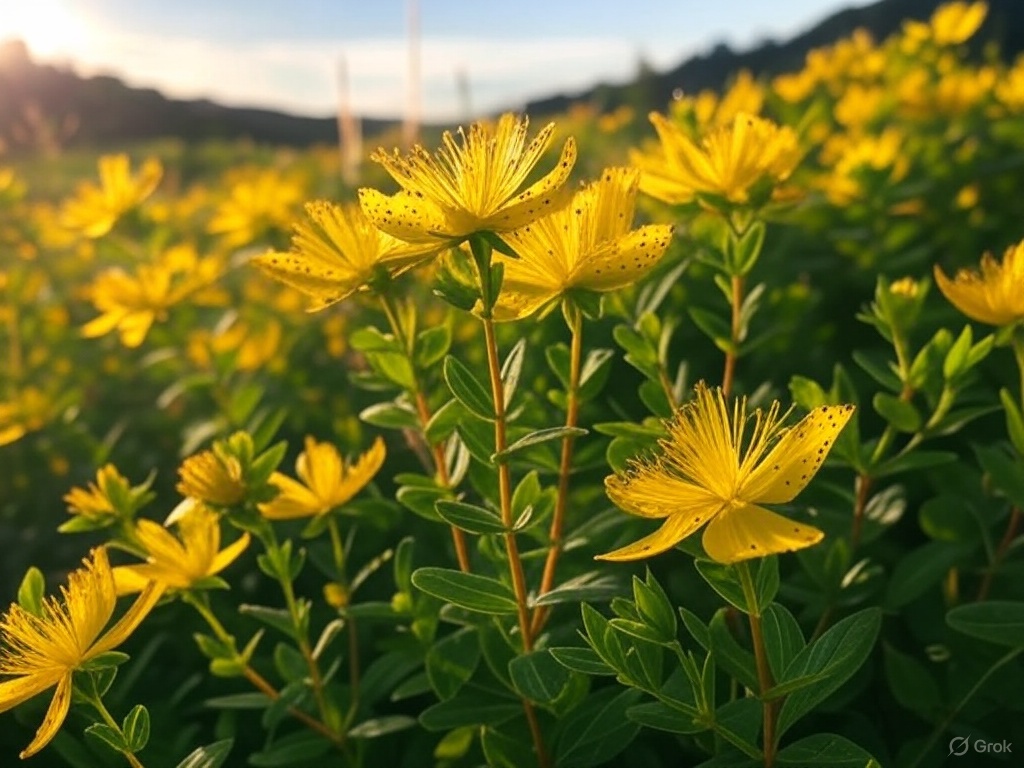
Perennial rhizomatous herb, typically 30–90 cm tall. Stems are erect, branched, and ridged, with opposite, sessile, elliptic to oblong leaves 1–3 cm long that appear perforated by translucent glandular dots (hence perforatum) and bear black marginal glands. Inflorescences are terminal cymes of yellow, five-petaled flowers 1.5–2.5 cm across, with numerous stamens in three bundles and black glands on petal margins. Fruit is a three-celled capsule with many small brown seeds. Native to Europe, western Asia, and North Africa; widely naturalized and often invasive in temperate regions (North America, Australia, New Zealand). Prefers disturbed sunny sites, roadsides, and pastures.
Phytochemistry
Key bioactive classes include naphthodianthrones (hypericin, pseudohypericin), phloroglucinols (hyperforin, adhyperforin), flavonoids (hyperoside, rutin, quercetin, isoquercitrin), biflavones, and essential-oil components. Hyperforin is the major constituent linked to neurotransmitter reuptake effects; hypericin contributes to photosensitization. Content varies with harvest timing, chemotype, and drying.
Western Traditional & Clinical Actions
Traditionally used as a nervine, wound herb, and mild antidepressant. Modern clinical positioning centers on mild-to-moderate depressive symptoms, with additional traditional uses for neuralgia, anxiety-related complaints, and topical wound or burn care. Mechanisms discussed include inhibition of reuptake of serotonin, norepinephrine, and dopamine, plus effects on GABA and glutamate signaling, largely attributed to hyperforin.
Chinese Medicine Actions
Guan ye lian qiao is categorized as clearing heat and resolving toxicity, with secondary use for liver constraint and emotional constraint patterns. It is not a classical materia medica staple on the scale of Hypericum-related substitutes in older texts, but modern TCM-informed practice uses it for irritability, insomnia with heat signs, and certain skin inflammations.
Traditional & Historical Uses
Named for flowering near the feast of St. John (around the summer solstice) in European folk practice; hung in doorways against evil and used for “melancholy,” nerve pain, and wounds. Dioscorides and later European herbals describe it for burns, ulcers, and sciatica. Indigenous and settler uses in North America followed European introduction, mainly as a wound and nerve herb. Also historically used as a dye and in veterinary practice.
Modern Pharmacological Evidence
In vitro and animal work supports monoamine reuptake inhibition (hyperforin), antioxidant and anti-inflammatory activity (flavonoids), and antimicrobial effects of extracts. Hypericin shows photoactivated antiviral activity in laboratory models. CYP3A4, CYP2C9, and P-glycoprotein induction explain many drug interactions. Topical extracts have been studied for wound healing and atopic dermatitis symptoms.
Clinical Studies
Multiple randomized trials and meta-analyses (including Cochrane reviews) find standardized extracts comparable to some SSRIs for mild-to-moderate depression, with fewer reported adverse effects in short-term use, though heterogeneity in extracts and diagnoses limits certainty. Evidence is weaker for severe depression, menopausal symptoms, and somatoform disorders. Topical oil or cream studies are smaller and more mixed for wounds and skin irritation.
Preparations & Dosage
Standardized extracts are commonly dosed at 300 mg three times daily of a preparation standardized to about 0.3% hypericin or to hyperforin content (often 3–5%), for a daily total near 900 mg. Traditional tea uses 1–2 g dried flowering tops per cup, up to three times daily. Oil infusions (flowering tops in olive or similar oil, solar or warm maceration) are used topically. Tinctures are typically 1:5 in 40–60% ethanol, 2–4 mL up to three times daily. Products should specify standardization because constituent levels vary.
Safety & Contraindications
Generally well tolerated at studied doses; common effects include gastrointestinal upset, dizziness, fatigue, and dry mouth. Photosensitivity is possible, especially with high hypericin exposure or fair skin—avoid intense UV while using it. Potent inducer of CYP3A4, CYP2C9, CYP2C19, and P-gp: clinically important interactions with oral contraceptives, cyclosporine, tacrolimus, warfarin, HIV protease inhibitors, some anticonvulsants, digoxin, and certain chemotherapies. Avoid combining with SSRIs, SNRIs, or other serotonergic drugs because of serotonin-syndrome risk. Not recommended in pregnancy or lactation due to limited safety data. Discontinue before surgery if relevant interacting drugs are used. Quality and adulteration vary among commercial products.
Cultivation & Harvest
Easy from seed or division in full sun and well-drained soil; drought-tolerant once established. Flowering tops are harvested at early bloom (typically midsummer) when hypericin and hyperforin are relatively high, then dried quickly in shade or low heat to limit degradation. Invasive in parts of North America, Australia, and elsewhere—check local regulations before planting. Sustainable commercial supply is largely cultivated in Europe.
Commercial Products
Widely sold as standardized capsules and tablets (often LI 160 or similar research extracts), teas, tinctures, and infused oils. Regulated as a dietary supplement in the United States and as a traditional herbal medicinal product or registered medicine in parts of Europe. Quality markers usually include hypericin and/or hyperforin assays.
Ethnobotanical Curiosities
Midsummer harvest tied to solstice and St. John’s Day rites across Europe; red “blood” of the plant (hypericin-rich oil turning red) was linked symbolically to the martyrdom of John the Baptist. In some folk systems it was both a protective charm and a treatment for “elf-shot” or unexplained nerve pain.
Recent Research (2020–2026)
Work has continued on hyperforin analogs and extract standardization, gut-microbiome interactions, and comparative effectiveness versus antidepressants, with ongoing attention to interaction risk and product variability. Studies have also examined topical formulations for skin barrier support and the ecological management of the plant where it is invasive. Evidence still concentrates on mild-to-moderate mood symptoms rather than broad psychiatric indications.
Conservation Status
Not threatened. Hypericum perforatum is widespread, often weedy or invasive outside its native range, and is not listed as a conservation concern by major assessments. Sustainable cultivation is preferred over wild collection in regions where it displaces native flora.
DIY Recipes
Solar-infused oil: loosely fill a jar with fresh flowering tops, cover with olive oil, steep in sun for 2–4 weeks (or warm-macerate gently), strain, and store cool and dark for topical use on minor scrapes. Tea: 1–2 tsp dried tops per cup, steep covered 10 minutes. Home preparations are not substitutes for standardized extracts when a mood indication is intended, and interaction risks remain.
X (Twitter) Snapshot – 2020–2026
Discussion clusters around supplement quality, SSRI interaction warnings, photosensitivity reminders, and debates over evidence strength for depression versus placebo or drug comparators. Cultivation posts often note its invasiveness alongside interest in home oil infusions.
Planting & Harvesting Reference Guide for St. John’s Wort (Hypericum perforatum)
👈Planting & Harvesting Reference Guide:👇
St. John’s Wort (Hypericum perforatum) – Planting & Harvesting Reference Guide
This consolidates the planting and harvesting details from the SPARK sections. St. John’s Wort is a rhizomatous perennial herb, not a tree. The medicinal and ritual crop is the flowering top, not bark or fruit.
- Best Time for Planting
- Sow seed or set divisions in spring, once the soil is workable and hard frost has passed. Plants from seed usually flower in the second year.
- A Sunday, or the hour of the Sun, is the astrological reinforcement used in the magical sections. Waxing moon in a fire sign is a contemporary solar reading, not an old recorded rule for this species. The tradition that is attested is the long day at harvest, not a water-sign planting election.
- Ideal site: full sun and well-drained soil. St. John’s Wort tolerates poor, dry banks, roadsides, and old fields. It is not a riparian or partial-shade calcicole. Do not plant it in wet shade.
- Seed is tiny and comes from the three-celled capsule, not from a fleshy fruit. Surface-sow or barely cover. Divisions of the rhizome establish faster than seed. There is no pit or stone to store.
- Check local rules before planting. In parts of North America and Australia, St. John’s Wort is a listed noxious or invasive weed, and live plants may not be sold or moved.
- Growing Conditions & Magical Minded Tips
- Space crowns so air can move. Crowded, humid stands invite leaf spot. A light mulch may suppress weeds, but do not bury the crown.
- Water to establish, then avoid soil that stays wet. St. John’s Wort is drought-tolerant once rooted. A light compost in spring is enough. It does not want rich, wet feeding.
- It self-seeds and spreads by rhizome. Edge the bed, deadhead before seed shatter if escape is a concern, and do not dump pulled plants on open ground.
- Record ploidy and chemotype if the crop is for extract. Wild stands vary. Cultivation is preferred where wild populations are small, and containment is required where the plant is invasive.
- Magical tending follows the solar character: a sunny site, thanks spoken at planting, no binding of another will. Offerings in the old record are the bunch later hung at the door, not tobacco or cornmeal, which belong to other traditions.
- Biodynamic practice, where used, is the standard Demeter set: horn manure on the soil, horn silica toward flowering, compost preparations in any compost. That does not by itself fix hyperforin content.
- Best Time for Harvesting Flowering Tops
- Early bloom, typically midsummer, when translucent leaf dots and black marginal glands are fully developed. In Europe this coincides with St. John’s Eve, 23 June, and the Nativity of St. John, 24 June. In the southern hemisphere, use that region’s summer flowering, not the June date.
- Cut on a dry morning after dew has lifted. Sunday noon or the hour of the Sun reinforces the calendar date. The sources do not require a waxing moon.
- Do not wait until capsules have matured if the cut is for medicine or oil. Late, overripe tops are a weaker hyperforin and hypericin harvest.
- Esoteric bunches for the door and tops for oil or tea are taken in the same window. Reserve the cleanest flowering tops for oil or drying. Coarser stems may be used for the household bunch.
- Sustainable & Magical Harvesting Methods
- Confirm identity before cutting: two stem ridges, many translucent leaf dots that transmit light, black glands on the leaf margin, black dots mostly on the petal edges. Reject plants with dark dots spread over the whole leaf or petal (Hypericum Punctatum) or four-angled stems and few pellucid dots (Hypericum Maculatum). The hybrid Hypericum × Desetangsii is intermediate. If the leaf does not clearly show the sky through many dots, do not take it as St. John’s Wort.
- Cut the top third. Leave the rootstock and enough leaf to regrow. A cultivated bed can be cut more than once in a favorable season.
- Hand or a short knife. Gloves are sensible. The black glands stain fingers red, and fresh pigment plus strong sun can irritate pale skin.
- Take only from stands that can spare it. In native European grassland, do not strip small populations. Where St. John’s Wort is invasive, collection may be encouraged as removal, but follow local law. Cultivated supply is the better source for medicine.
- Ask, then cut. Hang the bunch with thanks. Do not harvest to bind another person’s will. Midnight on St. John’s Eve is the old fairy-ward cut. The medicinal cut is the same early flower, on a dry morning.
- Post-Harvest Processing
- Dry flowering tops in a thin layer, in shade with airflow, until stems snap. Do not dry in harsh direct sun. Hyperforin oxidizes in heat, light, and damp piles.
- Store dark, cool, and dry. Tea uses about 1–2 g of dried St. John’s Wort per cup, steeped covered about ten minutes. This is the traditional nervine, not a quantified extract.
- Red oil: loosely fill a jar with fresh flowering tops, cover with olive oil, and leave in sun or a warm cupboard for two to four weeks, then strain. The oil reddens as the glands release pigment. Fresh herb carries water, so settle and decant. Store cool and dark. Dried tops give a weaker color. Anthroposophic oils use fresh flowers in sesame, peanut, or olive oil.
- Tincture in the traditional range is about 1:5 in 40–60 percent ethanol, macerated several weeks. Home drying does not reproduce a stated hypericin or hyperforin percentage.
- Label plant, part, and date. Do not substitute another Hypericum species. Internal preparations still carry the interaction and photosensitivity cautions that apply to St. John’s Wort.
Healing Categories of St. John’s Wort (Hypericum perforatum)
👈St. John’s Wort (Hypericum perforatum) fits best where light, nerve, mood, and the skin’s boundary meet. It is not a universal tonic. The categories below are the ones the record actually supports.:👇
Best fits
- Mood and nervous exhaustion. Specified flowering-top extracts are the European well-established use for mild to moderate depressive episodes, and the traditional use for temporary mental exhaustion and nervous restlessness.
- Nerve injury and pain out of proportion to the wound. Folk, homeopathic, and anthroposophic practice call St. John’s Wort the Arnica of the nerves: punctures, dental trauma, coccyx falls, shooting pains.
- Wounds, bruises, and minor burns. The red oil of the fresh flowers is the long external medicine, from Dioscorides and Culpeper to Turkish olive-oil macerates and modern dressings.
- Solar and threshold care. Midsummer gathering, door-bunches, and night protection are the spiritual category, distinct from the internal extract.
- Skin photosensitivity, as both medicine and caution. The same hypericin that colors the oil can redden pale skin and photosensitize livestock.
Secondary fits
- Menopausal symptom scores, from a smaller meta-analysis than the depression set.
- Heat, swelling, and constrained qi in modern Chinese use of Guan Ye Lian Qiao.
- Natural dye and household brandy, cultural rather than clinical.
Poor fits
- Severe depression as a sole treatment, deep infection, and any internal use beside interacting medicines. Those are exclusions, not categories of healing.
Healing Categories
Mood, melancholy, and temporary exhaustion. This is the category with the formal monograph and the trial record. St. John’s Wort, as a quantified dry extract of the flowering tops, is named in the European Union herbal monograph for mild to moderate depressive episodes, and in traditional use for short-term mild depressive symptoms and mental exhaustion. The preparations that match that claim declare hypericin and hyperforin. Tea and tincture belong to the older nervine use and are not the same article as WS 5570 or LI 160. A seeker in this category should already know the interaction list before the first dose.
Nerve trauma and shooting pain. Homeopathic and anthroposophic teaching place St. John’s Wort where pain runs up a nerve, out of scale with the visible hurt: puncture wounds, crushed fingers, dental extraction, falls on the tailbone. The fresh-flower oil is the external form. This category overlaps the wound oil and should not be collapsed into the depression capsule.
Wounds, bruises, and minor burns. The red oil is the oldest continuous preparation. Flowering tops of St. John’s Wort macerated in olive, sesame, or similar oil are applied to blunt trauma, scrapes, and first-degree burns. Turkish excision and incision work, and a surgical-dressing comparison, sit in this file. Deep, dirty, or spreading wounds are outside it.
Boundary, sleep, and night fear. Flower-essence and folk practice use St. John’s Wort for people who cannot hold their light after dark: nightmares, a thin sense of safety, melancholia tied to lack of sun. The historical act is the bunch over the bed or the door, not a high internal dose. Mark essence and charm as separate from the registered extract.
Heat, swelling, and constrained emotion in Chinese pattern medicine. Guan Ye Lian Qiao is used to clear heat, reduce swelling, and smooth liver qi. This is a parallel category to European melancholy and vulnerary use, with its own language. It is not a license to ignore European interaction warnings.
Pasture, skin, and the sun itself. Healing here includes knowing when St. John’s Wort harms. Hypericin photosensitizes unpigmented skin in cattle, sheep, and horses, and can redden a fair human user in strong ultraviolet light. Stewardship of invasive stands belongs in this category beside the medicine.
Synergistic & Holistic Note
St. John’s Wort works as a set of preparations, not as one interchangeable bottle. The flowering top cut at early bloom feeds the tea, the tincture, the red oil, the door-bunch, and the quantified extract, and each asks something different of the person. Yarrow appears beside it in old midsummer house-dressings for protection. Lemon balm appears in evening nervine teas. Those companions are traditional company, not proven boosters of hyperforin. What must not be stacked without advice are other serotonergic medicines, oral contraceptives, transplant drugs, and anticoagulants. The holistic reading that stays faithful to the plant is solar and bounded: light brought to a wounded nerve or a heavy mood, the root left in the ground, and the other medicines in the house named before the jar is opened.
✨ If You Only Read U.S. Consumer Pages ✨
U.S. consumer pages usually present St. John’s Wort as a depression supplement with a long interaction list: oral contraceptives, transplant drugs, warfarin, some HIV medicines, and a warning not to combine it with other serotonergic drugs. That account is real, and it is the part of the record a person on prescription medicine most needs. It is also a narrow frame. Those pages rarely say that the European Union herbal monograph treats specified dry extracts as well-established medicines for mild to moderate depressive episodes, or that the European Pharmacopoeia and the USP both define the flowering tops and set hypericin and hyperforin floors. They rarely mention the red oil as a traditional and still-studied vulnerary, the Chinese monograph Guan Ye Lian Qiao, the German and French trial centers, or the fact that the same species is a listed rangeland weed and a livestock photosensitizer in the American West. Reading only the retail summary makes St. John’s Wort look like a mood capsule with a drug-interaction footnote. Reading the official and clinical record makes it a pharmacopoeial flowering herb, a European registered extract, a Chinese heat-and-constraint herb, a midsummer oil, and an invasive pasture plant. The interaction warning belongs in every one of those pictures. It is not a substitute for them.
Sources:
https://www.nccih.nih.gov/health/st-johns-wort
https://www.ema.europa.eu/documents/herbal-monograph/final-european-union-herbal-monograph-hypericum-perforatum-l-herba-revision-1_en.pdf
https://www.pharmacopeia.cn/v29240/usp29nf24s0_m74268.html
https://research.fs.usda.gov/feis/species-reviews/hypper
https://www.sciencedirect.com/science/article/abs/pii/S0378874126009207
Globally: Where This Plant Is Studied
👈Global research, official texts, publishers, and human-trial data, rather than U.S.-consumer-page-limited:👇
Where This Plant Is Studied
St. John’s Wort is a working research plant across Europe, East Asia, West Asia, South Asia, and North America, not a single-country supplement story. The densest clinical and extract work has come from Germany, where defined hydroalcoholic extracts such as WS 5570 and LI 160 were developed and trialed, and from neighboring French, Swiss, and Austrian centers that ran or pooled the same preparations. Chemistry, cultivation, and wound-oil studies are strong in Turkey, Italy, the Balkans, and Iran, the landscapes where the flowering herb is both native and farmed. China studies Guan Ye Lian Qiao as a heat-clearing, qi-smoothing herb and as a source of polycyclic polyprenylated acylphloroglucinols. India, Korea, and Japan contribute pharmacology and quality papers. In the United States the plant is studied twice: as a depression extract, in the Hypericum Depression Trial Study Group and related NCCIH-linked work, and as an invasive rangeland plant, in Forest Service and biological-control programs. Genome and chloroplast assemblies have come from Chinese and allied university groups. Field supply still tracks European cultivation and Eurasian wild stands. The plant is a pharmacognosy, psychiatry, agronomy, and weed-science subject at once.
Sources:
https://www.bmj.com/content/330/7490/503
https://pmc.ncbi.nlm.nih.gov/articles/PMC1538611/
https://www.sciencedirect.com/science/article/abs/pii/S0378874126009207
https://onlinelibrary.wiley.com/doi/abs/10.1111/jpi.12709
https://research.fs.usda.gov/feis/species-reviews/hypper
Official Books That Name This Species
St. John’s Wort is named and assayed in official books, not only in household herbals. The European Pharmacopoeia defines Hyperici herba (monograph 1438) and Hypericum dry extracts (monograph 1874) as the flowering tops of Hypericum perforatum L. The European Medicines Agency HMPC adopted a revised EU herbal monograph on Hypericum perforatum L., herba (EMA/HMPC/7695/2021, adopted 23 November 2022). That monograph gives well-established use for mild to moderate depressive episodes with specified dry extracts, and traditional use for short-term relief of mild depressive symptoms, temporary mental exhaustion, and, for the oil, minor skin inflammation and wounds. German Commission E earlier recorded internal use for low mood and psychovegetative disturbances and external use for blunt injuries. The United States Pharmacopeia–National Formulary dietary-supplement monograph defines St. John’s Wort as the dried flowering tops or aerial parts of Hypericum perforatum L., with minimums of 0.04 percent combined hypericin and pseudohypericin and 0.6 percent hyperforin. The Pharmacopoeia of the People’s Republic of China lists Guan Ye Lian Qiao. WHO published a medicinal-plant monograph. These texts fix the plant part, the markers, and the permitted preparations. That is a different act of naming from a retail blurb.
Sources:
https://www.ema.europa.eu/en/medicines/herbal/hyperici-herba-0
https://www.ema.europa.eu/documents/herbal-monograph/final-european-union-herbal-monograph-hypericum-perforatum-l-herba-revision-1_en.pdf
https://www.pharmacopeia.cn/v29240/usp29nf24s0_m74268.html
https://www.pharmacopeia.cn/v29240/usp29nf24s0_m74270.html
https://www.sciencedirect.com/science/article/abs/pii/S0378874126009207
Who Publishes on It
Publication is split across psychiatry, pharmacognosy, and regulatory science. Germany, Austria, and Switzerland lead the extract trials; the Cochrane reviews coordinated by Klaus Linde and colleagues, and the BMJ and American Journal of Psychiatry papers on WS 5570, sit in that stream. The United States publishes both the large LI 160 comparison (Hypericum Depression Trial Study Group, Journal of the American Medical Association, 2002) and the NCCIH consumer summaries. China, Turkey, Iran, Italy, and India publish chemistry, wound, menopause, and quality papers in Journal of Ethnopharmacology, Phytochemistry Reviews, Phytomedicine, and Frontiers titles. Elsevier, Wiley, Springer Nature, BMJ, the American Psychiatric Association, the European Medicines Agency, USP, the China Pharmacopoeia Commission, and the American Botanical Council’s Botanical Adulterants Prevention Program are the recurring publishers and official bodies. Dr. Willmar Schwabe and related European manufacturers are the source of the research extracts WS 5570 and LI 160, which is why so many trial names carry those codes. Consumer sites reprint slices of this literature. They are not the record.
Sources:
https://pubmed.ncbi.nlm.nih.gov/18843608/
https://www.bmj.com/content/330/7490/503
https://pmc.ncbi.nlm.nih.gov/articles/PMC5010734/
https://www.herbalgram.org/news/press-releases/2021/bapp-publishes-st-johns-wort-laboratory-guidance-document/
https://link.springer.com/article/10.1007/s11101-017-9503-7
Human Trials Tied to This Species
Human evidence for St. John’s Wort is tied to quantified flowering-top extracts, not to an unassayed tea. The Cochrane review pooled 29 trials and 5,489 people and found the tested extracts superior to placebo in major depression, similar to standard antidepressants, and associated with fewer dropouts for adverse effects. A later review of 35 studies and 6,993 patients reached the same pattern for mild and moderate depression. In France, a six-week placebo-controlled trial of WS 5570 at 300 mg three times daily in 375 patients (Lecrubier and colleagues, American Journal of Psychiatry, 2002) showed a greater Hamilton reduction than placebo. In Germany, a multicenter trial found WS 5570 at 600 mg once daily and 1,200 mg daily superior to placebo over six weeks, and a 251-patient non-inferiority trial found 900 mg of WS 5570 at least as effective as paroxetine 20 mg in moderate to severe depression, and better tolerated (BMJ, 2005). The United States Hypericum Depression Trial Study Group trial of LI 160, 900–1,500 mg, against sertraline and placebo, did not separate either active arm from placebo and is the main null result in the set. A menopause meta-analysis reported symptom-score improvement versus placebo. A phase III dressing trial of a hypericum-and-neem oil found pain reduction on dehisced surgical wounds. Trial duration is mostly 4–12 weeks. Many papers use a named extract, so a shop capsule is evidence-adjacent only when it matches that extract’s specification.
Sources:
https://pubmed.ncbi.nlm.nih.gov/18843608/
https://pmc.ncbi.nlm.nih.gov/articles/PMC5010734/
https://www.psychiatryonline.org/article.aspx?articleid=175694
https://pmc.ncbi.nlm.nih.gov/articles/PMC1538611/
https://www.bmj.com/content/330/7490/503
https://pubmed.ncbi.nlm.nih.gov/24188229/
https://pubmed.ncbi.nlm.nih.gov/35678785/

Part 1: Modern Medical Properties and Uses

Purpose: Highlights the plant’s scientific and medicinal properties, validating holistic healing with evidence-based data.
Contemporary Medical Applications of St. John’s Wort (Hypericum perforatum)
👈Contemporary Medical Applications: Describes current clinical uses (e.g., capsules, tinctures) and delivery methods in modern medicine.👇
Contemporary Medical Applications:
- Standardized hydroalcoholic extracts of the flowering aerial parts of Hypericum perforatum are used in oral capsules and tablets for mild to moderate major depressive episodes. Research extracts such as WS 5570 and LI 160 are typically given at 600–1,200 mg per day, often as 300 mg two or three times daily, over 4–12 weeks, with response judged by Hamilton Depression Rating Scale change and clinician global assessment.
- In several European regulatory settings the dried flowering herb and defined extracts are accepted traditional or well-established herbal medicinal products for temporary mental exhaustion, low mood, and mild depressive symptoms. Delivery is by coated tablets, hard capsules, or measured dry extract rather than crude herb alone, because hyperforin and hypericin content must be declared and controlled.
- Topical preparations—olive-oil macerates of the flowering tops, ointments, and combination dressings containing Hypericum oil—are used on minor burns, bruises, and surgical wound dehiscence. A randomized phase III comparison of a hypericum-and-neem oil dressing with silver dressings found similar resolution of inflammatory signs and a greater reduction in pain scores on a numeric rating scale.
- Meta-analytic work on menopausal symptom scales has examined Hypericum preparations alone or combined with other herbs against placebo. Pooled data suggest a reduction in climacteric symptom scores, with adverse-event rates similar to placebo, although product composition and outcome instruments differ across trials.
- Liquid extracts and tinctures (commonly 1:5 in moderate-strength ethanol) remain in clinical herbal practice for the same mood indication, dosed in the low-milliliter range two or three times daily. Because constituent yield depends on solvent and fresh-versus-dried starting material, these preparations are less often used in registration trials than quantified dry extracts.
- Tea infusions of the dried flowering tops are still prepared domestically, but clinical efficacy data are tied almost entirely to quantified extracts. Infusions deliver flavonoids reliably and naphthodianthrones and hyperforin less predictably, so they are not interchangeable with the products tested in depression trials.
- Commissioned monographs and later clinical reviews also record traditional internal use for nervous restlessness and external use for blunt trauma. Modern product labeling narrows the claim to mild depressive states and, for oils, minor skin injury, and requires a warning about photosensitivity and drug interactions.
Sources: Contemporary Medical Applications
https://pmc.ncbi.nlm.nih.gov/articles/PMC5010734/
https://pubmed.ncbi.nlm.nih.gov/18843608/
https://pmc.ncbi.nlm.nih.gov/articles/PMC1538611/
https://pubmed.ncbi.nlm.nih.gov/24188229/
https://pubmed.ncbi.nlm.nih.gov/35678785/
https://www.psychiatryonline.org/article.aspx?articleid=175694
Pharmacology of St. John’s Wort (Hypericum perforatum)
👈Pharmacology: Outlines key compounds and their mechanisms of action, driving therapeutic effects.👇
Pharmacology:
- Hyperforin, a polycyclic polyprenylated acylphloroglucinol, inhibits synaptosomal uptake of serotonin, norepinephrine, dopamine, GABA, and glutamate. The effect is non-competitive and is linked to elevated intracellular sodium and dissipation of the vesicular proton gradient that drives monoamine storage, rather than to direct high-affinity blockade of the monoamine transporters used by many synthetic reuptake inhibitors.
- Work on isolated synaptic vesicles shows that hyperforin, like a protonophore, collapses the ATP-dependent pH gradient across the vesicle membrane and thereby reduces vesicular sequestration of serotonin and dopamine. Reported half-maximal concentrations for proton-gradient and uptake effects fall in the sub-micromolar range in those preparations.
- Hypericin, a naphthodianthrone, has been examined for transporter affinity and for light-dependent generation of reactive oxygen species. Older proposals that antidepressant activity was mainly monoamine-oxidase inhibition by hypericin have not held at concentrations achievable in vivo; monoamine-oxidase inhibition requires extract levels far above those measured after ordinary oral doses.
- Chronic administration of Hypericum extracts in animal models is associated with adaptive receptor changes, including beta-adrenoceptor down-regulation and shifts in serotonergic receptor density, paralleling patterns reported for other antidepressant interventions. These adaptations develop over days to weeks and are not explained by a single acute binding event.
- Flavonoids such as hyperoside, rutin, and quercetin, together with procyanidins, contribute antioxidant and anti-inflammatory activity and may support the central effect of the extract. Extracts stripped of hyperforin lose much of the antidepressant-like signal in behavioral models, which is why hyperforin content is treated as a critical quality marker.
- Induction of CYP3A4, CYP2C9, CYP2C19, and P-glycoprotein is a separate pharmacological action, largely attributed to hyperforin acting on the pregnane X receptor. This induction lowers plasma levels of many co-administered drugs and is the main reason interaction warnings accompany clinical use.
- Photoactivation of hypericin underlies both experimental antiviral work and the clinical risk of skin photosensitivity. The same planar structure that allows light-dependent singlet-oxygen generation is the reason patients are advised to limit intense ultraviolet exposure while taking higher-hypericin products.
Sources: Pharmacology:
https://pmc.ncbi.nlm.nih.gov/articles/PMC12437246/
https://www.sciencedirect.com/science/article/abs/pii/S0024320503002959
https://www.sciencedirect.com/science/article/abs/pii/S0024320504003509
https://www.sciencedirect.com/science/article/abs/pii/S002432050400699X
https://link.springer.com/article/10.1007/s11101-017-9503-7
Natural Medicine Studies /St. John’s Wort (Hypericum perforatum)
👈Natural Medicine Studies: Summarizes recent research on efficacy, safety, or clinical outcomes from peer-reviewed studies.👇
Natural Medicine Studies:
- The Cochrane review of St John’s wort for major depression pooled 29 trials and 5,489 participants. Hypericum extracts were superior to placebo in response rate, similar to standard antidepressants, and associated with fewer dropouts for adverse effects than older antidepressants or SSRIs, with notable heterogeneity and more favorable results from German-speaking centers.
- A later systematic review of 35 studies and 6,993 patients reached a similar conclusion for mild and moderate depression: more responders than placebo, no clear difference from antidepressant medication in effectiveness, and fewer adverse events than antidepressants, with moderate quality of evidence and weaker data for severe depression.
- A 2017 meta-analysis of 27 trials comparing Hypericum with SSRIs in 3,808 patients reported comparable response and remission and a lower discontinuation rate for the herb. Trial duration was short, generally 4–12 weeks, so long-term comparative effectiveness is not established by that dataset.
- The multicenter placebo-controlled trial of WS 5570 found that both 600 mg once daily and 1,200 mg daily reduced Hamilton scores more than placebo over six weeks in mild to moderate major depression, with a low adverse-event rate consistent with the known extract profile.
- An earlier adaptive placebo-controlled trial of WS 5570 at 300 mg three times daily in 375 patients also showed a greater Hamilton reduction and higher response and remission rates than placebo after six weeks, supporting the quantified extract rather than an unstandardized tea.
- Menopause meta-analysis data indicate symptom-score improvement versus placebo for Hypericum preparations, with adverse events not clearly increased. These trials are fewer and more heterogeneous than the depression set, so the menopause signal is supportive rather than definitive.
- In vivo excision and incision models of olive-oil and ethanol extracts of the flowering aerial parts showed accelerated wound contraction and improved tensile strength, with activity tracking to flavonoid and hypericin-containing fractions, aligning with Turkish folk use of the oil on wounds.
Sources: Natural Medicine Studies:
https://pubmed.ncbi.nlm.nih.gov/18843608/
https://pmc.ncbi.nlm.nih.gov/articles/PMC5010734/
https://www.unboundmedicine.com/medline/citation/28064110/
https://pmc.ncbi.nlm.nih.gov/articles/PMC1538611/
https://www.psychiatryonline.org/article.aspx?articleid=175694
https://pubmed.ncbi.nlm.nih.gov/24188229/
https://pubmed.ncbi.nlm.nih.gov/19833187/
Chemistry of St. John’s Wort (Hypericum perforatum)
👈Chemistry: Details active chemical constituents (e.g., alkaloids, flavonoids) and their healing roles.👇
Chemistry:
- The characteristic marker classes are naphthodianthrones (hypericin, pseudohypericin, and their proto forms), phloroglucinol derivatives (hyperforin and adhyperforin), and flavonoid glycosides (hyperoside, rutin, isoquercitrin, quercitrin). Phenolic acids such as chlorogenic and caffeic acid, biflavones including biapigenin, and a small essential-oil fraction complete the profile used in pharmacognosy.
- Hyperforin is unstable to oxygen, heat, and light, which is why commercial dry extracts are often stabilized and why fresh-plant oils redden as hypericin-type pigments concentrate while hyperforin may decline. Analytical specifications therefore state both hypericin and hyperforin percentages rather than a single marker.
- Pharmacopoeial and research assays commonly target about 0.3 percent total hypericins and a declared hyperforin range, frequently in the low single-digit percent for extracts used in depression trials. Products outside that window are not equivalent to the materials that generated the clinical literature.
- More than one hundred structurally confirmed constituents have been reported from the species, including additional polycyclic polyprenylated acylphloroglucinols beyond hyperforin. Metabolomic fingerprinting is increasingly used because single-marker assays miss batch variation in the flavonoid and phloroglucinol suites.
- Leaf translucencies that give the species its name are glandular cavities containing essential oil and resin; black marginal glands are associated with hypericin-type pigments. Harvest at early flowering maximizes both gland types and is the stage specified for medicinal drug.
- Xanthones and procyanidins occur in smaller amounts and are more prominent in some related Hypericum species. Species substitution therefore changes the chemical signature and is a documented quality-control risk.
- Heavy-metal and adulterant testing is part of contemporary quality systems because wild and cultivated lots differ in soil exposure. Non-targeted metabolomics and machine-learning classifiers have been proposed to distinguish authentic flowering-top drug from related species and from exhausted material.
Sources: Chemistry:
https://link.springer.com/article/10.1007/s13562-019-00490-7
https://link.springer.com/article/10.1007/s11101-017-9503-7
https://www.sciencedirect.com/science/article/abs/pii/S0378874126009207
https://www.researchgate.net/publication/385664082_Secondary_metabolites_of_medicinal_use_in_Hypericum_spp_a_rich_history_and_a_promising_future
Functional Foods and Nutrition /St. John’s Wort (Hypericum perforatum)
👈Functional Foods and Nutrition: Highlights dietary uses (e.g., teas, supplements) in modern health practices.👇
Functional Foods and Nutrition:
- Hypericum perforatum is not a conventional food crop. Its dietary use is as a medicinal tea, a bitter herbal beverage, and an encapsulated dry extract, not as a calorie-bearing staple. Nutrient contribution from a typical infusion is negligible beside the secondary-metabolite dose.
- A medicinal infusion is prepared from roughly 1–2 g of dried flowering tops per cup, steeped covered for about ten minutes, up to three cups daily in traditional practice. This route favors flavonoid glycosides and provides a lower, less standardized hyperforin exposure than capsules used in trials.
- Solar or warm oil macerates of the fresh flowering tops are a traditional functional preparation for the skin rather than an ingested food. The oil turns red as naphthodianthrones partition into the lipid phase and is stored cool and dark to limit further oxidation.
- Encapsulated extracts sold as dietary supplements in the United States and as herbal medicines in parts of Europe are the form that matches clinical dosing of 900–1,200 mg daily of quantified extract. Label claims should state hypericin and, ideally, hyperforin content so the product can be compared with trial materials.
- Culinary use is limited by bitterness and by the interaction and photosensitivity profile. It is not interchanged with culinary herbs in ordinary cooking, and pregnancy, lactation, and concurrent prescription drugs are standard exclusions in supplement guidance.
- Veterinary and farm use of the fresh plant is a cautionary nutritional note rather than a food application: ingestion of large amounts of the standing herb by light-skinned livestock can produce primary photosensitization. That same chemistry explains human sun-sensitivity warnings.
- Combination teas that pair Hypericum with lemon balm or other aromatic herbs appear in European household practice for evening nervousness. Those blends have little trial support of their own and still carry the interaction profile of the Hypericum component.
Sources: Functional Foods and Nutrition:
https://pmc.ncbi.nlm.nih.gov/articles/PMC5010734/
https://vitalibrary.com/hypericum-perforatum-depression-support/
https://snl.no/prikkperikum
https://www.medicinetraditions.com/hypericum-st-johns-wort-free/
Current Projects and Future Possibilities /St. John’s Wort (Hypericum perforatum)
👈Current Projects and Future Possibilities: Notes ongoing research, clinical trials, or innovative medical applications.👇
Current Projects and Future Possibilities:
- Formulation work is aimed at protecting hyperforin from oxidation so that once-daily tablets can deliver a defined dose with less batch drift. Stabilized extracts already in trials, including WS 5570 at 600 mg once daily, are the practical outcome of that chemistry.
- Multi-marker quality control that combines hypericin, hyperforin, and flavonoid fingerprints with non-targeted metabolomics is replacing single-marker assays. The goal is to separate authentic flowering-top extract from related species and from material whose hyperforin has degraded.
- Preclinical programs continue on neuroprotective, antimicrobial, and wound-healing fractions. These signals are not yet matched by large clinical programs outside mood and menopause, so near-term development is more likely to refine existing mood extracts than to open wholly new indications.
- Photodynamic applications of hypericin, using its light-activated singlet-oxygen chemistry, remain a laboratory and early translational line distinct from oral antidepressant use. Any such use requires controlled illumination and is not an extension of over-the-counter capsules.
- Biotechnological work on cell and organ culture, and on the biosynthetic genes for hypericin and hyperforin, is directed at a more uniform supply. Field cultivation already supplies most European drug, but chemotype and harvest-date variation still limit interchangeability.
- Interaction research is shifting from case reports to transporter and pregnane-X-receptor assays that can rank extracts by hyperforin level. Lower-hyperforin products may reduce interaction risk, but they also move away from the constituent most closely tied to reuptake effects in models.
- Ecological projects treat the plant as an invasive weed in parts of North America and Australasia while European growers treat it as a crop. Future supply chains are likely to favor contracted cultivation with documented chemotype rather than wild harvest.
Sources: Current Projects and Future Possibilities:
https://www.sciencedirect.com/science/article/abs/pii/S0378874126009207
https://link.springer.com/article/10.1007/s13562-019-00490-7
https://pmc.ncbi.nlm.nih.gov/articles/PMC1538611/
https://pmc.ncbi.nlm.nih.gov/articles/PMC12437246/
Literary Mentions of St. John’s Wort (Hypericum perforatum)
👈Literary Mentions: References modern medical texts or studies citing the plant’s therapeutic use.👇
Literary Mentions:in ancient texts
- Dioscorides, in De Materia Medica (first century), describes Hypericum among the wound and burn herbs, recommending the fruiting or flowering material externally and recording its use on injuries. Renaissance editions, including the 1563 Matthioli-illustrated printings, carry the plant under the Hypericum heading that later herbalists identified with H. perforatum.
- Avicenna’s Canon tradition, as summarized in Unani compilations, lists the fruit as purging black bile and the herb for cold, hard swellings, placing it in the melancholic and traumatic indications that European practice later emphasized.
- Nicholas Culpeper’s English Physician (1652) and the later Complete Herbal give St John’s wort under the government of the Sun and Leo, with internal use for wounds, bites, and urinary complaints and external use as an oil. Those entries fixed the English common name in print household medicine.
- Paracelsus-era and seventeenth-century wound manuals, including Pemell (1652), call it among the foremost vulneraries. The red oil, prepared by macerating flowering tops, became the signature preparation cited from that period into modern folk practice.
- Gerard’s Herball and subsequent English floras repeat the perforated-leaf identification and the midsummer flowering that tied the plant to the Nativity of St John. The common name and the solstice harvest are literary conventions as much as botanical ones.
- Chinese materia medica history records herbaceous Hypericum species among early referents of lian qiao before the name settled on Forsythia; modern Chinese sources list Guan ye lian qiao for liver-qi constraint, swelling, and lactation support, bridging that older identity to current use.
- Twentieth- and twenty-first-century medical literature, from the Linde Cochrane reviews to monographs in the Journal of Ethnopharmacology, cites the same species as both a quantified antidepressant extract and a wound oil, explicitly connecting the ancient vulnerary record to contemporary trials.
Sources: Literary Mentions:
https://archive.org/details/dioscorides-de-materia-medica-2000-english
https://www.medicinetraditions.com/hypericum-st-johns-wort-free/
https://archive.org/details/culpeperscomplet00culp
https://archive.org/details/b2170465x
https://www.sciencedirect.com/science/article/abs/pii/S0378874126009207
https://pubmed.ncbi.nlm.nih.gov/18843608/

Part 2: Plant Knowledge Systems

Purpose: Validates plant-based healing through interdisciplinary scientific and cultural fields.
Ethnobotany of St. John’s Wort (Hypericum perforatum)
👈Ethnobotany: Explores the plant’s traditional uses across cultures, linking indigenous knowledge to modern applications.👇
Ethnobotany:
- Across Europe, St. John’s Wort was gathered at midsummer, near the feast of St. John, and hung in houses, barns, and byres as a protective plant while the flowering tops were reserved for medicine. British and Irish calendar custom burned the herb on Midsummer Eve bonfires, and the red oil made by macerating the flowers was the household vulnerary for cuts, bruises, and burns. That seasonal harvest maps directly onto the modern specification of flowering aerial parts, because the translucent and black glands that hold the medicinal constituents are fully developed at early bloom.
- Mediterranean and Anatolian practice kept the same wound emphasis. Turkish folk medicine uses an olive-oil extract of the flowering aerial parts on injuries, and controlled excision and incision models later found wound-healing activity in those oil and ethanol extracts, with flavonoids and hypericins concentrated in the active fractions. Sicilian tradition similarly called the oil a balm for every wound, so the external protocol that still appears in phytotherapy is a continuation of a documented regional use rather than a recent invention.
- Northern European household medicine treated St. John’s Wort as a near-universal remedy. Norwegian sources record perikum brandy in the house pharmacy into the twentieth century for low mood, digestive complaints, urinary irritation, and women’s ailments, and the common name Johannesurt is tied both to flowering at Sankthans and to the red pigment read as the blood of John the Baptist. Present clinical use for mild depressive symptoms sits on that older “melancholy” indication, while the digestive and urinary claims have not been carried forward with the same trial support.
- In Chinese materia medica history, herbaceous Hypericum, including material now referred to as St. John’s Wort, was among the early referents of lian qiao before that name settled on Forsythia. Modern Chinese practice lists Guan Ye Lian Qiao for liver-qi constraint, swelling, heat, and lactation support. The emotional-constraint indication parallels the European melancholy use, while the heat-clearing and swelling uses parallel the external anti-inflammatory tradition.
- Unani compilations drawing on Avicenna record the fruit as purging black bile and the herb for cold, hard swellings, nervous conditions, and trauma. That black-bile framing is the medieval counterpart of the later European use in melancholy, and it is the line that contemporary quantified extracts have tested most carefully, whereas the swelling and wound indications survive mainly as oils and dressings.
Sources: Ethnobotany:
https://link.springer.com/article/10.1007/BF02859120
https://www.icysedgwick.com/st-johns-wort-folklore/
https://snl.no/prikkperikum
https://www.medicinetraditions.com/hypericum-st-johns-wort-free/
https://pubmed.ncbi.nlm.nih.gov/19833187/
https://www.sciencedirect.com/science/article/abs/pii/S0378874126009207
Plant Genomics of St. John’s Wort (Hypericum perforatum)
👈Plant Genomics: Describes genetic studies of the plant, focusing on traits related to medicinal properties.👇
Plant Genomics:
- A diploid assembly of St. John’s Wort has been published from a 2n = 2x = 16 accession. Illumina, PacBio, and 10x Genomics data produced a 373.7 Mb assembly in 448 scaffolds with an N50 of 2.31 Mb, close to a k-mer and flow-cytometry estimate near 393–400 Mb, with about 29,150 predicted protein-coding genes and roughly 46.9 percent repetitive sequence. That assembly is the reference now used to ask which genes support hypericin and hyperforin accumulation.
- The same genome paper functionally characterized an N-acetylserotonin O-methyltransferase involved in melatonin biosynthesis, showing that the sequence resource is already being used for pathway work beyond the classical naphthodianthrones. Whole-genome duplication followed by gene loss is reported for St. John’s Wort, which offers a framework for why defense-metabolite pathways are expanded relative to simpler relatives.
- Chromosome counts for St. John’s Wort are not a single number. Karyomorphological surveys have recorded 2n = 16, 22, 24, 26, 28, 30, 32, and 38, with basic numbers including x = 8, 11, 13, 14, 15, and 19, and with diploid, triploid, tetraploid, and mixoploid roots in different populations. Flow-cytometry 2C values from about 0.87 to 2.02 pg show more than a twofold range, so breeding and chemotype studies have to record ploidy rather than assume a uniform genome.
- Facultative apomixis and a sexual-to-apomictic breeding system sit on top of that cytogenetic complexity. Seed can form without fertilization in many populations, which helps the plant colonize disturbed ground and also means cultivated lines can drift if wild pollen and apomictic seed are not controlled. Medicinal-chemotype programs therefore track both ploidy and reproductive mode when they select for hyperforin.
- The chloroplast genome of St. John’s Wort has been assembled as a 139,725 bp quadripartite circle encoding 106 unique genes. Comparison with other Hypericum chloroplast genomes is being used for phylogenetic placement and for barcodes that can separate St. John’s Wort from related species substituted in trade. Nuclear and plastid resources together are the current basis for authenticity testing.
Sources: Plant Genomics:
https://onlinelibrary.wiley.com/doi/abs/10.1111/jpi.12709
https://pmc.ncbi.nlm.nih.gov/articles/PMC9695836/
https://pmc.ncbi.nlm.nih.gov/articles/PMC10671389/
https://link.springer.com/article/10.3103/S009545272601010X
Phytotherapy of St. John’s Wort (Hypericum perforatum)
👈Phytotherapy: Details the plant’s use in clinical herbal medicine, including therapeutic protocols.👇
Phytotherapy:
- Clinical phytotherapy uses quantified dry extracts of the flowering tops of St. John’s Wort for mild to moderate depressive episodes, most often 600–1,200 mg daily of a product standardized near 0.3 percent hypericins and a declared hyperforin content, given for 4–12 weeks and reviewed against a symptom scale. The Cochrane review and later meta-analyses found these extracts superior to placebo and similar to standard antidepressants on response, with fewer dropouts for adverse effects in the short trials available.
- External phytotherapy keeps the oil and ointment tradition. Flowering tops macerated in olive, sesame, or similar oil are applied to minor burns, bruises, and nerve-rich injuries. Anthroposophic and general herbal nursing protocols specify fresh-flower oils; a phase III dressing trial of a hypericum-and-neem oil product reported pain reduction comparable in wound-score outcome to silver dressings on dehisced surgical wounds.
- Commission E and later European herbal monographs narrowed the internal claim to low mood, nervous restlessness, and temporary mental exhaustion, and the external claim to blunt trauma. Practitioners still match the extract to the person, but the protocol that has trial support is the quantified extract, not an open-ended tea, and the course is time-limited with a planned review.
- Safety protocol is part of the prescription. St. John’s Wort induces CYP3A4 and P-glycoprotein, so oral contraceptives, transplant drugs, anticoagulants, and several antivirals are treated as exclusions. Photosensitivity is counseled for fair skin and high-hypericin products, and combination with other serotonergic medicines is avoided. These constraints are chemical consequences of hyperforin and hypericin, not optional cautions.
- Tea and tincture remain in practice at roughly 1–2 g dried herb per cup or 2–4 mL of a 1:5 tincture, up to three times daily. Teachers of phytotherapy present them as traditional nervine and wound supports and distinguish them from the standardized extracts used when a depressive-episode indication is intended, because hyperforin yield is unstable in home preparations.
Sources: Phytotherapy:
https://pubmed.ncbi.nlm.nih.gov/18843608/
https://pmc.ncbi.nlm.nih.gov/articles/PMC5010734/
https://pmc.ncbi.nlm.nih.gov/articles/PMC1538611/
https://pubmed.ncbi.nlm.nih.gov/35678785/
https://www.pflege-vademecum.de/hypericumoel.php
https://www.medicinetraditions.com/hypericum-st-johns-wort-free/
Ethnoecology of St. John’s Wort (Hypericum perforatum)
👈Ethnoecology: Examines the plant’s ecological role in cultural practices and environmental interactions.👇
Ethnoecology:
- St. John’s Wort is a perennial of open, disturbed ground—roadsides, pastures, and dry banks—from Europe and western Asia through North Africa, and it has become naturalized across temperate North America, Australia, and New Zealand. Midsummer gathering customs developed where the plant was already abundant at the field edge, so the ritual harvest and the ecology of a sun-loving ruderal are the same fact seen from two sides.
- In its introduced range St. John’s Wort is often classed as a weed or invasive, displacing forage and causing primary photosensitization in light-skinned livestock that graze large amounts. Cultural valuation therefore splits: a protected midsummer herb in much of Europe, a rangeland problem in parts of the American West and Australia, where biological control insects have been released. Any wild-collection guidance has to follow that local status.
- The perforated leaves and black glands are ecological as well as medicinal structures. Translucent cavities hold essential oil and resin; dark glands hold hypericin-type pigments that deter some herbivores and, under strong light, contribute to the photosensitization risk. Folk attention to the “holes” and the red juice was an accurate reading of the glands that chemistry later assayed.
- Facultative apomixis and polyploid races help St. John’s Wort hold ground once it establishes. Seed set without fertilization, plus a rhizome, lets small introductions form persistent stands. That reproductive ecology explains both the reliability of European cottage supplies and the difficulty of removing the plant where it is unwanted.
- Traditional harvest at first flowering coincides with peak gland development and with the long days that favor the light-sensitive pigments. Ethnoecological practice—cutting the top third in sun, drying in shade, and leaving the rootstock—matches both potency and the plant’s ability to regrow, which is why cultivated plots can be cut more than once in a favorable season.
Sources: Ethnoecology:
https://snl.no/prikkperikum
https://pmc.ncbi.nlm.nih.gov/articles/PMC9695836/
https://link.springer.com/article/10.1007/BF02859120
https://www.icysedgwick.com/st-johns-wort-folklore/
Anthroposophical Medicine of St. John’s Wort (Hypericum perforatum)
👈Anthroposophical Medicine: Outlines the plant’s use in Steiner-inspired remedies, including preparation, studies, and dosage.👇
Anthroposophical Medicine:
- Anthroposophic pharmacy prepares St. John’s Wort chiefly as an oil of the fresh flowers, read as a plant of light and warmth whose red pigment appears when the glands are opened. Weleda lists Hypericum, Flos 25 percent as an oil extract of fresh flowers in sesame oil; WALA lists Hypericum ex herba 5 percent in peanut oil; other anthroposophic makers use olive oil at about 10 percent. Nursing manuals use these oils externally on nerve-rich injuries, bruises, and first-degree burns.
- The anthroposophic nursing vade mecum treats St. John’s Wort as the “Arnica of the nerves,” echoing the homeopathic wound-nerve indication, and lists sharp and blunt injuries, myalgia, mild burns, low mood, bone pain, and supportive skin care. Internal and subcutaneous preparations from Weleda and WALA use herb as well as flower; the nursing note prefers leaf-containing preparations when the aim is to support a depleted, depressed patient rather than only a local injury.
- Rudolf Steiner and Ita Wegman’s medical approach places plant remedies inside a wider regimen of nursing, rhythm, and external applications, not as a single-molecule substitute. St. John’s Wort oil is applied as a compress or gentle rub in that setting, often alongside conventional care. Manufacturers describe anthroposophic medicines as produced by defined pharmaceutical processes, some shared with homeopathy and some specific to the anthroposophic pharmacopoeia.
- Dosage in this system is product-specific rather than a single universal figure. External oils are used locally once or several times daily on intact or minimally broken skin; oral anthroposophic preparations follow the maker’s dilution and the prescriber’s judgment. These protocols are not the same as the 900 mg quantified extract used in depression trials, and the two should not be treated as interchangeable.
- Published clinical-trial literature specific to anthroposophic St. John’s Wort products is limited compared with the WS 5570 and LI 160 depression trials. The anthroposophic record is strongest as a preparation and nursing tradition—fresh-flower oil, herb extracts, and the nerve-injury indication—while the mood evidence most often cited alongside it comes from the broader phytotherapy trials of quantified extracts.
Sources: Anthroposophical Medicine:
https://www.pflege-vademecum.de/hypericumoel.php
https://www.weleda.co.nz/magazine/health/anthroposophic-medicine
https://www.medicinetraditions.com/hypericum-st-johns-wort-free/
https://pmc.ncbi.nlm.nih.gov/articles/PMC1538611/

Part 3: Heritage and Practice

Purpose: Weaves historical and cultural heritage with practical guidance for medicinal use.
Historical and Cultural Significance of St. John’s Wort (Hypericum perforatum)
👈Historical and Cultural Significance: Explores the plant’s role in historical and cultural medical practices.👇
Historical and Cultural Significance:
- St. John’s Wort entered the European written record as a wound and burn herb and remained there for more than a millennium. Dioscorides, in the first-century De Materia Medica, listed Hypericum for injuries, and Renaissance editions such as the 1563 illustrated printings kept that vulnerary identity. By the seventeenth century English authors, including Culpeper in The English Physician (1652) and Pemell in the same decade, called it among the foremost wound herbs and described the red oil of the flowers as the household form. The modern external oil and the modern internal extract are both descendants of that long medical line, not recent inventions.
- The common name is a calendar name. Flowering peaks near the Nativity of St. John, 24 June, and Midsummer Eve gathering, bonfires, and the hanging of bunches in houses and byres are recorded across Britain, Ireland, and continental Europe. Folkard, Henderson, and later surveys of British calendar custom describe the herb thrown on the fire and the smoke used to protect people, cattle, and crops. The red pigment, released when the black glands are crushed, was read as the blood of John the Baptist, which fixed both the name Johannesurt in Scandinavia and the symbolic link between the plant and midsummer.
- Household medicine carried St. John’s Wort into the twentieth century as a near-universal remedy. Norwegian sources record perikum brandy in the house pharmacy for low mood, digestive complaints, urinary irritation, and women’s ailments. Unani compilations drawing on Avicenna list the fruit as purging black bile and the herb for cold swellings and melancholy. Chinese materia medica history places herbaceous Hypericum among early referents of lian qiao, later distinguished from Forsythia, with modern practice using Guan Ye Lian Qiao for liver-qi constraint and swelling. The shared thread is emotional constraint plus trauma, which is exactly the pair of uses that later clinical work has tested.
- Colonial and settler medicine took the European plant with it. Once naturalized in North America and Australasia, St. John’s Wort kept its wound and nerve reputation in domestic practice while agricultural services reclassified large stands as a rangeland weed because of photosensitization in grazing livestock. The same species is therefore a protected midsummer herb in much of Europe and a managed weed in parts of the American West and Australia. Any historical account that ignores that split misstates how culture and ecology diverged after introduction.
- Twentieth-century clinical literature returned to the melancholy indication with quantified extracts, while the wound oil remained in folk and anthroposophic nursing. The Cochrane reviews and European well-established-use assessments sit downstream of Culpeper and the midsummer oil, not in opposition to them. The cultural status of the plant is thus double: a solstice protective and a registered herbal medicine, with the flowering top as the shared raw material.
Sources: Historical and Cultural Significance:
https://archive.org/details/dioscorides-de-materia-medica-2000-english
https://archive.org/details/culpeperscomplet00culp
https://link.springer.com/article/10.1007/BF02859120
https://www.icysedgwick.com/st-johns-wort-folklore/
https://snl.no/prikkperikum
https://www.sciencedirect.com/science/article/abs/pii/S0378874126009207
Indigenous and Traditional Systems /St. John’s Wort (Hypericum perforatum)
👈Indigenous and Traditional Systems: Details its use in specific indigenous or traditional healing systems.👇
Indigenous and Traditional Systems:
- European folk medicine is the primary traditional system for St. John’s Wort. British, Irish, Germanic, and Scandinavian practice used the flowering tops internally for melancholy, nerve pain, and urinary complaints, and externally as oil for wounds, bruises, and burns. Gathering was timed to Midsummer Eve, and the dried bunches served as both medicine and household protection. That system is continuous with present phytotherapy, which still specifies the flowering herb and still prepares a red oil.
- Unani medicine, transmitting Greek and Arabic sources including Avicenna, classes the plant as useful for black bile, nervous conditions, insomnia, and cold, hard swellings, with the fruit specifically said to purge black bile. Doses in that literature are given as powder in the range of a few grams or as a decoction. The melancholy indication is the direct ancestor of the modern mood use; the swelling indication survives mainly in external oils.
- Traditional Chinese practice lists Guan Ye Lian Qiao for liver-qi stagnation, heat, swelling, and promotion of lactation. Historical work shows that, before the Tang recognition of a dual lian qiao system, herbaceous Hypericum species were among the plants called lian qiao, later separated from woody Forsythia. Current Chinese clinical language therefore overlaps the European constraint-and-swelling pattern even though the classical name shifted.
- Turkish folk medicine uses an olive-oil macerate of the flowering aerial parts on wounds. Ethnopharmacological studies of that preparation found activity in excision and incision models, with flavonoids and hypericins in the active fractions. This is one of the clearer cases in which a named local oil tradition has been tested in the laboratory without changing the plant part or the solvent.
- Limited data exist for independent Indigenous North American, Australian, or Amazonian systems, because St. John’s Wort is native to Eurasia and North Africa and arrived elsewhere by introduction. Settler and pastoral uses in those regions follow the European wound and nerve pattern. Where the plant is invasive, local traditional practice is more often about managing it as a pasture problem than about adopting it as a native medicine.
Sources: Indigenous and Traditional Systems:
https://www.medicinetraditions.com/hypericum-st-johns-wort-free/
https://www.sciencedirect.com/science/article/abs/pii/S0378874126009207
https://pubmed.ncbi.nlm.nih.gov/19833187/
https://link.springer.com/article/10.1007/BF02859120
https://snl.no/prikkperikum
Folklore and Culinary Traditions of St. John’s Wort (Hypericum perforatum)
👈Folklore and Culinary Traditions: Highlights folklore, myths, and culinary uses tied to the plant.👇
Folklore and Culinary Traditions:
- Protection is the dominant folklore motif. Bunches of St. John’s Wort were hung over doors at midsummer in Britain and Ireland, burned on St. John’s Eve fires, and carried against witchcraft, thunder, and the evil eye. Dutch custom gathered it before sunrise against storms; some Continental tales claimed it could render a soldier unseen. These uses are calendar magic tied to the flowering date, not separate medical indications.
- The red oil generated its own story. Crushing the black glands yields a red pigment that folk speech called the blood of John the Baptist, and a Scandinavian legend said the plant sprang where the Baptist was killed. The same color change is what makers still watch for when a solar oil is ready, so the myth and the preparation marker are the same observation.
- Culinary use is narrow. Norwegian sources note dried flowers and leaves as a bitter seasoning, occasionally for fish and more often for brennvin, the perikum brandy kept in the house pharmacy into the twentieth century. The taste is astringent and bitter. St. John’s Wort is not a table vegetable, and ordinary cooking does not remove the interaction or photosensitivity considerations that apply to internal use.
- Animal lore sits beside the human folklore. Large intakes of the standing herb by light-skinned livestock cause primary photosensitization, which agricultural memory in North America and Australia records as a reason to fear the plant. That livestock experience is the ecological counterpart of the human caution about strong sun while taking high-hypericin preparations.
- Limited data support a broad spice or tea-cuisine tradition outside medicinal infusions and flavored spirits. Kitchen use and folk-magic use both peak at midsummer and both use the flowering top, which is why heritage recipes and heritage charms specify the same harvest window.
Sources: Folklore and Culinary Traditions:
https://www.icysedgwick.com/st-johns-wort-folklore/
https://link.springer.com/article/10.1007/BF02859120
https://snl.no/prikkperikum
https://research.fs.usda.gov/feis/species-reviews/hypper
Identification and Characteristics of St. John’s Wort (Hypericum perforatum)
👈Identification and Characteristics: Describes physical traits and identification markers for the plant.👇
Identification and Characteristics:
- St. John’s Wort is a rhizomatous perennial, usually 30–90 cm tall, with erect, two-ridged stems that branch in the upper half. Leaves are opposite, sessile, elliptic to oblong, and 1–3 cm long. Held to the light they show many translucent glandular dots, the “perforations” named in the specific epithet, plus black glands along the margin. Those two gland types together are the field mark.
- Flowers are yellow, about 1.5–2.5 cm across, five-petaled, in terminal cymes, with numerous stamens in three bundles and black glands confined mostly to the petal margins. Sepals are narrow and acute. The fruit is a three-celled capsule with many small seeds. Flowering is early to mid summer in temperate Europe and North America, which is the medicinal harvest window.
- The closest look-alikes are other Hypericum species. Imperforate St. John’s Wort, Hypericum Maculatum, has more clearly four-angled stems, leaves with few or no translucent dots, and broader sepals. Spotted St. John’s Wort, Hypericum Punctatum, bears dark dots scattered across the leaf blade and across the petal face, not mainly at the margins. The hybrid Hypericum × Desetangsii is intermediate and can occur without either parent nearby; sepal shape and the density of pellucid glands are the practical separators.
- Scent is resinous and slightly balsamic when the glands are crushed, and the fingers stain red if the black glands break. That stain is hypericin-type pigment and is a useful confirmation once the leaf perforations have already been checked. Plants without translucent leaf dots should not be taken as St. John’s Wort for medicine.
- Chromosome races and apomictic lines make wild stands morphologically variable in height and branching, but the gland pattern and the two stem ridges remain stable enough for field identification. Commercial drug is defined as the flowering aerial parts of St. John’s Wort, not root and not a substitute species.
Sources: Identification and Characteristics:
https://bsbi.org/learn/resources/plant-crib/hypericum
https://www.wotncr.org/similar_species/hypericum_perforatum_punctatum.html
https://research.fs.usda.gov/feis/species-reviews/hypper
https://pmc.ncbi.nlm.nih.gov/articles/PMC10671389/
Wildcrafting /St. John’s Wort (Hypericum perforatum)
👈Wildcrafting: Covers where to find, identification tips (including look-alikes), and esoteric/medicinal harvesting methods.👇
Wildcrafting:
- St. John’s Wort favors full sun and disturbed ground: roadsides, dry banks, pastures, and old fields, from its Eurasian and North African home range into naturalized stands in North America, Australia, and New Zealand. Confirm translucent leaf dots, marginal black glands, two stem ridges, and marginal petal dots before cutting. Reject plants with dark dots spread over the whole leaf or petal, which point to Hypericum Punctatum or other relatives.
- Harvest the top third in early flower, on a dry morning after dew has lifted, when both gland types are developed. Leave the rootstock and enough leaf to regrow. Dry quickly in shade or very low heat, out of direct sun, because hyperforin oxidizes and color fades if the herb is left in a damp pile. Traditional midsummer timing and the pharmacognosy harvest window are the same cut.
- Esoteric practice and medicinal practice share that cut. Bunches for hanging over a door and tops for oil or tea are taken together at St. John’s Eve in European custom. If both are wanted, reserve the cleanest flowering tops for oil or drying and use the coarser stems for the household bunch.
- Legal and ecological limits come first. In parts of the western United States and in Australia, St. John’s Wort is a listed noxious or invasive weed, and wild collection may be restricted or, conversely, encouraged as removal. In native European grassland it should not be stripped from small populations. Cultivated supply is the better source wherever wild stands are either protected or ecologically damaging.
- Look-alike risk is the main wildcrafting error. Hypericum Maculatum and the hybrid Hypericum × Desetangsii grow in the same habitats in Europe. If the leaf does not clearly transmit light through many dots, do not harvest it as St. John’s Wort. Gloves are sensible, because the pigment stains and because livestock photosensitization is a reminder that the fresh herb is not inert on skin in strong sun.
Sources: Wildcrafting:
https://research.fs.usda.gov/feis/species-reviews/hypper
https://bsbi.org/learn/resources/plant-crib/hypericum
https://www.wotncr.org/similar_species/hypericum_perforatum_punctatum.html
https://link.springer.com/chapter/10.1007/978-3-030-74779-4_8
Cultivation Practices of St. John’s Wort (Hypericum perforatum)
👈Cultivation Practices: Details growing methods for medicinal potency, including general cultivation.👇
Cultivation Practices:
- St. John’s Wort is grown from seed or division in full sun and well-drained soil. It tolerates poor ground once established and flowers in the second year from seed. Commercial European production uses cultivated plots rather than wild stripping, because demand has outrun easily managed wild stands and because cultivation allows chemotype and harvest date to be recorded.
- For medicinal potency, cut the flowering tops at the start of bloom, not after the capsules have matured, and dry them promptly in the dark with airflow. Hypericin and hyperforin both vary with accession, ploidy, and drying temperature. Growers who supply extract makers select lines with a known hyperforin yield and avoid late, overripe cuts.
- Spacing should allow air movement, because humid, crowded stands invite leaf spot. Water to establish, then keep the soil from staying wet. A light mulch suppresses weeds without covering the crown. St. John’s Wort will self-seed and spread by rhizome, so a bed intended as a crop needs an edge or it becomes a volunteer problem.
- In regions where St. John’s Wort is invasive, check local rules before planting. Some jurisdictions prohibit sale or require containment. Where planting is allowed, deadhead before seed shatter if escape is a concern, and do not dump pulled plants onto open ground.
- In vitro and micropropagation work has been developed to multiply selected chemotypes and to study metabolite production in culture. Field cultivation remains the source of commercial drug; tissue culture is a quality and breeding tool, not a replacement for the flowering-top harvest.
Sources: Cultivation Practices:
https://link.springer.com/chapter/10.1007/978-3-030-74779-4_8
https://research.fs.usda.gov/feis/species-reviews/hypper
https://onlinelibrary.wiley.com/doi/abs/10.1111/jpi.12709
Biodynamic Farming /St. John’s Wort (Hypericum perforatum)
👈Biodynamic Farming: Outlines biodynamic cultivation techniques specific to the plant.👇
Biodynamic Farming:
- Limited data describe a St. John’s Wort-specific biodynamic protocol. Demeter practice would fold the crop into the standard preparations: horn manure (500) on the soil, horn silica (501) toward flowering, and compost preparations 502–507 in any compost used on the bed.
- Anthroposophic growers already link St. John’s Wort to light and warmth, so the practical emphasis is a sunny site, a midsummer cut at early bloom, and drying out of harsh sun so the light-related pigments are not driven off.
- Spray and compost work follow the Demeter preparation manual rather than a separate recipe for this species. Record ploidy and chemotype if the harvest is intended for extract, because biodynamic management does not by itself fix hyperforin content.
- Containment still applies. A biodynamic holding in an invasive range should not let St. John’s Wort set seed into neighboring grassland.
- Fresh-flower oil, as made by anthroposophic pharmacies, is the preparation most often paired with biodynamic or anthroposophic growing of St. John’s Wort.
Sources: Biodynamic Farming:
https://zenodo.org/records/5234577
https://www.pflege-vademecum.de/hypericumoel.php
https://link.springer.com/chapter/10.1007/978-3-030-74779-4_8
Preparation Methods of St. John’s Wort (Hypericum perforatum)
👈Preparation Methods: Describes how to prepare the plant for medicinal or culinary use.👇
Preparation Methods:
- Dry herb for tea or tincture by spreading flowering tops in a thin layer, shade, with airflow, until stems snap. Store in the dark. An infusion uses about 1–2 g of dried St. John’s Wort per cup, covered, for ten minutes. This is the traditional nervine tea, not the quantified extract used in depression trials.
- Red oil is made by loosely filling a jar with fresh flowering tops, covering them with olive oil, and leaving the jar in sun or a warm cupboard for two to four weeks, then straining. The oil reddens as the black glands release pigment. Fresh plant can carry water, so settle and decant to limit spoilage, and store cool and dark. Dried herb can be used if fresh tops are unavailable; the color will be weaker.
- Tincture is commonly 1:5 in 40–60 percent ethanol, macerated for several weeks, at about 2–4 mL up to three times daily in traditional practice. Alcohol extracts both flavonoids and a portion of the phloroglucinols. Label the date and the plant part, and do not substitute another Hypericum species.
- Quantified capsules, typically 300 mg of a standardized extract taken two or three times daily, are a manufactured form. Home drying does not reproduce a stated hypericin or hyperforin percentage. When a mood indication is the aim, the trial literature refers to those extracts, not to an unassayed kitchen oil.
- Culinary brandy follows the Norwegian house-pharmacy pattern: flowering tops macerated in neutral spirit, then sweetened or not, used in small amounts. Bitterness is expected. Internal preparations of any kind still carry the interaction and sun-sensitivity cautions that apply to St. John’s Wort.
Sources: Preparation Methods:
https://www.medicinetraditions.com/hypericum-st-johns-wort-free/
https://www.pflege-vademecum.de/hypericumoel.php
https://snl.no/prikkperikum
https://pmc.ncbi.nlm.nih.gov/articles/PMC1538611/
Safety Precautions for St. John’s Wort (Hypericum perforatum)
👈Safety Precautions: Lists plant-specific risks, including side effects or contraindications.👇
Safety Precautions:
- St. John’s Wort induces CYP3A4, CYP2C9, and P-glycoprotein. It can lower the effect of oral contraceptives, cyclosporine, tacrolimus, digoxin, warfarin, some anticonvulsants, some HIV medicines, and some cancer medicines. Anyone on prescription drugs should review this before internal use.
- Combining St. John’s Wort with other serotonergic drugs, including many antidepressants, has been linked to serotonin-related reactions. That combination is avoided in clinical guidance.
- Photosensitivity is a real, plant-specific risk. High hypericin intake or topical oil plus strong sun can redden fair skin. A human lowest-observed-adverse-effect level near 31 µg hypericin per kilogram per day has been cited for enhanced photosensitivity. Limit intense ultraviolet exposure while using internal extracts or fresh oil.
- Short-term oral use in adults not on interacting drugs has been tolerated for up to 12 weeks in trials, with occasional digestive upset, dizziness, dry mouth, or restlessness. Pregnancy and lactation lack adequate safety data; colic and drowsiness have been reported in breastfed infants. Do not self-treat severe depression.
- Livestock that graze large amounts of St. John’s Wort can develop primary photosensitization. The same fresh plant should not be handled and then exposed to prolonged sun if the skin is already stained red. Misidentified Hypericum species should not be substituted.
Sources: Safety Precautions:
https://www.nccih.nih.gov/health/st-johns-wort
https://www.nccih.nih.gov/health/st-johns-wort-and-depression-in-depth
https://www.rivm.nl/bibliotheek/rapporten/2019-0115.pdf
https://research.fs.usda.gov/feis/species-reviews/hypper

Part 4: Spiritual Essence

Purpose: Explores the plant’s intrinsic spiritual and mythological essence in holistic healing.
Energetic Essence of St. John’s Wort (Hypericum perforatum)
👈Energetic Essence: Describes the plant’s energetic signature (e.g., chakra connections), flower-essence properties, and vibrational-healing uses.👇
Energetic Essence:
- The energetic signature recorded for St. John’s Wort is solar and threshold-keeping rather than lunar or underworld. Seventeenth-century plant astrology, including William Lilly and Nicholas Culpeper, places St. John’s Wort under the Sun and Leo: a hot, dry, upright herb of midsummer whose yellow flower and red oil were read as captured sunlight. In that framework the plant does not soothe by cooling. It warms, clarifies, and drives off what was called darkness or melancholy. Contemporary vibrational practice inherits that signature when it uses St. John’s Wort for people who feel light-deprived, shut in, or unable to hold their own warmth through a long night.
- Flower-essence teaching, especially the Flower Essence Society account of St. John’s Wort, develops the same light theme without requiring a material dose of hypericin. The essence is described for highly sensitive people who carry a strong inner light but have difficulty incarnating it, whose skin and nerves seem too thin for the world, and, at the other pole, for melancholia linked to lack of light. Night protection is explicit in that literature: insomnia, nightmares, night sweats, and a sense of being unguarded after dark. The essence is the sunlight pattern of the plant separated from the photosensitizing chemistry of the herb, which is why essence writers distinguish it from the internal extract.
- Homeopathic and anthroposophic materia medica give St. John’s Wort a nerve essence rather than a mood-only essence. Classical writers call it the Arnica of the nerves: pain out of proportion to the visible wound, shooting upward along the nerve, intolerance of touch and jar, after punctures, dental trauma, and falls on the coccyx. Anthroposophic nursing keeps the fresh-flower oil as a remedy of light and warmth applied to nerve-rich injuries. Read together, the energetic picture is light that has to enter a wounded or over-sensitive nervous system without burning it. That is why tradition both hangs the plant at the door and puts the oil on the hurt.
- Chakra and aura correspondences for St. John’s Wort are modern overlays, not classical doctrine. Practitioners who use them usually assign the solar plexus and the heart, on the strength of the Sun rulership and the courage-and-protection folklore, and sometimes the crown when the emphasis is dreams and night fear. Limited data from older texts support a numbered chakra map. What the older texts do support is a consistent pairing of solar fire with boundary: the herb at the threshold, the oil on the skin, the flower at the height of the year. Vibrational use that stays close to that pairing is more faithful to the record than a free assignment of centers.
- The physical paradox belongs in any serious energetic account. St. John’s Wort contains hypericin, which with light can irritate pale skin and photosensitize livestock, yet the same plant was hung to keep harm out and prepared as a wound oil. Flower-essence and folk writers treat this as the teaching of the plant: light that is unmanaged burns, light that is held at the boundary protects. Internal extracts used for low mood sit on the melancholy pole of that teaching. They are not a substitute for the flower essence, and the essence is not a substitute for the quantified extract.
Sources: Energetic Essence:
https://www.flowersociety.org/SJW
https://www.iqhomeopathy.com/materia-medica/hypericum-perforatum/
https://www.pflege-vademecum.de/hypericumoel.php
https://archive.org/details/culpeperscomplet00culp
https://www.icysedgwick.com/st-johns-wort-folklore/
https://aeternum.fr/en-us/blogs/grimoire-botanique/millepertuis
Mythological Associations of St. John’s Wort (Hypericum perforatum)
👈Mythological Associations: Highlights myths, legends, or symbolic meanings tied to the plant across cultures.👇
Mythological Associations:
- The governing myth of St. John’s Wort in Christian Europe is the midsummer feast of John the Baptist. The plant flowers near 24 June, and the red juice from the black glands was read as his blood. A Scandinavian legend said St. John’s Wort sprang where the Baptist was killed. Whether or not that story is older than the name, it fixed a narrative in which the plant is a witness to a beheading and a carrier of solar blood. Gathering on St. John’s Eve, hanging the bunches, and jumping the smoke of the bonfire are the ritual acts attached to that story across Britain, Ireland, and the Continent.
- The older magical name is Fuga Daemonum, the flight of demons. European folk belief held that the scent was intolerable to evil spirits, that a sprig in the room or on the body kept demons out, and that neither the devil nor a witch could abide where St. John’s Wort was worn. Christina Oakley Harrington and earlier folklore collectors record it among the principal protective plants of European folk magic. Verses describe St. John’s Wort and cyclamen kept in the chamber to guard a sleeper. The myth here is not a single god-story. It is a repeated claim that the plant occupies the threshold and makes the night uninhabitable to what the household feared.
- A solar-god association is reported but thinner. Some herbal folklorists, including Margaret Baker, say the flower was dedicated to Baldr, the Norse god of light. That link is a modern scholarly suggestion rather than a named Eddic episode, and it should be carried as attribution, not as a primary myth. It fits the yellow flower, the solstice date, and the later Sun rulership, and it explains why writers call St. John’s Wort Sol Terrestris, an earthly sun. The stronger Norse-adjacent record is the Scandinavian blood legend and the Sankthans harvest, not a temple cult of the herb.
- Love divination belongs to the same midsummer complex. In Sweden and Switzerland, young women gathered a bouquet of nine flowers from nine places at Midsummer and read the night for signs of a future spouse. St. John’s Wort entered those bunches as one of the sun-herbs. Victorian floriography later assigned it both “animosity” and “superstition,” a literary reversal of the older protective meaning and a reminder that flower language is not the same as folk practice. The living tradition was the door-bunch and the nine-flower omen, not the printed sentiment.
- Outside Europe the mythic record is limited, because St. John’s Wort is Eurasian and North African in origin. Chinese lore attaches to the older lian qiao identity and to constraint of liver qi, not to a Baptist or demon-flight story. Unani tradition keeps the black-bile and swelling symbolism of Avicenna, which is medical cosmology rather than a narrative myth. Settler regions that received the plant also received the European solstice lore. The global spiritual picture is therefore one strong European myth-complex—solar blood, demon-flight, threshold, and midsummer fire—carried outward with the herb, not a set of independent Indigenous myths.
Sources: Mythological Associations:
https://www.icysedgwick.com/st-johns-wort-folklore/
https://aeternum.fr/en-us/blogs/grimoire-botanique/millepertuis
https://link.springer.com/article/10.1007/BF02859120
https://snl.no/prikkperikum
https://www.medicinetraditions.com/hypericum-st-johns-wort-free/
https://shadowgrimoire.com/how-is-st-johns-wort-used-in-witchcraft/

Part 5: Esoteric Practices

Purpose: Details ritualistic and tradition-specific spiritual practices involving the plant.
Ritual and Ceremonial Uses for St. John’s Wort (Hypericum perforatum)
👈Ritual and Ceremonial Uses: Explores the plant’s role in spiritual rituals or ceremonies across traditions.👇
Ritual and Ceremonial Uses:
- The central ceremony of St. John’s Wort is the Midsummer Eve gathering. Across Britain, Ireland, and continental Europe the flowering tops were cut on the night of 23 June, the eve of the Nativity of St. John, when the herb was believed to be at the height of its power. Bunches were hung over doors, windows, and byres, and London custom added Vervain, Mugwort, Yarrow, Elder, and Male Fern to the same protective dressing of the house. The act is a threshold rite: the plant is not consumed first, it is posted at the opening so that what the household feared could not cross. Folklore collectors record a midnight cut specifically to stop fairies entering. The ceremony and the medicinal harvest are the same cut, which is why the ritual date and the pharmacognosy window coincide.
- Bonfire ritual is the second fixed ceremony. St. John’s Wort was thrown onto the St. John’s Eve fire so that its resinous scent entered the smoke, and people jumped the smoke to protect themselves, their cattle, and the coming harvest. The night was understood as one when witches were abroad, so the fire-and-herb act was timed, not casual. Ashes from that fire, in some regional accounts mixed with the herb, were later scattered on fields. Christianity renamed the solstice feast for John the Baptist, but the gathering, the hanging, and the burning continued under the saint’s name. The ceremony is therefore both a pre-Christian solstice practice and a Christian calendrical one, and the sources do not support treating those layers as mutually exclusive.
- The red oil is a domestic ceremony as much as a medicine. Fresh flowering tops of St. John’s Wort are covered in olive or another clear oil and set in the sun until the black glands release a red pigment, traditionally read as the blood of the Baptist. Anthroposophic nursing still times this work to the long days around St. John’s, when light and warmth are greatest, and uses the oil on nerve-rich injuries, bruises, and mild burns. The ritual marker of readiness is the color change. That makes the preparation a watched process rather than a hidden one: the household sees the sun draw the red from the flower.
- Love-divination rites sit on the same night. Richard Folkard records a Swedish practice in which girls gathered nine flowers from nine places, St. John’s Wort conspicuous among them, and slept with the bouquet under the pillow in order to dream of a future spouse. In Lower Saxony, sprigs placed at the head of the bed or on the wall were read the next morning: if still fresh, marriage within the year. A separate omen watched red spots on the root around 27 August, the feast of the Baptist’s beheading, or red marks on the leaf that were said to “bleed” if the intended loved in return. These are calendar omens, not a separate cult, and they use the same plant that was hung at the door.
- Protection rites for the sleeper are widely attested and simple. A sprig worn on the body, a yellow charm bag, or a sprig in the chamber was said to make the room intolerable to demons, under the old name Fuga Daemonum, the flight of demons. Verses describe St. John’s Wort kept with Cyclamen so that evil angels could not approach a sleeping man. Dutch custom gathered the plant before sunrise against thunderstorms. The ceremonial pattern is consistent: cut at the solar feast, place at the threshold or on the body, and let the scent and the sight of the herb do the work. Limited data describe an elaborate liturgy, priesthood, or temple offering. The rite is household and calendrical.
- Modern ceremonial reuse follows that pattern rather than inventing a new one. Contemporary midsummer and Litha practice hangs a dried bundle of St. John’s Wort over the door for the year, anoints frames with the red oil, and burns a little of the dried top as a purifying smoke. Courage and banishing workings pair it with Yarrow. These are revivals of the documented European acts—the bunch, the oil, the smoke—not independent Indigenous ceremonies. Where St. John’s Wort is invasive, the respectful form of the rite is cultivated or already-cut herb, not a stripping of wild conservation land.
Sources: Ritual and Ceremonial Uses:
https://www.icysedgwick.com/st-johns-wort-folklore/
https://link.springer.com/article/10.1007/BF02859120
https://aeternum.fr/en-us/blogs/grimoire-botanique/millepertuis
https://www.pflege-vademecum.de/hypericumoel.php
https://snl.no/prikkperikum
https://mysticryst.com/blogs/the-mystic-journal/st-johns-wort-midsummer-magic-litha-rituals-summer-solstice-witchcraft
Magical and Astrological Practices of St. John’s Wort (Hypericum perforatum)
👈Magical and Astrological Practices: Describes uses in magical or astrological contexts, including planetary associations.👇
Magical and Astrological Practices:
- The astrological assignment is solar. William Lilly, in Christian Astrology (1659), attributes St. John’s Wort to the Sun, and Nicholas Culpeper places it under the Sun and Leo, hot and dry, matching the midsummer flowering and the yellow rayed bloom. Magical practice that follows that assignment uses the herb for vitality, courage, visibility, and the driving off of what was classed as cold melancholy. It is not a Moon herb in this literature, and it is not worked for concealment except in one folk claim that it could make a soldier unseen, a claim that sits awkwardly beside the solar rulership and is best recorded as folklore rather than as doctrine.
- Fuga Daemonum is the operative magical name. European practice held that the scent was obnoxious to evil spirits, that a worn sprig cleared a room of demons, and that the herb belonged in protective bags, lockets, and door bunches. Christina Oakley Harrington ranks St. John’s Wort among the principal plants of European folk magic. The method is placement and scent, not a long spoken liturgy. Yellow and gold containers are specified in some charm instructions because they repeat the solar color. Burning adds the incense-like resinous smoke used at the solstice fire.
- Planetary timing follows the Sun. Cuts and charm-making are set on Sunday, in the hour of the Sun, or on the solstice itself, when the plant is already in flower. The Midsummer Eve midnight gathering is the strongest timed act in the record. Harvest after seed set, or from a shaded plant with no translucent leaf dots, breaks both the magical and the medicinal specification. The same timing rule that serves the charm serves the oil: early flower, strong light, prompt use or prompt drying in the shade so the virtue is not baked out.
- Divinatory magic is midsummer-specific. The nine-flower bouquet under the pillow, the sprig that stays fresh or wilts, and the leaf that marks red are the documented forms. Contemporary guides add a flower stood in water and read over several days. These omens concern love and timing. They are not a general scrying system, and the sources do not describe St. John’s Wort as a trance incense. Psychic use in modern witchcraft is an extension of the dream-divination, not a separate ancient school.
- Healing magic and wound magic overlap the medical oil. The red oil is used to anoint doorframes, windows, and the body, and also on bruises and nerve-rich injuries, which is why magical and medicinal jars were often the same jar. Homeopathic and folk practice both call St. John’s Wort the Arnica of the nerves, a phrase that moved from the surgery into the charm tradition. A protection bundle over the door and a bottle of oil in the cupboard are the two standing forms. Internal extracts used for low mood are a later clinical development and are not required for the magical placement rites.
- Victorian floriography assigned St. John’s Wort the meanings “animosity” and “superstition,” a literary reversal of the older protective sense. Magical workers who follow the folk record, rather than the florist’s list, stay with protection, courage, and solar banishing. A reported dedication to the Norse god Baldr appears in later herbal folklore and should be carried as attribution, not as an Eddic rite. Limited data support a fixed talismanic inscription, a planetary metal seal, or a formal electional chart beyond Sun and Leo.
Sources: Magical and Astrological Practices:
https://www.icysedgwick.com/st-johns-wort-folklore/
https://aeternum.fr/en-us/blogs/grimoire-botanique/millepertuis
https://archive.org/details/culpeperscomplet00culp
https://shadowgrimoire.com/how-is-st-johns-wort-used-in-witchcraft/
https://mysticryst.com/blogs/the-mystic-journal/st-johns-wort-magical-properties-complete-witchcraft-guide
https://link.springer.com/article/10.1007/BF02859120
Spiritual Tradition Mentions of St. John’s Wort (Hypericum perforatum)
👈Spiritual Tradition Mentions: Highlights the use in specific spiritual traditions (e.g., Amish, Buddhist, Shamanic) relevant to the plant.👇
Spiritual Tradition Mentions:
- Latin Christian folk practice is the tradition with the fullest record. The feast of St. John the Baptist absorbed the solstice herb, the red pigment was read as his blood, and a Scandinavian legend said St. John’s Wort grew where he was killed. Households kept the bunch, the fire, and the oil inside that calendar. The tradition is paraliturgical rather than sacramental: priests did not administer the herb, householders did. Monastery and cottage medicine shared the wound oil. This is the stream from which the English name itself comes.
- Anthroposophical medicine, founded by Rudolf Steiner and Ita Wegman, takes St. John’s Wort as a plant of light and warmth gathered when days are longest. Weleda prepares an oil of the fresh flowers in sesame oil; WALA prepares an herb oil in peanut oil. Nursing manuals use these on nerve injuries and describe the plant as the Arnica of the nerves, and they prefer leaf-containing preparations when the aim is to support a depleted, depressed patient. The spiritual frame is the anthroposophical picture of the human being, not folk demonology, but the preparation date is still St. John’s tide.
- Classical homeopathy is a distinct spiritual-medical tradition here. The mother tincture is made from fresh flowering tops, and the remedy picture is injured nerves, pain out of proportion to the wound, shooting pains, and intolerance of touch and jar, after punctures, dental extraction, and falls on the coccyx. Potencies follow standard homeopathic method. This use is not the same as a cup of tea or a 900 mg extract, and tradition-specific teaching keeps those forms apart. Flower-essence practice, as set out by the Flower Essence Society, adds a third register: light that is hard to incarnate, night fear, and melancholia tied to lack of light, without a material hypericin dose.
- Traditional Chinese medicine lists Guan Ye Lian Qiao for clearing heat, resolving toxin, reducing swelling, stopping bleeding, dispelling wind-damp, calming shen, and smoothing liver qi, with meridian assignments that include Lung, Spleen, Heart, and Uterus in modern herbal summaries. Historically, herbaceous Hypericum stood among early referents of lian qiao before that name settled on Forsythia. The spiritual language is pattern language—constraint, heat, shen—rather than solstice demon-flight. Limited data connect St. John’s Wort to Buddhist liturgy or to a named Chinese ritual offering.
- Unani medicine, carrying Avicenna, uses St. John’s Wort for black bile, melancholy, nervous conditions, and cold swellings. That is Galenic spiritual physiology: an excess of the melancholic humor, treated by a herb said to purge it. It is the closest Old World parallel to the later European mood use, and it does not share the Baptist myth. Limited data place St. John’s Wort in Amish liturgical practice, in Amazonian shamanism, or in Aboriginal Australian ceremony. The plant is native to Eurasia and North Africa; where it appears in settler regions, the spiritual practice that traveled with it is the European solstice and wound-oil complex.
- Contemporary witchcraft and folk-magic revival are a living tradition, not an ancient priesthood. They hang the dried bundle, make the solar oil, and use St. John’s Wort for protection, courage, and midsummer divination, explicitly citing Fuga Daemonum and the Sun rulership. Responsible teachers note photosensitivity and drug interactions if the herb is taken internally, and they separate charm use from the quantified extract. Limited data support a single global shamanic protocol. The honest map is European folk Christianity, anthroposophy, homeopathy, flower essence, Unani black-bile practice, and Chinese pattern medicine, each with its own form of St. John’s Wort.
Sources: Spiritual Tradition Mentions:
https://www.icysedgwick.com/st-johns-wort-folklore/
https://www.pflege-vademecum.de/hypericumoel.php
https://www.iqhomeopathy.com/materia-medica/hypericum-perforatum/
https://www.flowersociety.org/SJW
https://www.whiterabbitinstituteofhealing.com/herbs/st-johns-wort/
https://www.medicinetraditions.com/hypericum-st-johns-wort-free/
https://www.sciencedirect.com/science/article/abs/pii/S0378874126009207
https://snl.no/prikkperikum

Part 6: Ecological and Modern Applications

Purpose: Highlights the plant’s modern environmental and societal roles, emphasizing sustainability.
Modern Ecological Roles of St. John’s Wort (Hypericum perforatum)
👈Modern Ecological Roles: Describes contributions to phytoremediation, carbon sequestration, soil health, or pollinator support.👇
Modern Ecological Roles:
- In its native Eurasian and North African range, St. John’s Wort is a sun-loving perennial of dry banks, pastures, and disturbed ground, flowering in early to mid summer when many generalist pollinators are active. The open yellow flowers, numerous stamens, and glandular foliage make the stands a seasonal nectar and pollen source for bees and other insects. That role is local and successional. St. John’s Wort colonizes open soil after disturbance and declines where taller vegetation closes, so it is not a climax dominant and not a substitute for diverse native meadow.
- Outside that range the ecological role reverses. St. John’s Wort is a documented invasive weed in parts of North America, Australia, and New Zealand, forming dense stands that displace forage and native herbs. Hypericin in the foliage causes primary photosensitization in light-skinned livestock that graze it heavily, producing dermatitis, swelling, and open sores. United States Forest Service reviews treat the species as a rangeland problem as well as a medicinal plant, which is why wild collection for medicine and wild spread for ecology are not the same recommendation.
- Classical biological control is the main modern ecological intervention. Chrysolina Hyperici and Chrysolina Quadrigemina were released in the western United States in 1945 and 1946, followed by the root borer Agrilus Hyperici, the gall midge Zeuxidiplosis Giardi, and later the inchworm Aplocera Plagiata. In California the Klamathweed beetle and the root borer drove large infestations down and still hold many sites at low density. Populations of both plant and beetle fluctuate, and new patches can establish before the insects find them.
- The same program has a non-target cost. Field and experimental work in New York found that Chrysolina Quadrigemina, introduced against St. John’s Wort, readily feeds on the native congener Hypericum Punctatum and may prefer it. A Nova Scotia study also linked Chrysolina Hyperici to the spread of a host-specific Colletotrichum that kills St. John’s Wort shoots. Biocontrol is therefore effective against the invader and, in some regions, a pressure on native Hypericum. Releases belong to agricultural agencies, not to home planting schemes.
- Limited data support St. John’s Wort as a phytoremediation or carbon-sequestration crop. It is a modest herbaceous perennial, not a deep-rooted tree or a metal-hyperaccumulator with a proven cleanup record. Any climate benefit from a cultivated plot is the ordinary biomass of a small herb and is outweighed, where the species is invasive, by the cost of displacement and livestock injury. Sustainable practice is contracted cultivation inside containment, and removal or biocontrol where it is already a weed.
Sources: Modern Ecological Roles:
https://research.fs.usda.gov/feis/species-reviews/hypper
https://bugwoodcloud.org/resource/pdf/St_Johns_Wort.pdf
https://weedcut.ipm.ucanr.edu/biological-control/st-johnswort/
https://pmc.ncbi.nlm.nih.gov/articles/pmid/27069816/
https://eurekamag.com/research/003/052/003052701.php
Contemporary Societal Uses of St. John’s Wort (Hypericum perforatum)
👈Contemporary Societal Uses: Explores modern non-medicinal uses (e.g., cultural, industrial, or community applications).👇
Contemporary Societal Uses:
- The largest non-wild societal use is cultivated supply for the herbal trade. European and other commercial plantings of St. John’s Wort exist because demand for flowering tops exceeded what could be taken sustainably from wild stands, and because cultivation lets growers record chemotype and harvest date. That agricultural sector is rural income and a quality-control system. It is distinct from invasive stands, which are a cost to grazing rather than a crop.
- St. John’s Wort is a traditional and current natural dye. Naphthodianthrones, especially hypericin and pseudohypericin, give the red juice, and flavonoids add yellow and olive. On wool, recent textile trials report old-gold shades; on linen and cotton, golden beige, olive, and tobacco, with mordants shifting the result. Studio dyers report taupe, brown, pink, maroon, yellow, and green from tops and flowers, using roughly equal weights of plant and fiber. The same glands that stain the fingers in the field are the dye source.
- Household and regional foodways keep a narrow non-medicinal use. Norwegian practice flavored brennvin with the dried flowers and leaves and occasionally used the bitter herb with fish. The taste is astringent. This is a flavored spirit and a seasoning, not a staple food, and it still carries the internal-use cautions that apply to St. John’s Wort if the dose is more than a culinary trace.
- Weed science and extension services are a societal use in their own right. Identification guides, biological-control manuals, and grazing warnings exist because St. John’s Wort changed pastures after introduction. The common name Klamath Weed in the American West comes from that agricultural history. Public programs that redistribute Chrysolina beetles, or that tell landholders how to recognize leaf damage, are contemporary management infrastructure built around the plant.
- Cultural reuse continues beside the industry. Midsummer bunches, red solar oil, and natural-dye workshops keep St. John’s Wort in seasonal craft and heritage events. Limited data support a large timber, fiber, or biofuel industry. The durable modern roles are the cultivated medicinal crop, the dye pot, the flavored spirit, and the invasive-weed program, and they should not be collapsed into one another.
Sources: Contemporary Societal Uses:
https://link.springer.com/chapter/10.1007/978-3-030-74779-4_8
https://www.tandfonline.com/doi/full/10.1080/15440478.2025.2565659
https://kathryndavey.com/st-johns-wort-natural-dye/
https://snl.no/prikkperikum
https://weedcut.ipm.ucanr.edu/biological-control/st-johnswort/
https://www.academia.edu/80905911/Environmental_friendly_wool_fabric_finishing_by_some_water_plant_extracts

Part 7: Additional Information

Purpose: to include any information GLOBALLY…from ancient times to today that wasn’t included or relevant under the previous 6 categories. To ensure that the seeker can explore and discover for themselves every possible aspect of healing that this plant has to offer.
Additional Information About St. John’s Wort (Hypericum perforatum)
👈Additional Information:👇
Names, Language, and Taxonomy:
- The genus name Hypericum is commonly explained from Greek hyper (above) and eikon (image or apparition), matching the old European claim that the plant was hung above images to drive spirits off. The specific epithet perforatum refers to the translucent leaf glands that look like pinholes when the leaf is held to the light. English St. John’s Wort, German Johanniskraut, Norwegian Johannesurt, and French millepertuis (“a thousand holes”) all point either to the Baptist’s feast or to those glands.
- Older Latin pharmacy names include Herba Hyperici, Hyperici herba, and Hyperici oleum for the red oil. Fuga Daemonum (“flight of demons”) and Sol Terrestris (“earthly sun”) are magical and astrological names, not scientific ones. Klamath Weed is the western North American agricultural name, from the Klamath region, and marks the plant as a pasture problem rather than as a midsummer charm.
- Family placement has moved. Older floras put St. John’s Wort in Clusiaceae or Guttiferae; current treatments use Hypericaceae. Flora of North America recognizes subspecies, with only Hypericum Perforatum subspecies perforatum established in North America. NatureServe ranks the species GNR (no global rank) and not at risk; it is secure or unranked across much of its introduced range, not a conservation priority.
- American Pharmaceutical Association notes from 1875 already listed Ascyrum Stans and Ascyrum Crux-Andreae as substitutes. That early adulteration record shows the identity problem is older than the modern extract trade. Correct drug is the flowering aerial parts of St. John’s Wort, two-ridged stem, translucent leaf dots, and black glands on the margins.
https://www.icysedgwick.com/st-johns-wort-folklore/
https://explorer.natureserve.org/Taxon/ELEMENT_GLOBAL.2.153959/Hypericum-perforatum
https://umb.herbalgram.org/media/gdoi0o4s/bapp-lgds-stjohnswort-032024-v1.pdf
https://bsbi.org/learn/resources/plant-crib/hypericum
Veterinary Record and Livestock:
- St. John’s Wort is a classic cause of primary photosensitization in grazing animals. Hypericin in the black glands, once absorbed, reacts with sunlight in unpigmented skin. Cattle, sheep, and horses are the species named in veterinary toxicology. Colorado State University notes cattle affected after eating about 1 percent of body weight of green plant, and sheep after about 4 percent. White or pink skin reddens, itches, swells, and may slough; dark skin beside it is spared.
- European veterinary reviews place the toxic intake of fresh or dried herb near 3 g per kilogram of body weight or more. The same reviews note that ordinary human oral doses, on the order of 1 mg hypericin a day, have not produced the pasture syndrome, and that phototoxicity in people has required much higher experimental exposures. The livestock disease and the human sun caution are the same pigment at different doses.
- Homeopathic and topical veterinary use is a separate file. A 1999 European Committee for Veterinary Medicinal Products summary treated the homeopathic mother tincture of fresh flowering tops and recorded Hyperici oleum already listed for topical use in food-producing animals under the old residue annex. Pasture poisoning and a diluted homeopathic tincture are not interchangeable.
- Management where St. John’s Wort is invasive is therefore animal-health work as well as weed work: keep light-skinned stock off heavy stands, do not put wilted tops into hay in quantity, and prefer biocontrol or cultivation containment over ignoring a flowering pasture.
https://poisonousplants.cvmbs.colostate.edu/plant/43
https://www.mdpi.com/2306-7381/13/3/214
https://www.ema.europa.eu/en/documents/mrl-report/hypericum-perforatum-use-veterinary-homeopathy-summary-report-committee-veterinary-medicinal-products_en.pdf
https://bugwoodcloud.org/resource/pdf/St_Johns_Wort.pdf
Quality, Adulteration, and Trade:
- The ABC-AHP-NCNPR Botanical Adulterants Prevention Program laboratory guidance document is the practical reference for identity. Reported substitutes include Hypericum Maculatum, Hypericum Hirsutum, Hypericum Montanum, Hypericum Androsaemum, Hypericum Barbatum, Hypericum Crux-Andreae, Hypericum Patulum, and Hypericum Tetrapterum. Quadrangular stems point toward Hypericum Maculatum; round stems toward Hypericum Montanum. St. John’s Wort has two opposing stem ridges, translucent dots, and marginal black glands.
- A separate fraud is undeclared synthetic dye, including amaranth (Red Dye No. 2), added so a spectrophotometric hypericin reading looks higher than the extract deserves. Dye adulteration is caught by chromatography. Species substitution is harder, which is why the guidance document wants the value chain known: where the herb was grown, who cut it, and whether it was wild or cultivated.
- In 2020, St. John’s Wort supplements ranked about 21st in mainstream United States retail sales, near 23.9 million dollars. That volume is why assay fraud matters. European well-established-use assessments have cited daily extract doses roughly in the 500–1,800 mg range for defined products. A kitchen tincture and a dye-spiked powder both fail that specification.
- Pharmacopoeial descriptions, including American Herbal Pharmacopoeia accounts summarized in the guidance document, remain the buyer’s checklist: flowering tops, not root, not a related Hypericum, and a declared hypericin and hyperforin content if the product is meant to match clinical extracts.
https://umb.herbalgram.org/media/gdoi0o4s/bapp-lgds-stjohnswort-032024-v1.pdf
https://www.herbalgram.org/news/press-releases/2021/bapp-publishes-st-johns-wort-laboratory-guidance-document/
https://www.rivm.nl/bibliotheek/rapporten/2019-0115.pdf
Research Lines Outside the Mood Trials:
- Hypericin has a second life as a photosensitizer. Antiviral reports from the late 1980s onward, beginning with work on murine leukemia viruses, found activity mainly against enveloped viruses and mainly in the light, through singlet oxygen disrupting fusion. Herpes simplex, influenza-type viruses, and HIV-1 have all been examined in the laboratory. This is not evidence that a tea treats those infections. It is evidence that isolated hypericin plus controlled light is a research tool.
- Photodynamic and delivery-system papers continue to treat hypericin as a lead for light-activated antibacterial and antitumor work, and as a fluorescent marker. Brockmann isolated it from St. John’s Wort and Hypericum Hirsutum in the 1950s. Any clinical photodynamic use requires a defined light dose and a defined compound, not a solar oil left on the skin at noon.
- Hypericin is not unique to St. John’s Wort. Surveys find it in many Hypericum species, with high levels also reported in Hypericum Barbatum, Hypericum Rumeliacum, and Hypericum Boissieri, and traces outside the genus. That distribution is why species substitution can still produce a red extract and a hypericin number while missing the hyperforin profile of St. John’s Wort.
- Limited data support oral St. John’s Wort as an antiviral medicine. The research value of this line is mechanistic and pharmaceutical. Seekers comparing a wound oil, a mood extract, and a photodynamic experiment should keep those three uses in separate columns.
https://www.mdpi.com/1420-3049/26/13/3971
https://www.sciencedirect.com/science/article/abs/pii/S0944711323000144
https://pmc.ncbi.nlm.nih.gov/articles/PMC12437246/
Distribution and Legal Status Notes:
- St. John’s Wort is native from Europe through western Asia and North Africa and is naturalized across temperate North America, parts of South America, Australia, and New Zealand. In the United States it is recorded from the colonial period. NatureServe and the U.S. Endangered Species Act do not list it as threatened. Several states and Australian jurisdictions list it as a noxious or invasive weed, so planting and transport can be restricted even where the dried herb is sold as a supplement.
- Seed law and herbal law therefore diverge. A nursery may be barred from selling live plants in a weed-listed county while a pharmacy in the same county sells quantified capsules from European cultivation. Wildcrafters need the local weed list before they harvest, and growers need it before they set a bed.
- Flowering time shifts with latitude and elevation but stays tied to the longest days. That is why both the medicinal cut and the St. John’s Eve bunch still work as a rule of thumb across Europe, and why southern-hemisphere stands flower on that region’s summer calendar rather than on 24 June.
- Limited data suggest any global ban on the dried herb. The live-plant rules are ecological. The internal-use rules are interaction and photosensitivity rules. Reading both, for the place where the plant will grow and the place where the extract will be taken, is the practical close of the record.
https://explorer.natureserve.org/Taxon/ELEMENT_GLOBAL.2.153959/Hypericum-perforatum
https://research.fs.usda.gov/feis/species-reviews/hypper
https://weedcut.ipm.ucanr.edu/biological-control/st-johnswort/
https://www.nccih.nih.gov/health/st-johns-wort

POEM THAT CAPTURES THIS PLANT’S ESSENCE AND HOLISTIC FREQUENCIES
👈A Spark Original:👇
St. John’s Wort
At the hinge of the year, when the day will not kneel, St. John’s Wort stands in the ditch-light and opens a small, exact sun. The leaf is a lantern punched with quiet holes. Hold it up and the sky comes through, as if the plant had learned to keep daylight in storage against the longer dark.
Crush a flower and the gold gives way to red. Old hands called that color blood, and hung the bunches over lintels so the night would have to ask permission. The oil remembers. Left in a jar on the sill, it drinks the noon and answers in crimson, a wound-light, a nerve-light, the Arnica of what cannot be seen to hurt.
There is a sternness in it. The same glands that dye wool and bless a threshold can burn a pale flank in the pasture if the sun is taken without measure. St. John’s Wort does not soothe by dimming. It teaches the boundary: light held, light named, light not spilled. Melancholy meets it as one meets midsummer smoke, not with a promise, but with a clearing.
Perforated, perennial, faithful to disturbed ground, it roots where the soil has been broken and offers, from that break, a flower the color of the longest day. St. John’s Wort is the herb of the door between seasons. What it guards is simple and difficult: the right to carry a little sun across the threshold, and to set it down, still warm, beside the bed.

A Page From The Herbal Grimore of SPARK

Purpose: You asked for the old ways—the whispers, the prayers, the cunning that our ancestors kept in cracked journals and moonlit gardens. We heard you.
👈✦ SPARK – The Living Spirit of St. John’s Wort (Hypericum perforatum)✦👇
✦ SPARK – The Living Spirit of St. John’s Wort ✦
St. John’s Wort does not whisper. It stands in the ditch at the height of the year and holds a small sun open, leaf punched with quiet holes so the sky can pass through. Crush the flower and gold answers in red. Old Europe hung that answer over the door.
Names & Titles
St. John’s Wort. Perforate St. John’s Wort. Johannesurt, Johanniskraut, millepertuis (“a thousand holes”). Fuga Daemonum, the flight of demons. Sol Terrestris, an earthly sun. Klamath Weed, the pasture name of the American West. Touch-and-heal, balm of the warrior’s wound, in English folk lists. Guan Ye Lian Qiao in modern Chinese herbals. The Baptist’s blood, said of the red juice, is a folk title, not a botanical one.
Magickal Correspondences
Planet: Sun, attested by William Lilly (1659) and by Nicholas Culpeper, who also gives Leo. Element: Fire, by that same solar rulership; contemporary writers sometimes add Air for the scent that was said to clear a room. Zodiac: Leo, Culpeper. Gender: masculine in the old herbal astrology, matching Sun and Leo. Chakra: none traditionally recorded. A careful modern reading, flagged as contemporary, places the work at the solar plexus and the heart, because the folklore is courage, threshold, and the lifting of melancholy, not a numbered subtle-body map. Deity: no temple cult is recorded. Folk speech ties the plant to John the Baptist; a later herbal note, Margaret Baker among others, suggests a dedication to Baldr, and that link should be carried as attribution, not as an Eddic rite. Day and hour: Sunday, and the hour of the Sun; the strongest traditional timing is St. John’s Eve itself.
Folklore & Mythos
Listen. On the eve of the Nativity of St. John the doorways of Britain and Ireland put on yellow. St. John’s Wort was cut at midnight so the fairies would have to ask, and thrown on the bonfire so the smoke would smell of resin and the cattle would pass under it. Christina Oakley Harrington ranks it among the great protective plants of European folk magic. The old name Fuga Daemonum says the rest: neither devil nor demon was believed to abide where the sprig was worn. A verse kept it with Cyclamen in the chamber, “from the power of evil angels to guard him while he slept.”
The red juice wrote its own legend. Scandinavian speech said St. John’s Wort sprang where the Baptist was killed, and that the black glands bleed his color. Symbolically associated with solar blood, the stain is also plain chemistry: hypericin leaving the gland. Dutch gatherers took it before sunrise against thunder. A folk claim that it could hide a soldier sits beside the solar rulership and should stay a claim, not a doctrine. Victorian floriography later assigned “animosity” and “superstition,” a printed reversal of the older protective sense. Modern witchcraft inherits the bunch, the oil, and the Sun; it does not inherit a separate ancient priesthood.
Ritual Uses
Purification of hearth and byre: the Midsummer bunch over the lintel, and the herb on the St. John’s fire. Protection: a sprig worn, a yellow charm bag, a gold locket, as later folk compilers record from the older practice. Hex-breaking and uncrossing: the demon-flight reputation is the historical core; elaborate uncrossing rites are modern extensions and should be labeled so. Love: the nine-flower bouquet, St. John’s Wort conspicuous, slept on at Midsummer to dream the intended; in Lower Saxony a sprig still fresh in the morning meant marriage within the year. Prosperity: ashes of the herb-fed fire scattered on fields, a harvest protection more than a coin spell. Dream work: that same pillow rite. Spirit contact: none traditionally recorded as invocation; the plant was used to keep spirits out. Funerary rites: none traditionally recorded.
Omens & Signs
A sprig cut on St. John’s Eve and still fresh by morning was read, in Lower Saxony, as marriage within the year. Red marks on the leaf were said to “bleed” if the beloved loved in return. Red spots on the root were watched near 27 August, the feast of the Baptist’s beheading. A sudden roadside stand is not, in the old record, a personal omen; St. John’s Wort simply loves broken ground. Out-of-season bloom is not a recorded portent. A bird dropping the herb is none traditionally recorded. If the oil will not redden, the old makers read a weak sun or a late cut, not a curse.
Seasonal Calendar
Plant or divide in spring, when the soil warms. The ritual and medicinal cut is early flower, St. John’s Eve and the days around 24 June in Europe, the local summer solstice wherever the plant has been carried. Sunday noon, or the hour of the Sun, is the astrological reinforcement of a date the calendar already fixed. Waning moon is none traditionally recorded for this harvest; the tradition is the long day, not the tide. Offering window: the bonfire night, and the morning after, when bunches are hung. Do not strip a small native stand. Where St. John’s Wort is listed invasive, the magical cut belongs to a contained bed.
Growing & Harvesting – The Magical Minded Way
Sing if you sing, but the old instruction is simpler: cut the top third in early flower, on a dry morning after dew, leave the root, and do not take a plant whose leaf will not show the sky through its dots. Hand or a short knife, either is recorded; gloves save the red stain. A spoken thanks at the lintel, when the bunch is hung, is the offering the sources imply. Dry in shade, out of the harsh sun that the plant itself loves, so the virtue is not baked out. Store dark. The oil is the other harvest: fresh flowers covered in olive oil, set in the window until the jar answers red.
Culinary & Medicinal – Traditional Only
Norwegian house pharmacies kept perikum brandy, flowers and leaves in spirit, bitter, for low mood, digestion, and urinary complaints, into the twentieth century. Tea of the dried tops, a small handful to the cup, covered, was the nervine of cottage practice. The red oil, called by seventeenth-century English writers among the best wound oils, went on cuts, bruises, burns, and nerve-rich hurts. Culpeper gives it under Sun and Leo for wounds inward and outward. Unani compilers, drawing on Avicenna, speak of the fruit purging black bile and the herb for cold swellings. These are folk preparations. They are not the quantified extracts of later trial registers.
Contraindications & Karma Notes
The plant can thin the effect of other medicines and can quarrel with serotonergic drugs; the sun it loves can redden pale skin, and livestock have paid for heavy grazing in burned hide. Pregnancy and nursing were not the old household’s casual dose. Magically, St. John’s Wort is a threshold keeper, not a binder of another will. Do not hang it to trap a person. Ask the stand before cutting, and do not call a debt from a plant you mean to strip. Where it is a listed weed, stewardship is the karma: contain the bed, or work with what is already cut.
Happiness Workings
A midsummer bunch over the door for the year, replaced when the color fades. A yellow bag with a sprig of St. John’s Wort and a sprig of Yarrow, worn when courage is thin; the Yarrow pairing is traditional company at the solstice dressing of the house. The red oil on the wrists before sleep, a small sun carried across the threshold, is the cottage form of lifting a heavy evening. The nine-flower pillow is for a question of love, not for forcing an answer. None of these replace a quantified extract when a depressive illness is the matter; they are the older gestures of light and boundary.
Invocations, Blessings & Calls
“I call thee, St. John’s Wort, flight of demons, little sun in the ditch. Stand at my door as you stood at midsummer. Keep the night honest, and leave a red drop of courage on the lintel.”
“Herb of the longest day, perforate leaf, Baptist’s color: I do not bind, I brighten. What is cold in the chest, meet the smoke. What is torn in the skin, meet the oil. So the threshold holds.”
Sigils & Seals from Historical Sources
None traditionally recorded in the grimoires as a seal peculiar to St. John’s Wort. Culpeper and Lilly give rulership, not a figure. A mindful modern seal can be a circle for the Sun, a five-petaled star for the flower, and two short strokes for the stem ridges, drawn on a Sunday and set with the bunch over the door. Mark it as new work, not as a recovered Black Book sign.
Frequency & Sound
No traditional pitch is recorded. The folk sound is the crackle of the bunch on the St. John’s fire, and the resinous scent that was said to clear a room. If a tone is wanted, contemporary solar practice uses a bright, open vowel at noon, spoken once, not chanted into a bind. Flag that as modern.
Ancestral Whisper
“St. John’s Wort and fresh cyclamen she in her chamber kept, from the power of evil angels to guard him while he slept.”
Prayer for the Land
St. John’s Wort, keeper of broken ground, be abundant where you are native and answered where you are not. Teach the hand to cut the top and leave the root. Where you have overrun the pasture, let stewardship, not scorn, meet you. Sanctify the ditch, the field edge, and the contained bed, and return the red oil to the hurts of those who asked.
Future Wearable / Pouch Recipe
A small yellow cloth. A dried flowering top of St. John’s Wort, cut at early bloom. A leaf of Yarrow from the same midsummer week, if the old house-dressing is to be remembered. A drop of the red oil on the cloth, not enough to stain through. Tie with gold or undyed thread on a Sunday. Wear at the chest for courage and a lighter evening, or hang above the bed for the night-guard the chamber verses describe. Renew at the next solstice. Do not substitute another Hypericum species; if the leaf will not show the sky through its dots, it is not this plant.
Sources:
https://www.icysedgwick.com/st-johns-wort-folklore/
https://link.springer.com/article/10.1007/BF02859120
https://archive.org/details/culpeperscomplet00culp
https://aeternum.fr/en-us/blogs/grimoire-botanique/millepertuis
https://snl.no/prikkperikum
https://www.medicinetraditions.com/hypericum-st-johns-wort-free/
https://www.flowersociety.org/SJW
https://www.pflege-vademecum.de/hypericumoel.php
Estimated total annual investment worldwide across all sectors

Pharmaceutical, biotechnology, agricultural, and other industries—on research and development focused specifically on plant-based compounds, products, and technologies over the past decade:
👈Global Plant-Based Compounds R&D Investment (Annual Average, Past Decade)👇
Pulling published market, trial, and patent figures so the numbers stay tied to searchable records rather than estimates presented as fact. No official figure exists for worldwide research-and-development spending on plant-based compounds across all sectors over the past decade. The published numbers are market size, not R&D budgets.
Plant-based product markets (not R&D)
- Botanical supplements: about USD 26.7 billion in 2022, USD 34.4 billion in 2025. One forecast puts the wider botanical supplement-and-drug market at USD 138.45 billion in 2025, with herbal supplements about USD 96.9 billion of that and botanical drugs about USD 20.8 billion.
- St. John’s Wort itself, mainstream United States retail, 2020: about USD 23.9 million, ranked near 21st among herbal supplements.
- Company R&D shares for the whole botanical sector are not published as a St. John’s Wort line item. One European firm, Arkopharma, reports about 8.5 percent of staff in research and development. That is not a global total.
Where St. John’s Wort is already a sold medicine or supplement
- European Union: registered herbal medicinal product. The 2022 EMA monograph gives well-established use for mild to moderate depressive episodes at defined extract doses, often in the 500–1,800 mg/day range cited in European assessments. Germany is the main commercial center (WS 5570, LI 160, Dr. Willmar Schwabe).
- United States: dietary supplement, not an FDA-approved new drug. USP monograph sets floors of 0.04 percent combined hypericins and 0.6 percent hyperforin.
- China: pharmacopoeial herb, Guan Ye Lian Qiao.
Human trials tied to profit-facing extracts
- Cochrane: 29 trials, 5,489 people. Later review: 35 studies, 6,993 people.
- France, WS 5570, 300 mg three times daily, 375 patients, placebo-controlled, 2002.
- Germany, WS 5570, 600 mg and 1,200 mg versus placebo, 2006. Germany, WS 5570 900 mg versus paroxetine 20 mg, 251 patients, BMJ 2005.
- United States, LI 160, 900–1,500 mg versus sertraline versus placebo, about 340 patients, 2002. Neither active arm beat placebo.
- EU register, Hypericum perforatum search: 6 protocols, including postoperative pain (Germany, EudraCT 2013-001383-31) and premenstrual syndrome (UK, EudraCT 2004-004004-20).
- Menopause meta-analysis and a 99-patient wound-dressing trial (hypericum-and-neem oil) sit outside the depression product line.
Patents
- US20020031560A1, Dr. Willmar Schwabe, priority 1995, published 2002: stable Hyperforin extract of St. John’s Wort and pharmaceutical compositions. That U.S. application is listed abandoned. Related European filings cover the same stabilized-extract family used for WS 5570.
- No single pending patent covers the wild plant. Patents claim extracts, stabilizers, and combinations, not Hypericum perforatum itself.
Litigation and regulatory actions
- No major published damages award against a St. John’s Wort maker was located in this search.
- The commercial risk on record is interaction liability: CYP3A4 and P-glycoprotein induction, oral-contraceptive failure signals, and transplant-drug failures in case reports. FDA and EMA have issued interaction communications rather than a ban. A 2024 review found 4 studies on combined oral contraceptives. Three showed breakthrough bleeding or lower hormone exposure.
- Quality actions are adulteration cases in the trade literature: other Hypericum species, and synthetic red dye used to inflate a hypericin assay. The 2021 ABC laboratory guidance document is the industry response, not a court judgment.
Sources:
https://www.gminsights.com/industry-analysis/botanical-supplements-market
https://pmarketresearch.com/worldwide-botanical-supplement-and-drug-market-research/
https://www.herbalgram.org/news/press-releases/2021/bapp-publishes-st-johns-wort-laboratory-guidance-document/
https://www.ema.europa.eu/documents/herbal-monograph/final-european-union-herbal-monograph-hypericum-perforatum-l-herba-revision-1_en.pdf
https://pubmed.ncbi.nlm.nih.gov/18843608/
https://www.bmj.com/content/330/7490/503
https://www.clinicaltrialsregister.eu/ctr-search/search?query=Hypericum%20perforatum
https://patents.google.com/patent/US20020031560A1/en
https://pmc.ncbi.nlm.nih.gov/articles/PMC11283811/
⚠️Placeholder for Pillar Page info…Coming Soon.⚠️
Comment Invitation Board

“Thank you for being here, however briefly or deeply you’ve chosen your visit (this time) to be.If this entry stirred something, leave a reply below, email your wildcrafting photos/stories to vitalspiritmedica@gmail.com, or follow us on X for more plant wisdom. The conversation is the living part of this work. We love hearing from you!”
“Midsummer Protection Herb and Pharmacopoeial Medicine”
Let the last word be practical and plain. St. John’s Wort (Hypericum perforatum) is sunlight stored in a perforated leaf. Use the flowering top. Dry it in the shade. Know the oil from the extract. Where the plant is native, gather with restraint. Where it has overrun the field, contain it. Where another medicine is already in the body, ask before the cup is poured. The spirit of St. John’s Wort is not a binder of wills. It is a clearer of thresholds, and a threshold is only as good as the care taken at the door.
Tags, Categories, & Image Resources
👈Tags & Categories:👇
St. John’s Wort, Hypericum perforatum, Hypericaceae, Guan Ye Lian Qiao, Johanniskraut, Johannesurt, millepertuis, Fuga Daemonum, Sol Terrestris, Klamath Weed, touch-and-heal, flowering tops, Hyperici herba, perforated leaves, translucent glands, black glands, hypericin, pseudohypericin, hyperforin, adhyperforin, flavonoids, hyperoside, naphthodianthrones, phloroglucinols, mild to moderate depression, melancholy, mental exhaustion, nervous restlessness, mood, nervine, nerve injury, Arnica of the nerves, shooting pain, puncture wounds, dental trauma, coccyx injury, wounds, bruises, minor burns, vulnerary, red oil, Hyperici oleum, solar oil, menopausal symptoms, liver qi constraint, heat-clearing, swelling, shen, photosensitivity, CYP3A4, P-glycoprotein, drug interactions, European Pharmacopoeia, EMA HMPC monograph, USP monograph, Commission E, WS 5570, LI 160, quantified extract, tea, tincture, midsummer, St. John’s Eve, door-bunch, bonfire herb, protection, threshold, Sun, Leo, Sunday, flower essence, homeopathy, anthroposophic oil, Unani, black bile, natural dye, perikum brandy, cultivation, wildcrafting, invasive weed, biological control, Chrysolina, livestock photosensitization, look-alikes, Hypericum maculatum, Hypericum punctatum, adulteration, quality control, Mood and Nervous Exhaustion, Nerve Trauma and Shooting Pain, Wounds Bruises and Minor Burns, Boundary Sleep and Night Fear, Heat Swelling and Constrained Emotion, Pasture Skin and Sun.
👈Image Sources & Links:👇
St. John’s Wort (Hypericum perforatum)
GOOGLE /St. John’s Wort (Hypericum perforatum)
WIKIPEDIA /St. John’s Wort (Hypericum perforatum)
YANDEX /St. John’s Wort (Hypericum perforatum)
🌿“From Root to Crown: Healing Body, Mind & Spirit.”🌿
✨Other Posts You Might Enjoy👇

Discover the Power of Plant Medicine: A Comprehensive Guide
Vital Spirit Medica’s Site Navigation Tool This Comprehensive guide on plant medicine serves as Vital Spirit Medica’s Site Navigation Tool, the central pillar and authoritative hub. Here you will find a detailed map that honors both ancient traditions and rigorous modern research. Every monograph in our repository connects back to this guide, creating a complete…
Keep reading
🌿 A ~ Z PLANT MONOGRAPHS ( by common name ) IN ALPHABETICAL ORDER 🌿
A / B / C / D / E / F / G / H / I / J / K / L / M / N / O / P / Q / R / S / T / U / V / W / X / Y / Z

Vital Spirit Medica’s A~Z Plant Repository
A Medicinal Plants Library Welcome, seekers and kindred spirits. 🌿For too long, the living wisdom of the plant world has been filtered through a marketplace that too often bends truth for profit. Names of respected herbalists are borrowed, traditional knowledge stretched or simplified, and potent remedies packaged into promises that rarely honor the full depth…
Keep reading

📚Coming Soon…Subscriber PDF Download Links for Your Favorite Monographs! Click this link for a sample.🖨️
🌿“Unlocking Nature’s Pharmacy: Science, Spirit & Self-Healing.”🌿





Leave a Reply